




- What Does Vitiligo Repigmentation Look Like?
- What Affects Your Chances of Vitiligo Repigmentation?
- What Results Can Ayurvedic and Other Vitiligo Treatments Achieve?
- How Long Does Vitiligo Treatment Take to Show Results?
- How Should Vitiligo Treatment Success Be Measured?
- Can Vitiligo Return After Successful Treatment?
- How Can You Reduce the Risk of Vitiligo Relapse?
- Ayurvedic Treatment for Vitiligo: What a Personalized Plan Involves
- Read the Complete Guide to Ayurvedic Treatment for Vitiligo
- When Should You Have Your Vitiligo Treatment Reviewed?
- Frequently Asked Questions
- References
Can vitiligo be cured permanently? Treatment can restore natural skin color and help control spreading patches, but there is currently no proven permanent cure. This does not mean that treatment is pointless: substantial repigmentation is possible, and maintenance treatment can help preserve the improvement. The important question is what a particular treatment can realistically achieve for your skin [1].
For someone considering Ayurvedic treatment, the decision involves more than choosing a medicine. You need to understand why it is being recommended, what evidence supports it, how progress will be measured and whether it can be used safely alongside your existing care [5, 18].
Table : Vitiligo Repigmentation, Stability and Permanent Cure , What Is the Difference?
| Treatment outcome | What it means | What it means for you |
|---|---|---|
| Disease stability | No new patches appear and existing patches do not enlarge during a documented observation period. | Controlling spread can represent progress even before white patches regain color. |
| Repigmentation | Natural pigment returns to previously depigmented skin. | Improvement may be partial or substantial and can differ between body areas. |
| Maintained repigmentation | Restored color remains during follow-up. | Record whether the improvement persists with maintenance treatment or after treatment ends. |
| Relapse | Previously restored pigment is lost again. | A review can determine whether treatment should restart or change. |
| Permanent cure | The condition is permanently resolved without future recurrence. | Current treatments have not established this outcome, although worthwhile and lasting improvement is possible. |
What Does Successful Vitiligo Treatment Mean?
Treatment has separate goals: controlling further pigment loss, restoring color within existing patches and maintaining the improvement. A patch may stop enlarging before it regains pigment, so an early response should not be judged only by how much white skin remains [1, 5].
Repigmentation means that natural color returns to affected skin. Stability means that new patches are not appearing and existing patches are not enlarging during observation. Neither automatically establishes permanent recovery, but both can represent worthwhile progress. Your treatment plan should explain which outcome is being pursued and how it will be assessed [1, 5].
Where Does Ayurvedic Treatment Fit?
Ayurveda discusses pigment-loss disorders under Shwitra in Charaka Samhita, Chikitsa Sthana, Chapter 7. Ayurvedic care may involve medicines taken by mouth, preparations applied to the skin, and individualized dietary or lifestyle advice. These components should have an explained purpose rather than being prescribed as an identical package for everyone [16, 18].
Published research offers some preliminary evidence of improvement. A six-month study involving 50 patients reported repigmentation with specific Ayurvedic treatment regimens that also included sunlight exposure. However, it did not establish whether the improvement persisted long after treatment ended, and the findings cannot be assumed to apply to every Ayurvedic medicine [17].
What Should Your Treatment Consultation Deliver?
An assessment should establish whether your patches are actively spreading, which areas are affected and how previous treatments have worked. Your medical history and current medicines also matter when deciding whether an additional treatment is suitable [1, 5, 18].
Before starting Ayurvedic treatment, ask for a written explanation of the proposed medicines, their ingredients, the intended benefits and the relevant precautions. The plan should also identify a review point and explain what would justify continuing, changing or stopping treatment. Coordinating this with your dermatologist makes the decision clearer and helps avoid conflicting prescriptions [5, 18].
You should leave the consultation knowing what improvement you are aiming for, what treatment will involve in daily life and how you will recognize whether it is helping. That provides a more useful basis for choosing care than a promise based on someone else’s before-and-after photograph.
What Does Vitiligo Repigmentation Look Like?
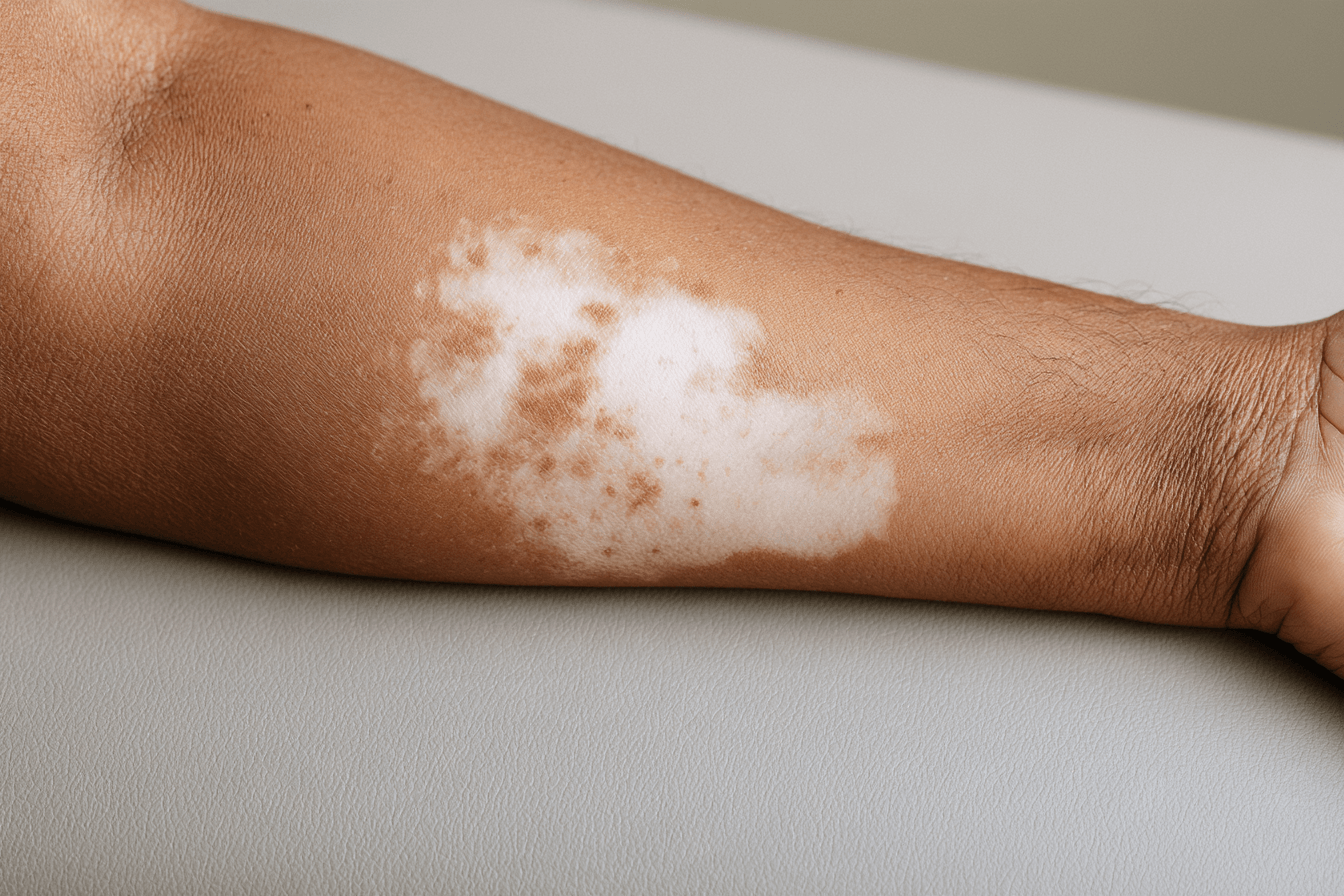
Vitiligo repigmentation is the return of natural skin color within a white patch. It may begin as small colored dots, pigment spreading inward from the edges, or a more even return of color across the affected area. Knowing what to look for helps you recognize improvement without mistaking changes in tanning or skin camouflage for a treatment response [3, 4].
Small Dots of Color Within White Patches
Tiny brown or skin-colored spots may appear around hair follicles, the structures from which hairs grow. This is called perifollicular repigmentation. As treatment progresses, these spots may expand and join together, gradually covering more of the white area [3].
A clinical study examining 352 treated vitiligo patches found that this was the most common repigmentation pattern. However, the researchers also observed other patterns, so the absence of colored dots does not automatically mean that treatment is ineffective [3].
Color Returning From the Edges of a Patch
Sometimes natural color extends inward from the border, making the white area progressively smaller. This is called marginal repigmentation. Other patches regain color more evenly across their surface, or show a combination of returning pigment around hairs and along their edges [3].
For example, a patch may remain visibly white in the center while its borders begin filling in. That can represent partial improvement rather than treatment failure, although its appearance alone cannot predict how completely it will eventually repigment [3].
How to Tell Whether Treatment Is Restoring Pigment
Look for changes within the previously white skin, not just a difference in how noticeable the patch appears. Tanning surrounding skin can increase the contrast, while camouflage makeup and self-tanners temporarily change appearance without restoring natural pigment [4].
Take dated photographs using similar lighting, distance and positioning, without filters or camouflage products. Compare the same patches over time rather than selecting only the area that looks best. Dermatology guidelines recommend photographs at the start of treatment and during follow-up to document response or progression [5].
When reviewing Ayurvedic treatment, keep changes in the skin separate from improvements in sleep, appetite or general well-being. Ask your physician to explain what has changed within the patches and whether that documented response justifies continuing the proposed treatment.
What Affects Your Chances of Vitiligo Repigmentation?

Your chances of vitiligo repigmentation depend on the location of your patches, whether they are spreading, their duration and their response to previous treatment. These findings should shape your treatment plan and expectations. Two people with similar-looking white patches may need different approaches, even when both are seeking Ayurvedic care [1, 5].
Active Versus Stable Vitiligo
New patches or enlarging areas suggest that vitiligo is active. When pigment loss is progressing quickly, controlling that activity becomes an immediate treatment priority alongside restoring color. An assessment should therefore consider recent changes across your skin, not just the patch that concerns you most [1, 5].
Stable patches create a different treatment decision. When there have been no new or enlarging patches for at least twelve months, certain grafting procedures may become suitable if other treatments have been unsuccessful. Stability does not mean that treatment is unnecessary or that every remaining patch will respond equally well [1, 5].
Segmental Versus Nonsegmental Vitiligo
Segmental vitiligo usually affects an area on one side of the body and often stabilizes relatively quickly. Nonsegmental vitiligo commonly affects corresponding areas on both sides and may spread more widely. Identifying the pattern helps your clinician assess the likely course and choose appropriate treatment [5].
This distinction also matters when evaluating treatment claims. Improvement in a small, stable segmental patch should not be presented as evidence that someone with widespread, actively spreading vitiligo can expect the same result. Ask whether the patients shown in a clinic’s treatment examples had a condition comparable to yours.
Why Patch Location and White Hair Matter
The face and neck generally respond better than the fingertips, toes and lips. Areas where hair does not grow can be particularly difficult to repigment, so facial improvement should not create an expectation that every finger patch will improve at the same rate [1].
White hair within a patch, called leukotrichia, can also influence expectations. A study of 82 patients with segmental vitiligo found that extensive white hair was associated with poor response to medical treatment. This does not make every affected patch untreatable, but it is a reason to discuss treatment selection carefully rather than repeatedly continuing an ineffective approach [7].
Patch Duration and Previous Treatment Response
Recent-onset patches may respond better to treatments such as tacrolimus and phototherapy. However, an older patch should not be dismissed on duration alone; its location, remaining pigment and previous response also need consideration [1, 5].
Bring the names of previous medicines, how long you used them and any photographs showing changes. In a study of 70 patients receiving narrowband UVB, an early response was associated with better eventual repigmentation. That finding provides useful context, but it does not establish a universal deadline after which treatment cannot help [8].
What These Findings Should Change in an Ayurvedic Treatment Plan
Before accepting an Ayurvedic prescription, ask how the assessment has influenced the proposed care. The explanation should distinguish the intended purpose of medicines taken by mouth from preparations applied to individual patches. It should also make clear which benefits are supported by clinical research and which are based on traditional practice.
For example, a plan for recently spreading patches should explain how continued spread will be addressed, while a plan for longstanding finger patches should acknowledge the difficulty of restoring pigment there. Personalized care should produce different treatment decisions and realistic expectations, not simply a different name for the same prescription [1, 5].
What Results Can Ayurvedic and Other Vitiligo Treatments Achieve?

Vitiligo treatments can produce partial or substantial repigmentation, but their reported results are not always directly comparable. A study may measure improvement in one patch, facial pigmentation or several clinical features together. Understanding these differences helps you judge what a proposed treatment might offer without mistaking an improvement percentage for a cure rate [9, 10, 17].
Table : Vitiligo Treatment Results—What Does the Evidence Show?
| Treatment approach | What the evidence shows | What to clarify before treatment |
|---|---|---|
| Corticosteroid creams or tacrolimus ointment | These medicines can encourage repigmentation. Tacrolimus is an option for facial vitiligo; corticosteroid use needs an appropriate schedule because of potential skin thinning [1, 5]. | Which medicine suits the affected area, how long to use it and when to review progress. |
| Home narrowband UVB combined with a corticosteroid | In the HI-Light trial, 27% of assessed participants reported that their selected patch was substantially less noticeable or no longer noticeable after nine months, compared with 17% using the corticosteroid alone [10]. | The result concerns one selected patch, not complete whole-body repigmentation. Discuss the treatment schedule and practical commitment. |
| Ruxolitinib cream | Across two trials, approximately 30% achieved at least a 75% improvement in their facial vitiligo score at 24 weeks, compared with approximately 7%–11% using the cream without the active medicine [9]. | These are facial-score results, not cure rates. Ask about eligibility, application limits and potential side effects. |
| Skin or cell transplantation | Grafting may restore pigment in selected stable patches that have not responded adequately to other treatments [5]. | Whether disease stability and the characteristics of your patches make surgery appropriate. |
| Ayurvedic oral and topical preparations | A six-month study involving 50 patients reported improvement with specific Ayurvedic regimens. Sunlight exposure formed part of treatment, so the findings do not isolate the effect of the preparations alone [17]. | Whether the proposed prescription matches the studied preparation, what supports its use, and how safety and progress will be assessed. Long-term prevention of relapse was not established. |
Ayurvedic Medicines: What Published Research Has Reported
Ayurvedic research has examined an approach combining an oral decoction, a liquid medicine prepared from herbs, with an ointment applied to affected patches. In the six-month study involving 50 patients, the authors described 17 of the 25 patients receiving combined treatment as achieving approximately 80% improvement in the assessed clinical features, including patch area, pigmentation and associated symptoms [17].
That figure does not mean that 80% of patients were permanently cured. The assessment included several features rather than measuring only restored pigment, and sunlight exposure was part of treatment. Most participants had segmental vitiligo, so the results cannot reliably predict outcomes for someone with widespread, actively spreading patches [17].
The findings provide preliminary evidence for that particular treatment approach, not every Ayurvedic prescription. The studied ointment also contained an arsenic compound, and some participants developed blisters. Before accepting a similar treatment, ask about the exact ingredients, relevant safety testing and whether the proposed medicine differs from the preparation studied [17].
Prescription Creams: Corticosteroids and Nonsteroid Options
Topical corticosteroids are commonly used to encourage repigmentation. They can be useful, but the strength, application site and treatment schedule matter because inappropriate prolonged use can thin the skin. Your prescription should explain these details rather than simply advise continued application until the patches disappear [1, 5].
Tacrolimus ointment and pimecrolimus cream are nonsteroid alternatives, particularly for areas such as the face and neck. They may be used for longer periods than corticosteroids, although temporary burning or irritation can occur. When a topical medicine provides insufficient improvement, your dermatologist may consider combining it with light therapy [1, 5].
Narrowband UVB Phototherapy and Excimer Treatment
Narrowband UVB uses controlled ultraviolet light to encourage returning pigment. It may be considered when creams alone have been insufficient or when several areas require treatment. The prescribed exposure is adjusted to your skin’s response; it is not interchangeable with sunbathing or using a tanning bed [1, 5].
The HI-Light trial enrolled 517 adults and children with active, limited vitiligo. Among participants with results available at nine months, 27% receiving a corticosteroid ointment combined with home narrowband UVB considered their selected patch substantially less noticeable or no longer noticeable. The corresponding result was 17% with the corticosteroid alone [10].
This supports a benefit from combining treatments for some patients, but it describes one selected patch rather than complete recovery across the body. Excimer treatment offers a more targeted light approach, and a small randomized study found better patch repigmentation when it was combined with tacrolimus than when used alone [10, 11].
Ruxolitinib Cream: Understanding Facial Repigmentation Results
Ruxolitinib cream is a prescription option for nonsegmental vitiligo in people aged 12 years and older. Its two major phase 3 trials included 674 participants whose vitiligo affected no more than 10% of their total body surface area [1, 9].
After 24 weeks, approximately 30% of participants receiving ruxolitinib achieved at least a 75% improvement in their facial vitiligo score. Around 7% to 11% receiving the cream without the active medicine reached the same threshold [9].
These are meaningful facial results, not evidence that every patch elsewhere disappeared. Improvement continued during longer treatment in some participants, while acne and itching where the cream was applied were among the commonly reported side effects. Suitability therefore requires a prescribing assessment, not simply matching your patches to a successful photograph [1, 9].
Skin Grafting and Cell Transplantation for Stable Patches
Surgical treatment transfers a person’s own pigmented skin or pigment-producing cells into affected areas. It may be considered when vitiligo is stable and other treatments have not produced satisfactory repigmentation. It is generally unsuitable while new patches are appearing or existing patches are enlarging [1, 5].
A retrospective transplantation study documented pigment retention for up to six years in some treated areas. However, long-term information was available for only 63 of the 100 patients, and additional treatments were not controlled. The findings support the possibility of durable local improvement, while leaving uncertainty about the result an individual patient will achieve [12].
How Long Does Vitiligo Treatment Take to Show Results?

Vitiligo treatment usually requires several months to assess meaningful repigmentation, and improvement with some treatments can continue over six to twelve months. Your treatment plan should distinguish when progress will be reviewed from when the best achievable result might become apparent. A review date is not a deadline for complete recovery [1, 5, 9].
What Should You Expect During the First Few Weeks?
Little visible change during the first few weeks does not necessarily mean that treatment has failed. Natural skin color returns gradually, and the response varies between treatments and affected areas. Early follow-up can help check whether you are using the prescribed treatment correctly and whether irritation or other difficulties need attention [1, 5].
However, continuing rapid spread should not be dismissed simply because repigmentation takes time. Tell your dermatologist when new patches are appearing frequently or existing areas are enlarging quickly, rather than waiting several months for a routine assessment [1, 5].
Reviewing Progress at Three, Six and Twelve Months
Dermatology guidelines recommend reassessing topical treatments approximately every three to six months. Comparing your skin with baseline photographs helps establish whether there is enough improvement to justify continuing or whether the approach needs adjustment [5].
For ruxolitinib cream specifically, contact your dermatologist if no pigment has returned after 24 weeks of use as prescribed. This is a reason to reassess treatment, not to increase the amount yourself. Its major clinical trials continued through 52 weeks, showing why a six-month assessment does not necessarily represent the final treatment outcome [1, 9].
Narrowband UVB may involve two or three sessions weekly, sometimes for up to a year. Discuss this commitment before starting, including whether appointments are manageable alongside work and travel. Treatment duration should remain subject to response and safety reviews rather than an automatic commitment to twelve months [5].
How Long Does Ayurvedic Treatment for Vitiligo Take?
The Ayurvedic study discussed earlier evaluated treatment over six months. That study duration does not establish a standard six-month course, predict when your first pigment will return or validate the same timeline for a different prescription [17].
Before beginning Ayurvedic care, ask your physician to separate the initial prescription period from the expected overall treatment course. A thirty-day supply, for example, describes how much medicine is provided—not evidence that the patches should disappear within thirty days.
Agree on when your skin will be reassessed and what findings would support another prescription. This gives you a practical basis for deciding whether to continue, particularly when treatment involves recurring medicine costs or travel.
When Does Slow Improvement Need a Different Approach?
At the agreed review, discuss whether limited progress reflects the affected area, difficulty following the schedule or an insufficient treatment response. Your clinician may recommend continuing, combining treatments or changing the approach; there is no single timetable suitable for every patch [1, 5].
A longer course does not mean that every medicine can be used continuously. Corticosteroid creams require a specific prescribing schedule, and troublesome side effects warrant an earlier review rather than waiting for the next pigmentation assessment [1].
How Should Vitiligo Treatment Success Be Measured?
Vitiligo treatment success should be measured by whether patches stop spreading, how much natural color returns and whether the improvement makes a meaningful difference to you. Recording these outcomes separately gives a clearer picture than describing treatment as simply “working” or “not working” [5, 13].
Track Disease Activity Separately From Returning Pigment
Your initial assessment should document the affected areas and whether patches have recently appeared or enlarged. Follow-up should compare these findings with the starting record, rather than relying only on your most visibly improved patch [5].
For example, returning pigment on the face and a new patch on the hand represent two different findings. Both belong in the assessment: improvement in a treated area should not conceal continuing pigment loss elsewhere [5, 13].
Use Photographs and Clinical Scores Together
Photographs help document changes, but a clinical examination can assess the extent of pigment loss more systematically. In the study that introduced the Vitiligo Area Scoring Index, or VASI, researchers used standardized photographs alongside direct examination. The photographs supported assessment; they did not replace the examination used to calculate the score [13].
VASI combines the size of affected areas with the amount of pigment missing within them. For example, a score falling from eight to two represents a 75% improvement from the starting score. It does not mean that every patch has disappeared or that 75% of people receiving that treatment will achieve the same result [13].
When a clinic reports a percentage improvement, ask which measurement was used and whether it describes one patch, the face or wider skin involvement. Without that explanation, apparently similar treatment results may describe very different outcomes [10, 13].
Document the Complete Ayurvedic Treatment Plan
During Ayurvedic treatment, keep a dated record of oral medicines, external applications and any changes to the prescription. Share the complete list with your treating clinicians, including supplements and dermatological treatments, so safety and possible interactions can be reviewed [18].
When Ayurvedic medicines are used alongside prescription creams or phototherapy, the record should identify all these treatments. Improvement during a combined plan does not, by itself, establish which medicine or ingredient produced it.
At follow-up, request a clear account of what has improved, what remains unchanged and how those findings affect the next prescription. This makes the consultation useful for treatment decisions, rather than simply becoming an occasion to renew medicines.
Include the Results That Matter to You
Your assessment also matters. The HI-Light trial used patients’ reports of how noticeable a selected patch remained as its main measure of treatment success, rather than relying solely on a clinician’s pigmentation assessment [10].
Discuss whether treatment is helping you feel more comfortable in daily life, as well as any irritation, inconvenience or distress. Dermatology guidelines recommend monitoring quality of life and psychological well-being alongside skin changes, so a worthwhile treatment result should consider both [5].
Can Vitiligo Return After Successful Treatment?

Vitiligo can return after successful treatment, either as fading color within an improved patch or as new patches elsewhere. Returning patches do not necessarily mean that further treatment will be ineffective, but they should prompt a review rather than an automatic repeat prescription [1, 2, 14].
Loss of Color in Treated Patches Versus New Patches Elsewhere
Fading within a treated patch represents a loss of restored pigment. New patches on previously unaffected skin indicate additional disease activity. These changes can occur separately, so improvement in older patches does not rule out spreading elsewhere [1, 5].
Tell your clinician which change you have noticed and how quickly it is happening. The distinction matters because treatment may need to address active spreading as well as restoring color in previously treated areas [1, 5].
What Research Shows About Relapse After Stopping Treatment
Relapse rates depend on the treatment, the patients studied and how recurrence is defined. In the TRuE-V extension study, patients who had already achieved at least a 90% improvement in their facial vitiligo score either continued ruxolitinib cream or stopped the active medicine for up to another year [14].
Relapse was reported in 16 of 56 evaluable participants who stopped treatment, compared with 8 of 55 who continued. Here, relapse meant falling below a 75% improvement in the facial score, not simply noticing minor fading. Some participants left the study early, so these counts should not be treated as a precise one-year risk for every patient [14].
The findings support discussing maintenance after a good response, but they do not establish an identical maintenance plan for other medicines or for Ayurvedic treatment [14].
Can Restarting Treatment Restore Lost Pigment?
After restarting ruxolitinib, 12 of the 16 participants who relapsed following withdrawal regained at least a 75% improvement in their facial score. The reported median time was 85 days. These results show that pigment can return again, although they apply to previous strong responders using this particular medicine [14].
Your clinician may consider restarting a previously helpful treatment, modifying it or choosing another approach. Do not increase an old prescription or light-treatment exposure yourself, because the appropriate plan depends on your current skin changes and previous side effects [1, 5].
What Should Happen if Vitiligo Returns During Ayurvedic Care?
An Ayurvedic follow-up should reassess the returning patches rather than simply extend the same prescription. Review when oral medicines, external applications, prescription creams or phototherapy were started, reduced or stopped. Comparing that history with dated photographs helps establish what changed, although timing alone cannot prove which treatment caused an improvement or recurrence [5].
The six-month Ayurvedic study discussed earlier did not establish long-term protection against relapse. A recommendation to continue an Ayurvedic medicine should therefore explain its intended purpose and how the benefit will be reassessed, rather than promise that continued use will prevent every future patch [17].
You should leave the review knowing whether the priority is controlling renewed spread, restoring lost pigment or maintaining the color already regained. Any revised Ayurvedic prescription should also be shared with your dermatologist so the complete treatment plan can be reviewed for safety [1, 5, 18].
How Can You Reduce the Risk of Vitiligo Relapse?
Reducing the risk of vitiligo relapse involves deciding how to maintain restored pigment, protecting your skin and recognizing renewed disease activity. Maintenance treatment can help preserve improvement, but it should be tailored to the medicine and your response rather than continuing every prescription indefinitely [1, 5].
Agree on a Maintenance Plan Before Treatment Ends
Once a patch has regained color, your dermatologist may recommend applying a prescribed medicine less frequently to help retain that pigment. Ask which areas still need treatment, how often to apply it and when the schedule will be reviewed. A maintenance schedule for one medicine should not be applied automatically to another [1].
A small randomized trial involving 35 adults evaluated twice-weekly tacrolimus ointment after successful repigmentation. It found a benefit among participants who completed treatment as planned, although the adjusted analysis including all randomized participants was inconclusive. The study supports discussing this option with your dermatologist, not assuming that it prevents recurrence in everyone [15].
Make Ayurvedic Follow-Up Specific to Your Remaining Needs
During Ayurvedic care, the prescription after improvement should have a clear purpose. Ask your physician to distinguish medicines intended for patches still lacking pigment from anything proposed for longer-term care. The written plan should identify the oral and external preparations, explain why each is being continued and specify when its use will be reassessed.
For example, a repigmented facial patch and a finger patch that remains white should not be treated as the same outcome. The face generally responds more readily than the fingers, so follow-up decisions should account for each area rather than simply repeat the original prescription unchanged [1].
Share any revised Ayurvedic prescription with your dermatologist. Some Ayurvedic preparations carry ingredient-related risks, making continued use a decision that requires review rather than an automatic precaution against relapse [18].
Protect Skin From Sunburn and Repeated Injury
Use a broad-spectrum, water-resistant sunscreen with SPF 30 or higher on exposed skin when outdoors, together with shade and protective clothing. Reapply sunscreen every two hours and after swimming or sweating. Skin affected by vitiligo burns easily, and a bad sunburn can worsen the condition [4].
Cuts, scrapes and burns can trigger new patches in some people. Avoid deliberately tanning affected areas, and discuss tattooing or other skin-injuring procedures before proceeding. These precautions reduce avoidable skin damage; they are not substitutes for maintenance treatment [4].
Arrange Follow-Up That You Can Sustain
Before leaving a review, clarify what changes should prompt earlier contact and whom to contact. New patches appearing frequently or existing patches enlarging quickly warrant reassessment because controlling active spreading may require a different treatment approach [1, 5].
Discuss irritation, cost or an application schedule that is difficult to follow rather than silently abandoning treatment. A useful maintenance plan should balance pigment retention with safety and the practical burden of care, with opportunities to simplify or change it when appropriate [5].
Ayurvedic Treatment for Vitiligo: What a Personalized Plan Involves

Ayurvedic treatment for vitiligo may combine medicines taken by mouth, preparations applied to affected skin, and dietary guidance. The treatment should explain what each component is intended to achieve and why it suits your circumstances. Its value must then be assessed through documented skin changes, tolerability and practical benefit—not simply the number of medicines prescribed [5, 16, 18].
How Ayurvedic Assessment Shapes Your Prescription
Ayurveda discusses pigment-loss disorders under Shwitra in Charaka Samhita, Chikitsa Sthana, Chapter 7. This provides a traditional framework for treatment selection, while a dermatological assessment establishes the diagnosis, disease activity and extent of pigment loss. The two assessments should complement each other rather than use different names for the same findings [1, 16].
In the approach described in Panaceayur’s treatment guide, the physician also assesses Agni, the Ayurvedic concept of digestive function. Appetite, bloating, bowel habits and tolerance of previous medicines help inform the proposed oral preparation. These observations guide traditional prescribing; they do not establish that poor digestion caused your vitiligo or that improving digestion alone will restore pigment [19].
For example, persistent stomach discomfort should influence the discussion before introducing a concentrated oral preparation. Personalization should produce a clear prescribing decision, such as selecting a different preparation or reconsidering its suitability, rather than merely recording your constitution.
Internal Medicines: Understanding Their Intended Role
Internal Ayurvedic treatment may use a kashaya, meaning a herbal decoction, or another prescribed preparation. Khadira has a specific classical association with Shwitra: Charaka Samhita, Chikitsa Sthana, Chapter 7, verse 166, describes Khadira-based administration. This establishes its traditional use, not a modern clinical success rate [16].
The Shvitrahara Kashaya evaluated in the clinical study discussed earlier contained Bakuchi, Khadira, Haridra and other herbs. It was investigated alongside an external preparation and sunlight exposure, with improvements reported over six months. The study assessed the combined approach; it did not establish that each ingredient independently restores pigment [17].
Your prescription should therefore distinguish a medicine selected on traditional grounds from one supported by clinical research for a particular use. It should also explain whether the proposed preparation matches the studied product or differs in ingredients, concentration or method of administration.
Where a Classically Inspired Avaleha Fits
An avaleha is a semisolid preparation taken by mouth. Panaceayur’s pillar guide describes Somaraji Khadiradi Shwitra Rasayana Avaleha as a physician-designed formulation inspired by classical references, including Ashtanga Hridaya, Uttara Sthana, Chapter 39, verses 107–108, and Charaka Samhita, Chikitsa Sthana, Chapter 7, verse 166 [16, 19].
The complete modern formulation is not an unchanged recipe from one classical text, and the guide states that it has not been evaluated as a finished product in a randomized clinical trial. Its suitability therefore requires an individual prescribing assessment; research on separate ingredients cannot establish its overall effectiveness or a permanent cure [19].
Before starting such a preparation, obtain the complete ingredient list and clarify the prescribed amount, initial supply period and review arrangements. A convenient dosage form can make treatment easier to follow, but convenience should remain separate from claims about effectiveness.
External Applications and the Role of Bakuchi
External treatment applies a preparation directly to selected patches. Bakuchi, also called Psoralea corylifolia, contains psoralens that increase the skin’s sensitivity to ultraviolet light. This helps explain its use in pigmentation treatments, but also why an oil or ointment containing it should not be treated as an ordinary moisturizer [17].
The studied Shvitrahara Lepa was a compounded topical preparation containing an arsenic compound, and blistering occurred in some participants. It should not be copied as a home remedy. Any proposed external medicine needs clear instructions about application sites, skin reactions and compatibility with existing creams or phototherapy [17, 18].
Do not add deliberate sun exposure to a Bakuchi prescription yourself. The treating clinicians should decide whether light exposure is appropriate and coordinate it with the rest of your treatment [17, 18].
Does Every Patient Need Shodhana or Panchakarma?
Shodhana refers to traditional purification procedures. Charaka Samhita, Chikitsa Sthana, Chapter 7, verse 162, discusses purgation in Shwitra management. Its place in the classical text should be explained accurately without presenting it as a proven requirement for modern vitiligo treatment [16].
A recommendation for such a procedure needs a separate discussion of its purpose, suitability, risks and alternatives. Dermatology guidelines find insufficient evidence to recommend a specific complementary therapy for vitiligo, so Panchakarma should not be presented as an established prerequisite for repigmentation [5].
Dietary Guidance Without Unnecessary Restrictions
Dietary advice should be manageable and compatible with your nutritional needs and other medical conditions. It should explain the reason for a recommended change rather than provide an unexplained list of forbidden foods.
Nutritional support and correction of a confirmed deficiency are different from treating pigment loss. Supplements have not been established as a permanent vitiligo treatment, and dietary advice should not replace an effective prescription or justify delaying assessment of spreading patches [1, 5].
What Your Consultation Should Deliver
For an Ayurvedic consultation at Panaceayur, bring previous prescriptions, relevant medical reports and dated photographs. Use the appointment to establish whether the proposed approach is suitable and how it will fit with any dermatological treatment you already receive [18, 19].
Before committing to medicines, request a written plan explaining their intended benefits, ingredients, application or administration instructions, and review date. Clarify consultation, medicine and follow-up costs separately, along with how to report a problem between appointments.
The outcome should be a treatment decision you understand: what you will use, what improvement would justify continuing, and what would lead to a change. Your dermatologist should remain informed about additional products so the complete plan can be reviewed for safety [18].
Read the Complete Guide to Ayurvedic Treatment for Vitiligo

For a closer look at the medicines and assessments discussed here, read Ayurvedic Treatment for Vitiligo: Complete Patient Guide. It explains classical treatment approaches, the ingredients and rationale behind the classically inspired avaleha, dietary considerations, and how Ayurvedic care can be coordinated with dermatological treatment [19].
Use the guide to prepare questions relevant to your circumstances, particularly when previous treatment has not helped or you are considering adding another medicine. It also explains which photographs, prescriptions and medical reports to bring to a consultation, helping you discuss treatment suitability, expected benefits and safety before deciding whether to begin care [19].
When Should You Have Your Vitiligo Treatment Reviewed?
Arrange a vitiligo treatment review when patches continue spreading, improvement remains limited at the agreed assessment point, or side effects make treatment difficult. The purpose is to decide whether the current approach still suits your needs, rather than simply renew the same prescription [1, 5].
New or Enlarging Patches During Treatment
Contact your dermatologist promptly if new patches are appearing frequently or existing patches are enlarging quickly. Rapidly progressing vitiligo may need treatment directed at controlling further pigment loss, even when some older patches are beginning to regain color [1, 5].
An uncertain diagnosis also warrants reassessment. Other conditions can cause lighter patches, and a dermatologist may use a Wood’s lamp to examine the pigment loss more clearly. Continuing to change medicines without confirming the diagnosis can leave the underlying problem unaddressed [1].
Little Improvement Despite Following the Prescribed Plan
Before deciding that treatment has failed, review which medicines you have used, where you applied them and how consistently you could follow the schedule. Your clinician should consider these details alongside patch location and treatment duration when deciding whether to continue, combine treatments or change the approach [1, 5].
During Ayurvedic care, ask what the recorded skin changes show about the current plan. The explanation should distinguish a reason to continue from a reason to modify the oral preparation, external application or overall approach. A repeat prescription should follow that assessment, not replace it.
Share proposed prescription changes with your dermatologist, including the ingredients of additional Ayurvedic products. Reviewing the complete regimen helps clinicians coordinate care and consider potential safety concerns before another medicine is introduced [18].
Side Effects, Treatment Burden or Distress About Your Skin
Report persistent burning, worsening irritation or noticeably thinning skin where treatment is applied. Corticosteroids and other topical medicines have different precautions, and your prescriber may need to adjust the medicine or application schedule rather than continue it unchanged [1, 2].
A new pregnancy or breastfeeding also warrants a review before continuing Ayurvedic products, because some ingredients may be unsuitable. Bring the product labels or written ingredient lists so your healthcare professional can assess the actual preparation rather than its brand name alone [18].
Tell your clinician when cost, repeated appointments or complicated instructions make treatment hard to maintain. Concerns about appearance that affect relationships, work or social activities also deserve attention. Psychological support can be provided alongside skin treatment; you do not need to wait until distress becomes severe to discuss it [2, 5].
Frequently Asked Questions
Can Early-Stage Vitiligo Be Cured Permanently?
Early treatment can improve the chance of restoring pigment, but it does not guarantee permanent recovery. Having new patches assessed also helps confirm the diagnosis and identify active spreading. Longstanding vitiligo should not automatically be dismissed, because some older patches can still respond to treatment
Can Ayurveda Help Restore Skin Color?
A six-month study involving 50 patients reported improved pigmentation with particular Ayurvedic treatment regimens that included sunlight exposure. This provides preliminary evidence, not proof that every Ayurvedic medicine works or that results are permanent. Ask how your proposed prescription compares with the studied treatment and how your response will be measured.
Can I Use Ayurvedic Medicines With Creams or Phototherapy?
Compatibility depends on the actual ingredients and your prescribed treatment, so have both clinicians review the proposed combination first. Bakuchi products can increase sensitivity to ultraviolet light and should not be added to phototherapy or deliberate sun exposure without medical supervision. Do not stop an effective prescription solely to begin Ayurvedic care.
Can Vitiligo Go Away Without Treatment?
Some natural pigment can return without treatment, but complete spontaneous repigmentation is uncommon. Patches may remain unchanged or spread, so waiting is not a reliable way to restore color. A dermatological assessment can clarify your diagnosis and options even when you have not decided whether to pursue treatment.
Can Vitiligo Return Years After Improvement?
Pigment loss can return, and a long period without change does not establish lifelong remission. Research in segmental vitiligo has documented renewed activity after years of stability. Report new patches or fading pigment so your clinician can reassess the condition rather than simply repeat an old prescription.
Does Stable Segmental Vitiligo Mean It Is Permanently Cured?
Stable segmental vitiligo means that patches are no longer changing during observation, not that the condition has been permanently eliminated. Stability can make skin grafting or cell transplantation an option when other treatments have not helped. Suitability requires specialist assessment rather than relying only on how long a patch has existed.
Will I Need Vitiligo Treatment for the Rest of My Life?
Vitiligo does not automatically require lifelong medication. Some people need maintenance treatment to retain restored pigment, but the medicine and schedule should be reviewed over time. Ask what would justify reducing or stopping each treatment and what to do if color begins fading again
Can Diet or Supplements Prevent Vitiligo From Returning?
No particular diet or supplement has been reliably shown to prevent vitiligo relapse. Correcting a confirmed nutritional deficiency may be appropriate, but that is different from proving that supplementation preserves pigment. For example, vitamin D may be recommended when levels are low, rather than prescribed as a cure for white patches.
References
[1] Ludmann, P. (2026, April 15). Vitiligo: Diagnosis and treatment. American Academy of Dermatology Association.
https://www.aad.org/public/diseases/a-z/vitiligo-treatment
Used for: Sections 1, 3, 4, 5, 7, 8, 9, 11, and 12. Supports treatment goals, differences in response between body areas, available treatments, gradual repigmentation, maintenance care, and the distinction between restored pigment and a permanent cure.
[2] National Health Service. (2023, March 22). Vitiligo: Treatment.
https://www.nhs.uk/conditions/vitiligo/treatment/
Used for: Sections 7 and 11. Explains that treatment benefits may not be permanent and provides patient guidance on adverse effects, treatment monitoring, specialist referral, and psychological support. It is not the main source for newer treatment developments.
[3] Parsad, D., Pandhi, R., Dogra, S., & Kumar, B. (2004). Clinical study of repigmentation patterns with different treatment modalities and their correlation with speed and stability of repigmentation in 352 vitiliginous patches. Journal of the American Academy of Dermatology, 50(1), 63–67.
https://pubmed.ncbi.nlm.nih.gov/14699367/
Used for: Section 2. This study examined 352 patches in 125 patients and described perifollicular, marginal, diffuse, and combined repigmentation. It supports explaining the different visible patterns of returning skin color.
[4] Ludmann, P. (2026, April 15). Vitiligo: How to make it less visible and prevent spreading. American Academy of Dermatology Association.
https://www.aad.org/public/diseases/a-z/vitiligo-self-care
Used for: Sections 2 and 8. Supports distinguishing natural repigmentation from tanning or camouflage, using sun protection, avoiding tanning beds, and reducing skin injuries that can trigger new patches in some patients.
[5] Eleftheriadou, V., Atkar, R., Batchelor, J., McDonald, B., Novakovic, L., Patel, J. V., Ravenscroft, J., Rush, E., Shah, D., Shah, R., Shaw, L., Thompson, A. R., Hashme, M., Exton, L. S., Mohd Mustapa, M. F., Manounah, L., & British Association of Dermatologists’ Clinical Standards Unit. (2022). British Association of Dermatologists guidelines for the management of people with vitiligo 2021. British Journal of Dermatology, 186(1), 18–29.
https://onlinelibrary.wiley.com/doi/10.1111/bjd.20596
Used for: Sections 1–9, 11, and 12. Provides clinical guidance on assessment, treatment selection, disease stability, photographic monitoring, review intervals, phototherapy, surgical suitability, and psychological well-being. It also addresses the limited evidence supporting specific complementary therapies.
[6] Park, J.-H., Jung, M.-Y., Lee, J.-H., Yang, J.-M., Lee, D.-Y., & Park, K. K. (2014). Clinical course of segmental vitiligo: A retrospective study of eighty-seven patients. Annals of Dermatology, 26(1), 61–65.
https://pmc.ncbi.nlm.nih.gov/articles/PMC3956796/
Used for: Section 12. This retrospective study documented renewed disease activity in some patients after prolonged stability. It supports explaining that stable segmental vitiligo should not automatically be described as permanently cured.
[7] Lee, D.-Y., Kim, C.-R., Park, J.-H., & Lee, J.-H. (2011). The incidence of leukotrichia in segmental vitiligo: Implication of poor response to medical treatment. International Journal of Dermatology, 50(8), 925–927.
https://onlinelibrary.wiley.com/doi/abs/10.1111/j.1365-4632.2011.04914.x
Used for: Section 3. Examined white hair within patches in 82 patients with segmental vitiligo. Extensive leukotrichia was associated with poor medical-treatment response, supporting more cautious expectations without implying that every affected patch is untreatable.
[8] Nicolaidou, E., Antoniou, C., Stratigos, A. J., Stefanaki, C., & Katsambas, A. D. (2007). Efficacy, predictors of response, and long-term follow-up in patients with vitiligo treated with narrowband UVB phototherapy. Journal of the American Academy of Dermatology, 56(2), 274–278.
https://pubmed.ncbi.nlm.nih.gov/17224369/
Used for: Section 3. This uncontrolled study of 70 patients associated early response and facial involvement with better eventual phototherapy outcomes. Its findings help explain prognostic factors but do not establish a universal deadline for improvement.
[9] Rosmarin, D., Passeron, T., Pandya, A. G., Grimes, P., Harris, J. E., Desai, S. R., Lebwohl, M., Ruer-Mulard, M., Seneschal, J., Wolkerstorfer, A., Kornacki, D., Sun, K., Butler, K., Ezzedine, K., & TRuE-V Study Group. (2022). Two phase 3, randomized, controlled trials of ruxolitinib cream for vitiligo. The New England Journal of Medicine, 387(16), 1445–1455.
https://www.nejm.org/doi/full/10.1056/NEJMoa2118828
Used for: Sections 4 and 5. These trials enrolled 674 participants and measured repigmentation through 52 weeks. They support the reported facial-response results, treatment timelines, and adverse effects—not a claim of permanent cure.
[10] Thomas, K. S., Batchelor, J. M., Akram, P., Chalmers, J. R., Haines, R. H., Meakin, G. D., Duley, L., Ravenscroft, J. C., Rogers, A., Sach, T. H., Santer, M., Tan, W., White, J., Whitton, M. E., Williams, H. C., Cheung, S. T., Hamad, H., Wright, A., Ingram, J. R., . . . UK Dermatology Clinical Trials Network’s HI-Light Vitiligo Trial Team. (2021). Randomized controlled trial of topical corticosteroid and home-based narrowband ultraviolet B for active and limited vitiligo: Results of the HI-Light Vitiligo Trial. British Journal of Dermatology, 184(5), 828–839.
https://onlinelibrary.wiley.com/doi/10.1111/bjd.19592
Used for: Sections 4 and 6. This 517-participant trial compared topical corticosteroid, home narrowband UVB, and combined treatment. It supports the reported nine-month target-patch outcomes and the importance of patient-reported noticeability when assessing success.
[11] Passeron, T., Ostovari, N., Zakaria, W., Fontas, E., Larrouy, J.-C., Lacour, J.-P., & Ortonne, J.-P. (2004). Topical tacrolimus and the 308-nm excimer laser: A synergistic combination for the treatment of vitiligo. Archives of Dermatology, 140(9), 1065–1069.
https://jamanetwork.com/journals/jamadermatology/fullarticle/480783
Used for: Section 4. This small randomized, lesion-level study supports combining excimer laser with tacrolimus for selected patches. Its findings should not be interpreted as equivalent results for every patient or body area.
[12] Silpa-Archa, N., Griffith, J. L., Huggins, R. H., Henderson, M. D., Kerr, H. A., Jacobsen, G., Mulekar, S. V., Lim, H. W., & Hamzavi, I. H. (2017). Long-term follow-up of patients undergoing autologous noncultured melanocyte-keratinocyte transplantation for vitiligo and other leukodermas. Journal of the American Academy of Dermatology, 77(2), 318–327.
https://pubmed.ncbi.nlm.nih.gov/28502377/
Used for: Section 4. Documents long-term pigment retention after cellular transplantation in selected patients. Available follow-up extended to six years, but incomplete follow-up and uncontrolled additional treatments limit generalization.
[13] Hamzavi, I., Jain, H., McLean, D., Shapiro, J., Zeng, H., & Lui, H. (2004). Parametric modeling of narrowband UV-B phototherapy for vitiligo using a novel quantitative tool: The Vitiligo Area Scoring Index. Archives of Dermatology, 140(6), 677–683.
https://jamanetwork.com/journals/jamadermatology/fullarticle/480622
Used for: Section 6. Introduced VASI as a quantitative assessment combining affected area and depigmentation. Supports systematic monitoring and explaining why percentage improvement in an individual’s score differs from the percentage of patients who respond.
[14] Harris, J. E., Papp, K., Ezzedine, K., Sebastian, M., Pandya, A. G., Seneschal, J., Amster, M., Alam, M. S., Forman, S. B., Zdybski, J., Nuara, A., Kornacki, D., Wei, S., Passeron, T., & Rosmarin, D. (2026). Randomized, double-blind treatment withdrawal or continuation with ruxolitinib cream in vitiligo: Findings from the Topical Ruxolitinib Evaluation in Vitiligo (TRuE-V) long-term extension phase III study. British Journal of Dermatology, 194(5), 971–973.
https://academic.oup.com/bjd/article/194/5/971/8405494
Used for: Section 7. Examined continued treatment versus withdrawal in patients with substantial previous facial repigmentation. Supports the article’s relapse and retreatment figures, including regained response after restarting treatment. These findings concern selected prior responders.
[15] Cavalié, M., Ezzedine, K., Fontas, E., Montaudié, H., Castela, E., Bahadoran, P., Taïeb, A., Lacour, J.-P., & Passeron, T. (2015). Maintenance therapy of adult vitiligo with 0.1% tacrolimus ointment: A randomized, double blind, placebo-controlled study. Journal of Investigative Dermatology, 135(4), 970–974.
https://pubmed.ncbi.nlm.nih.gov/25521460/
Used for: Section 8. This 35-patient trial evaluated twice-weekly tacrolimus after repigmentation. The per-protocol analysis showed benefit, while the adjusted intention-to-treat analysis was inconclusive, supporting a qualified discussion of maintenance treatment.
[16] Ojha, S. N., & Samant, A. (2020). Kushtha chikitsa adhyaya. In M. S. Baghel, Y. S. Deole, & G. Basisht (Eds.), Charak samhita new edition (Chikitsa Sthana, Chapter 7). Charak Samhita Research, Training and Skill Development Centre.
https://www.carakasamhitaonline.com/index.php/Kushtha_Chikitsa
Used for: Sections 1 and 9. Provides the classical Shwitra discussion in verses 162–177, including purgation in verse 162 and Khadira-associated administration in verse 166. This supports textual attribution, not a modern clinical success rate.
[17] Dhanik, A., Sujatha, N., & Rai, N. P. (2011). Clinical evaluation of the efficacy of Shvitrahara kashaya and lepa in vitiligo. AYU, 32(1), 66–69.
https://pmc.ncbi.nlm.nih.gov/articles/PMC3215421/
Used for: Sections 1, 4, 5, 7, 9, and 12. This six-month study of 50 patients reported improvement with specific Ayurvedic regimens involving oral treatment, topical treatment, and sunlight exposure. It supports discussing preliminary results and reported adverse effects, but not permanent cure or the effectiveness of a different formulation.
[18] National Center for Complementary and Integrative Health. (2019, January). Ayurvedic medicine: In depth. National Institutes of Health.
https://www.nccih.nih.gov/health/ayurvedic-medicine-in-depth
Used for: Sections 1, 6, 7, 8, 9, 11, and 12. Supports ingredient disclosure, communication between treating clinicians, product-safety assessment, and additional precautions during pregnancy or breastfeeding. This is general Ayurvedic safety guidance, not a vitiligo efficacy study.
[19] Kumar, A. (2026, August 30). Ayurvedic treatment for vitiligo: Causes, types, diagnosis, medicines, diet and repigmentation. Panaceayur.
https://panaceayur.com/ayurvedic-treatment-for-vitiligo/
Used for: Sections 9 and 10. Documents the practice’s described assessment approach, its classically inspired avaleha, and consultation preparation. It also supplies the internal pillar link. It should not be treated as independent clinical validation of the proprietary formulation.
[20] Ludmann, P. (2026, April 14). Vitiligo: FAQs. American Academy of Dermatology Association.
https://www.aad.org/public/diseases/a-z/vitiligo-overview
Used for: Section 12. Supports patient-friendly answers about spontaneous repigmentation, the potential benefit of earlier treatment, and why improvement does not establish permanent recovery.
[21] Vāgbhaṭa. (n.d.). Ashtanga Hridaya: Uttara Sthana, Rasayana Vidhi Adhyaya (Chapter 39, verses 107–108) [Digital Sanskrit text]. Siva.
https://www.siva.sh/astanga-hrudaya/uttara-sthana/39/106-110
Used for: Section 9, specifically “Where a Classically Inspired Avaleha Fits.” Verse 107 describes a Somaraji-based preparation involving Asana and Khadira; verse 108 describes Somaraji with Krishna Tila. Add [21] to that subsection’s classical-reference sentence. These verses establish the traditional inspiration, not the clinical effectiveness of the complete modern formulation.