


- Thalassemia Blood Test Report Needs Ayurveda Centred Interpretation
- CBC in Thalassemia Blood Test Report as the First Warning Sign
- MCV and MCH in Thalassemia Blood Test Report
- HbA2 in Thalassemia Blood Test Report
- HPLC Test in Thalassemia Blood Test Report
- Ferritin Test in Thalassemia Blood Test Report
- Genetic Test in Thalassemia Blood Test Report
- Thalassemia Blood Test Report and Iron Deficiency Difference
- Ayurveda Centred Recovery Map After Thalassemia Blood Test Report
- Rasayana Avaleha Medicine After Thalassemia Blood Test Report
- When Urgent Hematology Care Is Needed in Thalassemia Blood Test Report
- FAQs
- Reference
Thalassemia Blood Test Report Needs Ayurveda Centred Interpretation
A thalassemia blood test report must be read with both modern hematology and Ayurveda together. CBC, MCV, MCH, HbA2, HPLC, ferritin and genetic testing show how red blood cells are formed, how much hemoglobin they carry, whether the condition is inherited, and whether iron is deficient or overloaded. Ayurveda keeps the patient at the centre by reading these findings through Rakta Dhatu, meaning blood tissue; Raktagni, meaning the metabolic power that supports healthy blood formation; Ranjaka Pitta, meaning the Pitta function that gives colour and quality to blood; Yakrit, meaning liver; Pleeha, meaning spleen; Bala, meaning physical strength; and Ojas, meaning deep vitality and immune resilience [1,2,3].
Table: Thalassemia Blood Test Report Meaning at a Glance
| Test in Report | What It Tells the Patient |
|---|---|
| CBC | Shows hemoglobin, RBC count and the first signs of anemia. |
| MCV | Shows whether red blood cells are smaller than normal. |
| MCH | Shows how much hemoglobin each red blood cell carries. |
| HbA2 | Helps detect beta thalassemia trait when raised. |
| HPLC | Confirms hemoglobin fractions such as HbA, HbA2 and HbF. |
| Ferritin | Shows whether iron is low, normal or overloaded. |
| Genetic Test | Confirms inherited alpha or beta thalassemia changes. |
Thalassemia Blood Test Report and Pandu in Ayurveda
Thalassemia is not named directly in classical Ayurvedic texts, so it is understood as an Anukta Vyadhi, meaning a disease not named separately but interpreted through classical principles. Its clinical picture closely connects with Pandu, the Ayurvedic condition marked by pallor, weakness, low vitality and disturbed blood nourishment. In thalassemia, the CBC may show low hemoglobin, low MCV and low MCH, while the patient may experience fatigue, poor stamina, paleness, poor appetite, delayed growth, spleen enlargement or liver burden [3,4].
Sanskrit shloka
दोषाः पित्तप्रधानास्तु यस्य कुप्यन्ति धातुषु।
शैथिल्यं तस्य धातूनां गौरवं चोपजायते॥४॥
Transliteration
doṣāḥ pittapradhānāstu yasya kupyanti dhātuṣu।
śaithilyaṃ tasya dhātūnāṃ gauravaṃ copajāyate॥4॥
Simple English meaning
When Pitta dominant Doshas disturb the body tissues, the tissues lose firmness and become heavy or functionally weak. In thalassemia, this helps explain why the blood tissue does not give normal strength, colour and stamina even when the body keeps producing red cells.
Classical reference
Charaka Samhita, Chikitsa Sthana, Chapter 16, Pandu Chikitsa, Verse 4 [1].
This shloka is important because it connects blood related weakness with deeper tissue disturbance. Dhatu means body tissue. In this section, Rakta Dhatu is the main tissue being discussed. The modern report shows the measurable side of this disturbance through hemoglobin, red cell size and hemoglobin content.
Low Hemoglobin MCV and MCH as Rakta Dhatu Weakness
In modern blood testing, CBC is usually the first report that raises suspicion of thalassemia. NHLBI states that CBC measures hemoglobin and blood cells, and people with thalassemia may have fewer healthy red blood cells, less hemoglobin and smaller red cells under the microscope [4]. MCV means the average size of red blood cells. MCH means the average hemoglobin amount inside each red cell. In thalassemia, both are commonly low because globin chain production is reduced or abnormal [5].
Ayurveda reads this as reduced Rakta Dhatu Bala, meaning weakened blood tissue strength. Low hemoglobin shows reduced oxygen carrying capacity. Low MCV shows small red cells. Low MCH shows that each red cell carries less hemoglobin. This is why a patient may feel tired, pale, breathless on exertion or weak even when the RBC count looks normal or high.
Sanskrit shloka
ततो वर्णबलस्नेहा ये चान्येऽप्योजसो गुणाः।
व्रजन्ति क्षयमत्यर्थं दोषदूष्यप्रदूषणात्॥५॥
Transliteration
tato varṇabalasnehā ye cānye’py ojaso guṇāḥ।
vrajanti kṣayam atyarthaṃ doṣadūṣyapradūṣaṇāt॥5॥
Simple English meaning
When Dosha and body tissues are disturbed, complexion, strength, tissue nourishment and the qualities of Ojas decline. In thalassemia, this explains pallor, fatigue, low stamina and reduced vitality in a language patients can understand.
Classical reference
Charaka Samhita, Chikitsa Sthana, Chapter 16, Pandu Chikitsa, Verse 5 [1].
Here, Varna means healthy complexion, Bala means strength, Sneha means natural tissue lubrication and nourishment, and Ojas means the refined essence of vitality and immune strength. These words make the CBC report more clinically meaningful because the report is not only showing anemia; it is showing how blood quality affects the whole person.
Why Ferritin and HPLC Change the Ayurveda Reading
A thalassemia blood test report should never be read as simple iron deficiency until ferritin and hemoglobin analysis are checked. Ferritin reflects stored iron. In iron deficiency, ferritin is usually low. In thalassemia trait, ferritin may be normal even when MCV and MCH are low. ARUP Consult notes that thalassemia often presents with very low MCV, normal or high RBC count and normal ferritin, while iron deficiency anemia more often shows low ferritin and a lower RBC count [5].
HPLC helps measure HbA, HbA2, HbF and abnormal hemoglobin variants. Raised HbA2 supports beta thalassemia trait, while normal HbA2 with persistent low MCV and MCH may require evaluation for alpha thalassemia or other causes. Genetic testing becomes important when HPLC is unclear, when alpha thalassemia is suspected, or when family planning is needed [5].
Sanskrit shloka
सोऽल्परक्तोऽल्पमेदस्को निःसारः शिथिलेन्द्रियः।
वैवर्ण्यं भजते, तस्य हेतुं शृणु सलक्षणम्॥६॥
Transliteration
so’lparakto’lpamedasko niḥsāraḥ śithilendriyaḥ।
vaivarṇyaṃ bhajate, tasya hetuṃ śṛṇu salakṣaṇam॥6॥
Simple English meaning
When blood and tissue essence are reduced, the person loses vitality, the senses and body functions become weak, and abnormal complexion appears. In thalassemia, this supports the clinical link between low hemoglobin, pallor, reduced strength and long term tissue burden.
Classical reference
Charaka Samhita, Chikitsa Sthana, Chapter 16, Pandu Chikitsa, Verse 6 [1].
Alpa Rakta means reduced blood or weakened blood status. Nihsara means loss of tissue essence. These concepts help explain why ferritin and HPLC are essential. If ferritin is low, the patient may also need iron deficiency correction. If ferritin is high, especially after repeated transfusions, the treatment focus must include iron overload monitoring, liver protection and chelation review under hematology care [6].
Yakrit Pleeha and Ferritin in a Thalassemia Blood Test Report
In Ayurveda, the blood system is closely connected with Yakrit and Pleeha. Yakrit means liver, and Pleeha means spleen. This is highly relevant in thalassemia because repeated transfusions can lead to iron overload, and the CDC notes that excess iron from transfusions can collect in organs such as the heart, liver and brain, making organ function difficult if not managed properly [6].
Sanskrit shloka
रसवहानां स्रोतसां हृदयं मूलं दश च धमन्यः।
शोणितवहानां स्रोतसां यकृन्मूलं प्लीहा च॥८॥
Transliteration
rasavahānāṃ srotasāṃ hṛdayaṃ mūlaṃ daśa ca dhamanyaḥ।
śoṇitavahānāṃ srotasāṃ yakṛn mūlaṃ plīhā ca॥8॥
Simple English meaning
The channels that carry nutritive fluid are rooted in the heart and major vessels, and the channels that carry blood are rooted in the liver and spleen. This gives a strong classical reason to monitor liver, spleen and ferritin in thalassemia.
Classical reference
Charaka Samhita, Vimana Sthana, Chapter 5, Sroto Vimana, Verse 8 [2].
Srotas means functional channels of transport and nourishment in the body. Shonitavaha Srotas means blood carrying channels, also understood as Raktavaha Srotas. When ferritin is rising, Ayurveda does not see it as an isolated number. It is read as a measurable sign of Yakrit Pleeha burden, oxidative stress risk, digestive weakness, fatigue and long term tissue pressure.
Genetic Test and Beejadushtijanya Pandu
Thalassemia is inherited through genes. Modern testing confirms this through HBB gene testing for beta thalassemia and HBA1 or HBA2 testing for alpha thalassemia. Ayurveda explains inherited disease through Beeja, meaning reproductive seed; Beejabhaga, meaning gene like inherited part; and Beejabhagavayava, meaning chromosome like inherited subpart. This makes the genetic report clinically meaningful in Ayurvedic language [2,5].
Sanskrit shloka
एवमेव पुरुषस्य यदा बीजे बीजभागः प्रदोषमापद्यते, तदा वन्ध्यं जनयति;
यदा पुनरस्य बीजे बीजभागावयवः प्रदोषमापद्यते, तदा पूतिप्रजं जनयति॥३१॥
Transliteration
evameva puruṣasya yadā bīje bījabhāgaḥ pradoṣamāpadyate, tadā vandhyaṃ janayati;
yadā punarasya bīje bījabhāgāvayavaḥ pradoṣamāpadyate, tadā pūtiprajaṃ janayati॥31॥
Simple English meaning
When the inherited reproductive seed, its gene like part or chromosome like subpart is disturbed, it can affect the child’s health and development. In thalassemia, this supports the Ayurvedic diagnosis of Beejadushtijanya Pandu, meaning inherited blood weakness arising from a seed level defect.
Classical reference
Charaka Samhita, Sharira Sthana, Chapter 4, Mahatigarbhavakranti Sharira, Verse 31 [3].
This does not mean Ayurveda replaces genetic testing. It means Ayurveda has a classical framework to understand why some blood disorders pass through families. Genetic testing confirms the inherited mutation, while Ayurveda guides long term care for Rakta Dhatu, Bala, Ojas, Agni, Yakrit and Pleeha.
Practical Ayurveda Centred Meaning for Patients
A complete thalassemia blood test report should answer whether the patient has iron deficiency anemia, thalassemia trait, thalassemia intermedia, thalassemia major or another hemoglobin variant. CBC shows the blood picture. MCV and MCH show red cell size and hemoglobin content. HbA2 and HPLC show the hemoglobin pattern. Ferritin shows whether iron is low, normal or overloaded. Genetic testing confirms the inherited cause when needed [4,5].
Ayurveda adds clinical depth to this interpretation. Agni means digestive and metabolic fire, which supports nutrition and tissue formation. Raktagni means the blood level metabolic function that helps form healthy Rakta Dhatu. Ranjaka Pitta means the Pitta function that supports blood colour and hemoglobin like activity. Bala means strength, and Ojas means deeper vitality. A responsible Ayurveda centred plan watches hemoglobin, MCV, MCH, HbA2, HPLC findings, ferritin trend, appetite, fatigue, growth, liver function, spleen size and transfusion interval together.
A published clinical study on Triphaladi Avaleha used the formulation along with standard medical care in thalassemia patients. The study reported highly significant improvement in pallor and clinical symptoms in the treated group, and the trial drug performed better than standard control in lowering serum ferritin with P < .05 [7]. This supports an Ayurveda centred Rasayana approach as a measurable adjuvant model, especially when used with regular hematology supervision, transfusion planning, ferritin monitoring and chelation review where required.
CBC in Thalassemia Blood Test Report as the First Warning Sign
A thalassemia blood test report usually begins with CBC, because CBC shows the first visible pattern of disturbed red blood cell formation. CBC means complete blood count. It measures hemoglobin, red blood cell count, hematocrit, MCV, MCH, MCHC, RDW, white blood cells and platelets. In thalassemia, the most important early clues are low hemoglobin, low MCV, low MCH and a red cell pattern that may look like iron deficiency unless ferritin and HPLC are checked carefully [1].
Why CBC Matters in a Thalassemia Blood Test Report
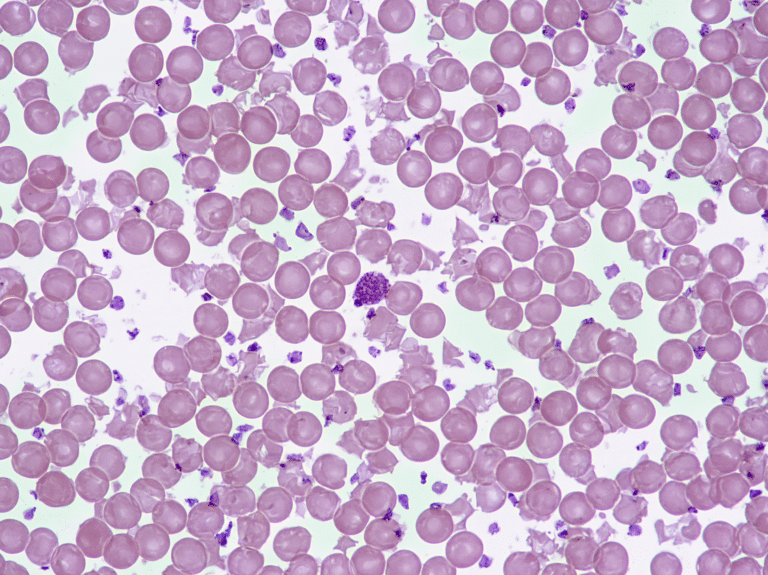
CBC helps the doctor understand whether the patient has anemia, how small the red blood cells are, and how much hemoglobin each red cell carries. In thalassemia, the body often produces small red blood cells because alpha or beta globin chain production is reduced. This is why CBC may show microcytosis, meaning small red blood cells, and hypochromia, meaning red cells with less hemoglobin and paler colour [2].
Ayurveda reads this as a disturbance of Rakta Dhatu, which means the blood tissue responsible for nourishment, colour, vitality and oxygen carrying strength. When Rakta Dhatu becomes weak, the patient may develop paleness, fatigue, low stamina, poor growth, dizziness, breathlessness on exertion or reduced exercise tolerance. These symptoms match the practical meaning of a low hemoglobin, low MCV and low MCH pattern in the CBC report [1,2].
Low Hemoglobin and Rakta Dhatu Kshaya
Hemoglobin is the oxygen carrying protein inside red blood cells. In thalassemia, hemoglobin may be mildly reduced in thalassemia trait and significantly reduced in thalassemia major or intermedia. Low hemoglobin explains why the patient may feel tired, weak, pale or breathless. Ayurveda understands this through Rakta Dhatu Kshaya, meaning reduction or weakness of the blood tissue, and Bala Kshaya, meaning reduction in physical strength.
Sanskrit shloka
ततो वर्णबलस्नेहा ये चान्येऽप्योजसो गुणाः।
व्रजन्ति क्षयमत्यर्थं दोषदूष्यप्रदूषणात्॥५॥
Transliteration
tato varṇabalasnehā ye cānye’py ojaso guṇāḥ।
vrajanti kṣayam atyarthaṃ doṣadūṣyapradūṣaṇāt॥5॥
Simple English meaning
When Dosha and body tissues are disturbed, complexion, strength, tissue nourishment and the qualities of Ojas decline. In thalassemia, this explains why a patient with low hemoglobin may show pallor, fatigue, poor stamina and reduced vitality.
Classical reference
Charaka Samhita, Chikitsa Sthana, Chapter 16, Pandu Chikitsa, Verse 5 [3].
Here, Varna means healthy complexion, Bala means strength, Sneha means tissue nourishment, and Ojas means deep vitality and immune resilience. This shloka is clinically relevant because CBC does not only show a number. It reflects how blood weakness affects the patient’s strength, colour, endurance and daily function.
MCV and MCH in CBC
MCV means mean corpuscular volume, which shows the average size of red blood cells. MCH means mean corpuscular hemoglobin, which shows how much hemoglobin is present in each red cell. In thalassemia, both MCV and MCH are commonly low. A very low MCV with a normal or high RBC count strongly suggests thalassemia trait, especially when ferritin is normal [2].
Ayurveda explains this as poor quality Rakta Dhatu formation. Raktagni means the blood level metabolic function that helps transform nourishment into healthy blood tissue. When Raktagni is weak or disturbed, the blood tissue may not form with full strength and quality. In modern terms, the red cells may be present in number, but they may remain small and carry less hemoglobin.
RBC Count and the Difference From Iron Deficiency
One of the most useful CBC clues is the RBC count. In iron deficiency anemia, the RBC count is often low or low normal. In thalassemia trait, the RBC count may be normal or high, even though MCV and MCH are low. This happens because the body tries to compensate by producing more red cells, but the red cells remain small and carry less hemoglobin [2].
This is why CBC should never be read alone. A patient with low MCV and low MCH should not automatically be given iron for a long period unless ferritin confirms iron deficiency. If ferritin is low, iron deficiency may be present. If ferritin is normal and RBC count is high with very low MCV, thalassemia trait becomes more likely. This distinction protects patients from unnecessary iron use and guides the next step toward HbA2 testing, HPLC and genetic confirmation when needed [2,4].
Ayurveda Reading of CBC Through Pandu
In Ayurveda, the CBC pattern of low hemoglobin, low MCV and low MCH can be clinically connected with Pandu, the classical disease group associated with pallor, weakness, reduced complexion and disturbed blood nourishment. Thalassemia is not a simple nutritional Pandu in every case. Because it is inherited, it is better understood as Beejadushtijanya Pandu, meaning an inherited blood weakness arising from a seed level or genetic level disturbance.
Sanskrit shloka
दोषाः पित्तप्रधानास्तु यस्य कुप्यन्ति धातुषु।
शैथिल्यं तस्य धातूनां गौरवं चोपजायते॥४॥
Transliteration
doṣāḥ pittapradhānāstu yasya kupyanti dhātuṣu।
śaithilyaṃ tasya dhātūnāṃ gauravaṃ copajāyate॥4॥
Simple English meaning
When Pitta dominant Doshas disturb the body tissues, the tissues lose firmness and become functionally weak. In thalassemia, this helps explain why blood tissue does not provide normal strength, colour and stamina.
Classical reference
Charaka Samhita, Chikitsa Sthana, Chapter 16, Pandu Chikitsa, Verse 4 [3].
Dosha means the functional biological forces of the body. Pitta supports transformation, colour, metabolism and blood related functions. Dhatu means body tissue. In this section, the main Dhatu is Rakta Dhatu, the blood tissue. When CBC shows low hemoglobin and small pale red cells, Ayurveda reads it as a measurable sign of disturbed Rakta Dhatu strength.
What CBC Tells the Patient Practically
CBC tells the patient whether the blood is carrying enough hemoglobin, whether the red cells are small, whether each red cell carries less hemoglobin, and whether the pattern looks more like thalassemia or iron deficiency. A low hemoglobin value explains weakness, but MCV, MCH, RBC count and ferritin explain why the weakness is happening.
From an Ayurveda centred view, CBC becomes the first map for treatment planning. The aim is to support Rakta Dhatu, improve Agni, strengthen Raktagni, preserve Bala, improve Ojas and protect the liver and spleen system as the condition is monitored. The next step after CBC is usually to interpret MCV and MCH more deeply, because these two values often reveal the thalassemia pattern before the final HPLC or genetic report confirms it [1,2,4].
MCV and MCH in Thalassemia Blood Test Report
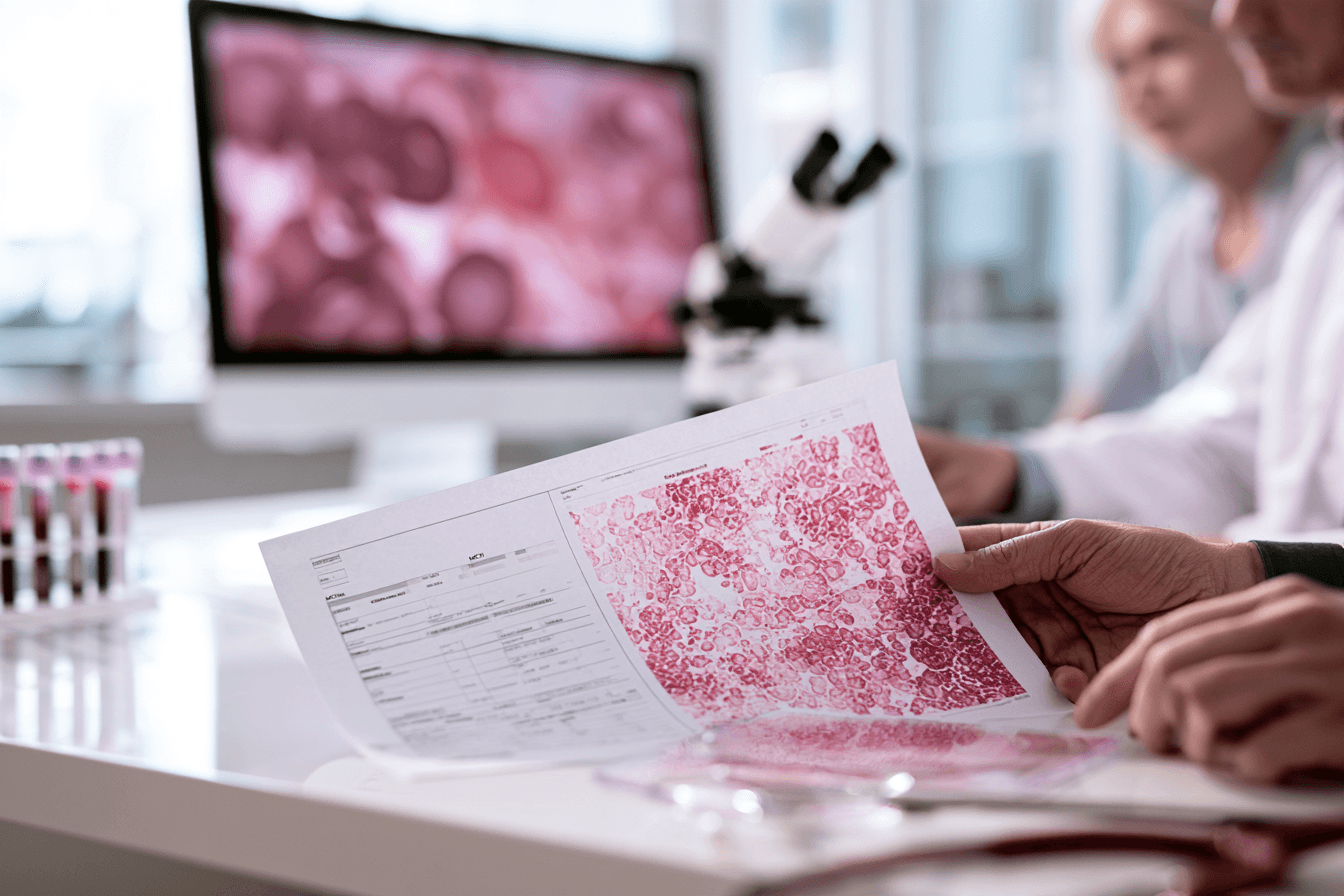
MCV and MCH in a thalassemia blood test report are two of the most convincing early markers because they show the quality of red blood cell formation before the final HPLC or genetic test confirms the diagnosis. MCV means the average size of red blood cells. MCH means the average hemoglobin carried by each red blood cell. In adults, MCV below 80 fL is generally called microcytosis, meaning small red blood cells, and MCH below about 27 pg is commonly considered low, meaning each red cell carries less hemoglobin than expected [1,2]. In thalassemia, these two values often become low together because the body produces red cells with reduced hemoglobin content due to impaired globin chain production [3].
Why Low MCV and Low MCH Are Strong Clues in Thalassemia Blood Test Report
Low MCV and low MCH can appear in both iron deficiency anemia and thalassemia, but the strategy is to look at the full pattern, not one value alone. In thalassemia trait, MCV can be very low while the RBC count remains normal or high. This is different from many cases of iron deficiency, where the RBC count is often low or low normal and ferritin is low. A practical screening calculation called the Mentzer index uses MCV divided by RBC count. A value below 13 supports thalassemia trait, while a value above 13 supports iron deficiency anemia [3].
This simple interpretation protects the patient from a common mistake. A person with low MCV and low MCH may be told, “You are iron deficient,” but thalassemia trait can produce the same small red cell pattern without true iron deficiency. Ferritin is therefore essential before long term iron is given. If ferritin is normal and the RBC count is high with very low MCV, the next convincing step is HbA2 and HPLC testing. If HbA2 is raised, especially above the commonly used diagnostic threshold of 3.5 percent, beta thalassemia trait becomes more likely [3,4].
Ayurveda Meaning of Low MCV and MCH in Thalassemia Blood Test Report
Ayurveda reads low MCV and low MCH through Rakta Dhatu, meaning the blood tissue that nourishes the body, gives healthy complexion and supports vitality. When red cells are small and carry less hemoglobin, the report is showing reduced blood strength at a measurable level. This connects with Rakta Dhatu Kshaya, meaning depletion or weakness of blood tissue, and Raktagni Mandya, meaning reduced metabolic strength involved in proper blood formation.
Sanskrit shloka
ततो वर्णबलस्नेहा ये चान्येऽप्योजसो गुणाः।
व्रजन्ति क्षयमत्यर्थं दोषदूष्यप्रदूषणात्॥५॥
Transliteration
tato varṇabalasnehā ye cānye’py ojaso guṇāḥ।
vrajanti kṣayam atyarthaṃ doṣadūṣyapradūṣaṇāt॥5॥
Simple English meaning
When Dosha and body tissues are disturbed, complexion, strength, nourishment and the qualities of Ojas decline. In thalassemia, this explains why low MCV and low MCH are not only lab abnormalities. They can reflect pallor, fatigue, low stamina, poor tissue nourishment and reduced vitality.
Classical reference
Charaka Samhita, Chikitsa Sthana, Chapter 16, Pandu Chikitsa, Verse 5 [5].
Here, Varna means healthy complexion, Bala means strength, Sneha means tissue nourishment, and Ojas means deep vitality and immune resilience. This verse is clinically useful because thalassemia patients often do not suffer only from low hemoglobin. They may also show tiredness, poor growth, low exercise tolerance, repeated weakness and reduced quality of life.
Why MCV Can Be Very Low Even When RBC Count Is High
One convincing feature of thalassemia trait is that the body may produce more red blood cells, but each cell remains smaller and carries less hemoglobin. This is why the RBC count can look normal or high while MCV and MCH remain low. For patients, this explains an important point: more red cells do not always mean stronger blood. If each red cell is microcytic and hypochromic, meaning small and pale, oxygen carrying efficiency may still be reduced [3,6].
Ayurveda explains this as quantity without full quality of Rakta Dhatu. The body may attempt to compensate, but the inherited defect affects the quality of blood formation. This is why thalassemia should not be managed only by raising hemoglobin temporarily. The deeper clinical aim is to improve blood nourishment, protect liver and spleen function, maintain appetite, preserve strength and monitor modern markers over time.
The Strong Report Strategy for Patients
The most practical strategy is to read MCV and MCH with RBC count, ferritin and HPLC. If MCV is below 80 fL and MCH is below 27 pg, the report confirms a microcytic hypochromic pattern. If ferritin is low, iron deficiency may be present and should be corrected carefully. If ferritin is normal and RBC count is normal or high, thalassemia trait becomes a stronger possibility. If HbA2 is raised on HPLC, beta thalassemia trait becomes strongly supported. If HbA2 is normal but MCV and MCH remain very low with normal ferritin, alpha thalassemia should be considered and genetic testing may be needed [3,4,6].
This strategy makes the report trustworthy because it prevents guesswork. CBC gives the first warning. MCV and MCH show the red cell defect. Ferritin separates iron deficiency from thalassemia like patterns. HPLC confirms the hemoglobin fractions. Genetic testing confirms the inherited defect when needed. Ayurveda then uses this confirmed report to plan support for Rakta Dhatu, Raktagni, Agni, Bala, Ojas, Yakrit and Pleeha.
How Ayurveda Uses MCV and MCH for Follow Up
MCV and MCH do not change quickly in inherited thalassemia, so they should not be used alone to judge short term improvement. A more responsible Ayurveda centred follow up looks at fatigue, appetite, sleep, weight, pallor, activity level, transfusion requirement, ferritin trend, liver function, spleen size and infection frequency along with CBC. This gives the patient a clearer 30 day and long term monitoring plan.
In thalassemia trait, the goal is to avoid wrong treatment, strengthen digestion and blood nourishment, and prevent unnecessary iron use when ferritin is normal. In thalassemia intermedia or major, the goal is broader: support Bala and Ojas, protect Yakrit and Pleeha, maintain nutrition, monitor ferritin, coordinate transfusion planning and keep hematology care active. This is how MCV and MCH become more than numbers. They become the first clinical doorway into a complete Ayurveda centred thalassemia care plan.
HbA2 in Thalassemia Blood Test Report
HbA2 in a thalassemia blood test report is one of the most important values for detecting beta thalassemia trait. HbA2 means hemoglobin A2, a small adult hemoglobin fraction normally present in low quantity. When HbA2 is raised with low MCV and low MCH, it strongly supports an inherited beta globin chain disorder rather than simple iron deficiency. In practical diagnosis, HbA2 of 3.5 percent or higher is commonly used as a key screening marker for beta thalassemia trait [1].
Why HbA2 Is Powerful in Thalassemia Blood Test Report
CBC may create suspicion, but HbA2 gives direction. A patient may have low hemoglobin, very low MCV and low MCH for different reasons, including iron deficiency, thalassemia trait or mixed anemia. When HbA2 is clearly raised on HPLC, the report becomes much more convincing for beta thalassemia trait. This is why HbA2 should be read with MCV, MCH, RBC count, ferritin and HPLC, not as an isolated number [1,2].
The strategy is simple. If MCV is very low, MCH is low, RBC count is normal or high, ferritin is normal and HbA2 is raised, beta thalassemia trait becomes the most likely explanation. If HbA2 is normal but MCV and MCH remain low with normal ferritin, alpha thalassemia or another hemoglobin pattern should be considered. This protects patients from repeated iron use when the real issue is inherited hemoglobin formation [2].
Ayurveda Meaning of Raised HbA2 in Thalassemia Blood Test Report
Ayurveda reads raised HbA2 as a modern laboratory sign of deeper inherited blood formation disturbance. This connects with Beejadushtijanya Pandu, meaning an inherited anemia like disorder arising from Beeja level disturbance. Beeja means the reproductive seed or inherited genetic blueprint. Beejabhaga means the gene like part of that seed. Beejabhagavayava means a smaller inherited subpart, comparable to a chromosome or gene segment in modern explanation.
Sanskrit shloka
एवमेव पुरुषस्य यदा बीजे बीजभागः प्रदोषमापद्यते, तदा वन्ध्यं जनयति;
यदा पुनरस्य बीजे बीजभागावयवः प्रदोषमापद्यते, तदा पूतिप्रजं जनयति॥३१॥
Transliteration
evameva puruṣasya yadā bīje bījabhāgaḥ pradoṣamāpadyate, tadā vandhyaṃ janayati;
yadā punarasya bīje bījabhāgāvayavaḥ pradoṣamāpadyate, tadā pūtiprajaṃ janayati॥31॥
Simple English meaning
When the inherited seed, its gene like part or its smaller inherited subpart is disturbed, it can affect the health and development of the child. In thalassemia, this gives Ayurveda a clear classical foundation to understand why the disorder can pass through families.
Classical reference
Charaka Samhita, Sharira Sthana, Chapter 4, Mahatigarbhavakranti Sharira, Verse 31 [3].
This shloka makes HbA2 clinically meaningful in Ayurveda. Raised HbA2 is not only a laboratory marker. It helps separate ordinary nutritional Pandu from Beejadushtijanya Pandu. Pandu means an anemia like condition with pallor, weakness and reduced blood strength. In thalassemia, the cause is not only poor diet or low iron. The deeper issue is an inherited weakness in hemoglobin formation, so Ayurveda care must focus on Rakta Dhatu, Raktagni, Agni, Bala, Ojas, Yakrit and Pleeha together.
HbA2 and Ferritin Must Be Read Together
Ferritin tells whether the body is iron deficient, iron sufficient or iron overloaded. This is important because low MCV and low MCH may tempt patients to take iron immediately. In thalassemia trait, ferritin may be normal even when red cells are small. ARUP notes that serum ferritin is generally low in iron deficiency anemia but not in thalassemia, and severe iron deficiency may reduce HbA2 by as much as 0.5 percent [2].
A recent pediatric study of 213 children with beta thalassemia trait found that 51 children had iron deficiency using ferritin below 15 ng per mL. Among iron deficient carriers, the median HbA2 was still 4.1 percent, compared with 4.9 percent in iron sufficient carriers, and the difference was statistically significant. Importantly, the authors concluded that HbA2 can still be useful for beta thalassemia trait screening even when iron deficiency is present, and evaluation should continue when suspicion remains strong [1].
This data is very convincing for patients because it prevents two mistakes. A low ferritin should be corrected, but it should not automatically close the thalassemia investigation when CBC strongly suggests a carrier pattern. At the same time, normal ferritin with low MCV, low MCH and raised HbA2 should not be treated as simple weakness or ordinary anemia.
Ayurveda Strategy After Raised HbA2
Once HbA2 supports beta thalassemia trait, Ayurveda planning becomes more precise. Rakta Dhatu means blood tissue, and the aim is to support its strength and quality. Raktagni means the blood level metabolic function that helps proper blood formation. Agni means digestion and metabolism, because weak digestion can worsen fatigue, poor appetite and poor tissue nourishment. Bala means physical strength, and Ojas means deeper vitality and immune resilience.
For a patient with thalassemia trait, the Ayurveda strategy is to avoid unnecessary iron if ferritin is normal, improve appetite and digestion, support Rakta Dhatu nourishment, reduce fatigue, maintain healthy energy and check family screening when needed. For thalassemia intermedia or major, HbA2 is only one part of the report, so the plan must also consider HbF, HbA, ferritin, liver function, spleen size, transfusion history and hematology advice [2,4].
When HbA2 Is Borderline or Normal
A borderline HbA2 result should not be ignored when MCV and MCH are clearly low. HbA2 may appear borderline due to iron deficiency, coexisting hemoglobin variants, delta beta thalassemia or technical interpretation issues. In such cases, the safer strategy is to repeat the report after correcting proven iron deficiency, review the full HPLC pattern, check family history and consider genetic testing if the clinical picture remains suspicious [1,2].
Normal HbA2 does not rule out alpha thalassemia. In alpha thalassemia trait, HbA2 may be normal or slightly reduced, while MCV and MCH may remain low. This is why a patient with persistent microcytosis, normal ferritin and normal HbA2 may still need alpha globin gene testing. In Ayurveda language, the Beejadushti may still be present, but the modern marker may not be HbA2 in that patient [2].
Practical Meaning for the Patient
HbA2 helps the patient understand whether the blood report is pointing toward an inherited beta thalassemia pattern. If HbA2 is high, the patient should not panic, but the report should be taken seriously. It can explain lifelong low MCV, low MCH, mild anemia, family history of anemia and the risk of passing the trait to children.
In an Ayurveda centred model, HbA2 confirms that treatment should go beyond ordinary iron and general tonics. The care should support Rakta Dhatu, improve Agni, protect Bala and Ojas, and keep ferritin, CBC and family risk under proper monitoring. This gives the patient a clearer, safer and more complete path after reading the thalassemia blood test report.
HPLC Test in Thalassemia Blood Test Report
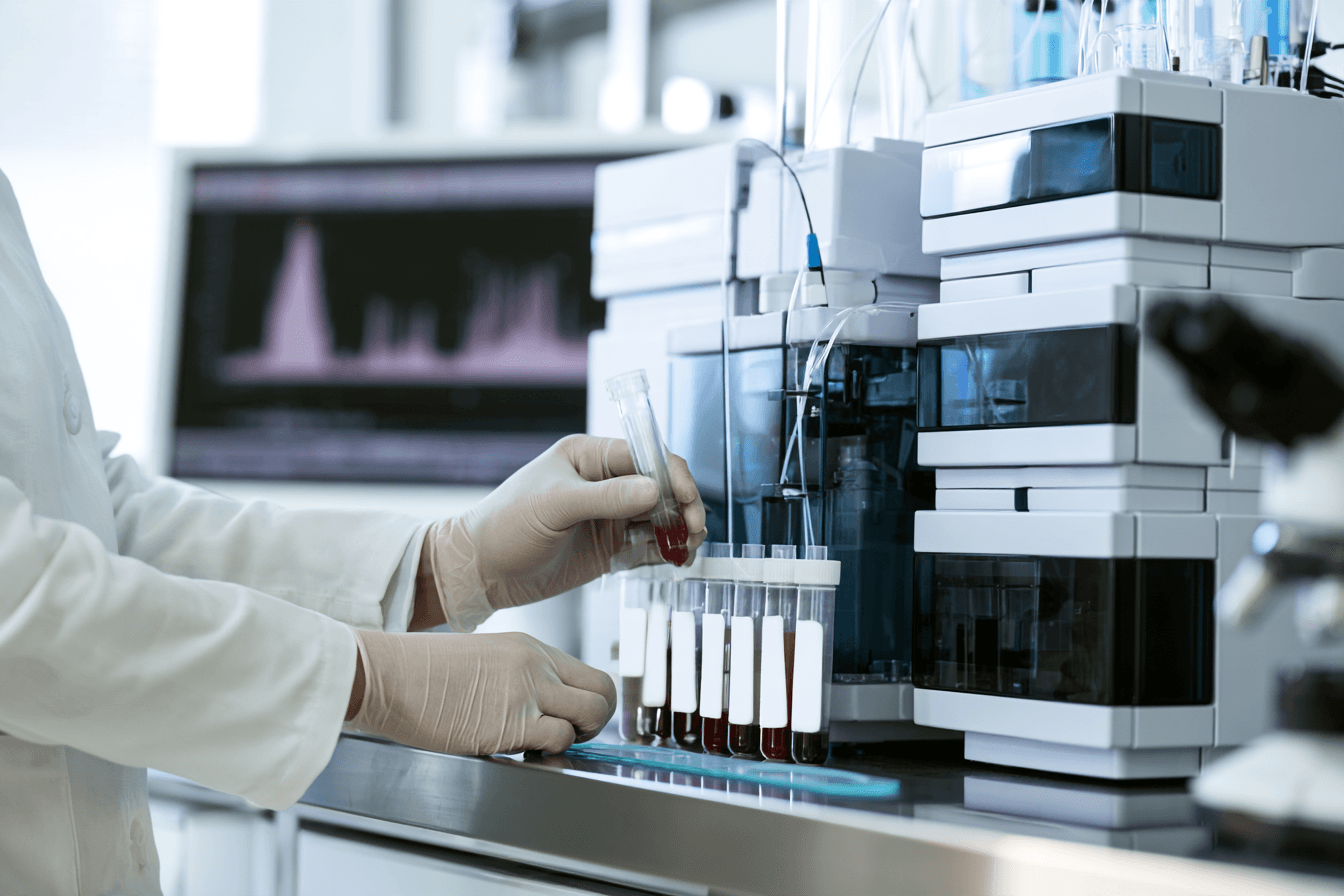
The HPLC test in a thalassemia blood test report gives one of the clearest modern pictures of hemoglobin formation. HPLC means high performance liquid chromatography. It separates different hemoglobin fractions such as HbA, HbA2, HbF and abnormal hemoglobin variants. CBC, MCV and MCH may create suspicion, but HPLC helps confirm whether the pattern is beta thalassemia trait, thalassemia major, thalassemia intermedia, HbE beta thalassemia, sickle beta thalassemia or another hemoglobin variant [1,2].
Why HPLC Test in Thalassemia Blood Test Report Is So Important
A patient may have low hemoglobin, very low MCV and low MCH, but these findings alone cannot confirm thalassemia. Iron deficiency anemia, thalassemia trait and mixed anemia can look similar in CBC. HPLC adds confidence because it measures hemoglobin fractions directly. When HbA2 is raised, especially above the commonly used diagnostic level of 3.5 percent, beta thalassemia trait becomes strongly supported. When HbF is very high and HbA is reduced or absent, the report may suggest a more severe beta thalassemia pattern, depending on age, transfusion history and clinical findings [1,2,3].
This is the strategy that convinces patients. CBC shows that the red cells are small and hemoglobin is low. Ferritin shows whether iron deficiency or iron overload is present. HPLC shows whether the hemoglobin pattern is inherited. Genetic testing then confirms the mutation when the report is unclear, when alpha thalassemia is suspected, or when family planning is important [1,2].
Ayurveda Meaning of HPLC Test in Thalassemia Blood Test Report
Ayurveda reads HPLC as a modern confirmation of the deeper blood formation pattern. Rakta Dhatu means blood tissue. Ranjaka Pitta means the Pitta function that supports the colour and quality of blood. Raktagni means the metabolic intelligence involved in forming healthy blood tissue. When HPLC shows an abnormal hemoglobin fraction, Ayurveda understands that the disorder is not only nutritional weakness. It is a deeper inherited disturbance of blood formation, called Beejadushtijanya Pandu, meaning inherited anemia like blood weakness arising from a seed level or genetic level defect.
Sanskrit shloka
एवमेव पुरुषस्य यदा बीजे बीजभागः प्रदोषमापद्यते, तदा वन्ध्यं जनयति।
यदा पुनरस्य बीजे बीजभागावयवः प्रदोषमापद्यते, तदा पूतिप्रजं जनयति॥३१॥
Transliteration
evameva puruṣasya yadā bīje bījabhāgaḥ pradoṣamāpadyate, tadā vandhyaṃ janayati।
yadā punarasya bīje bījabhāgāvayavaḥ pradoṣamāpadyate, tadā pūtiprajaṃ janayati॥31॥
Simple English meaning
When the inherited seed, its gene like part or its smaller inherited subpart is disturbed, it can affect the health and development of the child. In thalassemia, this explains why the disease can pass through families and why HPLC and genetic testing are important for confirmation.
Classical reference
Charaka Samhita, Sharira Sthana, Chapter 4, Mahatigarbhavakranti Sharira, Verse 31 [4].
Here, Beeja means inherited reproductive seed, Beejabhaga means gene like inherited part, and Beejabhagavayava means a smaller inherited subpart. This classical concept gives Ayurveda a strong foundation for understanding inherited hemoglobin disorders. HPLC does not replace Ayurvedic diagnosis, and Ayurveda does not replace HPLC. Both strengthen each other when the patient needs clarity, safety and long term planning.
Reading HbA HbA2 and HbF in HPLC
HbA is the main adult hemoglobin. HbA2 is a smaller adult hemoglobin fraction that becomes important in beta thalassemia trait. HbF is fetal hemoglobin, which is normally higher in newborns and usually becomes low after infancy. In many beta thalassemia patterns, HbF may remain raised because the body tries to compensate for defective adult hemoglobin production [1,3].
When HbA2 is raised with low MCV and low MCH, the report supports beta thalassemia trait. When HbF is significantly raised, the doctor checks whether the patient has thalassemia intermedia, thalassemia major, hereditary persistence of fetal hemoglobin or another hemoglobin disorder. When an abnormal peak appears, such as HbE, HbS or HbD, the report must be interpreted carefully because combined disorders can change symptoms, severity and family risk [1,2].
Why Transfusion History Must Be Checked Before HPLC
HPLC must always be read with transfusion history. If the patient recently received blood transfusion, donor red cells may affect the hemoglobin fraction pattern. This can make the report less reliable for diagnosis during that period. For this reason, the doctor should know the date of the last transfusion before interpreting HbA, HbA2, HbF or any abnormal peak [5].
This point is very important in thalassemia major and transfusion dependent thalassemia. A child or adult who receives regular transfusions may show a mixed hemoglobin pattern because the blood sample contains both the patient’s own red cells and transfused donor red cells. In such cases, previous reports, newborn screening, family reports and genetic testing become more important for final confirmation [1,5].
Ayurveda View of HPLC and Rakta Dhatu Quality
In Ayurveda, HPLC helps confirm the quality and pattern of Rakta Dhatu disturbance. Rakta Dhatu is not just blood volume. It represents the functional strength of blood, nourishment, complexion, vitality and tissue oxygenation. When HPLC shows abnormal hemoglobin production, it gives measurable proof that Rakta Dhatu formation is affected at a deeper level.
Sanskrit shloka
ततो वर्णबलस्नेहा ये चान्येऽप्योजसो गुणाः।
व्रजन्ति क्षयमत्यर्थं दोषदूष्यप्रदूषणात्॥५॥
Transliteration
tato varṇabalasnehā ye cānye’py ojaso guṇāḥ।
vrajanti kṣayam atyarthaṃ doṣadūṣyapradūṣaṇāt॥5॥
Simple English meaning
When Dosha and body tissues are disturbed, complexion, strength, nourishment and the qualities of Ojas decline. In thalassemia, this helps explain why abnormal hemoglobin formation may appear with pallor, fatigue, low stamina, poor growth and reduced vitality.
Classical reference
Charaka Samhita, Chikitsa Sthana, Chapter 16, Pandu Chikitsa, Verse 5 [6].
Varna means healthy complexion. Bala means strength. Ojas means deep vitality and immune resilience. These words help patients understand why HPLC is not only a technical report. It explains why the body may struggle with oxygen strength, energy, growth and long term endurance.
HPLC Strategy That Helps Patients Avoid Wrong Treatment
The strongest patient strategy is to read HPLC only after checking CBC and ferritin. If MCV and MCH are low and ferritin is normal, HPLC becomes essential to detect beta thalassemia trait or another hemoglobin variant. If ferritin is low, iron deficiency may also be present, but thalassemia investigation should continue when RBC count is high, MCV is very low or family history is suggestive. If HbA2 is borderline, the doctor may repeat testing after correcting proven iron deficiency or proceed to genetic testing when suspicion remains strong [1,2,3].
This strategy prevents three common mistakes. The first mistake is treating every low MCV report as iron deficiency. The second mistake is ignoring a raised HbA2 because the patient has only mild anemia. The third mistake is assuming normal HbA2 rules out all thalassemia, because alpha thalassemia trait may show normal HbA2 and still need genetic testing when the CBC pattern is convincing [1,2].
How Ayurveda Uses HPLC for Long Term Care
Once HPLC confirms the hemoglobin pattern, Ayurveda treatment can be planned with more precision. In thalassemia trait, the focus is usually on preserving strength, improving digestion, supporting Rakta Dhatu, avoiding unnecessary iron when ferritin is normal, and guiding family screening. In thalassemia intermedia or major, the focus becomes broader, including Bala, Ojas, appetite, growth, liver and spleen support, ferritin monitoring, transfusion interval and coordination with hematology care.
Agni means digestion and metabolic fire. Raktagni means the blood level metabolic function that supports proper blood formation. Yakrit means liver, and Pleeha means spleen. These organs are central in Ayurveda because blood carrying channels are classically rooted in the liver and spleen [7]. In practical thalassemia care, this connects directly with ferritin, liver function, spleen size and long term monitoring.
A good HPLC report gives the patient direction. It shows whether the problem is beta thalassemia trait, a more severe thalassemia pattern or a combined hemoglobin variant. Ayurveda then uses this confirmed diagnosis to build a responsible plan around blood strength, tissue nourishment, vitality, digestion, liver spleen protection and measurable follow up.
Ferritin Test in Thalassemia Blood Test Report
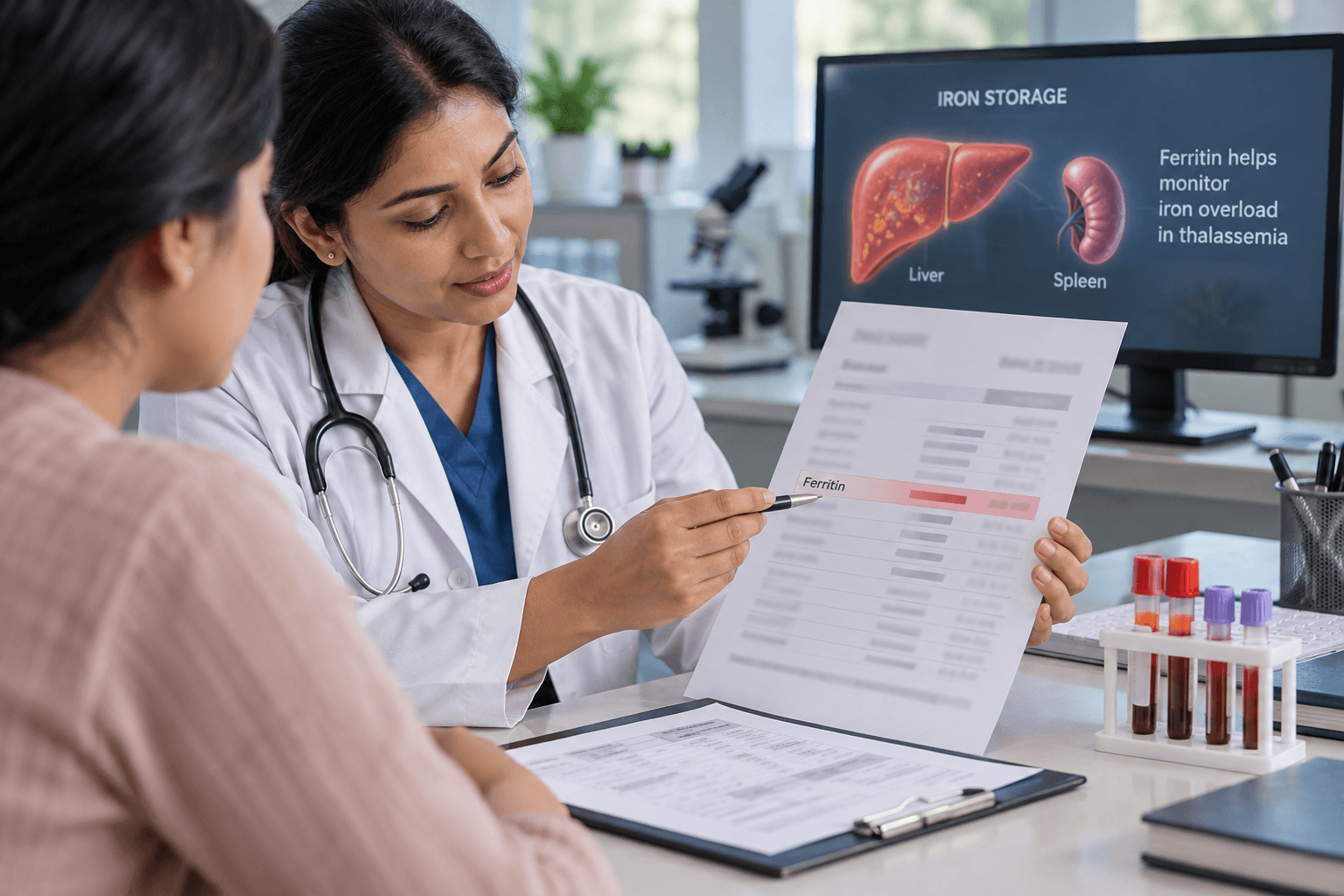
The ferritin test in a thalassemia blood test report is one of the most important safety markers because it can change the entire interpretation of anemia. Low hemoglobin does not always mean low iron. In thalassemia trait, MCV and MCH may be very low even when ferritin is normal. In transfusion dependent thalassemia, ferritin may become high because repeated blood transfusions add iron faster than the body can remove it naturally [1,2].
Why Ferritin Test in Thalassemia Blood Test Report Is a Deciding Marker
Ferritin is a protein that reflects stored iron in the body. For a patient, this number answers a very practical question: is the body lacking iron, storing normal iron, or carrying excess iron? This matters because the wrong interpretation can lead to the wrong direction. If ferritin is low, iron deficiency may be present along with anemia. If ferritin is normal with very low MCV and low MCH, thalassemia trait becomes more likely. If ferritin is high in a patient receiving repeated transfusions, iron overload becomes a major concern [1,2].
The data is strong. One unit of packed red blood cells can add about 200 to 250 mg of elemental iron. In transfusion dependent thalassemia, repeated transfusions may create an iron loading rate of about 0.3 to 0.6 mg per kg per day. Since the human body has no strong natural pathway to remove this much excess iron, the iron can gradually deposit in the liver, heart, pancreas, endocrine glands and other tissues [1]. This is why ferritin should not be treated as an optional test in thalassemia care.
The 2025 Thalassaemia International Federation guideline recommends serial serum ferritin monitoring at least every 3 months in transfusion dependent thalassemia, with frequency adjusted according to the level of iron overload and clinical need. The same guideline also places liver iron concentration by MRI and myocardial T2 star MRI into routine monitoring, usually starting around 8 to 10 years of age in transfusion dependent patients [2]. This gives the patient a clear strategy: ferritin gives regular tracking, while MRI helps confirm organ iron load more directly.
Ayurveda Meaning of Ferritin as Yakrit Pleeha Burden
Ayurveda reads ferritin through the liver and spleen system. Yakrit means liver. Pleeha means spleen. Raktavaha Srotas means the channels and functional system related to blood formation, blood circulation and blood nourishment. This is clinically meaningful in thalassemia because ferritin, liver function, spleen size, transfusion history and fatigue are often connected.
Sanskrit shloka
रसवहानां स्रोतसां हृदयं मूलं दश च धमन्यः।
शोणितवहानां स्रोतसां यकृन्मूलं प्लीहा च॥८॥
Transliteration
rasavahānāṃ srotasāṃ hṛdayaṃ mūlaṃ daśa ca dhamanyaḥ।
śoṇitavahānāṃ srotasāṃ yakṛn mūlaṃ plīhā ca॥8॥
Simple English meaning
The channels carrying nutritive fluid are rooted in the heart and major vessels, and the blood carrying channels are rooted in the liver and spleen. In thalassemia, this gives a strong Ayurvedic reason to observe ferritin, liver function, spleen size and blood strength together.
Classical reference
Charaka Samhita, Vimana Sthana, Chapter 5, Sroto Vimana, Verse 8 [3].
This shloka is highly relevant because a high ferritin report is not only an iron number. Ayurveda sees it as a sign that the Yakrit Pleeha system needs careful protection. When iron burden rises, patients may develop tiredness, poor appetite, abdominal heaviness, liver enzyme changes, spleen enlargement, skin darkening, hormonal issues or reduced stamina. Ferritin therefore becomes a measurable modern marker for deeper Raktavaha Srotas stress.
Low Ferritin Normal Ferritin and High Ferritin
Low ferritin usually supports iron deficiency, but the diagnosis should still be connected with CBC, MCV, MCH, RBC count and HPLC. A patient can have both iron deficiency and thalassemia trait. In that case, ferritin correction may improve weakness, but it does not remove the inherited hemoglobin pattern. This is why the report should be read step by step, not emotionally or by guesswork [1,4].
Normal ferritin with very low MCV and low MCH is a different signal. If the RBC count is normal or high, and HbA2 is raised on HPLC, beta thalassemia trait becomes strongly supported. This is the situation where patients are often mistakenly treated with repeated iron. Ayurveda centred care becomes more precise here because the focus shifts toward Rakta Dhatu nourishment, Agni correction, Bala improvement and family screening instead of blind iron supplementation.
High ferritin is especially important in transfusion dependent thalassemia. A study in beta thalassemia major found that patients with serum ferritin above 2500 micrograms per litre had higher odds of diabetes, hypothyroidism, hypoparathyroidism and hypogonadism compared with patients whose ferritin was 1000 micrograms per litre or lower. The reported odds were 3.53 times for diabetes, 3.25 times for hypothyroidism, 3.27 times for hypoparathyroidism and 2.75 times for hypogonadism [5]. This data explains why ferritin is directly linked with future organ protection.
Ferritin and Pandu in Ayurveda
In Ayurveda, thalassemia connects with Pandu, an anemia like condition marked by pallor, weakness, reduced complexion and low blood strength. However, thalassemia is not simple nutritional Pandu in many patients. Because it is inherited, it is better understood as Beejadushtijanya Pandu, meaning inherited blood weakness arising from a seed level or genetic level disturbance. Ferritin then helps separate three clinical states: iron deficiency, thalassemia carrier pattern and iron overload.
Sanskrit shloka
सोऽल्परक्तोऽल्पमेदस्को निःसारः शिथिलेन्द्रियः।
वैवर्ण्यं भजते, तस्य हेतुं शृणु सलक्षणम्॥६॥
Transliteration
so’lparakto’lpamedasko niḥsāraḥ śithilendriyaḥ।
vaivarṇyaṃ bhajate, tasya hetuṃ śṛṇu salakṣaṇam॥6॥
Simple English meaning
When blood and tissue essence are reduced, the person becomes low in vitality, the body and senses become weak, and abnormal complexion appears. In thalassemia, this helps explain pallor, fatigue, poor stamina and tissue weakness seen along with abnormal blood reports.
Classical reference
Charaka Samhita, Chikitsa Sthana, Chapter 16, Pandu Chikitsa, Verse 6 [6].
Here, Alpa Rakta means reduced or weakened blood status. Nihsara means loss of tissue essence. Indriya Shaithilya means weakness of body functions and sensory strength. These words help Western patients understand that Ayurveda is not reading ferritin separately from the person. Ayurveda connects the number with blood quality, tissue nourishment, organ burden, strength and long term vitality.
Ayurveda Strategy When Ferritin Is High
When ferritin is high, the first strategy is to confirm whether the rise is due to transfusion iron load, inflammation, liver disease, infection or a combination of factors. Ferritin can rise in inflammation, so one single value should not create panic. The trend over several months is more important, especially when it is read with CBC, transfusion frequency, liver function tests, CRP, spleen size and MRI based liver iron concentration when advised [2,4].
Ayurveda keeps the treatment focus on Rakta Dhatu, Yakrit, Pleeha, Agni, Bala and Ojas. Rakta Dhatu means blood tissue. Agni means digestive and metabolic fire. Bala means physical strength. Ojas means deep vitality and immune resilience. The aim is to support blood quality, improve appetite, protect liver and spleen function, reduce fatigue, preserve growth in children and make the patient stronger while modern ferritin monitoring continues.
In transfusion dependent thalassemia, hematology care, transfusion planning and chelation review remain part of the measurable safety plan. Ayurveda adds value by supporting digestion, nourishment, liver spleen resilience, fatigue reduction and overall strength. This combined approach is more practical than looking only at hemoglobin or only at ferritin.
Published Ayurveda Data on Ferritin Support
A clinical study on Triphaladi Avaleha in thalassemia included diagnosed children between 1 and 15 years of age. Thirty patients were enrolled, and twenty two completed the study. The treated group received Triphaladi Avaleha along with standard modern management, while the control group received standard modern management alone. After two months of treatment, the trial drug showed better lowering of serum ferritin than the standard control with statistical significance at P less than .05 [7].
The same study reported highly significant relief in pallor and several clinical features in the treated group, including chronic fatigue. The treated group showed mild improvement in 84.61 percent of patients and moderate improvement in 7.69 percent, while the control group showed no overall improvement in the reported final assessment [7]. This data supports a serious Ayurveda centred Rasayana Avaleha strategy for thalassemia care when it is used with proper diagnosis, ferritin monitoring, transfusion planning and medical supervision.
Triphaladi Avaleha means a classical style herbal linctus based on Triphala and related herbs. Avaleha is a semi solid herbal preparation, similar to a medicinal jam, designed for sustained nourishment and compliance. Rasayana means rejuvenative therapy that supports tissue strength, vitality, recovery capacity and Ojas. In thalassemia, a Rasayana Avaleha approach becomes clinically meaningful because the patient needs long term support for blood tissue, appetite, liver spleen function and measurable follow up.
Practical Follow Up After Ferritin Test
In the first 30 days, ferritin may not fall dramatically in every patient, especially in transfusion dependent disease. A trustworthy follow up should look at appetite, fatigue, sleep, stool, pallor, abdominal heaviness, liver function, transfusion interval, infection tendency and medicine tolerance along with CBC and ferritin trend. For thalassemia trait, the main benefit is often correct diagnosis, avoidance of unnecessary iron when ferritin is normal, better digestion, improved strength and proper family screening.
For thalassemia major or intermedia, ferritin becomes a long term protection marker. The patient should know the baseline ferritin, the previous 3 to 6 month trend, transfusion frequency, chelation status, liver function and whether MRI based liver or heart iron assessment is needed. Ayurveda centred care becomes stronger when every decision is connected with these measurable markers. This is how ferritin changes from a single blood test into a practical roadmap for safer thalassemia management.
Genetic Test in Thalassemia Blood Test Report
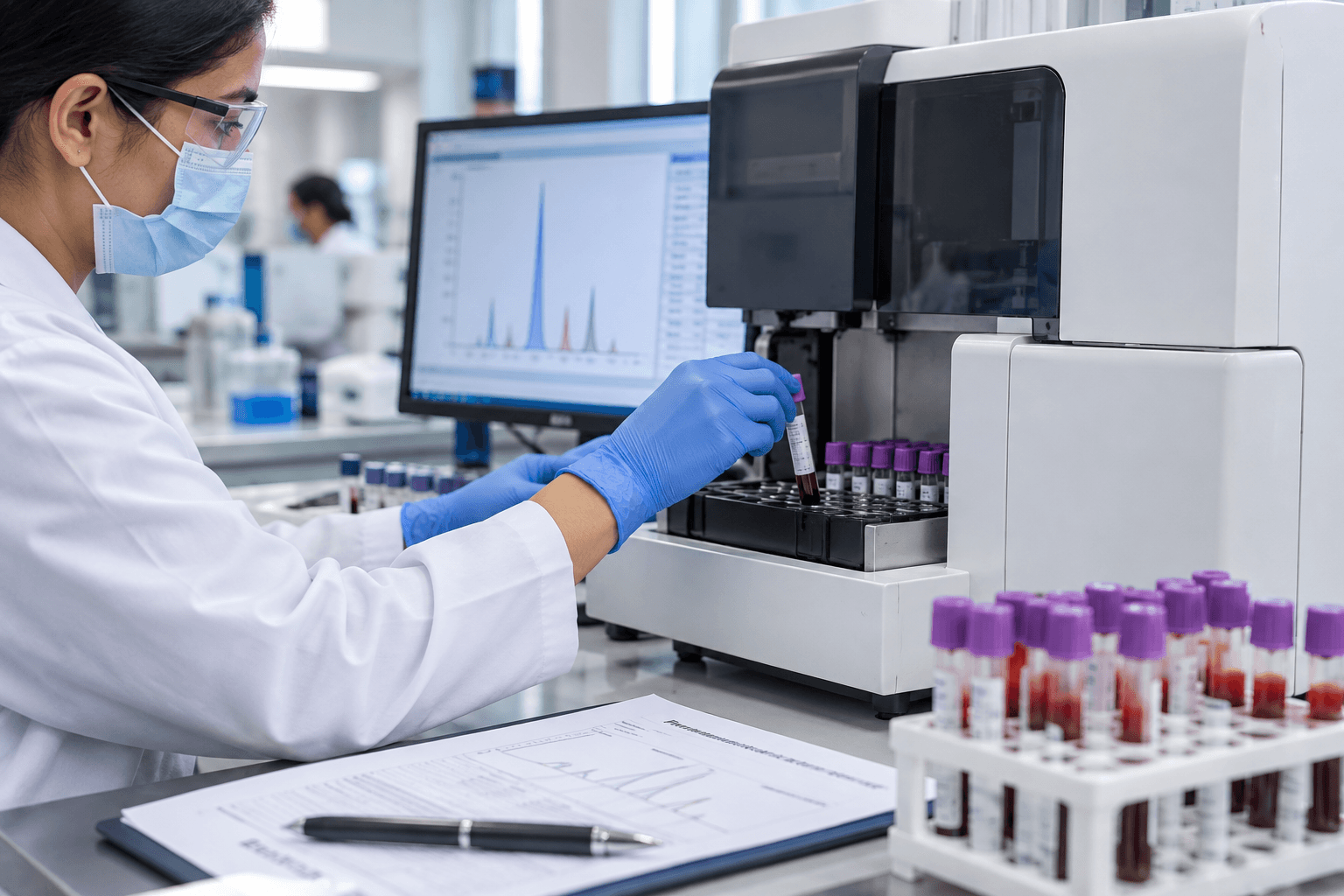
The genetic test in a thalassemia blood test report gives the final inherited cause behind the CBC, MCV, MCH, HbA2, HPLC and ferritin pattern. CBC may show small red cells. HPLC may show raised HbA2 or abnormal hemoglobin fractions. Ferritin may show whether iron is low, normal or overloaded. Genetic testing goes deeper and confirms whether the disorder is linked with beta globin gene changes, alpha globin gene deletions, or another inherited hemoglobin pattern [1,2].
Why Genetic Test in Thalassemia Blood Test Report Gives Final Confirmation
Thalassemia is an inherited hemoglobin disorder. Beta thalassemia usually involves changes in the HBB gene, which controls beta globin production. Alpha thalassemia usually involves HBA1 and HBA2 genes, and deletions of one or more alpha globin genes are the most common cause of alpha thalassemia [1,3]. This is why HPLC alone may not be enough in every patient, especially when HbA2 is normal but MCV and MCH remain very low.
The strongest diagnostic strategy is to move step by step. CBC gives the first suspicion. MCV and MCH show microcytosis and low hemoglobin content. Ferritin separates iron deficiency from a thalassemia pattern. HPLC identifies HbA, HbA2, HbF and abnormal hemoglobin peaks. Genetic testing confirms the exact inherited defect when the report is unclear, when alpha thalassemia is suspected, when both partners may be carriers, or when pregnancy planning is important [1,2].
Ayurveda Meaning of Genetic Test in Thalassemia Blood Test Report
Ayurveda understands inherited disease through Beeja, Beejabhaga and Beejabhagavayava. Beeja means the reproductive seed or inherited blueprint. Beejabhaga means the gene like inherited part. Beejabhagavayava means a smaller inherited subpart. In thalassemia, this gives a classical foundation for understanding why the disease can pass from parents to children and why family screening is essential.
Sanskrit shloka
एवमेव पुरुषस्य यदा बीजे बीजभागः प्रदोषमापद्यते, तदा वन्ध्यं जनयति।
यदा पुनरस्य बीजे बीजभागावयवः प्रदोषमापद्यते, तदा पूतिप्रजं जनयति॥३१॥
Transliteration
evameva puruṣasya yadā bīje bījabhāgaḥ pradoṣamāpadyate, tadā vandhyaṃ janayati।
yadā punarasya bīje bījabhāgāvayavaḥ pradoṣamāpadyate, tadā pūtiprajaṃ janayati॥31॥
Simple English meaning
When the inherited seed, its gene like part, or its smaller inherited subpart is disturbed, it can affect the health and development of the child. In thalassemia, this explains the Ayurvedic logic behind inherited blood disorders and supports the diagnosis of Beejadushtijanya Pandu.
Classical reference
Charaka Samhita, Sharira Sthana, Chapter 4, Mahatigarbhavakranti Sharira, Verse 31 [4].
Beejadushtijanya Pandu means an inherited anemia like blood disorder arising from seed level disturbance. Pandu means an anemia like condition with pallor, weakness, reduced complexion and low blood strength. This does not mean Ayurveda replaces genetic testing. It means Ayurveda has a deep classical language to understand inherited blood weakness, while genetic testing gives the modern molecular confirmation.
HBB Genetic Test for Beta Thalassemia
The HBB gene provides instructions for beta globin production. When HBB changes reduce beta globin production, the body cannot form normal adult hemoglobin properly. This may appear as beta thalassemia trait, beta thalassemia intermedia or beta thalassemia major, depending on the type and severity of the inherited changes [1,2].
In a practical report, beta thalassemia trait often shows low MCV, low MCH, normal or high RBC count, normal ferritin and raised HbA2 on HPLC. Genetic testing is especially useful when HbA2 is borderline, when there is mixed iron deficiency, when the family history is strong, or when a couple needs pregnancy risk assessment. HBB sequencing is commonly used because beta thalassemia is often caused by point mutations or small sequence changes rather than large deletions [1].
Ayurveda reads this as a confirmed inherited Rakta Dhatu formation disorder. Rakta Dhatu means blood tissue. Raktagni means the metabolic power that supports healthy blood formation. Bala means strength, and Ojas means deep vitality and immune resilience. Once HBB testing confirms beta thalassemia, the Ayurveda plan should focus on blood strength, appetite, liver spleen protection, fatigue reduction, ferritin monitoring and family guidance.
HBA1 and HBA2 Genetic Test for Alpha Thalassemia
Alpha thalassemia is different because HbA2 may be normal. This is why many patients with alpha thalassemia trait are missed if the doctor depends only on HbA2. A patient may have lifelong low MCV and low MCH, normal ferritin, normal HbA2 and still carry alpha thalassemia. In such cases, HBA1 and HBA2 deletion testing becomes highly important [1,3].
This is a powerful patient education point. Normal HbA2 does not always mean there is no thalassemia. It mainly makes beta thalassemia trait less likely. If the CBC pattern remains suspicious, especially with family history or ethnic risk, alpha thalassemia genetic testing should be considered. Deletion and duplication testing is often used first because alpha thalassemia is commonly caused by deletion of alpha globin genes [1,3].
From Ayurveda view, this still fits Beejadushtijanya Pandu because the inherited blood forming pattern remains disturbed, even when HbA2 is not raised. The patient should not be dismissed as having ordinary weakness if MCV and MCH are persistently low and ferritin is normal.
Genetic Test and Family Risk Strategy
Genetic testing is most convincing when patients understand the family risk clearly. If both parents carry a beta thalassemia trait, each pregnancy has a 25 percent chance of a child with beta thalassemia major, a 50 percent chance of a child who is a carrier, and a 25 percent chance of a child who does not inherit the affected genes [5]. This risk repeats in every pregnancy, so one healthy child does not remove the risk for the next child.
This is why partner testing matters. If one person has thalassemia trait, the partner should be tested before pregnancy planning. If both partners are carriers, genetic counselling becomes essential. This gives the family time to understand reproductive options, prenatal testing, newborn planning and long term care needs [2,5].
Ayurveda supports this with the classical concept of Beeja protection before conception. The aim is not fear. The aim is clear knowledge, responsible family planning and early protection of the child’s health.
Ayurveda Classical Support for Preconception Care
Ayurveda gives high importance to healthy conception, healthy reproductive seed and parental preparation. In inherited disorders like thalassemia, this becomes clinically meaningful because modern genetics also shows that the child receives globin gene patterns from the parents.
Sanskrit shloka
शुक्रशोणितजीवसंयोगे तु खलु कुक्षिगते गर्भसंज्ञा भवति॥५॥
Transliteration
śukra śoṇita jīva saṃyoge tu khalu kukṣigate garbhasaṃjñā bhavati॥5॥
Simple English meaning
When Shukra, Shonita and the living principle unite in the womb, the state called Garbha begins. Shukra means the male reproductive seed. Shonita means the female reproductive seed or ovum related principle. Garbha means embryo or developing child.
Classical reference
Charaka Samhita, Sharira Sthana, Chapter 4, Mahatigarbhavakranti Sharira, Verse 5 [4].
This verse helps patients understand why Ayurveda does not look at thalassemia only after birth. When a disease is inherited, preconception awareness, carrier screening and family history become part of prevention. Modern genetic testing gives the laboratory proof, while Ayurveda gives the clinical philosophy of protecting the future child through informed planning.
When Genetic Testing Is Most Needed
Genetic testing becomes especially important when CBC shows persistent low MCV and low MCH but ferritin is normal. It is also needed when HbA2 is borderline, when HPLC is difficult to interpret, when alpha thalassemia is suspected, when the patient has a strong family history, when both partners belong to a high risk community, when pregnancy is planned, or when a child has transfusion dependent anemia and the exact diagnosis must be confirmed [1,2].
In transfusion dependent thalassemia, genetic testing also helps the family understand severity, future pregnancy risk and sibling screening. In thalassemia trait, it helps prevent confusion with iron deficiency and gives the patient a clear explanation for lifelong low MCV and low MCH.
Practical Meaning for the Patient
A genetic test changes the thalassemia blood test report from suspicion to confirmation. It tells the patient whether the disorder is linked with HBB, HBA1, HBA2 or another hemoglobin related gene. It also tells the family whether partner testing, child testing or pregnancy counselling is needed.
In Ayurveda centred care, genetic confirmation gives direction. The patient is not treated blindly as an ordinary anemia case. The plan is built around Rakta Dhatu support, Agni improvement, Raktagni correction, Bala strengthening, Ojas protection, Yakrit Pleeha monitoring, ferritin safety and long term family guidance. This creates a stronger, safer and more trustworthy thalassemia care model, where modern genetic proof and Ayurvedic clinical wisdom work together.
Thalassemia Blood Test Report and Iron Deficiency Difference

A thalassemia blood test report becomes convincing only when it clearly separates thalassemia from iron deficiency anemia. Both conditions can show low hemoglobin, low MCV and low MCH, so many patients are wrongly told that they only need iron. The safer strategy is to read CBC, RBC count, Mentzer index, ferritin, HbA2 and HPLC together. This prevents unnecessary iron use, avoids delayed diagnosis and gives Ayurveda a clearer foundation for Rakta Dhatu centred care [1,2].
Why the Difference Changes the Whole Treatment Direction
Iron deficiency anemia usually means the body does not have enough usable iron to make hemoglobin. Thalassemia is different because the problem is inherited globin chain formation. In simple words, iron deficiency is mainly a supply problem, while thalassemia is mainly a blood formation pattern problem. This is why the same low MCV report can need two very different treatment plans.
The key data is practical. In thalassemia trait, MCV is often very low, RBC count is often normal or high, Mentzer index is usually below 13 and ferritin is usually normal when inflammation is absent. In iron deficiency anemia, MCV is low, RBC count is often low or low normal, Mentzer index is usually above 13 and ferritin is usually low [1]. This one pattern can change the patient’s entire diagnosis.
The Three Number Strategy in Thalassemia Blood Test Report
The first number is MCV. MCV means mean corpuscular volume, which shows the average size of red blood cells. MCV below 80 fL means microcytosis, or small red blood cells. The second number is MCH. MCH means mean corpuscular hemoglobin, which shows how much hemoglobin each red cell carries. MCH below about 27 pg commonly shows hypochromia, meaning red cells with less hemoglobin. The third number is RBC count. This is where thalassemia often reveals itself.
If MCV and MCH are low but RBC count is normal or high, thalassemia trait becomes more likely. If MCV and MCH are low and RBC count is also low, iron deficiency becomes more likely. Ferritin then gives the next confirmation. Low ferritin supports iron deficiency, while normal ferritin with very low MCV and low MCH supports a thalassemia pattern. After this, HbA2 and HPLC help confirm beta thalassemia trait, especially when HbA2 is raised above the commonly used 3.5 percent diagnostic threshold [1,3].
Ayurveda Meaning of Thalassemia Versus Iron Deficiency
Ayurveda does not read every low hemoglobin report in the same way. Pandu means an anemia like condition with pallor, weakness, low complexion and reduced blood strength. Rakta Dhatu means blood tissue. Agni means digestive and metabolic fire. Raktagni means the metabolic function that supports healthy blood formation. In iron deficiency, the main focus is often Agni, nutrition, absorption and Rakta Dhatu nourishment. In thalassemia, the focus becomes deeper because the condition is inherited and linked with Beejadushti.
Sanskrit shloka
ततो वर्णबलस्नेहा ये चान्येऽप्योजसो गुणाः।
व्रजन्ति क्षयमत्यर्थं दोषदूष्यप्रदूषणात्॥५॥
Transliteration
tato varṇabalasnehā ye cānye’py ojaso guṇāḥ।
vrajanti kṣayam atyarthaṃ doṣadūṣyapradūṣaṇāt॥5॥
Simple English meaning
When Dosha and body tissues are disturbed, healthy complexion, strength, nourishment and the qualities of Ojas decline. In thalassemia and anemia like states, this explains pallor, fatigue, low stamina and reduced vitality.
Classical reference
Charaka Samhita, Chikitsa Sthana, Chapter 16, Pandu Chikitsa, Verse 5 [4].
Here, Varna means healthy complexion, Bala means physical strength, Sneha means tissue nourishment and Ojas means deep vitality and immune resilience. This verse helps patients understand why Ayurveda does not treat the report as a number only. The report is read with the person’s colour, strength, appetite, growth, fatigue, immunity and daily endurance.
Why Thalassemia Trait Is Not Ordinary Pandu
Thalassemia trait may look mild, but it should not be dismissed as ordinary weakness. A person may have lifelong low MCV and low MCH, mild anemia, normal ferritin and a family history of low hemoglobin. In this situation, repeated iron may not correct the report because the root cause is not iron shortage. The root cause is inherited hemoglobin formation.
Ayurveda explains this inherited pattern through Beeja, meaning the reproductive seed or inherited blueprint; Beejabhaga, meaning the gene like inherited part; and Beejabhagavayava, meaning the smaller inherited subpart. This makes thalassemia closer to Beejadushtijanya Pandu, meaning inherited anemia like blood weakness arising from seed level disturbance.
Sanskrit shloka
एवमेव पुरुषस्य यदा बीजे बीजभागः प्रदोषमापद्यते, तदा वन्ध्यं जनयति।
यदा पुनरस्य बीजे बीजभागावयवः प्रदोषमापद्यते, तदा पूतिप्रजं जनयति॥३१॥
Transliteration
evameva puruṣasya yadā bīje bījabhāgaḥ pradoṣamāpadyate, tadā vandhyaṃ janayati।
yadā punarasya bīje bījabhāgāvayavaḥ pradoṣamāpadyate, tadā pūtiprajaṃ janayati॥31॥
Simple English meaning
When the inherited seed, its gene like part or its smaller inherited subpart is disturbed, it can affect the health and development of the child. In thalassemia, this supports the Ayurvedic understanding of inherited blood weakness and the need for family screening.
Classical reference
Charaka Samhita, Sharira Sthana, Chapter 4, Mahatigarbhavakranti Sharira, Verse 31 [5].
This classical explanation makes the modern genetic concept easier to understand. Thalassemia is passed through families, so the report is not only about the patient’s present hemoglobin. It also has meaning for marriage counselling, pregnancy planning, partner testing and child screening [6].
When Iron Helps and When Iron Can Mislead
Iron is useful when ferritin is genuinely low and iron deficiency is proven. It can improve hemoglobin, weakness, hair fall, dizziness and fatigue when the body is truly iron deficient. The mistake happens when low MCV and low MCH are treated as iron deficiency without checking ferritin, RBC count, HbA2 and HPLC.
In thalassemia trait, ferritin may be normal, and long term iron may not correct the inherited red cell pattern. In transfusion dependent thalassemia, iron overload is a major safety concern because repeated transfusions can increase body iron stores. This is why ferritin must be monitored, and iron should not be used blindly in any patient with suspected thalassemia [2,7].
Ayurveda Strategy to Convince the Patient With Reports
The most convincing Ayurveda strategy is to show the patient the difference step by step. First, check whether the MCV is low. Second, check whether MCH is low. Third, check whether the RBC count is normal or high. Fourth, calculate Mentzer index by dividing MCV by RBC count. Fifth, check ferritin. Sixth, confirm the pattern with HbA2 and HPLC. Seventh, use genetic testing when alpha thalassemia is suspected, HbA2 is borderline or family planning is needed [1,3].
This approach builds trust because the patient can see that Ayurveda is not rejecting modern diagnosis. Ayurveda is using modern diagnosis to choose the right clinical path. In iron deficiency, the plan supports Agni, absorption and Rakta Dhatu nourishment. In thalassemia trait, the plan supports Rakta Dhatu quality, Bala, Ojas and family screening while avoiding unnecessary iron when ferritin is normal. In thalassemia major or intermedia, the plan also includes ferritin tracking, liver and spleen protection, transfusion coordination and hematology supervision.
Yakrit Pleeha Meaning When Ferritin Is High
Ferritin becomes especially important when the patient has received repeated transfusions. Yakrit means liver, and Pleeha means spleen. Ayurveda connects the blood carrying channels with the liver and spleen, which is clinically relevant because iron overload, spleen enlargement and liver burden are common concerns in thalassemia care.
Sanskrit shloka
रसवहानां स्रोतसां हृदयं मूलं दश च धमन्यः।
शोणितवहानां स्रोतसां यकृन्मूलं प्लीहा च॥८॥
Transliteration
rasavahānāṃ srotasāṃ hṛdayaṃ mūlaṃ daśa ca dhamanyaḥ।
śoṇitavahānāṃ srotasāṃ yakṛn mūlaṃ plīhā ca॥8॥
Simple English meaning
The channels carrying nutritive fluid are rooted in the heart and major vessels, and the blood carrying channels are rooted in the liver and spleen. In thalassemia, this explains why ferritin, liver function, spleen size and blood strength should be read together.
Classical reference
Charaka Samhita, Vimana Sthana, Chapter 5, Sroto Vimana, Verse 8 [8].
This verse gives a strong Ayurvedic foundation for reading ferritin with Yakrit Pleeha function. A high ferritin report is not only an iron number. It is a warning to protect organ strength, digestion, vitality and long term tissue health.
Practical Meaning for Patients
A patient should not accept a thalassemia blood test report as “just anemia” until the pattern is clear. Low MCV and low MCH need ferritin, RBC count and HPLC interpretation. Raised HbA2 supports beta thalassemia trait. Normal HbA2 with persistent low MCV and normal ferritin may still need alpha thalassemia genetic testing. High ferritin in transfusion dependent disease needs careful monitoring and chelation review under hematology care [1,2,3].
Ayurveda becomes stronger when it is report based. The goal is to support Rakta Dhatu, improve Agni, strengthen Bala, protect Ojas, monitor ferritin, observe Yakrit Pleeha burden and guide the family with clarity. This is how the difference between thalassemia and iron deficiency protects the patient from wrong treatment and creates a safer long term care plan.
Ayurveda Centred Recovery Map After Thalassemia Blood Test Report

An Ayurveda centred recovery map after a thalassemia blood test report begins with one clear principle: the report must guide the treatment, not fear. CBC, MCV, MCH, HbA2, HPLC, ferritin and genetic testing show the modern disease pattern, while Ayurveda explains how this pattern affects Rakta Dhatu, which means blood tissue; Agni, which means digestive and metabolic fire; Raktagni, which means the blood level metabolic function; Bala, which means physical strength; Ojas, which means deep vitality; and Yakrit Pleeha, meaning the liver and spleen system. When both systems are read together, the patient receives a more complete, measurable and trustworthy plan [1,2].
Thalassemia Blood Test Report Must First Classify the Patient
The first strategy is classification. The report should clearly show whether the patient has thalassemia trait, thalassemia intermedia, thalassemia major, alpha thalassemia, beta thalassemia, HbE beta thalassemia or another hemoglobin variant. This matters because each group needs a different level of monitoring. A thalassemia trait patient may have lifelong low MCV and low MCH with mild anemia, while a transfusion dependent patient may need regular blood transfusion, ferritin monitoring, chelation review and liver heart iron assessment [1,2].
This classification also changes the Ayurveda plan. In thalassemia trait, Ayurveda focuses on correct diagnosis, avoiding unnecessary iron when ferritin is normal, improving digestion, strengthening Rakta Dhatu and guiding family screening. In thalassemia intermedia or major, the plan becomes deeper because the patient may have chronic anemia, repeated transfusion, high ferritin, spleen enlargement, growth issues, fatigue and organ burden. Here, Ayurveda must support Rakta Dhatu, Bala, Ojas, Agni, Yakrit and Pleeha while the patient continues hematology supervision [2,3].
Ayurveda Reads the Report Through Rakta Dhatu and Pandu
In Ayurveda, thalassemia is understood as an Anukta Vyadhi, meaning a disease not named separately in the classical texts but interpreted through Ayurvedic principles. Its symptoms connect strongly with Pandu, an anemia like condition marked by pallor, weakness, poor complexion, low strength and disturbed blood nourishment. In inherited thalassemia, the deeper diagnosis becomes Beejadushtijanya Pandu, meaning an inherited anemia like disorder arising from a seed level or genetic level disturbance.
Sanskrit shloka
ततो वर्णबलस्नेहा ये चान्येऽप्योजसो गुणाः।
व्रजन्ति क्षयमत्यर्थं दोषदूष्यप्रदूषणात्॥५॥
Transliteration
tato varṇabalasnehā ye cānye’py ojaso guṇāḥ।
vrajanti kṣayam atyarthaṃ doṣadūṣyapradūṣaṇāt॥5॥
Simple English meaning
When Dosha and body tissues are disturbed, healthy complexion, strength, nourishment and the qualities of Ojas decline. In thalassemia, this explains why the patient may show pallor, fatigue, poor stamina, low growth, weakness and reduced vitality along with abnormal blood reports.
This verse is from Charaka Samhita, Chikitsa Sthana, Chapter 16, Pandu Chikitsa, Verse 5 [4]. Varna means healthy complexion. Bala means physical strength. Sneha means tissue nourishment. Ojas means the refined strength that supports vitality, immunity and resilience. This gives a direct Ayurvedic foundation for reading hemoglobin, MCV, MCH and clinical symptoms together.
The First Thirty Days After a Thalassemia Blood Test Report
The first thirty days should be used to create a baseline and observe early clinical changes. In thalassemia trait, the immediate goal is not to force MCV and MCH to become normal because these values are often genetically determined. The goal is to identify the correct diagnosis, check ferritin, avoid unnecessary iron when ferritin is normal, improve appetite, reduce fatigue, support blood nourishment and guide family screening.
In thalassemia intermedia or major, the first thirty days should be more closely monitored. The patient should know the current hemoglobin, MCV, MCH, ferritin, liver function, spleen size, transfusion history, chelation status, appetite, weight, fatigue level and infection tendency. Modern guidelines commonly use regular transfusion and iron chelation in transfusion dependent thalassemia, and ferritin is monitored repeatedly because iron overload can damage organs over time [2,3].
A practical Ayurveda centred review after thirty days should observe whether appetite improves, sleep becomes better, fatigue reduces, pallor appears less prominent, stool and digestion become steadier, abdominal heaviness reduces, activity tolerance improves and the patient feels stronger. In transfusion dependent thalassemia, hemoglobin changes must be interpreted with transfusion timing, not as a single isolated value. Ferritin usually needs longer trend monitoring, so one month should be treated as an early response window rather than a final judgment [2,5].
Rasayana Strategy After Thalassemia Blood Test Report
Rasayana means rejuvenative therapy that supports tissue strength, recovery capacity, vitality and Ojas. Avaleha means a semi solid herbal preparation, similar to a medicinal linctus, designed for long term use, nourishment and patient compliance. In thalassemia, a Rasayana Avaleha strategy is clinically logical because the patient needs sustained support for Rakta Dhatu, digestion, strength, liver spleen resilience, fatigue and quality of life.
Sanskrit shloka
दीर्घमायुः स्मृतिं मेधामारोग्यं तरुणं वयः।
प्रभावर्णस्वरोदार्यं देहेन्द्रियबलं परम्॥
वाक्सिद्धिं प्रणतिं कान्तिं लभते ना रसायनात्॥७॥
Transliteration
dīrgham āyuḥ smṛtiṃ medhām ārogyaṃ taruṇaṃ vayaḥ।
prabhā varṇa svaraudāryaṃ dehendriya balaṃ param॥
vāk siddhiṃ praṇatiṃ kāntiṃ labhate nā rasāyanāt॥7॥
Simple English meaning
Rasayana supports long life, memory, intelligence, health, youthful strength, radiance, healthy complexion, good voice, body strength, sensory strength and vitality. In thalassemia, this supports the clinical aim of improving strength, nourishment, complexion, resilience and quality of life.
This verse is from Charaka Samhita, Chikitsa Sthana, Chapter 1, Rasayana Adhyaya, Pada 1, Verse 7 [6]. The verse does not replace CBC, HPLC, ferritin or genetic testing. It gives the Ayurvedic purpose of Rasayana therapy: to rebuild strength at the tissue level and protect vitality in chronic disease states.
Yakrit Pleeha Protection Is Central in the Recovery Map
The liver and spleen need special attention after a thalassemia blood test report. In thalassemia, the spleen may enlarge because of increased red cell destruction and extra blood formation activity. The liver may carry iron burden in transfusion dependent patients. Ferritin, liver enzymes, spleen size and MRI based iron assessment become important safety markers in long term care [2,3].
Sanskrit shloka
रसवहानां स्रोतसां हृदयं मूलं दश च धमन्यः।
शोणितवहानां स्रोतसां यकृन्मूलं प्लीहा च॥८॥
Transliteration
rasavahānāṃ srotasāṃ hṛdayaṃ mūlaṃ daśa ca dhamanyaḥ।
śoṇitavahānāṃ srotasāṃ yakṛn mūlaṃ plīhā ca॥8॥
Simple English meaning
The channels carrying nutritive fluid are rooted in the heart and major vessels, and the blood carrying channels are rooted in the liver and spleen. In thalassemia, this explains why ferritin, liver function, spleen size, digestion and blood strength should be monitored together.
This verse is from Charaka Samhita, Vimana Sthana, Chapter 5, Sroto Vimana, Verse 8 [7]. Srotas means functional channels of transport and nourishment. Shonitavaha Srotas means blood carrying channels, also understood clinically as Raktavaha Srotas. This classical statement makes liver spleen protection a central part of Ayurvedic thalassemia care.
Strong Data Behind a Measurable Ayurveda Plan
A published Ayurvedic clinical study on Triphaladi Avaleha in thalassemia included diagnosed children aged 1 to 15 years. Thirty patients were enrolled, and twenty two completed the study. The treated group received Triphaladi Avaleha with standard modern care, while the control group received standard modern care alone. After two months, the study reported statistically significant improvement in pallor and selected symptoms, and the treated group performed better than control in lowering serum ferritin with statistical significance at P less than .05 [5].
This data is valuable because it gives a measurable direction for Ayurveda. The goal is not vague support. The goal is to track pallor, fatigue, appetite, growth, ferritin trend, liver spleen burden, transfusion pattern and quality of life. In the same study, the treated group showed mild improvement in most patients and moderate improvement in a smaller group, while the control group showed no overall improvement in the final assessment used by the authors [5].
For patient trust, this evidence should be read correctly. It supports an adjuvant Ayurveda model, especially around Rasayana, ferritin burden, pallor and clinical strength. It does not remove the need for hematology care in transfusion dependent thalassemia. The strongest model is integrated, measurable and report based.
Recovery Strategy for Thalassemia Trait
In thalassemia trait, the recovery map is mainly about correct diagnosis and long term protection. The patient often has low MCV and low MCH for life, even when they are otherwise stable. Ayurveda care should not promise that inherited red cell indices will become completely normal. The stronger promise is clinical clarity, better strength, better digestion, better Rakta Dhatu nourishment, reduced unnecessary iron use, better pregnancy planning and correct family screening.
The patient should know the ferritin level, HbA2 value, HPLC pattern and whether partner testing is required. If ferritin is normal, repeated iron may not help. If ferritin is low, iron deficiency may coexist and should be corrected carefully. Ayurveda can support Agni, Rakta Dhatu, Bala and Ojas so that the patient feels stronger and understands the report correctly [1,2].
Recovery Strategy for Thalassemia Intermedia and Major
In thalassemia intermedia and major, the recovery map must be more intensive. The patient may need regular transfusions, chelation, ferritin monitoring, liver and heart iron assessment, endocrine screening and growth monitoring. Some guidelines describe regular transfusion schedules every few weeks in transfusion dependent thalassemia, and ferritin monitoring is commonly repeated because transfusion related iron overload is a major long term risk [2,3].
Ayurveda centred care in this stage focuses on reducing the burden of chronic weakness. The practical goals are better appetite, improved digestion, stable sleep, reduced fatigue, better activity tolerance, support for liver and spleen resilience, better tissue nourishment and protection of Ojas. In children, growth, weight, appetite, infections, abdominal size and school activity become important daily markers. In adults, fatigue, work capacity, abdominal heaviness, ferritin trend, liver function and cardiac monitoring become important.
Practical Meaning for Patients
A thalassemia blood test report should become a recovery map, not a confusing document. CBC shows the blood picture. MCV and MCH show red cell size and hemoglobin content. HbA2 and HPLC show the hemoglobin pattern. Ferritin shows iron deficiency or overload. Genetic testing confirms the inherited cause when needed. Ayurveda then reads the same report through Rakta Dhatu, Agni, Raktagni, Bala, Ojas, Yakrit and Pleeha.
This is the most trustworthy strategy for patients. First, confirm the type of thalassemia. Second, separate it from iron deficiency. Third, check ferritin and organ burden. Fourth, understand family risk. Fifth, build an Ayurveda centred plan that is measurable through symptoms and reports. When this method is followed, Ayurveda becomes practical, evidence aware and deeply centred on the patient’s long term strength.
Rasayana Avaleha Medicine After Thalassemia Blood Test Report
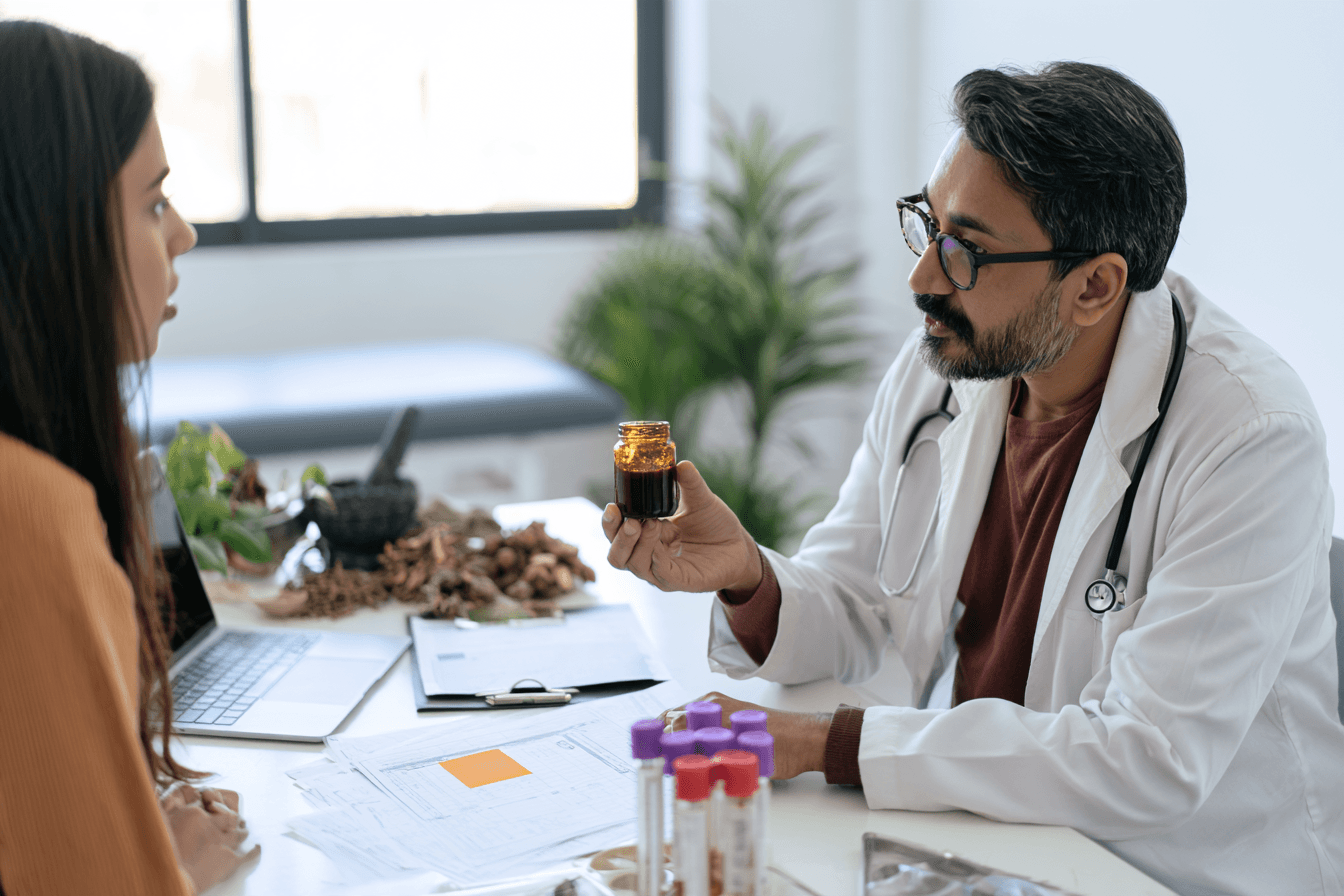
A Rasayana Avaleha strategy after a thalassemia blood test report should be built from the report, not from guesswork. CBC, MCV, MCH, HbA2, HPLC, ferritin and genetic testing show the type of thalassemia, the strength of hemoglobin formation, the red cell pattern, the inherited background and the iron burden. Ayurveda keeps the treatment centred on Rakta Dhatu, meaning blood tissue; Agni, meaning digestive and metabolic fire; Raktagni, meaning blood level metabolic function; Bala, meaning physical strength; Ojas, meaning deep vitality and immune resilience; and Yakrit Pleeha, meaning the liver and spleen system [1,2].
Why Rasayana Avaleha Belongs in a Thalassemia Blood Test Report
Thalassemia is a long term inherited blood disorder, so the patient needs more than a short course of general anemia medicine. In thalassemia trait, the goal is to improve strength, appetite, tissue nourishment and report understanding while avoiding unnecessary iron when ferritin is normal. In thalassemia intermedia or major, the goal becomes broader because the patient may face chronic anemia, repeated transfusion, ferritin rise, liver spleen burden, fatigue, poor growth and reduced stamina [1,2].
Rasayana means rejuvenative therapy that supports tissue strength, recovery capacity, vitality and Ojas. Avaleha means a semi solid herbal preparation, similar to a medicinal linctus, designed for sustained nourishment and better long term compliance. This dosage form is clinically suitable for chronic blood weakness because it can be planned around digestion, nourishment, strength, liver spleen protection and measurable follow up.
Sanskrit shloka
दीर्घमायुः स्मृतिं मेधामारोग्यं तरुणं वयः।
प्रभावर्णस्वरौदार्यं देहेन्द्रियबलं परम्॥७॥
Transliteration
dīrgham āyuḥ smṛtiṃ medhām ārogyaṃ taruṇaṃ vayaḥ।
prabhā varṇa svaraudāryaṃ dehendriya balaṃ param॥7॥
Simple English meaning
Rasayana supports long life, memory, intelligence, health, youthful strength, radiance, healthy complexion, good voice, body strength and sensory strength. In thalassemia, this gives the Ayurvedic purpose of supporting strength, complexion, vitality and resilience.
Classical reference
Charaka Samhita, Chikitsa Sthana, Chapter 1, Rasayana Adhyaya, Abhayamalakiya Rasayana Pada, Verse 7 [3].
Rasayana Means Better Dhatu Quality Not Only Temporary Energy
Ayurveda does not use Rasayana only as an energy booster. It is used to improve the quality of tissues. Dhatu means body tissue. In thalassemia, the main Dhatu is Rakta Dhatu, the blood tissue, but the treatment also has to support nutrition, digestion, liver spleen function and overall vitality because chronic anemia affects the whole body.
Sanskrit shloka
वाक्सिद्धिं प्रणतिं कान्तिं लभते ना रसायनात्।
लाभोपायो हि शस्तानां रसादीनां रसायनम्॥८॥
Transliteration
vāk siddhiṃ praṇatiṃ kāntiṃ labhate nā rasāyanāt।
lābhopāyo hi śastānāṃ rasādīnāṃ rasāyanam॥8॥
Simple English meaning
Rasayana is the method for attaining excellence of Rasa and other Dhatus, meaning the body tissues. In thalassemia, this supports the idea that treatment should aim at better tissue nourishment, not only a temporary rise in energy.
Classical reference
Charaka Samhita, Chikitsa Sthana, Chapter 1, Rasayana Adhyaya, Abhayamalakiya Rasayana Pada, Verse 8 [3].
Here, Rasa Dhatu means the first nourishing fluid formed after digestion, and Rakta Dhatu means blood tissue. When Agni is weak, nourishment does not transform well into healthy tissues. When Rakta Dhatu is weak, the patient may show pallor, tiredness, breathlessness, low stamina and poor growth. Rasayana Avaleha is therefore used as a deeper nourishment strategy, especially when the plan is monitored with CBC, ferritin, appetite, weight, fatigue and activity level.
Published Paper Supporting an Ayurveda Centred Avaleha Approach
A published Ayurvedic clinical study evaluated Triphaladi Avaleha as an adjuvant therapy in thalassemia. The study enrolled 30 diagnosed children aged 1 to 15 years, and 22 completed the treatment course. The treatment group received Triphaladi Avaleha along with standard modern care, while the control group received standard modern care alone. After two months, the treated group showed highly significant improvement in pallor and selected clinical symptoms, and serum ferritin reduction was better than the control group with statistical significance at P less than .05 [4].
This data is useful because it gives patients a measurable Ayurveda direction. The focus is not vague wellness. The focus is pallor, fatigue, appetite, ferritin trend, liver spleen burden, transfusion pattern and quality of life. The study does not mean every patient will respond in the same way, and it does not replace transfusion or chelation where required. It supports a rational Rasayana Avaleha model as an adjuvant strategy when guided by reports and clinical supervision [4].
Modern data also makes this strategy more convincing. Moderate and severe thalassemia may require blood transfusions, and beta thalassemia major may need transfusion every 3 to 4 weeks. Regular transfusion can cause iron overload, and ferritin is commonly monitored because excess iron can affect organs such as the liver and heart [2,5]. This is exactly where Ayurveda places Yakrit, Pleeha, Rakta Dhatu, Bala and Ojas at the centre of long term care.
How Avaleha Supports Rakta Dhatu Bala and Ojas
A thalassemia patient may have small red cells, low hemoglobin content, pallor, weakness and poor stamina. Ayurveda reads this through Rakta Dhatu Kshaya, meaning weakness or depletion of blood tissue. Bala Kshaya means reduced physical strength. Ojas Kshaya means reduced vitality and resilience. A properly planned Avaleha supports nourishment gradually because it is taken daily and is usually designed with herbs that support digestion, blood tissue, liver spleen function and strength.
Sanskrit shloka
ततो वर्णबलस्नेहा ये चान्येऽप्योजसो गुणाः।
व्रजन्ति क्षयमत्यर्थं दोषदूष्यप्रदूषणात्॥५॥
Transliteration
tato varṇabalasnehā ye cānye’py ojaso guṇāḥ।
vrajanti kṣayam atyarthaṃ doṣadūṣyapradūṣaṇāt॥5॥
Simple English meaning
When Dosha and body tissues are disturbed, healthy complexion, strength, nourishment and the qualities of Ojas decline. In thalassemia, this explains why the patient may have pallor, fatigue, low stamina and reduced vitality along with abnormal blood reports.
Classical reference
Charaka Samhita, Chikitsa Sthana, Chapter 16, Pandu Chikitsa, Verse 5 [6].
Varna means healthy complexion. Bala means strength. Sneha means tissue nourishment. Ojas means deep vitality. This verse directly supports the clinical aim of Rasayana Avaleha in thalassemia because the patient needs improvement in visible complexion, strength, nourishment and long term resilience.
Why Yakrit Pleeha Support Is Essential in Rasayana Avaleha
In thalassemia, the liver and spleen are not secondary organs. They are central to the recovery map. The spleen may enlarge because of increased red cell destruction and extra blood formation activity. The liver may carry iron burden in transfusion dependent patients. Ferritin, liver enzymes, spleen size and MRI based iron assessment may become important depending on disease severity [1,2].
Sanskrit shloka
रसवहानां स्रोतसां हृदयं मूलं दश च धमन्यः।
शोणितवहानां स्रोतसां यकृन्मूलं प्लीहा च॥८॥
Transliteration
rasavahānāṃ srotasāṃ hṛdayaṃ mūlaṃ daśa ca dhamanyaḥ।
śoṇitavahānāṃ srotasāṃ yakṛn mūlaṃ plīhā ca॥8॥
Simple English meaning
The channels carrying nutritive fluid are rooted in the heart and major vessels, and the blood carrying channels are rooted in the liver and spleen. In thalassemia, this explains why liver function, spleen size, ferritin and blood strength should be interpreted together.
Classical reference
Charaka Samhita, Vimana Sthana, Chapter 5, Sroto Vimana, Verse 8 [7].
Srotas means functional channels of transport and nourishment. Shonitavaha Srotas means blood carrying channels, also understood clinically as Raktavaha Srotas. This classical reference gives a strong Ayurvedic reason to include Yakrit Pleeha support in the Avaleha strategy, especially when ferritin is rising or the patient has abdominal heaviness, poor appetite, spleen enlargement or liver enzyme changes.
The Thirty Day Strategy With Rasayana Avaleha
The first thirty days should be used to judge early clinical response, not to make unrealistic claims about genetic correction. In thalassemia trait, MCV and MCH may remain low because the pattern is inherited. A more practical first month goal is better appetite, improved digestion, less fatigue, better sleep, steadier stool, reduced pallor, better activity tolerance and correct understanding of ferritin, HbA2 and HPLC.
In thalassemia intermedia or major, the thirty day strategy should also include transfusion timing, baseline ferritin, liver function, spleen size, chelation status, weight, appetite, fatigue score and infection tendency. Hemoglobin must be interpreted with the date of the last transfusion. Ferritin should be read as a trend, not as a one time emotional number. This makes the Ayurvedic plan safer and more convincing because every claim is connected with measurable clinical markers [1,2,5].
When Urgent Hematology Care Is Needed in Thalassemia Blood Test Report

A thalassemia blood test report should be read calmly, but some findings need urgent hematology review. Ayurveda remains central in long term care, but severe anemia, high ferritin, repeated transfusion burden, fever, jaundice, fast heartbeat, breathlessness, chest discomfort, abdominal swelling, poor growth or sudden weakness should not be managed by home care alone. These signs may show that Rakta Dhatu, the blood tissue, is under serious stress and that the patient needs immediate modern assessment along with Ayurveda centred support [1,2].
Severe Anemia in Thalassemia Blood Test Report
Severe anemia means the hemoglobin has fallen to a level where the body may not carry enough oxygen safely. In thalassemia major or intermedia, this can appear as extreme tiredness, breathlessness, fast heartbeat, dizziness, poor feeding in children, fainting tendency, poor growth, reduced activity, chest discomfort or worsening paleness. A low hemoglobin value should always be interpreted with age, symptoms, transfusion history and the usual baseline of the patient [1].
Ayurveda explains this through Rakta Dhatu Kshaya, meaning depletion or weakness of blood tissue, and Bala Kshaya, meaning reduction of physical strength. When Rakta Dhatu becomes weak, the body loses colour, stamina and oxygen carrying strength. When Bala declines, the patient may not tolerate ordinary activity, infection, poor appetite or travel.
Sanskrit shloka
ततो वर्णबलस्नेहा ये चान्येऽप्योजसो गुणाः।
व्रजन्ति क्षयमत्यर्थं दोषदूष्यप्रदूषणात्॥५॥
Transliteration
tato varṇabalasnehā ye cānye’py ojaso guṇāḥ।
vrajanti kṣayam atyarthaṃ doṣadūṣyapradūṣaṇāt॥5॥
Simple English meaning
When Dosha and body tissues are disturbed, healthy complexion, strength, nourishment and the qualities of Ojas decline. In thalassemia, this explains why severe anemia may appear with pallor, weakness, poor stamina and reduced vitality.
Classical reference
Charaka Samhita, Chikitsa Sthana, Chapter 16, Pandu Chikitsa, Verse 5 [3].
Here, Varna means healthy complexion, Bala means strength, Sneha means tissue nourishment, and Ojas means deep vitality and immune resilience. This verse gives a classical foundation for treating severe pallor and weakness seriously, especially when the CBC report shows very low hemoglobin.
High Ferritin and Organ Risk in Thalassemia Blood Test Report
High ferritin in thalassemia needs careful attention, especially in patients who receive repeated transfusions. Ferritin reflects stored iron, but in transfusion dependent thalassemia it can become a warning marker for iron overload. Modern guidelines explain that regular transfusion can make iron overload unavoidable because the body has no strong natural pathway to remove excess iron at that speed [2]. Excess iron may affect the liver, heart, pancreas and hormone producing glands, so ferritin must be read with liver function, chelation status, transfusion history and MRI based iron assessment when advised [2,4].
Ayurveda reads high ferritin through Yakrit Pleeha and Raktavaha Srotas. Yakrit means liver. Pleeha means spleen. Raktavaha Srotas means the functional channels related to blood formation, blood circulation and blood nourishment. When ferritin rises repeatedly, Ayurveda does not see it as an isolated number. It is a sign that the liver spleen blood system needs protection.
Sanskrit shloka
रसवहानां स्रोतसां हृदयं मूलं दश च धमन्यः।
शोणितवहानां स्रोतसां यकृन्मूलं प्लीहा च॥८॥
Transliteration
rasavahānāṃ srotasāṃ hṛdayaṃ mūlaṃ daśa ca dhamanyaḥ।
śoṇitavahānāṃ srotasāṃ yakṛn mūlaṃ plīhā ca॥8॥
Simple English meaning
The channels carrying nutritive fluid are rooted in the heart and major vessels, and the blood carrying channels are rooted in the liver and spleen. In thalassemia, this explains why ferritin, liver function, spleen size and blood strength should be monitored together.
Classical reference
Charaka Samhita, Vimana Sthana, Chapter 5, Sroto Vimana, Verse 8 [5].
This verse makes ferritin clinically meaningful in Ayurveda. If ferritin is rising, the plan should include hematology review, chelation discussion where indicated, liver spleen monitoring and Ayurveda centred support for digestion, strength, tissue nourishment and Ojas.
Fever Infection and Spleen Related Warning Signs
Fever in a thalassemia patient should be taken seriously, especially in children, transfusion dependent patients, patients with high iron load and patients whose spleen has been removed. Thalassemia patients can have increased infection risk, and the risk is especially important after splenectomy, because the spleen helps protect against certain infections [6]. Fever with chills, severe weakness, fast breathing, confusion, persistent vomiting, abdominal pain, yellow eyes or unusual sleepiness needs urgent medical attention.
In Ayurveda, infection risk and low resilience are connected with reduced Ojas. Ojas means the deep vital essence that supports immunity, recovery and stability. When chronic blood weakness, poor appetite, repeated transfusion burden, iron overload or organ stress are present, Ojas must be protected through food, rest, Rasayana support and proper medical monitoring.
Jaundice Abdominal Swelling and Spleen Enlargement
Yellow eyes, dark urine, increasing abdominal size, left upper abdominal heaviness, early fullness after food or pain under the ribs may suggest increased red cell breakdown, liver stress, gallbladder problems, spleen enlargement or other complications. These symptoms should be reviewed urgently when they appear suddenly or worsen quickly. Thalassemia can be associated with jaundice, hepatosplenomegaly, endocrine problems and severe anemia in more serious forms [7].
Ayurveda connects these signs with Yakrit, Pleeha, Rakta Dhatu and Ranjaka Pitta. Ranjaka Pitta means the Pitta function associated with blood colour, liver activity and transformation of nutrients into healthy blood. When Ranjaka Pitta and Rakta Dhatu are disturbed, patients may develop abnormal complexion, yellowish discoloration, poor appetite, heaviness and weakness. This is why abdominal symptoms should never be ignored in thalassemia care.
Heart Breathing and Extreme Fatigue Warning Signs
Breathlessness at rest, chest pain, fast heartbeat, swelling of feet, fainting, blue lips, severe dizziness or inability to walk normally require urgent medical evaluation. Severe anemia can strain the heart because the body must work harder to deliver oxygen. Iron overload can also affect heart function over time in transfusion dependent thalassemia, so cardiac monitoring becomes important in long term care [2,4].
Ayurveda sees these symptoms as a serious decline of Bala and Ojas. When strength and vitality are sharply reduced, Rasayana alone is not enough for immediate safety. The patient needs urgent assessment, CBC review, oxygen status, cardiac evaluation when required, transfusion planning if indicated and careful follow up. Ayurveda support can continue, but the emergency must be handled first.
Poor Growth Delayed Puberty and Hormone Warning Signs
Children with thalassemia need regular growth monitoring. Poor weight gain, short stature, delayed puberty, delayed milestones, repeated tiredness, poor school activity or reduced appetite may show chronic anemia, iron overload, endocrine involvement, undernutrition or inadequate disease control. Iron overload can affect hormone producing glands, and modern thalassemia monitoring includes endocrine assessment in long term care [2,4].
Ayurveda reads growth and development through Dhatu Poshana, meaning proper nourishment of body tissues. When Rakta Dhatu is weak, later tissues may also receive poor nourishment. Agni must remain strong because digestion supports tissue formation. Bala and Ojas must be protected because they reflect strength, immunity and developmental resilience. A child’s height, weight, appetite, sleep, activity and infection frequency should be watched with the same seriousness as blood reports.
Ayurveda Centred Safety for Urgent Situations
The safest way is to divide thalassemia care into daily support and urgent care. Daily support focuses on Rakta Dhatu nourishment, Agni improvement, Raktagni support, Bala, Ojas, Yakrit and Pleeha. Urgent care focuses on warning signs such as very low hemoglobin, fever, chest discomfort, breathlessness, jaundice, severe abdominal pain, sudden weakness, high or rising ferritin, missed transfusions, transfusion reactions or rapid clinical decline.
This approach protects patient trust. Ayurveda remains central for long term recovery strength, but the report decides urgency. If the CBC shows severe anemia or the patient has dangerous symptoms, hematology review should not be delayed. If ferritin is rising, chelation and organ monitoring should be reviewed. If infection signs appear, medical care should be taken promptly. A strong Ayurveda model works best when it is measurable, timely and fully aware of modern safety needs.
Practical Meaning for Patients
A thalassemia blood test report should guide action, not create confusion. Mild trait patterns may need counselling, ferritin checking, HPLC confirmation and family screening. Moderate or severe thalassemia needs closer monitoring because hemoglobin, ferritin, liver spleen status, heart function, growth and transfusion history can change the patient’s risk.
Ayurveda centred care becomes stronger when it recognises urgency early. The patient should continue to protect Rakta Dhatu, Agni, Bala, Ojas, Yakrit and Pleeha, but severe anemia, high ferritin, infection, jaundice, breathlessness, chest symptoms, abdominal swelling or sudden weakness need urgent hematology care. This is the responsible path where Ayurveda gives strength and modern monitoring gives safety.
FAQs
A thalassemia blood test report should be read by connecting CBC, MCV, MCH, HbA2, HPLC, ferritin and genetic testing. Ayurveda adds deeper meaning by looking at Rakta Dhatu, the blood tissue; Agni, the digestive and metabolic fire; Bala, physical strength; Ojas, deep vitality; and Yakrit Pleeha, the liver and spleen system.
Which blood test confirms thalassemia?
HPLC or hemoglobin analysis helps confirm the thalassemia pattern by checking HbA, HbA2, HbF and abnormal hemoglobin variants. Genetic testing confirms the exact inherited cause when the report is unclear or family planning is needed.
What does low MCV mean in a thalassemia blood test report?
Low MCV means the red blood cells are smaller than normal. In thalassemia, this often happens because the body forms small red cells with reduced hemoglobin due to inherited globin chain changes.
What does low MCH mean in thalassemia?
Low MCH means each red blood cell carries less hemoglobin. This explains why a patient may feel tired, pale or weak even when the red blood cell count is not very low.
What HbA2 level suggests beta thalassemia trait?
Raised HbA2 on HPLC strongly supports beta thalassemia trait, especially when MCV and MCH are low and ferritin is normal. The exact value should be interpreted by a doctor with the full CBC and family history.
Can normal HbA2 still mean thalassemia?
Yes. Normal HbA2 does not rule out alpha thalassemia. If MCV and MCH remain low with normal ferritin, alpha thalassemia genetic testing may still be needed.
Why is ferritin important in a thalassemia blood test report?
Ferritin shows iron storage. Low ferritin suggests iron deficiency, normal ferritin with low MCV and MCH may suggest thalassemia trait, and high ferritin in transfusion dependent thalassemia may show iron overload risk.
Should thalassemia patients take iron?
Iron should be taken only when iron deficiency is confirmed. In thalassemia trait, unnecessary iron may not improve the inherited blood pattern. In transfusion dependent thalassemia, high iron stores need careful monitoring.
How does Ayurveda understand thalassemia?
Ayurveda understands thalassemia through Beejadushtijanya Pandu, meaning inherited anemia like blood weakness arising from a seed level or genetic level disturbance. The focus is Rakta Dhatu support, Agni correction, Bala improvement and Ojas protection.
Why does Ayurveda focus on the liver and spleen in thalassemia?
Ayurveda connects blood carrying channels with Yakrit and Pleeha, meaning liver and spleen. This is important because thalassemia may involve spleen enlargement, liver burden, ferritin rise and long term iron overload risk.
Can Ayurveda help after a thalassemia blood test report?
Ayurveda can support blood tissue strength, digestion, appetite, fatigue, vitality, liver spleen resilience and quality of life. In moderate or severe thalassemia, it should be used with hematology care, transfusion planning and ferritin monitoring.
What should improve in the first month of Ayurveda care?
Early improvement may appear as better appetite, improved digestion, reduced fatigue, better sleep, less pallor, better activity tolerance and improved strength. CBC and ferritin should be monitored according to disease severity.
When should a thalassemia patient seek urgent care?
Urgent care is needed for severe weakness, breathlessness, chest discomfort, fainting, high fever, jaundice, dark urine, sudden abdominal swelling, severe abdominal pain, missed transfusion or suspected transfusion reaction.
What is the best way to read a thalassemia blood test report?
The best way is to read CBC, MCV, MCH, RBC count, ferritin, HbA2, HPLC and genetic testing together. Ayurveda then converts the report into a practical care plan for Rakta Dhatu, Agni, Bala, Ojas, Yakrit and Pleeha.
Reference
[1] ARUP Consult. (2026). Thalassemias. ARUP Laboratories.
Working link: https://arupconsult.com/content/thalassemias
Brief: Use for CBC interpretation, MCV, MCH, Mentzer index, ferritin difference, HbA2, HPLC, alpha thalassemia testing, beta thalassemia testing and genetic confirmation.
[2] National Heart, Lung, and Blood Institute. (2022, June 1). Thalassemia diagnosis. National Institutes of Health.
Working link: https://www.nhlbi.nih.gov/health/thalassemia/diagnosis
Brief: Use for patient friendly diagnosis explanation, CBC, special hemoglobin tests and genetic testing.
[3] National Heart, Lung, and Blood Institute. (2022, June 1). Thalassemia treatment. National Institutes of Health.
Working link: https://www.nhlbi.nih.gov/health/thalassemia/treatment
Brief: Use for transfusion need, beta thalassemia major transfusion interval, chelation and treatment severity.
[4] Centers for Disease Control and Prevention. (2025, January 2). Treatment of thalassemia. U.S. Department of Health and Human Services.
Working link: https://www.cdc.gov/thalassemia/treatment/index.html
Brief: Use for transfusion dependent thalassemia, iron overload risk, chelation and organ protection.
[5] Musallam, K. M., Cappellini, M. D., Porter, J. B., Farmakis, D., Eleftheriou, A., Angastiniotis, M., & Taher, A. T. (2025). TIF guidelines for the management of transfusion dependent β thalassemia. HemaSphere, 9(3), e70095.
Working link: https://pmc.ncbi.nlm.nih.gov/articles/PMC11880825/
Brief: Use for transfusion dependent thalassemia monitoring, ferritin tracking, liver iron concentration, cardiac MRI, chelation and multidisciplinary care.
[6] Munkongdee, T., Chen, P., Winichagoon, P., Fucharoen, S., & Paiboonsukwong, K. (2020). Update in laboratory diagnosis of thalassemia. Frontiers in Molecular Biosciences, 7, Article 74.
Working link: https://pmc.ncbi.nlm.nih.gov/articles/PMC7326097/
Brief: Use for laboratory diagnosis, MCV, MCH, HPLC, capillary electrophoresis, DNA analysis and limitations of red cell indices.
[7] Muncie, H. L., Jr., & Campbell, J. (2009). Alpha and beta thalassemia. American Family Physician, 80(4), 339–344.
Working link: https://www.aafp.org/afp/2009/0815/p339
Brief: Use for thalassemia overview, iron deficiency difference, Mentzer index, genetic counselling and avoiding unnecessary iron in thalassemia trait.
[8] Değermenci, Ş., & Aslan, D. (2024). HbA2 levels in children with β thalassemia trait associated with iron deficiency: A perspective for pediatricians. American Journal of Clinical Pathology, 162(6), 544–548.
Working link: https://academic.oup.com/ajcp/article/162/6/544/7718957
Brief: Use for HbA2 threshold, iron deficiency effect on HbA2 and pediatric beta thalassemia trait screening data.
[9] Motiani, A., Zubair, M., & Sonagra, A. D. (2024). Laboratory evaluation of alpha thalassemia. In StatPearls. StatPearls Publishing.
Working link: https://www.ncbi.nlm.nih.gov/books/NBK587402/
Brief: Use for alpha thalassemia, HBA1 and HBA2 genes, normal or low HbA2 pattern, and alpha globin genetic testing.
[10] Khan, A., & Rehman, A. U. (2023). Laboratory evaluation of beta thalassemia. In StatPearls. StatPearls Publishing.
Working link: https://www.ncbi.nlm.nih.gov/books/NBK585044/
Brief: Use for beta thalassemia lab evaluation, HBB gene, CBC, iron studies, hemoglobin analysis and molecular testing.
[11] Needs, T., Gonzalez Mosquera, L. F., & Lynch, D. T. (2023). Beta thalassemia. In StatPearls. StatPearls Publishing.
Working link: https://www.ncbi.nlm.nih.gov/books/NBK531481/
Brief: Use for beta thalassemia classification, trait, intermedia, major, clinical features and complications.
[12] National Library of Medicine. (2024, April 11). Hemoglobin electrophoresis. MedlinePlus.
Working link: https://medlineplus.gov/lab-tests/hemoglobin-electrophoresis/
Brief: Use for patient friendly explanation of hemoglobin electrophoresis, HbA, HbF, abnormal hemoglobin and transfusion history affecting results.
[13] National Health Service. (2022, October 17). Causes: Thalassaemia.
Working link: https://www.nhs.uk/conditions/thalassaemia/causes/
Brief: Use for inheritance explanation, carrier risk, partner testing and the 25 percent pregnancy risk when both parents carry beta thalassemia trait.
[14] Jadhav, S. B., Anand, I. P., & Patel, K. S. (2010). Effect of Triphaladi Avaleha as an adjuvant therapy in the management of thalassemia. AYU, 31(4), 403–409.
Working link: https://pubmed.ncbi.nlm.nih.gov/22048530/
Brief: Use for published Ayurveda adjuvant data on Triphaladi Avaleha, pallor, fatigue, ferritin support and Rasayana based thalassemia care.
[15] Patalia, A. Y., Kori, V. K., Patel, K. S., & Rajagopala, S. (2014). Efficacy of Triphaladi Avaleha on Beejadushtijanya Pandu (thalassemia). AYU, 35(1), 15–21.
Working link: https://pubmed.ncbi.nlm.nih.gov/25364194/
Brief: Use for Beejadushtijanya Pandu, thalassemia as an inherited Ayurveda blood disorder and Triphaladi Avaleha clinical relevance.
[16] Agniveśa. (n.d.). Charaka Samhita, Chikitsa Sthana, Chapter 16, Pandu Chikitsa, verses 4–6. Siva.sh.
Working links:
Verse 4: https://www.siva.sh/caraka-samhita/chikitsa-sthana/16/4
Verse 5: https://www.siva.sh/caraka-samhita/chikitsa-sthana/16/5
Verse 6: https://www.siva.sh/caraka-samhita/chikitsa-sthana/16/6
Brief: Use for Pandu, pallor, Rakta Dhatu weakness, Varna, Bala, Ojas decline and anemia like presentation.
[17] Agniveśa. (n.d.). Charaka Samhita, Vimana Sthana, Chapter 5, Sroto Vimana, verse 8. Siva.sh.
Working link: https://www.siva.sh/caraka-samhita/vimana-sthana/5/8
Brief: Use for Raktavaha Srotas, Yakrit, Pleeha, liver spleen connection and ferritin interpretation in thalassemia.
[18] Agniveśa. (n.d.). Charaka Samhita, Sharira Sthana, Chapter 4, Mahatigarbhavakranti Sharira, verse 31. Siva.sh.
Working link: https://www.siva.sh/caraka-samhita/sharira-sthana/4/31
Brief: Use for Beeja, Beejabhaga, Beejabhagavayava, inherited disease logic and Beejadushtijanya Pandu.
[19] Agniveśa. (n.d.). Charaka Samhita, Chikitsa Sthana, Chapter 1, Rasayana Adhyaya, Abhayamalakiya Rasayana Pada, verses 7–8. Siva.sh.
Working links:
Verse 7: https://www.siva.sh/caraka-samhita/chikitsa-sthana/1/1/7
Verse 8: https://www.siva.sh/caraka-samhita/chikitsa-sthana/1/1/8
Brief: Use for Rasayana definition, tissue nourishment, Dhatu strengthening, Bala, Varna, Ojas and the rationale for Rasayana Avaleha in chronic thalassemia care.