


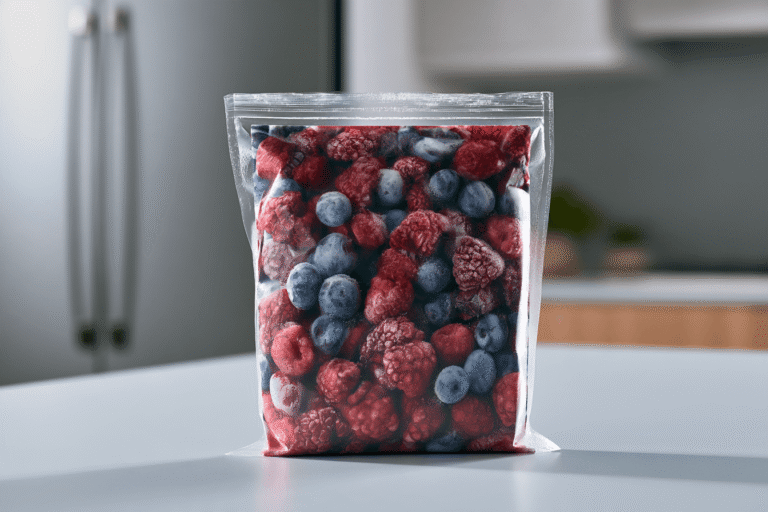
Walmart Frozen Berries Recall: Great Value and E. coli Risk
The Walmart frozen berries recall affects one lot of Great Value Organic Triple Berry Blend sold in 10 ounce bags. Check your freezer for lot code 6040 01-6 and a best if used by date of February 9, 2028. Do not eat the affected berries. Discard them or return them to Walmart for a full refund [1].
In its September 3, 2026, update, the FDA reported 17 illnesses, six hospitalizations and no deaths in the broader E. coli outbreak linked to organic frozen blueberries. Those figures do not mean that 17 people became ill after eating the Great Value blend. The company reported no illnesses associated specifically with this product when it announced the precautionary recall [1,2].
For anyone who keeps frozen fruit for smoothies or breakfast bowls, the immediate priority is to identify the package, stop using recalled berries and recognize symptoms that need medical attention.
Which Great Value Frozen Berries Are Recalled?
Supplier Frutas y Hortalizas del Sur S.A. announced the recall expansion on September 2, 2026. The FDA published the company’s announcement on September 3 [1].
Check the printed package information against the details below. The product name, size and lot code matter more than the appearance of the bag [1,3].
| What to check | Affected product details |
|---|---|
| Brand | Great Value |
| Product | Organic Triple Berry Blend |
| Fruit included | Strawberries, blackberries and blueberries |
| Package size | 10 ounces |
| Lot code | 6040 01-6 |
| Lot code location | Front of the package |
| Best if used by date | February 9, 2028 |
| UPC as published in the recall notice | 7874211226 |
| Retailer | Select Walmart stores |
The recall identifies a particular Great Value lot. It is not an announcement that every frozen fruit product sold at Walmart is affected [1,3].
Where Were the Recalled Berries Sold?
The affected Great Value blend was distributed to Walmart stores in 16 states: Alabama, Arkansas, Florida, Illinois, Indiana, Kentucky, Louisiana, Minnesota, Mississippi, Missouri, North Carolina, Ohio, Oklahoma, South Carolina, Texas and Wisconsin [2,3].
Reported outbreak illnesses were identified in Florida and Georgia. Product distribution and illness locations are different measures; a state receiving recalled berries does not necessarily have a reported outbreak case [2].
How Is This Connected to the Earlier Publix Recall?
The investigation initially involved GreenWise organic frozen blueberries sold at Publix. A single lot was recalled on July 3, 2026. On July 29, Publix expanded its recall to all lots of GreenWise Organic Whole Blueberries and Whole Mixed Berries in 10 ounce and 48 ounce packages [4].
The Great Value announcement is a later expansion connected with the same investigation. Households that shop at both retailers should therefore check for affected GreenWise products as well as the specified Great Value lot [2,4].
What Should You Do With Recalled Frozen Berries?
Stop using the affected product, even when the package remains unopened. Do not serve the berries to anyone else or use them in another meal. Follow the recall instructions to discard the product or return it to the store [3].
When berries have been transferred into a freezer container and the original packaging is missing, do not rely on memory or appearance to identify them. The FDA advises discarding frozen berries when you cannot determine whether they are part of this recall [2].
Wash containers, utensils and surfaces that contacted the berries with hot, soapy water or in a dishwasher where appropriate. Include any blender components used to prepare the fruit. Businesses should also clean and sanitize affected food contact surfaces [3].
Does Freezing Kill E. coli?
Freezing does not reliably make contaminated food safe. The FDA explains that freezing stops bacterial growth but does not kill most bacteria already present. Leaving the recalled berries in the freezer for longer does not remove the risk [5].
Contaminated food can also look, smell and taste normal. Do not taste a berry to decide whether the bag is safe, and do not attempt to salvage recalled fruit by rinsing or cooking it. The instructions for these products are to discard or return them [3,5].
What Are the Symptoms of E. coli Infection?
The outbreak involves E. coli O145:H28, a type of Shiga toxin producing E. coli, often shortened to STEC. This infection can cause severe stomach cramps, watery or bloody diarrhea, and vomiting. Some people develop a low fever, but fever is not required for an E. coli infection [4,6].
Symptoms usually begin three to four days after swallowing the bacteria, although timing varies. Most people recover within about a week, but some develop complications that require hospital treatment [3].
Do not wait for diarrhea to become bloody before seeking advice. The FDA recommends contacting a healthcare professional immediately when symptoms resembling E. coli infection develop after eating recalled berry products [2].
When Should You Seek Urgent Medical Care?
Bloody diarrhea, inability to keep liquids down and signs of dehydration require prompt assessment. Tell the healthcare professional about the recalled berries and, where possible, provide the product name, lot code and date you ate them [3,6].
The following warning signs can help distinguish symptoms that need medical advice from those that warrant emergency assessment [6,7].
| Warning sign | Recommended action |
|---|---|
| Bloody diarrhea, significant abdominal cramps or symptoms after eating recalled berries | Contact a healthcare professional promptly |
| Diarrhea or vomiting lasting more than two days, or fever above 102°F | Obtain medical advice |
| Repeated vomiting, very dry mouth, dizziness or inability to drink enough fluids | Seek urgent assessment for dehydration |
| Little or no urine, blood in the urine, unusual bruising, marked paleness or reduced alertness | Seek emergency care because these may indicate a serious complication |
These are not symptoms to wait for before asking for help. A person who feels increasingly unwell after a suspected exposure should be assessed earlier, particularly when they cannot maintain normal fluid intake [2,6].
Why Reduced Urination Needs Immediate Attention
STEC infection can lead to hemolytic uremic syndrome, or HUS, a serious complication that can cause kidney failure. Warning signs include passing much less urine, unusual bruising, paleness, extreme tiredness and reduced awareness [7].
HUS is a medical emergency and requires hospital care. Although anyone can develop it, among people with diarrhea it is most common in children younger than five. A child who becomes unusually sleepy or stops urinating normally needs immediate medical attention [7].
What Should You Do if You Already Ate the Berries?
Stop eating the product and make a note of when you consumed it. A photograph of the packaging can help you give an accurate exposure history if symptoms develop.
People with diarrhea or vomiting need to replace lost fluids. An oral rehydration solution can be helpful, especially for children, who may become dehydrated quickly. Persistent vomiting or inability to drink enough requires medical assessment rather than continued home treatment [6,8].
Do not start antibiotics simply because you ate a recalled product. Antibiotics are not recommended for STEC infection because they can increase the chance of HUS [8].
Will You Need an E. coli Test?
A clinician may request a stool sample when symptoms suggest STEC infection. Testing can detect the bacteria, Shiga toxin or the genes responsible for producing the toxin. Mentioning the recalled product helps the clinician interpret the symptoms and consider appropriate testing [9].
When there is concern about HUS, blood counts and blood chemistry tests help assess kidney function and other abnormalities. Early assessment is important because treatment decisions, including fluid management, can affect outcomes [9].
Which Medicines Should You Avoid?
Do not use leftover antibiotics to treat diarrhea after a possible STEC exposure. The CDC specifically advises against antibiotics for STEC infection because of the potential increase in HUS risk [8].
Medicines that slow diarrhea, such as loperamide, should also be avoided in STEC infection and in people with bloody diarrhea or high fever. Check with a healthcare professional before taking a medicine to suppress symptoms [8,9].
A 2021 observational study involving 1,308 people with E. coli O157 diarrhea found that treatment with beta lactam antibiotics was associated with higher odds of developing HUS. The study involved a different STEC strain, not the current berry outbreak, and does not establish that every antibiotic carries the same risk. It reinforces the importance of appropriate prescribing rather than self treatment [10].
Frequently Asked Questions
Are All Great Value Frozen Berries Recalled?
No. This announcement identifies one lot of Great Value Organic Triple Berry Blend in 10 ounce bags. Check the package details rather than assuming that every Great Value frozen fruit product is included [1].
Is an Unopened Bag of Recalled Berries Safe?
No. An unopened package is still covered by the recall when its product details match. Do not open it for tasting or use it in a recipe [3].
Can E. coli Infection Occur Without a Fever?
Yes. Diarrhea and stomach cramps are common symptoms, while only some people develop a fever. The absence of fever does not rule out E. coli infection [6].
Does Everyone With E. coli Need Antibiotics?
No. Most people recover without antibiotics, and the CDC advises against using them for STEC infection because they can increase the chance of HUS. Treatment should be guided by the suspected infection and the person’s clinical condition [8].
References
[1] Frutas y Hortalizas del Sur S.A. (2026, September 2). Frutas y Hortalizas del Sur S.A. expands recall to include one lot of Great Value frozen Organic Triple Berry Blend because of potential contamination with Escherichia coli O145:H28 (E. coli O145) [Company announcement]. Food and Drug Administration.
Used for: Product identification, announcement dates, refund instructions and the absence of reported illnesses associated specifically with the Great Value blend. (fda.gov)
[2] Food and Drug Administration. (2026, September 3). Outbreak investigation of E. coli O145:H28: Frozen blueberries (July 2026).
Used for: The broader outbreak count of 17 illnesses, six hospitalizations and no deaths; distribution information; missing packaging advice; and recommendations for symptomatic consumers. (U.S. Food and Drug Administration)
[3] Centers for Disease Control and Prevention. (2026, September 3). E. coli outbreak linked to frozen blueberries.
Used for: Recalled products, household cleaning, symptom timing, expected recovery and consumer safety instructions. (CDC)
[4] Publix. (2026, July 29). Publix recalls all lots of GreenWise organic frozen blueberries and whole mixed berries due to potential E. coli O145 contamination [Company announcement]. Food and Drug Administration.
Used for: The earlier recall, affected GreenWise package sizes and background on the implicated STEC strain. (U.S. Food and Drug Administration)
[5] Food and Drug Administration. (n.d.). Are you storing food safely?
Used for: The limitations of freezing and why normal appearance, smell or taste cannot establish food safety. (U.S. Food and Drug Administration)
[6] Centers for Disease Control and Prevention. (2024, May 14). Symptoms of E. coli infection.
Used for: Symptoms, dehydration, oral rehydration and circumstances requiring medical advice. (CDC)
[7] Centers for Disease Control and Prevention. (2024, May 14). Signs of hemolytic uremic syndrome.
Used for: Kidney complication warning signs, emergency assessment and the particular concern for children younger than five. (CDC)
[8] Centers for Disease Control and Prevention. (2024, May 14). Treatment of E. coli infection.
Used for: Hydration and the advice to avoid antibiotics and medicines that slow diarrhea in STEC infection. (CDC)
[9] Centers for Disease Control and Prevention. (2024, May 14). Information for clinicians.
Used for: Stool testing, early clinical management, medication precautions and blood testing for suspected HUS. (CDC)
[10] Mody, R. K., Hoekstra, R. M., Scott, M. K., Dunn, J., Smith, K., Tobin-D’Angelo, M., Shiferaw, B., Wymore, K., Clogher, P., Palmer, A., Comstock, N., Burzlaff, K., Lathrop, S., Hurd, S., & Griffin, P. M. (2021). Risk of hemolytic uremic syndrome related to treatment of Escherichia coli O157 infection with different antimicrobial classes. Microorganisms, 9(9), Article 1997.
Used for: Research supporting careful antibiotic selection. This observational study found an association between beta lactam treatment and higher HUS odds; it did not investigate the current berry outbreak. (UNM Digital Repository)