


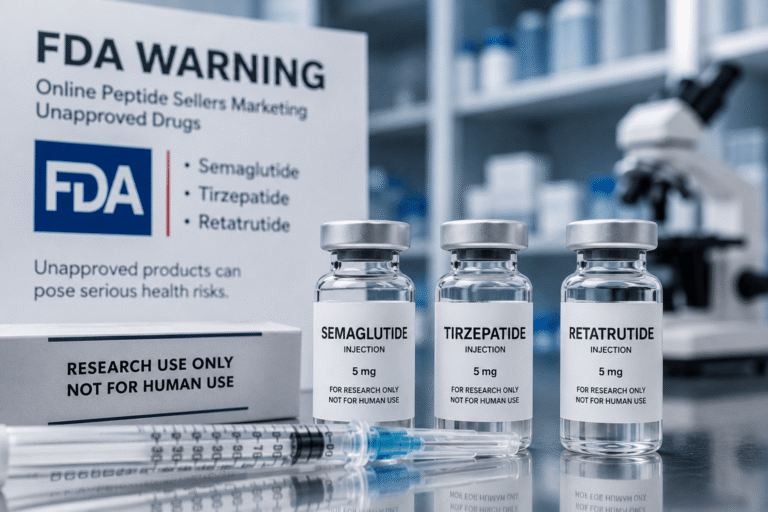
FDA peptide warning letters issued to five online sellers have raised serious concerns about products marketed as semaglutide, tirzepatide and retatrutide. The U.S. Food and Drug Administration stated that the products identified in the August 24, 2026 letters were being marketed as unapproved new drugs and could expose consumers to uncertain ingredients, incorrect concentrations, contamination and potentially dangerous dosing errors [1–5].
The FDA peptide warning does not mean that approved semaglutide or tirzepatide medicines have been recalled. It applies to specific products offered by named online peptide sellers, including products labeled “research use only” or “not for human consumption.”
Patients who purchased one of these products should not assume that the vial contains the ingredient, strength or purity stated on its label. Anyone who has already injected an online research peptide should avoid another dose until the product and their medical condition have been reviewed by a qualified clinician or licensed pharmacist.
FDA stated that the products identified in the letters were being marketed as unapproved new drugs. Some were labeled “research use only” or “not for human consumption,” yet the websites also contained claims, calculators, mixing instructions and supplies that appeared to support human injection.
What the FDA Warning Means for Patients
Semaglutide and tirzepatide are active ingredients used in certain FDA approved prescription medicines. However, FDA approval applies only to a specific finished product, manufacturer, formulation, strength, delivery system and approved labeling.
A vial purchased from an online peptide seller does not become an approved medicine simply because its label contains the words semaglutide or tirzepatide.
Retatrutide has a different regulatory status. It remains an investigational medicine and has not been approved by FDA for weight loss, diabetes treatment or any other medical use [6,10].
The warning letters also do not confirm that every product contained the ingredient or concentration stated on its label. The agency’s findings were largely based on how the products were presented and marketed on the sellers’ websites. It is therefore more accurate to describe them as products marketed as semaglutide, tirzepatide or retatrutide.
Which Online Peptide Sellers Received FDA Warning Letters?
FDA issued related warning letters to the following businesses:
| Online seller | Semaglutide named | Tirzepatide named | Retatrutide named |
|---|---|---|---|
| Peak Performance Peptides | Yes | Not named | Yes |
| TXP Innovations LLC, doing business as Tex Peptides | Yes | Yes | Yes |
| Royal Peptides LLC | Yes | Yes | Yes |
| NuScience Peptides LLC | Yes | Yes | Yes |
| Peptide Partners LLC | Yes | Yes | Yes |
The letters also addressed other peptides marketed by some of these sellers, including products presented as tesamorelin, bremelanotide, elamipretide and related injectable substances [1–5].
Several websites sold bacteriostatic water, peptide calculators, dosing guides or reconstitution solutions alongside the peptide products. FDA considered these materials relevant because they could help consumers prepare and inject the products.
Each company was instructed to respond within 15 business days and explain the corrective actions it had taken. FDA stated that failure to address the violations could lead to further enforcement, including seizure or injunction [1–5].
A warning letter describes FDA’s position at the time it is issued. It is not necessarily the final regulatory outcome, because the recipient may respond, correct the violations or dispute the agency’s findings.
Why “Research Use Only” Did Not Prevent FDA Action
A seller cannot avoid drug regulation merely by placing “research use only,” “not for human use” or “not for human consumption” on a product label.
FDA considers the entire presentation of a product. This includes website claims, customer instructions, dosing information, injection supplies, testimonials, product descriptions and statements about weight loss, appetite, blood sugar or other bodily effects.
When a product is promoted in a way that suggests it is intended to affect the structure or function of the human body, prevent disease or treat a medical condition, it may meet the legal definition of a drug.
In these warning letters, FDA concluded that the overall marketing showed an intended human drug use despite the research disclaimers [1–5].
For patients, the message is straightforward. A research label is not evidence of pharmaceutical quality, safety, sterility or correct dosing. It should instead be treated as a warning that the product has not been supplied as an approved medicine for patient use.
Is This a Recall of Semaglutide or Tirzepatide?
No. FDA has not recalled all semaglutide or tirzepatide medicines through this action.
The warning letters do not provide recalled lot numbers, expiration dates, recall classifications or instructions to return approved prescription products. They address particular products offered by named online peptide sellers.
A patient who received a prescribed semaglutide or tirzepatide medicine from a licensed pharmacy should not stop treatment solely because of these warning letters. Suddenly changing treatment may worsen blood glucose control, appetite regulation or other medical conditions.
Anyone who is uncertain about a product should check the label for the patient’s name, prescriber, dispensing pharmacy, manufacturer, concentration, storage instructions and dose. A licensed pharmacist can usually confirm whether the medicine came through a legitimate dispensing channel.
Approval Status of Semaglutide, Tirzepatide and Retatrutide
| Substance | Regulatory status | Patient meaning |
|---|---|---|
| Semaglutide | Certain prescription products are FDA approved | Approval does not extend to every vial or powder sold under the semaglutide name |
| Tirzepatide | Certain prescription products are FDA approved | An online research product is not equivalent to an approved prescription medicine |
| Retatrutide | Not FDA approved | It remains under clinical investigation and should not be purchased for self treatment |
FDA approved medicines are reviewed for manufacturing quality, identity, strength, stability, effectiveness and safety. The production facilities and manufacturing processes are also subject to regulatory requirements.
Unapproved online products may not provide the same assurance. Their contents, concentration, storage conditions and sterility may be uncertain.
Why Online Injectable Peptides Can Be Medically Dangerous
The Vial May Not Contain What the Label Claims
A product name on a website does not confirm the identity, purity or amount of the substance inside the vial.
An online peptide could contain too much active ingredient, too little active ingredient, a different substance, degradation products, contaminants or no active ingredient. Even when a seller provides a certificate of analysis, that document may apply only to a submitted sample and may not establish the quality of every vial sold.
A certificate also does not replace full manufacturing controls for sterility, stability, filling accuracy, packaging, storage and consistency between batches.
Injectable Products Must Be Sterile
Injectable substances require strict sterile manufacturing because they enter the body beneath the skin and bypass several natural protective barriers.
A contaminated injection can cause local redness, pain, swelling or an abscess. More serious contamination may lead to bloodstream infection, fever, severe inflammation, organ injury or life threatening illness.
FDA specifically emphasized the public health concern associated with unapproved injectable products because microorganisms or toxins introduced during manufacturing, storage, shipping or reconstitution can be carried directly into the body [1–5].
Bacteriostatic water does not make an unverified peptide safe. The water, vial, powder, stopper, syringe, mixing environment and injection technique must all be appropriate.
Reconstitution Can Lead to Major Dosing Errors
Research peptides may arrive as powders that require the purchaser to add a liquid before injection. The person must then calculate a dose using the vial strength, amount of liquid added, syringe markings and prescribed quantity.
Errors can occur when milligrams, milliliters and syringe units are confused. Concentrations may also differ between sellers or between batches.
FDA previously received reports of compounded semaglutide dosing errors in which some patients reportedly administered five to twenty times the intended dose [7].
Reported symptoms included severe nausea, repeated vomiting, abdominal pain, dehydration, fainting, headache, pancreatitis and gallstones. Some patients required hospital assessment or admission [7].
Those reports were not specifically attributed to the five sellers named in the August 2026 letters. They nevertheless show how easily serious overdosing can occur when injectable concentrations are unclear or patients are expected to calculate their own doses.
Online Purchasing May Bypass Medical Assessment
Semaglutide and tirzepatide should not be selected only on the basis of body weight or an online questionnaire.
Before prescribing, a clinician may need to assess diabetes status, current glucose lowering medicines, previous pancreatitis, gallbladder disease, kidney function, gastrointestinal symptoms, hydration, pregnancy plans and other relevant medical risks.
Dose escalation also requires care. Gastrointestinal symptoms are more likely when a dose is started too high or increased too quickly.
When products are sold without proper medical assessment, important contraindications, interactions and warning signs may be missed.
Storage and Shipping Conditions Matter
Peptide medicines can be affected by temperature, light, freezing, prolonged heat and handling during transportation.
A package that arrives warm, damaged, leaking, unsealed or without appropriate temperature control may no longer meet the quality expected of an injectable medicine. Visual appearance alone cannot confirm that the product remains stable or sterile.
Patients should not assume that cold packaging proves that the product was stored correctly throughout its journey.
Common and Serious Reactions That Require Attention
Approved medicines containing semaglutide or tirzepatide commonly cause gastrointestinal effects, particularly during treatment initiation or dose escalation. These can include nausea, vomiting, diarrhea, constipation, reduced appetite and abdominal discomfort.
Most mild symptoms can be managed with appropriate medical guidance, but severe or persistent symptoms should not be ignored.
Repeated vomiting or diarrhea can cause dehydration. Dehydration may then contribute to dizziness, fainting, electrolyte disturbance or worsening kidney function.
Severe upper abdominal pain, particularly pain that spreads toward the back, may require assessment for pancreatitis. Upper abdominal pain with fever or yellowing of the eyes may indicate a gallbladder or bile duct problem.
Low blood sugar is more likely when a GLP 1 related medicine is combined with insulin or certain other diabetes medicines. Sweating, shaking, confusion, unusual drowsiness, weakness or loss of consciousness requires prompt attention.
What Patients Should Do After Buying an Online Peptide
Do Not Inject a Product Sold Only for Research
A product labeled “research use only” or “not for human consumption” should not be used as a substitute for a prescribed medicine.
A person who has already used such a product should avoid taking another dose until the product and clinical situation have been reviewed by a qualified clinician or pharmacist.
Keep the Vial and Packaging
The vial, box, label, receipt, lot number, shipping materials and order confirmation should be preserved.
Photographs of the product and website listing may also help a clinician, pharmacist or regulator understand what was purchased.
The product should not be shared, resold or given to another person.
Record the Dose as Accurately as Possible
The patient should document the date and time of injection, the amount of powder in the vial, the volume of liquid added, the syringe markings used and any symptoms that followed.
Even when the exact dose is uncertain, these details can help a poison specialist or emergency clinician estimate the possible exposure.
Contact a Clinician or Pharmacist
A clinician should be told about every medicine used, including insulin, diabetes tablets, weight loss medicines, supplements and other injectable substances.
A patient being treated for diabetes should not independently stop insulin or prescribed glucose lowering treatment. Abrupt changes can result in severe high blood sugar or other complications.
Report Suspected Harm
Unexpected reactions, dosing errors, contamination concerns, incorrect labeling and suspected counterfeit products can be reported through the FDA MedWatch program.
Reporting does not prove that the product caused the event, but it helps regulators identify patterns that may require investigation.
When Emergency Medical Care Is Needed
Emergency assessment is appropriate if a person develops breathing difficulty, facial or throat swelling, collapse, seizure, severe confusion or loss of consciousness after an injection.
Urgent assessment is also needed for persistent vomiting, inability to retain fluids, fainting, markedly reduced urination, severe abdominal pain, yellowing of the skin or eyes, fever, rapidly spreading injection site redness or pus.
A person with diabetes should seek immediate help for severe sweating, shaking, confusion, extreme weakness, unusual drowsiness or other suspected signs of dangerously low blood sugar.
Because semaglutide remains in the body for an extended period, symptoms following a substantial overdose may continue and require prolonged observation [7].
What the Adverse Event Numbers Do and Do Not Show
As of May 31, 2026, FDA had received 990 adverse event reports associated with compounded semaglutide and more than 730 associated with compounded tirzepatide [6].
These figures refer to compounded products broadly. They are not a count of injuries caused by the five businesses that received the August 2026 warning letters.
An adverse event report also does not automatically prove that a medicine caused the reported problem. Other illnesses, medicines and patient factors may contribute.
At the same time, the true number of events may be higher because many state licensed pharmacies are not required to submit every adverse event report to FDA [6].
Are All Compounded Semaglutide and Tirzepatide Products Illegal?
No. Compounding may be legally appropriate for an individual patient under specific circumstances, particularly when a patient’s medical needs cannot be met by an available approved medicine.
However, compounded drugs are not FDA approved. FDA does not evaluate each compounded preparation for safety, effectiveness and manufacturing quality before it is dispensed [6].
A prescription prepared for an identified patient by a properly licensed pharmacy is also different from a research peptide sold directly through a website for self reconstitution and self injection.
Patients considering a compounded product should confirm why an approved medicine is not suitable or available, whether the pharmacy is licensed and whether the prescription has been issued by a qualified clinician.
Why Clinical Trial Results Do Not Validate Online Peptide Vials
Semaglutide, tirzepatide and retatrutide have produced meaningful metabolic effects in controlled clinical research. Those results came from carefully manufactured study products administered according to defined protocols with medical monitoring.
They do not establish that a vial purchased from an online peptide seller contains the correct ingredient, dose or purity.
| Medicine and study | Study population | Main published finding | What the study does not prove |
|---|---|---|---|
| Semaglutide, STEP 1 | 1,961 adults with overweight or obesity without diabetes, followed for 68 weeks | Mean body weight decreased by 14.9 percent with semaglutide and 2.4 percent with placebo [8] | It does not validate online semaglutide powders or research vials |
| Tirzepatide, SURMOUNT 1 | 2,539 adults with overweight or obesity without diabetes, followed for 72 weeks | Mean weight reductions ranged from 15.0 percent to 20.9 percent across the studied doses, compared with 3.1 percent with placebo [9] | It does not establish the quality of independently sold tirzepatide products |
| Retatrutide, TRANSCEND T2D 1 | 537 adults with type 2 diabetes, followed for 40 weeks | HbA1c and body weight decreased across the investigated doses [10] | Retatrutide remains investigational and is not FDA approved |
These percentages should not be compared as though the studies were direct comparisons. The study populations, treatment periods, dosing schedules and primary outcomes were different.
Clinical research supports conclusions about the exact products used in the trials. It cannot be used to confirm the safety or effectiveness of unknown online preparations carrying similar ingredient names.
Is Retatrutide a “GLP 3” Medicine?
No recognized FDA approved drug category is called GLP 3.
Some online sellers use terms such as “GLP 3,” “GLP 3R” or “Reta” when promoting retatrutide. These are marketing descriptions rather than an established therapeutic class.
Retatrutide is more accurately described as an investigational triple receptor agonist acting at the glucose dependent insulinotropic polypeptide receptor, the GLP 1 receptor and the glucagon receptor [10].
It remains under clinical study and should not be treated as an approved weight loss injection.
Frequently Asked Questions
Did FDA ban semaglutide?
No. FDA did not ban approved semaglutide medicines. The warning letters concern specific unapproved products offered by online peptide sellers.
Did FDA recall tirzepatide?
No. These warning letters are not a general tirzepatide recall. Patients should verify the source of their medicine rather than stopping a pharmacy dispensed prescription without medical advice.
Is retatrutide available by prescription?
No. Retatrutide is not FDA approved and is not available as an approved prescription medicine.
Is a research peptide safe when the website provides laboratory results?
Not necessarily. A laboratory document may not establish sterility, stability, accurate filling, safe storage or consistency across every vial. It also does not replace regulatory review.
Can bacteriostatic water make an online peptide safe to inject?
No. Bacteriostatic water cannot correct contamination, incorrect ingredients, inaccurate concentration or poor manufacturing of the peptide product itself.
Should a patient stop prescribed semaglutide after reading this warning?
A patient using a prescribed medicine from a licensed pharmacy should not stop it solely because of these letters. Treatment changes should be discussed with the prescriber.
What should someone do after injecting an unknown peptide?
The person should not take another dose until medically assessed, should preserve the product and packaging, and should seek urgent care if severe vomiting, abdominal pain, fainting, breathing difficulty, confusion or signs of infection occur.
Clinical Summary
FDA’s August 24, 2026 warning letters concern five online businesses that marketed unapproved injectable peptide products, including products presented as semaglutide, tirzepatide and retatrutide.
The action does not represent a recall or ban of FDA approved semaglutide or tirzepatide medicines.
The main patient safety concerns are uncertain ingredients, incorrect concentrations, contamination, dosing mistakes, inadequate medical screening and the absence of reliable pharmaceutical manufacturing controls.
Patients should obtain these medicines only through a qualified prescriber and a verifiable licensed pharmacy. Research labeled peptides should not be reconstituted or injected for weight loss, diabetes or any other medical purpose.
References
- U.S. Food and Drug Administration. (2026, August 24). Peak Performance Peptides, MARCS CMS 735127.
https://www.fda.gov/inspections-compliance-enforcement-and-criminal-investigations/warning-letters/peak-performance-peptides-735127-08242026 - U.S. Food and Drug Administration. (2026, August 24). TXP Innovations LLC dba Tex Peptides, MARCS CMS 735067.
https://www.fda.gov/inspections-compliance-enforcement-and-criminal-investigations/warning-letters/txp-innovations-llc-dba-tex-peptides-735067-08242026 - U.S. Food and Drug Administration. (2026, August 24). Royal Peptides LLC, MARCS CMS 734884.
https://www.fda.gov/inspections-compliance-enforcement-and-criminal-investigations/warning-letters/royal-peptides-llc-734884-08242026 - U.S. Food and Drug Administration. (2026, August 24). NuScience Peptides LLC, MARCS CMS 733652.
https://www.fda.gov/inspections-compliance-enforcement-and-criminal-investigations/warning-letters/nuscience-peptides-llc-733652-08242026 - U.S. Food and Drug Administration. (2026, August 24). Peptide Partners LLC, MARCS CMS 735063.
https://www.fda.gov/inspections-compliance-enforcement-and-criminal-investigations/warning-letters/peptide-partners-llc-735063-08242026 - U.S. Food and Drug Administration. (n.d.). FDA’s concerns with unapproved GLP 1 drugs used for weight loss. Retrieved September 2, 2026, from
https://www.fda.gov/drugs/drug-alerts-and-statements/fdas-concerns-unapproved-glp-1-drugs-used-weight-loss - U.S. Food and Drug Administration. (2024, July 26). FDA alerts health care providers, compounders and patients of dosing errors associated with compounded injectable semaglutide products.
https://www.fda.gov/drugs/human-drug-compounding/fda-alerts-health-care-providers-compounders-and-patients-dosing-errors-associated-compounded - Wilding, J. P. H., Batterham, R. L., Calanna, S., Davies, M., Van Gaal, L. F., Lingvay, I., McGowan, B. M., Rosenstock, J., Tran, M. T. D., Wadden, T. A., Wharton, S., Yokote, K., Zeuthen, N., & Kushner, R. F. (2021). Once weekly semaglutide in adults with overweight or obesity. The New England Journal of Medicine, 384(11), 989–1002.
https://pubmed.ncbi.nlm.nih.gov/33567185/ - Jastreboff, A. M., Aronne, L. J., Ahmad, N. N., Wharton, S., Connery, L., Alves, B., Kiyosue, A., Zhang, S., Liu, B., Bunck, M. C., & Stefanski, A. (2022). Tirzepatide once weekly for the treatment of obesity. The New England Journal of Medicine, 387(3), 205–216.
https://pubmed.ncbi.nlm.nih.gov/35658024/ - Bajaj, H. S., Welch, M., Shah, P., Luna, E., Jaouimaa, F. Z., Liu, B., Liu, R., Chen, Y., Patel, H., & Bartee, A. (2026). Efficacy and safety of retatrutide, a GIP, GLP 1, and glucagon receptor agonist, in people with type 2 diabetes and inadequate glycaemic control with diet and exercise: The TRANSCEND T2D 1 trial. The Lancet, 407(10546), 2402–2413.
https://pubmed.ncbi.nlm.nih.gov/42250575/