



Publication date: 16 October 2026
Study country: United States
Original source: Nature Medicine
Clinical-trial identifier: NCT02303678
Recurrent glioblastoma treatment remains one of the most difficult areas of neuro-oncology because the tumour commonly progresses after surgery, radiotherapy and temozolomide. A Phase 1 trial published in Nature Medicine has reported early safety, dosing and survival findings for D2C7-ATC, an experimental antibody–toxin conjugate designed to target EGFR and the tumour-associated EGFRvIII variant. [1]
The study enrolled 81 adults with biopsy-confirmed recurrent malignant glioma, including 72 patients with IDH-wild-type recurrent glioblastoma. Median overall survival in this 72-patient subgroup was 7.9 months. Although exploratory biomarker analyses identified smaller groups with longer survival, the study had no randomized control group and therefore cannot prove that D2C7-ATC improves survival compared with currently available care. [1]
Why Recurrent Glioblastoma Needs New Treatment Strategies
Glioblastoma is biologically aggressive and infiltrates normal brain tissue beyond the tumour margin visible on an MRI scan. Even after maximal safe surgery, radiotherapy and chemotherapy, microscopic tumour cells usually remain within the surrounding brain.
Recurrent disease is especially difficult to treat because tumour cells may have become resistant to previous therapies. The recurrent tumour may also contain several genetically different cell populations, meaning that a treatment effective against one group of cells may leave other groups unaffected.
Treatment decisions at recurrence depend on the tumour’s location, size, growth pattern, molecular profile, previous treatment, neurological symptoms and the patient’s functional condition. Possible approaches include repeat surgery, selected reirradiation, systemic treatment, symptom-directed care and participation in a clinical trial. There is no single treatment strategy suitable for every patient. [6]
What Is D2C7-ATC?
D2C7-ATC is a recombinant antibody–toxin conjugate, also described in earlier research as D2C7 immunotoxin or D2C7-IT. It combines two functional components.
The targeting component recognizes wild-type epidermal growth factor receptor, known as EGFR, and EGFR variant III, known as EGFRvIII. These receptors are found in substantial subsets of glioblastomas and can contribute to abnormal tumour-cell growth.
The toxin component is an engineered fragment of Pseudomonas exotoxin called PE38KDEL. After D2C7-ATC binds to a susceptible tumour cell, it is taken inside the cell, where the toxin interferes with protein synthesis and may cause tumour-cell death. [4,5]
D2C7-ATC is therefore different from a conventional chemotherapy drug. It is also different from many intravenously administered antibody–drug conjugates because the experimental treatment was delivered directly into the tumour region.
How Was D2C7-ATC Delivered?
The researchers used convection-enhanced delivery, a technique in which catheters are surgically positioned in the brain and treatment is infused under controlled pressure.
In the registered trial, D2C7-ATC was continuously infused into the enhancing tumour region over approximately 72 hours. This local administration was intended to bypass the blood–brain barrier, which often prevents systemically administered medicines from reaching adequate concentrations inside brain tumours. [2,3]
Direct delivery may increase drug exposure within the selected tumour region while limiting exposure elsewhere in the body. However, it also introduces important practical challenges. Distribution can be affected by catheter position, tumour shape, tissue pressure, previous surgery, scar tissue, necrosis and leakage away from the intended treatment area.
Glioblastoma cells may also extend beyond the region reached by the infusion. Local delivery therefore does not guarantee that every infiltrating tumour cell will receive an effective drug concentration.
How the Phase 1 Trial Was Conducted
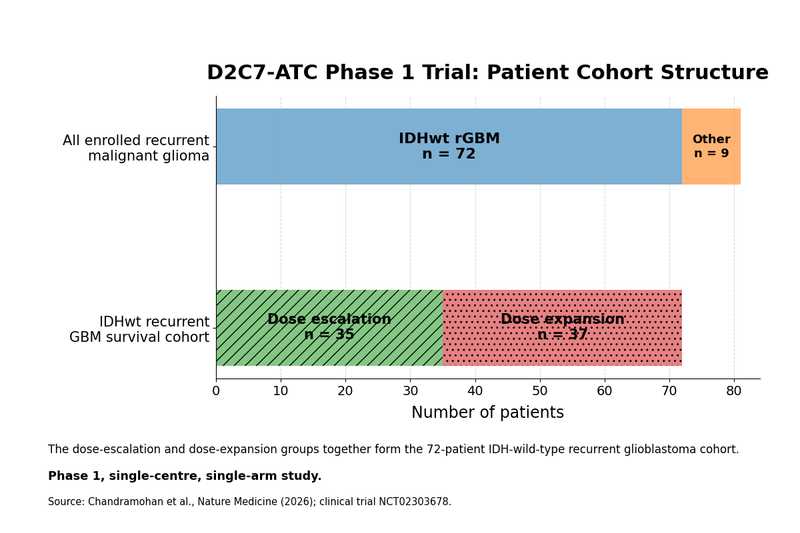
This was a single-centre, open-label, single-arm Phase 1 study. Every treated participant received D2C7-ATC, and there was no placebo or standard-treatment comparison group.
The trial’s principal purpose was to identify treatment-related toxicity and determine a recommended dose for subsequent research. Survival and biomarker analyses were important secondary or exploratory objectives rather than definitive tests of clinical effectiveness. [1–3]
A total of 81 patients with biopsy-confirmed recurrent malignant glioma received one convection-enhanced infusion. The principal survival analysis involved 72 patients with IDH-wild-type recurrent glioblastoma.
Among these 72 patients, 35 participated in the dose-escalation stage, which tested concentrations ranging from 40 to 35,032 nanograms per millilitre. Another 37 patients participated in the dose-expansion stage at the recommended Phase 2 concentration of 6,920 nanograms per millilitre. [1]
Key D2C7-ATC Trial Results
| Trial measure | Reported result | What it means |
|---|---|---|
| Total recurrent malignant glioma participants | 81 | Included glioblastoma and other malignant glioma diagnoses |
| IDH-wild-type recurrent glioblastoma subgroup | 72 patients | Main population used for the reported survival analysis |
| Dose-escalation participants | 35 | Received different concentrations to evaluate safety and dose |
| Dose-expansion participants | 37 | Received the recommended Phase 2 concentration |
| Recommended Phase 2 concentration | 6,920 ng/ml | Selected concentration for further investigation |
| Median overall survival | 7.9 months | Half of the 72 patients lived longer and half lived for a shorter period |
| Mainly grade 1–2 treatment-related adverse events | 67% | Most reported treatment-related events were mild or moderate |
| Dose-limiting toxicities at the highest concentration | 4 patients | Two grade 3 and two grade 4 events occurred at 35,032 ng/ml |
| Deaths during the study | 8 | Investigators judged all eight deaths unrelated to D2C7-ATC |
| Trial design | Phase 1, single-arm | The study cannot establish comparative survival benefit |
What Does Median Survival of 7.9 Months Mean?
Median overall survival is the point at which half the studied patients have died and half remain alive. It is not the same as an average, and it does not predict precisely how long an individual patient will live.
The reported 7.9-month median survival should not be interpreted as proof that D2C7-ATC added 7.9 months of life or performed better than another recurrent glioblastoma treatment.
Without randomization, researchers cannot know whether the observed survival resulted from the experimental treatment, patient selection, tumour characteristics, subsequent therapies or other prognostic factors.
Patients eligible for a catheter-based Phase 1 trial may differ considerably from the wider recurrent glioblastoma population. They may have better functional status, more accessible tumours, less extensive disease or sufficient stability to undergo another neurosurgical procedure.
For these reasons, comparing the 7.9-month result directly with survival figures from unrelated glioblastoma studies would be unreliable.
What Did the Biomarker Analysis Find?
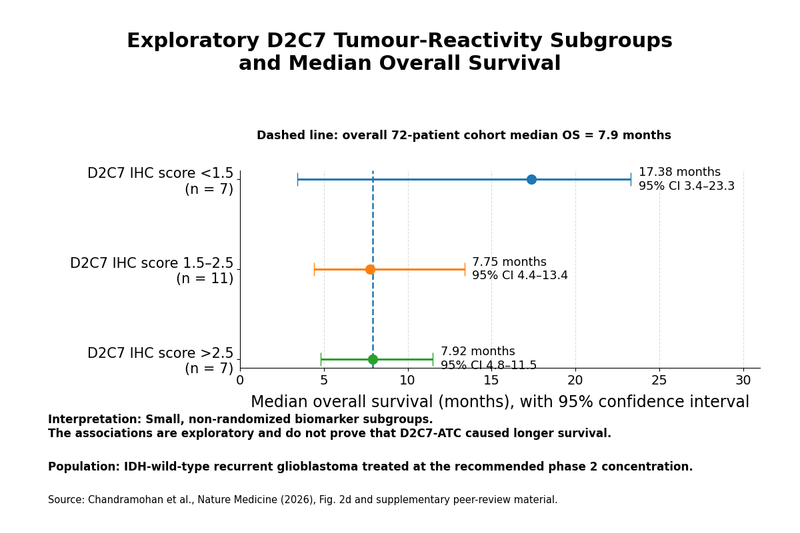
The investigators examined several biological measurements to explore why some patients survived longer than others. These included tumour staining with the D2C7 antibody, circulating cytokines, inflammatory gene activity and changes in neutrophils, monocytes and lymphocytes in the blood. [1]
Patients whose pretreatment tumours had a D2C7 antibody-reactivity score below 1.5+ had a reported median overall survival of 17.38 months. This finding may appear counterintuitive because a lower reactivity score could indicate less detectable target expression.
It does not demonstrate that low EGFR expression predicts a better response. The result may have been influenced by tumour biology, tissue sampling, differences between tumour regions, small subgroup size or unrelated prognostic characteristics.
The investigators also reported a median overall survival of 16.6 months among patients with low interleukin-8 levels in plasma measured after treatment. Interleukin-8 is an inflammatory signalling protein that can be associated with tumour-promoting inflammation and immune-cell recruitment.
Because this measurement was obtained after treatment, it cannot currently be used as a pretreatment test to decide who should receive D2C7-ATC.
These biomarker findings were exploratory. They require confirmation in larger, prospectively designed studies before they can be used to select patients or predict treatment response.
Did D2C7-ATC Activate the Immune System?
The study identified changes suggesting both intratumoural and systemic immune activation. One proposed explanation is that toxin-mediated destruction of EGFR-expressing tumour cells may release tumour antigens and inflammatory signals, potentially helping immune cells recognize the tumour.
This is biologically plausible, but the trial did not prove that immune activation caused longer survival. Blood-cell and cytokine changes can be influenced by corticosteroids, infection, tumour progression, surgery, stress and other treatments.
Future studies will need to determine whether the observed immune changes are consistent, whether they occur only in responding patients and whether they can be strengthened safely through combination treatment.
What Were the Main Safety Findings?
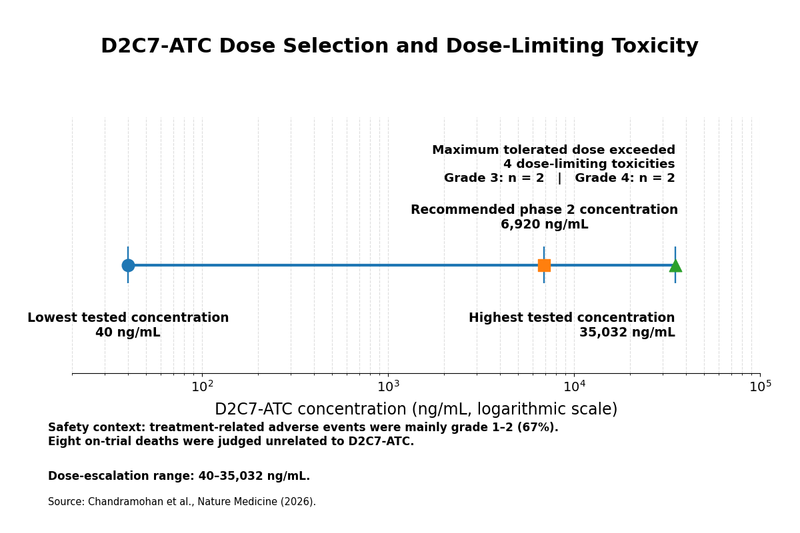
The researchers reported that treatment-related adverse events were mainly grade 1 or grade 2, accounting for 67% of the reported treatment-related event pattern. These categories generally represent mild or moderate events. [1]
However, clinically important toxicity occurred at the highest tested concentration of 35,032 nanograms per millilitre. Four patients experienced dose-limiting toxicities, including two grade 3 events and two grade 4 events. The maximum tolerated dose was therefore considered to have been exceeded at that concentration.
Eight participants died while on the study, but investigators assessed all eight deaths as unrelated to D2C7-ATC. In an aggressive recurrent brain tumour trial, deaths may result from disease progression, neurological decline or other medical complications rather than the experimental treatment itself.
The procedure also involves risks that extend beyond the drug’s molecular toxicity. Catheter placement and infusion into the brain may be associated with bleeding, infection, seizures, neurological deficits, cerebral oedema or uneven treatment distribution.
A predominance of grade 1–2 adverse events should therefore not be interpreted as meaning that D2C7-ATC is a simple or low-risk procedure.
Why Targeting EGFR and EGFRvIII Is Important
EGFR alterations are among the most extensively studied molecular abnormalities in glioblastoma. Increased EGFR signalling can promote tumour-cell proliferation, survival, invasion and resistance to treatment.
EGFRvIII is a tumour-associated mutant form of the receptor. Because it is not normally expressed in healthy tissue in the same way as wild-type EGFR, it has attracted interest as a potentially selective treatment target.
However, glioblastoma is highly heterogeneous. One part of a tumour may express EGFRvIII strongly, while another part may express wild-type EGFR, a different target or neither receptor at a therapeutically useful level.
EGFRvIII expression can also change during tumour evolution or after treatment. A therapy directed exclusively at EGFRvIII may therefore allow tumour cells lacking the target to survive.
D2C7-ATC was designed to recognize both wild-type EGFR and EGFRvIII. This dual recognition could theoretically target a wider range of glioblastoma cells than a treatment directed only at the mutant receptor. [4,5]
Why Previous EGFR Treatments Require Caution
EGFR remains a scientifically attractive glioblastoma target, but several earlier EGFR-directed approaches have failed to produce a clear overall-survival benefit in late-stage clinical trials.
The Phase 3 ACT IV trial evaluated rindopepimut, a vaccine directed against EGFRvIII, in newly diagnosed EGFRvIII-positive glioblastoma. Despite promising earlier findings and a strong biological rationale, adding the vaccine to standard treatment did not improve overall survival. [7]
Depatuxizumab mafodotin, an EGFR-targeted antibody–drug conjugate, was also investigated in EGFR-amplified glioblastoma. Although earlier studies generated interest, a later Phase 3 trial did not demonstrate a significant overall-survival advantage. [8]
D2C7-ATC differs from these treatments because it recognizes both wild-type EGFR and EGFRvIII and is delivered directly into the tumour region. These distinctions may be important, but they do not guarantee clinical success.
The history of EGFR-targeted glioblastoma research shows why encouraging Phase 1 findings must be confirmed through larger controlled trials.
Why the Current Study Cannot Prove a Survival Benefit
The most important limitation is the absence of a randomized control group. Every participant received D2C7-ATC, so the study provides no simultaneous comparison with patients receiving another treatment or supportive care.
The trial was also performed at a single specialist centre. Outcomes achieved by an experienced team using a technically demanding catheter-based procedure may not immediately translate to other hospitals.
The enrolled patients were selected according to specific eligibility requirements. For example, trial criteria required adequate functional status and excluded several patterns of extensive, multifocal or clinically unstable disease. [2,3]
The exploratory biomarker analyses involved multiple biological measurements and smaller subgroups. Such analyses are useful for generating hypotheses but can identify apparently strong associations that later disappear when tested prospectively.
The authors’ interpretation that treatment may have prolonged survival in a subset should therefore be regarded as a research hypothesis rather than a confirmed comparative treatment effect.
What Does This Mean for Patients Now?
D2C7-ATC remains an experimental recurrent glioblastoma treatment. The Phase 1 findings support further research but do not establish it as a replacement for surgery, radiotherapy, systemic treatment or other evidence-based neuro-oncology care.
Patients should not assume that the presence of EGFR amplification or EGFRvIII automatically makes them eligible for D2C7-ATC. Trial eligibility may depend on tumour location, accessibility, disease pattern, functional status, corticosteroid requirement, organ function and previous treatment.
A suspected recurrence should first be reviewed by a multidisciplinary neuro-oncology team. MRI changes after radiotherapy can sometimes reflect radiation injury, treatment effect or pseudoprogression rather than active tumour growth.
When uncertainty remains, additional imaging, serial MRI assessment, advanced imaging techniques, biopsy or repeat surgery may be considered according to the clinical situation.
Patients discussing an experimental locally delivered treatment should ask how recurrence was confirmed, whether the tumour can be safely accessed, how catheter coverage will be measured, what neurological complications may occur and what treatments remain available if the disease progresses.
Current Treatment Decisions After Glioblastoma Recurrence
There is no universally preferred treatment for every recurrence. Current expert guidance supports individualized decisions based on clinical and molecular factors. Clinical-trial participation is particularly important when appropriate because established options provide limited and variable benefit. [6]
Repeat surgery may be considered when the recurrent tumour is accessible and when removing tissue could reduce pressure, improve symptoms, establish the diagnosis or provide material for updated molecular analysis.
Reirradiation may be considered for selected patients, particularly when the recurrence is localized, sufficient time has passed since previous radiotherapy and the patient retains adequate functional status.
Systemic treatment options vary by country, previous therapy, tumour biology and patient fitness. Medicines may provide disease control or reduce swelling in selected patients, but meaningful long-term control remains uncommon.
Symptom management is equally important. Corticosteroids may be required for cerebral oedema, antiseizure treatment may be needed for tumour-related epilepsy, and rehabilitation can help preserve movement, speech, swallowing and independence.
Where Integrative and Ayurvedic Care May Fit
Patients and families seeking a broader overview of tumour classification, warning symptoms, MRI, biopsy, molecular diagnosis, conventional treatment and supervised supportive care may read Panaceayur’s guide to brain gliomas, diagnosis and integrative Ayurvedic care.
In recurrent glioblastoma, integrative care should be coordinated with the treating neuro-oncology team. Appropriate supportive objectives may include appetite, sleep, digestive comfort, fatigue, emotional distress, rehabilitation and quality of life.
Ayurvedic or herbal treatment should not delay MRI assessment, biopsy, corticosteroid treatment for cerebral oedema, seizure control, neurosurgical review, radiotherapy or evaluation for a clinical trial.
Every herb, mineral preparation, supplement and traditional formulation should be disclosed before surgery or experimental therapy. Some products may affect bleeding, sedation, liver function, kidney function or the metabolism of corticosteroids, antiseizure medicines and anticancer drugs.
No herbal formulation should be presented as a substitute for urgent management of raised intracranial pressure, progressive neurological weakness or uncontrolled seizures.
Symptoms That Require Urgent Medical Assessment
Patients with a known or suspected recurrent brain tumour require urgent assessment if they develop a new seizure, prolonged seizure, rapidly worsening weakness, speech difficulty, increasing confusion, severe drowsiness or loss of consciousness.
Progressively worsening headache accompanied by repeated vomiting, new visual disturbance or marked behavioural change may indicate rising intracranial pressure or cerebral oedema.
Sudden neurological deterioration should not be managed through supplements, diet changes or routine outpatient follow-up. Emergency neurological evaluation and brain imaging may be required.
What Evidence Is Needed Next?
The next stage should include multicentre research using standardized catheter-placement procedures, treatment-distribution measurements and independent imaging review.
A randomized comparator will ultimately be necessary to determine whether D2C7-ATC improves overall survival, progression-free survival or neurological function compared with an appropriate contemporary treatment strategy.
Future trials should also assess quality of life, cognitive function, corticosteroid use, seizure frequency, hospitalization, functional independence and treatment-related neurological complications.
The proposed biomarkers require prospective validation. Researchers must determine whether pretreatment EGFR measurements, D2C7 antibody reactivity, inflammatory gene patterns or circulating cytokines can genuinely predict treatment benefit.
A useful biomarker must do more than identify patients with a generally better prognosis. It must identify patients who benefit specifically from D2C7-ATC compared with another treatment.
Bottom Line
D2C7-ATC is an experimental antibody–toxin conjugate that targets both wild-type EGFR and EGFRvIII and is delivered directly into recurrent glioma tissue through convection-enhanced delivery.
In the Phase 1 trial, 81 patients received treatment, including 72 with IDH-wild-type recurrent glioblastoma. Median overall survival in the glioblastoma subgroup was 7.9 months, and the recommended Phase 2 concentration was 6,920 nanograms per millilitre.
The treatment produced mainly grade 1–2 adverse events, although four dose-limiting toxicities occurred at the highest tested concentration. Exploratory analyses identified tumour and inflammatory biomarkers associated with longer survival, but these findings are not ready for clinical decision-making.
The study provides a meaningful scientific signal and supports continued investigation. It does not yet prove that D2C7-ATC improves survival compared with established recurrent glioblastoma treatment, and the therapy should currently be considered appropriate only within specialist clinical research.
References
- Chandramohan, V., Herndon, J. E., II, Barnwal, A., et al. (2026). EGFR-targeted antibody–toxin conjugate in recurrent glioma: A phase 1 trial. Nature Medicine.
Used for: Trial design, participant numbers, dose levels, median survival, adverse events, dose-limiting toxicities, deaths and biomarker findings. Nature - National Library of Medicine. (2026). D2C7 for adult patients with recurrent malignant glioma: NCT02303678. ClinicalTrials.gov.
Used for: Trial registration, study design, eligibility and treatment objectives. - National Cancer Institute. (2026). D2C7-IT via convection-enhanced delivery in treating patients with recurrent malignant glioma.
Used for: Infusion procedure, 72-hour delivery, eligibility requirements, follow-up and trial objectives. Cancer.gov - Bao, X., Pastan, I., Bigner, D. D., & Chandramohan, V. (2016). EGFR/EGFRvIII-targeted immunotoxin therapy for the treatment of glioblastomas via convection-enhanced delivery. Receptors & Clinical Investigation, 3(4), e1430.
Used for: D2C7-ATC mechanism, receptor targeting, toxin component and convection-enhanced delivery. PubMed - Chandramohan, V., Bao, X., Keir, S. T., et al. (2013). Construction of an immunotoxin, D2C7-(scdsFv)-PE38KDEL, targeting EGFRwt and EGFRvIII for brain tumour therapy. Clinical Cancer Research, 19(17), 4717–4727.
Used for: Preclinical construction, dual EGFR targeting and tumour-cell killing mechanism. - Wen, P. Y., Weller, M., Lee, E. Q., et al. (2025). Glioblastoma in adults: A Society for Neuro-Oncology and European Association of Neuro-Oncology consensus review on current management and future directions. Neuro-Oncology, 27(11), 2751–2788.
Used for: Current recurrent glioblastoma management, multidisciplinary decision-making and clinical-trial context. PubMed - Weller, M., Butowski, N., Tran, D. D., et al. (2017). Rindopepimut with temozolomide for patients with newly diagnosed, EGFRvIII-expressing glioblastoma: The ACT IV randomized Phase 3 trial. The Lancet Oncology, 18(10), 1373–1385.
Used for: Previous late-stage experience with an EGFRvIII-targeted glioblastoma treatment. PubMed - Lassman, A. B., Pugh, S. L., Wang, T. J. C., et al. (2023). Depatuxizumab mafodotin in EGFR-amplified newly diagnosed glioblastoma: A Phase 3 randomized clinical trial. Neuro-Oncology, 25(2), 339–350.
Used for: Limitations encountered by previous EGFR-targeted antibody–drug conjugate research. - Wick, W., Gorlia, T., Bendszus, M., et al. (2017). Lomustine and bevacizumab in progressive glioblastoma. The New England Journal of Medicine, 377(20), 1954–1963.
Used for: Randomized recurrent-glioblastoma treatment context and interpretation of overall-survival outcomes. - Panaceayur. (2026). Gliomas: Symptoms, diagnosis and integrative Ayurvedic care for brain tumours.
Used for: Internal supporting information on glioma symptoms, diagnosis, monitoring, conventional treatment and supervised integrative care. Panaceayur