


Publication date: 15 October 2026
Study country: Spain
Original source: JAMA Network Open
Vaginal laser for breast cancer survivors did not improve sexual function, painful intercourse or vaginal health more than a sham procedure after 12 months. The randomized trial involved women receiving aromatase inhibitors for breast cancer, and both treatment groups also received nonhormonal supportive care, including vaginal moisturizers and vibrator-based therapy.
The findings are important because fractional carbon dioxide laser procedures are increasingly marketed to women experiencing vaginal dryness, burning, painful sex and other symptoms after breast cancer treatment. These procedures may require several sessions, are frequently paid for privately and are sometimes promoted as “vaginal rejuvenation,” despite continuing uncertainty about their added clinical value.
Why Aromatase Inhibitors Can Cause Vaginal and Sexual Symptoms
Aromatase inhibitors are commonly prescribed after hormone receptor–positive breast cancer to reduce estrogen production and lower the risk of cancer recurrence. However, profound estrogen suppression can also affect the vulva, vagina, bladder and pelvic tissues.
Women may experience vaginal dryness, reduced lubrication, burning, irritation, pain during intercourse, urinary urgency, discomfort while urinating or recurrent urinary symptoms. This collection of problems is commonly described as genitourinary syndrome of menopause, or GSM.[5,7]
These symptoms can be severe enough to affect sleep, body image, emotional wellbeing, intimate relationships and adherence to cancer treatment. They may begin during therapy, become progressively worse or persist after other parts of breast cancer treatment have ended.
Many patients do not discuss sexual or vaginal symptoms during oncology appointments. Some assume that the symptoms are unavoidable, while others feel embarrassed or believe that their cancer team is focused only on preventing recurrence. As a result, treatable causes of pain and irritation may remain unrecognized.
How the Vaginal Laser Study Was Conducted
The new publication was a 12-month secondary analysis of the LIGHT randomized clinical trial conducted at a tertiary academic hospital in Spain. The trial enrolled breast cancer survivors who were receiving aromatase inhibitors and had genitourinary syndrome of menopause with painful intercourse.[1,2]
A total of 84 participants were randomly assigned to receive either fractional carbon dioxide laser treatment or a sham laser procedure. Each participant was scheduled for five monthly sessions.
The sham procedure was designed to resemble active laser treatment without delivering the same therapeutic laser energy. This is important because symptoms such as pain, dryness and sexual function can be influenced by expectations, clinical attention, treatment rituals and other supportive measures.
Both groups also received first-line nonhormonal treatment. This included vaginal moisturizers or lubricants and guidance on vibrator use. The trial therefore did not compare vaginal laser treatment with no care. It tested whether laser treatment added a measurable benefit beyond nonhormonal supportive care.
Sixty-seven women completed the 12-month assessment: 32 in the active-laser group and 35 in the sham-laser group.
What the Researchers Found After 12 Months
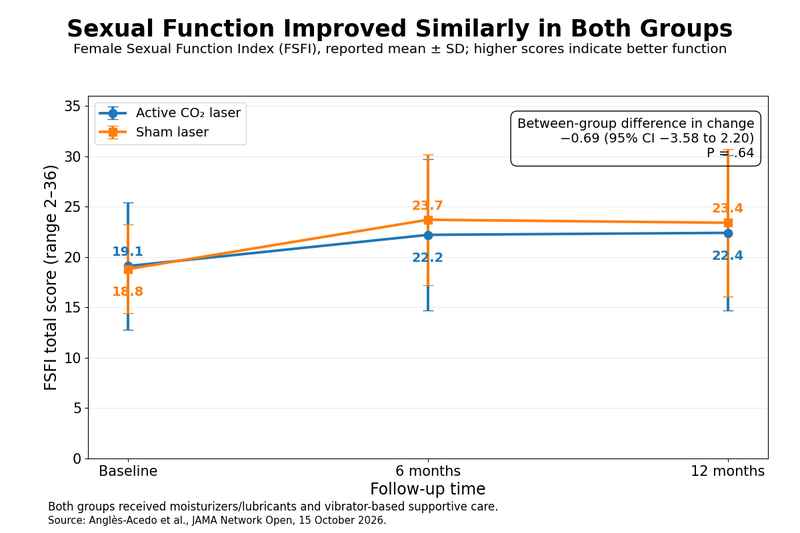
The principal outcome was the change in Female Sexual Function Index score, a validated questionnaire that assesses desire, arousal, lubrication, orgasm, satisfaction and pain.
The difference in improvement between the active-laser and sham-laser groups was −0.69 points. The 95% confidence interval ranged from −3.58 to 2.20, and the probability value was 0.64. These results did not show a statistically significant advantage for the active laser.[1]
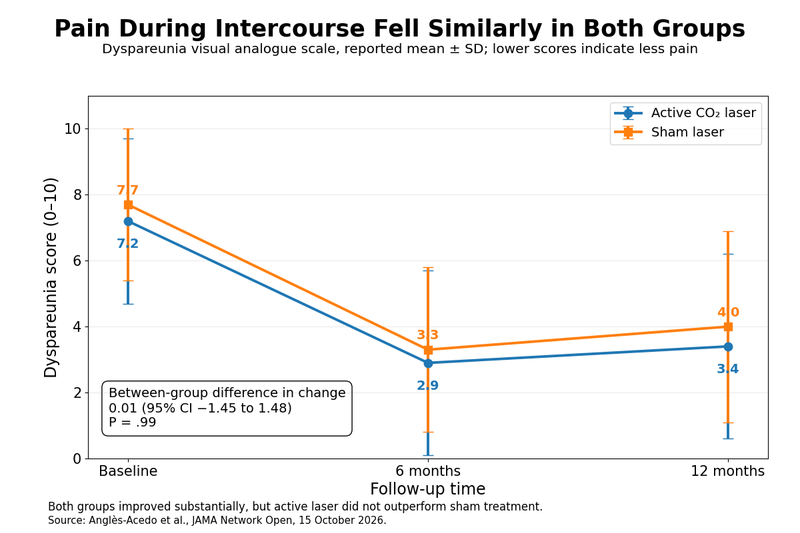
Laser treatment also failed to provide additional improvement in painful intercourse, vaginal-health scores, body-image concerns, quality of life, vaginal pH, tissue-maturation measurements or other objective vaginal outcomes.
No severe treatment-related adverse effects were reported during the 12-month follow-up. However, a trial involving 67 women at the final assessment cannot establish long-term safety for every laser device, energy setting, treatment schedule or patient population.
Both Groups Improved, but the Laser Was Not the Reason
Women in both groups experienced improvement over time. Across the study population, sexual-function scores increased, pain during intercourse decreased, body-image scores improved and vaginal-health measurements became more favourable.[1]
The proportion of women reporting sexual activity also increased during follow-up. These improvements were clinically meaningful for the women involved, but they occurred to a similar degree in both the active-laser and sham-laser groups.
The results do not suggest that the women’s symptoms were imagined. Instead, they indicate that the laser energy itself did not provide a detectable additional benefit.
Regular use of vaginal moisturizers or lubricants may have contributed to symptom relief. Vibrator-based therapy may also have supported tissue flexibility, circulation, comfort and confidence in selected participants.
Repeated clinical contact, sexual-health discussions, treatment adherence and the experience of being closely followed within a trial may have influenced outcomes. These are sometimes called contextual or trial-participation effects, and they can be particularly relevant when outcomes include pain, sexual activity and perceived quality of life.
What “No Additional Benefit” Means
The study does not prove that every vaginal laser device is ineffective in every patient. It evaluated a particular fractional carbon dioxide laser protocol consisting of five monthly sessions in breast cancer survivors receiving aromatase inhibitors.
However, the results do challenge the assumption that symptom improvement after laser treatment necessarily means the laser caused the improvement.
Before-and-after studies often report that patients feel better following a procedure. Such studies cannot determine whether the improvement resulted from the treatment itself, natural symptom fluctuation, concurrent moisturiser use, increased sexual-health support or patient expectations.
Sham-controlled trials are more reliable because the experience of receiving the procedure is similar in both groups. The principal difference is whether therapeutic laser energy is delivered.
A systematic review of seven randomized trials involving 407 women found that carbon dioxide laser and sham treatment produced comparable results for most major outcomes, including sexual-function scores, painful intercourse, vaginal-health measurements, vaginal pH and patient satisfaction.[3]
The new 12-month findings are therefore consistent with a wider pattern: the apparent benefits reported in uncontrolled laser studies often become smaller or disappear when the treatment is tested against a convincing sham procedure.
Why the Findings Matter to Breast Cancer Survivors
Women recovering from breast cancer may be especially vulnerable to commercial claims about hormone-free procedures. Many are understandably concerned about using estrogen-based treatments and may feel that laser therapy offers a safer, more permanent or more natural alternative.
The term “vaginal rejuvenation” can make the treatment sound restorative, low risk and established. In reality, vaginal laser protocols differ between clinics, and patients may receive different devices, energy settings, numbers of sessions and maintenance recommendations.
The total financial cost may also extend beyond the initial treatment package. Some clinics recommend repeated maintenance sessions even though the ideal frequency, long-term effectiveness and cumulative safety remain uncertain.
Before paying for treatment, patients should ask whether the device has been tested against a sham procedure in women with the same cancer history, whether improvement is expected beyond standard supportive care, how long any benefit is likely to last and what complications have been reported.
Professional guidance has remained cautious. The Royal College of Obstetricians and Gynaecologists concluded that vaginal laser treatment should not be adopted into widespread practice until stronger evidence is available and recommended that it be used within research settings.[4]
Evidence-Based Options Patients Can Discuss
Nonhormonal vaginal moisturizers are generally considered a first treatment option for breast cancer survivors with persistent dryness or irritation. They are intended for regular use rather than only during sexual activity.
Lubricants can reduce friction and pain during intercourse or vaginal examination. Water-based and silicone-based products differ in duration, texture and tolerability, so some women need to try more than one formulation.
Products containing perfumes, warming ingredients, unnecessary flavourings or other irritants may worsen burning in sensitive tissues. Persistent irritation after starting a product should prompt discontinuation and reassessment.
Pelvic-floor physiotherapy may help when pain is associated with involuntary muscle tightening, pelvic-floor overactivity, scar-related discomfort or fear of penetration. Treatment may include relaxation exercises, manual techniques, graded vaginal stretching and education about pain mechanisms.
Vaginal dilators or vibrator-based therapy may be appropriate for selected women, particularly when maintaining tissue flexibility or gradually returning to comfortable sexual activity is an important goal. They should be introduced according to comfort and clinical circumstances rather than used through severe pain.
Psychosexual counselling can address fear, reduced desire, altered body image, relationship strain and anxiety following breast cancer treatment. Physical and emotional factors often occur together, and treating only vaginal dryness may not resolve the full problem.[7]
Can Vaginal Estrogen Be Considered After Breast Cancer?
Low-dose vaginal estrogen may be considered for some breast cancer survivors whose symptoms remain severe despite nonhormonal care. The decision depends on the type of breast cancer, recurrence risk, current endocrine treatment, symptom severity and patient preference.[5,6]
The discussion is particularly important for women taking aromatase inhibitors because these medicines are intended to maintain very low estrogen levels. Treatment decisions should therefore involve the patient, gynecologist and oncology team.
Patients should not stop an aromatase inhibitor because of vaginal symptoms without speaking to the prescribing oncologist. Severe symptoms deserve active treatment, but changes to cancer therapy require an individualized assessment of benefits, risks and alternatives.
Persistent Symptoms Need Proper Examination
Vaginal dryness and painful intercourse during aromatase-inhibitor therapy are often related to estrogen suppression, but not every genital or urinary symptom is caused by GSM.
Persistent burning, unusual discharge, offensive odour, vulvar skin changes, bleeding, sores, urinary pain or recurrent infections require clinical evaluation. Possible causes include vaginal infection, vulvar dermatoses, pelvic-floor dysfunction, urinary disorders, nerve-related pain or treatment-related tissue changes.
Pain during intercourse can also arise from scar tissue, pelvic-floor muscle spasm, inadequate lubrication, anxiety, infection or another gynecological condition. Repeatedly treating symptoms without an examination may delay the correct diagnosis.
Postmenopausal bleeding, bleeding after intercourse or unexplained genital bleeding should not be attributed automatically to vaginal dryness. These symptoms require timely medical assessment.
The Role of Integrative Support
Some breast cancer survivors use Ayurveda, yoga, mindfulness, dietary changes or other complementary approaches to support sleep, stress management, fatigue and overall wellbeing.
Integrative care should be coordinated with the oncology team, particularly when herbal products or supplements are being considered. Some herbs and concentrated supplements can interact with cancer medicines or affect drug metabolism.[9]
Complementary care may support general wellbeing, but it should not replace the assessment of vaginal bleeding, persistent pain, infection, urinary symptoms or suspicious breast findings.
Women who are also trying to understand a benign breast lump, atypical biopsy finding or future breast-cancer risk can read our guide to benign breast lumps and atypical hyperplasia, which explains biopsy interpretation, surveillance and treatment decisions.
What Patients Should Take From This Study
The study offers two important messages.
First, structured nonhormonal care can be associated with meaningful improvement in vaginal symptoms, painful intercourse and sexual health. Breast cancer survivors should not assume that these problems must simply be tolerated.
Second, adding fractional carbon dioxide laser treatment did not produce better 12-month outcomes than a sham procedure. Improvement following a laser procedure should therefore not automatically be interpreted as evidence that the laser itself was effective.
For women considering vaginal laser treatment, the most appropriate next step is a careful assessment of the cause of symptoms, review of first-line options and a realistic discussion about the uncertainty surrounding the procedure’s additional benefit.
References
- Anglès-Acedo, S., Alonso, I., Ribera-Torres, L., Mension, E., Otero, J., Herranz-Diez, C., Farré, R., Castrejon, N., Alòs, S., & Castelo-Branco, C. (2026). Laser therapy for sexual health in breast cancer survivors receiving aromatase inhibitors: A secondary analysis of a randomized clinical trial. JAMA Network Open, 9(10), e2638937. JAMA Network
- Mension, E., Alonso, I., Anglès-Acedo, S., et al. (2023). Effect of fractional carbon dioxide vs sham laser on sexual function in survivors of breast cancer receiving aromatase inhibitors for genitourinary syndrome of menopause: The LIGHT randomized clinical trial. JAMA Network Open, 6(2), e2255697. JAMA Network
- Prodromidou, A., Zacharakis, D., Athanasiou, S., Kathopoulis, N., Varthaliti, A., Douligeris, A., Michala, L., Athanasiou, V., Salvatore, S., & Grigoriadis, T. (2023). CO₂ laser versus sham control for the management of genitourinary syndrome of menopause: A systematic review and meta-analysis of randomized controlled trials. Journal of Personalized Medicine, 13(12), 1694. PubMed Central
- Phillips, C., Hillard, T., Salvatore, S., Cardozo, L., & Toozs-Hobson, P. (2022). Laser treatment for genitourinary syndrome of menopause: Scientific Impact Paper No. 72. BJOG: An International Journal of Obstetrics & Gynaecology, 129(12), e89–e94. RCOG
- Faubion, S. S., Larkin, L. C., Stuenkel, C. A., et al. (2018). Management of genitourinary syndrome of menopause in women with or at high risk for breast cancer: Consensus recommendations. Menopause, 25(6), 596–608. PubMed
- American College of Obstetricians and Gynecologists. (2021). Treatment of urogenital symptoms in individuals with a history of estrogen-dependent breast cancer. Obstetrics & Gynecology, 138(6), 950–960.
- National Cancer Institute. (2022). Sexual health issues in women with cancer. Cancer.gov
- The North American Menopause Society 2020 Genitourinary Syndrome of Menopause Position Statement Editorial Panel. (2020). The 2020 genitourinary syndrome of menopause position statement. Menopause, 27(9), 976–992.
- National Center for Complementary and Integrative Health. (2021). Cancer and complementary health approaches: What you need to know. NCCIH