


Publication date: 14 October 2026
Study country: Italy
International relevance: Adults with newly diagnosed Philadelphia chromosome-positive acute lymphoblastic leukemia
Original source: The New England Journal of Medicine
Trial: GIMEMA ALL2820 randomized Phase III trial
Ph-positive ALL treatment has entered a new phase after the randomized Phase III GIMEMA ALL2820 trial reported an estimated two-year event-free survival of 86% with ponatinib plus blinatumomab, compared with 67% with imatinib plus chemotherapy. The study involved adults with newly diagnosed Philadelphia chromosome-positive acute lymphoblastic leukemia and provides important evidence for a systemic treatment strategy that avoids conventional multiagent chemotherapy.[1]
This chemotherapy-free Ph-positive ALL treatment is not treatment-free, natural or suitable for every type of leukemia. Ponatinib is a targeted anticancer drug, while blinatumomab is an intravenous immunotherapy. Patients still require specialist supervision, central nervous system prophylaxis, molecular testing, measurable residual disease monitoring and continued assessment for toxicity or relapse.
What Is Philadelphia Chromosome-Positive Acute Lymphoblastic Leukemia?
Philadelphia chromosome-positive acute lymphoblastic leukemia is an aggressive form of B-cell ALL in which leukemia cells contain an abnormal fusion known as BCR::ABL1. This genetic change produces an overactive tyrosine kinase that continually signals leukemia cells to grow and survive.
Testing for BCR::ABL1 is therefore not merely descriptive. It identifies a specific biological target and directly influences treatment selection. Tyrosine kinase inhibitors such as imatinib, dasatinib and ponatinib were developed to block this abnormal signaling pathway.
Ph+ ALL should not be confused with chronic myeloid leukemia, even though both diseases may contain BCR::ABL1. They differ in their clinical behavior, affected blood-cell lineage, treatment strategy and monitoring requirements.
How the GIMEMA ALL2820 Trial Was Conducted
The Italian GIMEMA investigators enrolled 236 adults with newly diagnosed Ph+ ALL. Their median age was 55 years, with participants ranging from 24 to 82 years. Patients were randomly assigned in a two-to-one ratio to one of two treatment groups.[1]
The experimental group included 158 patients who received ponatinib followed by blinatumomab. Ponatinib was used to inhibit BCR::ABL1, while blinatumomab was introduced to recruit the immune system against CD19-positive leukemia cells.
The control group included 78 patients who received imatinib with an age-adjusted chemotherapy programme. Imatinib also blocks BCR::ABL1 but is an earlier-generation tyrosine kinase inhibitor.
Patients who had persistent measurable disease, treatment resistance or certain emerging mutations could cross over from the control strategy to the ponatinib–blinatumomab approach. This is clinically important because crossover may reduce the apparent difference in overall survival between the original randomized groups.
Although the experimental approach is described as chemotherapy-free, the term principally refers to avoiding conventional systemic multiagent chemotherapy. The study protocol included central nervous system prophylaxis with medicated lumbar punctures and intrathecal treatment. Patients also required corticosteroids, laboratory monitoring, bone-marrow examinations, molecular testing and other specialist supportive care.[2]
Two-Year Event-Free Survival Increased From 67% to 86%
The GIMEMA ALL2820 trial reported better event-free survival and complete hematologic response with ponatinib plus blinatumomab, while the cumulative incidence of relapse was lower than with imatinib plus chemotherapy.
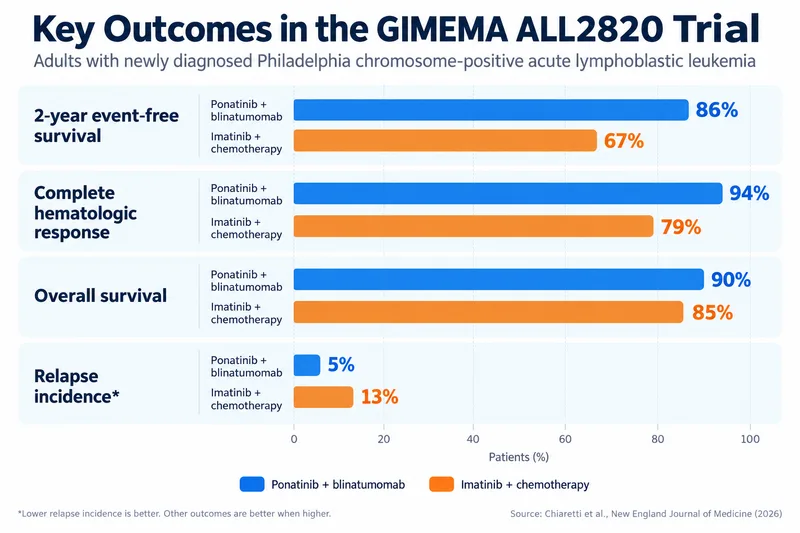
After a median follow-up of 23.7 months, estimated event-free survival at 24 months was:
86% with ponatinib plus blinatumomab
67% with imatinib plus chemotherapy
This represents an absolute difference of 19 percentage points. Expressed in patient terms, approximately 19 more people out of every 100 were estimated to remain free from a protocol-defined event at two years with the ponatinib–blinatumomab strategy.[1]
This comparison should not be interpreted as a guarantee for an individual patient. Age, initial white-cell count, central nervous system involvement, additional genetic abnormalities, treatment tolerance and depth of molecular response can all affect the prognosis.
Event-free survival also differs from overall survival. Depending on the study definition, an event may include failure to achieve remission, disease recurrence, progression or death. A patient can therefore experience an event and still remain alive after receiving additional treatment.
Complete Hematologic Response Was Also Higher
At the end of induction treatment, 94% of patients receiving ponatinib–blinatumomab achieved a complete hematologic response, compared with 79% of patients receiving imatinib plus chemotherapy.[1]
A complete hematologic response means that leukemia is no longer evident by standard blood and bone-marrow criteria and normal blood-cell production has recovered sufficiently. It does not necessarily mean that every leukemia cell has been eliminated.
More sensitive polymerase chain reaction and measurable residual disease tests may still detect very small quantities of BCR::ABL1-positive cells. Molecular monitoring therefore remains essential even after a patient enters complete hematologic remission.
Relapse Was Lower, but Not Eliminated
The reported cumulative incidence of relapse was approximately 5% with ponatinib–blinatumomab and 13% with imatinib–chemotherapy. Estimated overall survival was 90% and 85%, respectively.[1]
The smaller difference in overall survival should be interpreted in the context of relatively short follow-up and the trial’s crossover design. Some control-group patients who were not responding adequately were permitted to receive the experimental strategy, potentially improving their subsequent survival.
The presence of relapse despite encouraging response rates is also a reminder that chemotherapy-free treatment is not synonymous with permanent eradication. Continued BCR::ABL1 testing, bone-marrow assessment when indicated and surveillance for central nervous system or extramedullary disease remain important.
How Ponatinib and Blinatumomab Work Together
Ponatinib targets the BCR::ABL1 driver
Ponatinib is a third-generation tyrosine kinase inhibitor designed to block BCR::ABL1 signaling. It also retains activity against several resistant BCR::ABL1 mutations, including the clinically important T315I mutation.
By suppressing this molecular driver early in treatment, ponatinib can rapidly reduce the survival advantage of Ph+ leukemia cells. Its potency is one reason it has been investigated in chemotherapy-free combinations.
Blinatumomab recruits T cells against leukemia cells
Blinatumomab is a bispecific T-cell engager. One part binds CD19, a protein commonly found on B-lineage leukemia cells, while another part binds CD3 on T cells.
This connection places the patient’s T cells in close contact with CD19-positive leukemia cells and promotes immune-mediated destruction. Blinatumomab is generally administered as a prolonged intravenous infusion during defined treatment cycles.
The two drugs therefore attack the leukemia through complementary mechanisms: ponatinib suppresses the molecular signal driving the disease, while blinatumomab redirects immune cells toward the malignant B-cell population.
Why This Phase III Trial Is Important
Earlier studies had already suggested that combining a tyrosine kinase inhibitor with blinatumomab could reduce the need for conventional chemotherapy in Ph+ ALL.
In the earlier GIMEMA D-ALBA study, dasatinib followed by blinatumomab produced high initial remission and survival rates. At a median follow-up of 53 months, disease-free survival was 75.8% and overall survival was 80.7%.[3,4]
A separate United States Phase II study evaluated ponatinib with blinatumomab. In its updated analysis, the estimated three-year overall survival was 91% and event-free survival was 77%, although the absence of a randomized control group limited the certainty of comparison with standard treatment.[5,6]
GIMEMA ALL2820 is therefore important because it directly compared the targeted immunotherapy strategy with imatinib plus chemotherapy in a randomized Phase III setting. The stronger study design makes it less likely that the difference was caused only by patient selection or differences between treatment centres.
Chemotherapy-Free Does Not Mean Side-Effect-Free
Avoiding systemic chemotherapy may reduce exposure to some toxicities associated with conventional cytotoxic drugs. However, ponatinib and blinatumomab have their own potentially serious risks.
In the ponatinib–blinatumomab group, the investigators reported 79 severe adverse events of grade 3 or higher among 53 of 158 patients, representing approximately 34% of the experimental group. Infections were the most frequently reported severe events.[1]
Ponatinib carries warnings concerning arterial occlusive events, venous thromboembolism, heart failure and hepatotoxicity. Depending on the patient, monitoring may include blood pressure, cardiovascular history, liver enzymes, pancreatic enzymes, blood counts and symptoms suggesting impaired circulation.[9]
Blinatumomab can cause cytokine release syndrome and neurological toxicity. Patients may require monitoring for fever, low blood pressure, confusion, speech disturbance, seizures, weakness or altered coordination, particularly during the early stages of an infusion cycle.[10]
The treatment should therefore be delivered by a hematology team experienced in Ph+ ALL, targeted drugs, immunotherapy and management of treatment-related complications. A patient should never start, stop or alter either medicine without specialist supervision.
Which Patients Do These Results Apply To?
These findings apply specifically to adults with newly diagnosed Philadelphia chromosome-positive ALL.
They should not automatically be applied to:
Ph-negative B-cell ALL, T-cell ALL, acute myeloid leukemia, chronic lymphocytic leukemia, chronic myeloid leukemia, childhood ALL or leukemia that has already relapsed after multiple therapies.
The trial included both younger and older adults, but treatment selection must still consider cardiovascular health, liver function, infection risk, neurological history, BCR::ABL1 transcript type, additional genetic abnormalities and the patient’s ability to receive prolonged intravenous therapy.
A separate prospective study of ponatinib–blinatumomab found that a very high white-cell count at diagnosis was associated with a greater risk of relapse. Central nervous system relapses also remained an important concern, reinforcing the need for appropriate CNS-directed prophylaxis and close follow-up.[7]
Does This Treatment Remove the Need for Stem-Cell Transplantation?
The study does not establish that stem-cell transplantation can be abandoned for every patient with Ph+ ALL.
The role of allogeneic transplantation is increasingly being individualized according to measurable residual disease, molecular response, additional genetic risk, treatment resistance, BCR::ABL1 mutations, relapse history, patient fitness and donor availability.
Some patients who achieve a rapid and deep molecular response may be able to avoid transplantation in first remission. Others may still benefit from it because their disease remains molecularly detectable or carries high-risk clinical or genetic features.
Transplant decisions should therefore be made after reviewing the patient’s serial molecular results rather than relying only on a normal blood count or an initial complete remission.
Event-Free Survival Is Not the Same as a Permanent Cure
An 86% two-year event-free survival rate is highly encouraging, but it does not mean that 86% of patients have been permanently cured.
The median follow-up was slightly under two years. Acute lymphoblastic leukemia can relapse after an initial response, and longer observation is needed to determine whether the separation between the treatment groups remains stable at five years and beyond.
The study also does not show that treatment can be stopped after two years. Many patients require continued tyrosine kinase inhibition, serial BCR::ABL1 testing and individualized decisions about treatment duration.
Terms such as remission, complete molecular response, event-free survival, overall survival and cure should not be used interchangeably. Each describes a different clinical outcome.
What This Means for Patients Seeking Leukemia Treatment Without Chemotherapy
Patients searching for leukemia treatment without chemotherapy now have randomized Phase III evidence that conventional systemic chemotherapy can be avoided in some adults with newly diagnosed Ph+ ALL.
However, the successful alternative in this trial was not an untreated, dietary or herbal approach. Conventional chemotherapy was replaced with a potent molecularly targeted drug and an intravenous immune therapy, accompanied by intensive laboratory monitoring, CNS prophylaxis and specialist care.
No Ayurvedic medicine, herbal formulation, supplement, detoxification programme or dietary protocol was tested in GIMEMA ALL2820. The trial therefore cannot be cited as evidence that Ayurveda alone can replace ponatinib, blinatumomab, molecular monitoring or transplantation when transplantation is medically indicated.
Patients interested in coordinated supportive or integrative care can read our broader guide to Ayurvedic treatment for leukemia. It explains leukemia subtypes, diagnostic testing, treatment decisions, supportive-care considerations and the precautions required when combining herbs or supplements with oncology medicines.
Any Ayurvedic or nutritional intervention should be disclosed to the treating hematologist. This is especially important because the ponatinib–blinatumomab regimen already requires careful assessment of liver function, cardiovascular risk, bleeding or clotting symptoms and neurological changes. Adding unreviewed products could complicate toxicity assessment or interact with supportive medicines.
Important Limitations of the Trial
The follow-up period is not yet long enough to define permanent cure rates. Five-year event-free and overall survival will provide a more reliable picture of long-term disease control.
The comparator was imatinib plus chemotherapy. The study does not directly establish that ponatinib–blinatumomab is superior to every other modern TKI–immunotherapy combination, such as dasatinib–blinatumomab, or to other newer risk-adapted approaches.
Crossover from the control group to the experimental treatment may have reduced the observed difference in overall survival. Although ethically useful for patients with an inadequate response, crossover makes long-term survival comparisons more complicated.
The trial was conducted through an Italian cooperative group. Outcomes may differ in health systems with less access to molecular testing, blinatumomab infusion services, infection management or regular specialist follow-up.
Central nervous system relapse remains a clinically important concern in chemotherapy-free ALL programmes. Intrathecal prophylaxis and neurological surveillance must not be omitted simply because conventional systemic chemotherapy has been reduced.
Questions Patients Should Discuss With Their Hematologist
Has BCR::ABL1 been definitively confirmed?
The ponatinib–blinatumomab results apply only when Philadelphia chromosome positivity or BCR::ABL1 has been confirmed with appropriate cytogenetic or molecular testing. A general diagnosis of acute leukemia is not sufficient to select this regimen.
How will measurable residual disease be monitored?
Patients should ask which molecular assay will be used, how frequently it will be repeated and what change in BCR::ABL1 level would trigger additional therapy, mutation testing or consideration of transplantation.
Is ponatinib appropriate for my cardiovascular risk?
Previous heart disease, stroke, peripheral arterial disease, uncontrolled hypertension, diabetes, abnormal lipids, smoking history and previous thrombosis may influence the risk–benefit assessment and required monitoring.
What is the plan for central nervous system prophylaxis?
Even when systemic chemotherapy is omitted, leukemia can involve or relapse in the central nervous system. Patients should understand the planned lumbar punctures, intrathecal treatment and evaluation of any new headache, visual symptom, weakness or neurological change.
Could I still require a stem-cell transplant?
The answer depends on response depth, residual disease, mutations, additional genetic findings, treatment tolerance and relapse risk. The decision should be reassessed as molecular results become available rather than assumed at diagnosis.
Frequently Asked Questions
Is ponatinib plus blinatumomab a cure for leukemia?
The combination produced an estimated 86% two-year event-free survival rate in newly diagnosed adult Ph+ ALL, but the follow-up is too short to describe every event-free patient as permanently cured. Continued molecular monitoring is required because residual disease and relapse can still occur.
Does chemotherapy-free mean that no chemotherapy is used anywhere in treatment?
It mainly means that conventional systemic multiagent chemotherapy was omitted from the experimental strategy. CNS prophylaxis may still include chemotherapy delivered directly into the spinal fluid. Corticosteroids, targeted anticancer drugs, immunotherapy and intensive supportive treatment are also required.
Can this treatment be used for every type of leukemia?
No. The evidence applies to adults with newly diagnosed Philadelphia chromosome-positive ALL. Patients with AML, CLL, T-cell ALL, Ph-negative B-cell ALL, CML or relapsed leukemia require disease-specific evaluation and should not assume that the same results apply.
Is ponatinib–blinatumomab safer than chemotherapy?
It avoids some toxicities associated with conventional systemic chemotherapy, but it creates a different risk profile. Ponatinib can cause serious vascular, cardiac and liver complications, while blinatumomab can cause cytokine release syndrome and neurological toxicity. Specialist monitoring remains essential.
Can Ayurvedic treatment be taken with ponatinib and blinatumomab?
Only after the complete formulation has been reviewed by the hematology team and a suitably qualified Ayurvedic physician. The trial did not evaluate Ayurveda, and unreviewed herbs, extracts or herbo-mineral products could complicate liver monitoring, cardiovascular risk assessment or the interpretation of treatment-related symptoms.
References
- Chiaretti, S., Piciocchi, A., et al. (2026). Ponatinib–blinatumomab or imatinib–chemotherapy for adult Philadelphia chromosome-positive acute lymphoblastic leukemia. The New England Journal of Medicine, 395(15), 1483–1494. Full article
Used for: Randomization, patient population, complete response, event-free survival, overall survival, relapse and adverse-event results. New England Journal of Medicine - Chiaretti, S., Leoncin, M., Elia, L., et al. (2023). Comparison between dasatinib–blinatumomab versus ponatinib–blinatumomab chemotherapy-free strategy for newly diagnosed Ph+ acute lymphoblastic leukemia: Preliminary results of the GIMEMA ALL2820 trial. Blood, 142(Supplement 1), 4249. ASH trial poster
Used for: Early trial protocol, ponatinib dosing, CNS prophylaxis, intrathecal treatment and risk-adapted transplantation. postersessiononline.eu - Foà, R., Bassan, R., Vitale, A., et al. (2020). Dasatinib–blinatumomab for Ph-positive acute lymphoblastic leukemia in adults. The New England Journal of Medicine, 383(17), 1613–1623. Full article
Used for: Earlier GIMEMA chemotherapy-free TKI–blinatumomab evidence. New England Journal of Medicine - Foà, R., Bassan, R., Elia, L., et al. (2024). Long-term results of the dasatinib–blinatumomab protocol for adult Philadelphia-positive ALL. Journal of Clinical Oncology, 42(8), 881–885. Journal article
Used for: Long-term disease-free and overall survival after the D-ALBA strategy. ASC Publications - Jabbour, E., Short, N. J., Jain, N., et al. (2023). Ponatinib and blinatumomab for Philadelphia chromosome-positive acute lymphoblastic leukaemia: A US, single-centre, single-arm, phase 2 trial. The Lancet Haematology, 10(1), e24–e34. PubMed record
Used for: Initial Phase II response, molecular remission and safety evidence for the combination. PubMed - Kantarjian, H., Short, N. J., Haddad, F. G., et al. (2024). Results of the simultaneous combination of ponatinib and blinatumomab in Philadelphia chromosome-positive ALL. Journal of Clinical Oncology, 42(36), 4246–4251. PubMed record
Used for: Updated three-year survival, relapse patterns, transplantation use and treatment discontinuations. PubMed - Short, N. J., Kantarjian, H., Furudate, K., et al. (2025). Molecular characterization and predictors of relapse in patients with Ph+ ALL after frontline ponatinib and blinatumomab. Journal of Hematology & Oncology, 18, Article 55. Full article
Used for: High white-cell count, CNS relapse, intrathecal prophylaxis and longer-term relapse considerations. Springer - Luskin, M. R., & DeAngelo, D. J. (2024). Ph+ ALL: New approaches for upfront therapy. Hematology: American Society of Hematology Education Program, 2024(1), 78–87. ASH publication
Used for: Contemporary treatment context and the evolving role of TKI–immunotherapy strategies. ASH Publications - U.S. Food and Drug Administration. (2024). ICLUSIG (ponatinib) tablets: Prescribing information. FDA prescribing information
Used for: Arterial occlusion, venous thromboembolism, heart failure and hepatotoxicity warnings. Access Data - U.S. Food and Drug Administration. (2025). BLINCYTO (blinatumomab) for injection: Prescribing information. FDA prescribing information
Used for: Cytokine release syndrome, neurological toxicity and administration safety information.