

Recall notice published September 4, 2026. Information verified September 6, 2026.
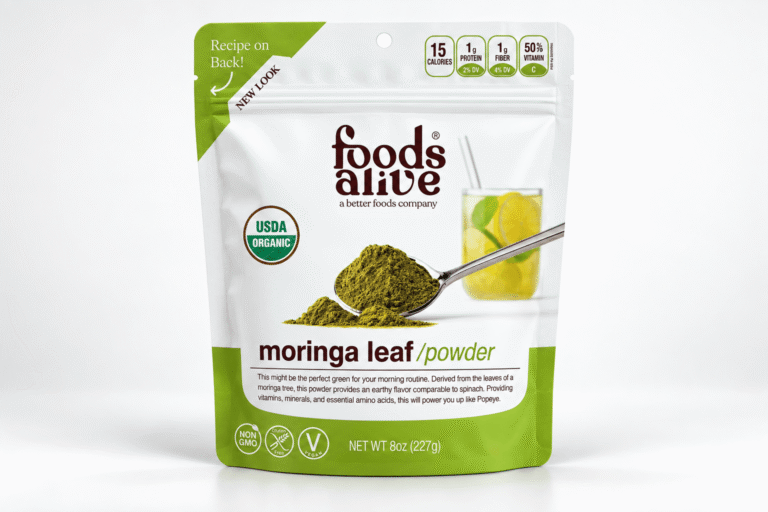
The Foods Alive moringa recall affects Organic Moringa Leaf Powder that may contain Salmonella. Consumers should stop using affected packages and check the printed identifiers before preparing another smoothie, drink or meal. Recalled food should not be consumed simply because previous servings caused no noticeable illness [1–3].
For anyone who has already used the powder, the immediate priorities are to prevent further exposure, watch for symptoms and recognize when medical care is needed. Salmonella symptoms can take several days to develop, so feeling well immediately after consumption does not rule out a later illness [4].
Foods Alive Moringa Recall: Which Packages Are Affected?
Check the product name, package size and both printed codes. The original recall identifies the following product [1].
| Identification detail | Recalled product |
|---|---|
| Brand | Foods Alive |
| Product | Organic Moringa Leaf Powder |
| Package | 8 ounce upright pouch |
| Freshest by code | 110127 |
| Number printed below the date | 02726 |
| Shipment period | January 27 through August 7, 2026 |
| Distribution | Retail stores nationwide and online sellers, including the company website |
| Company contact | 260-488-4497 |
Match the details rather than relying only on the pouch’s appearance or the word “moringa.” Recall notices identify particular products and batches, and a similar product name does not establish that two packages come from the same manufacturer [2,3].
When a code is missing or unreadable, set the powder aside and contact the company before using it. A photograph of the remaining label and your order confirmation may help resolve the uncertainty. An unidentified container should not be assumed unaffected merely because its original packaging has been discarded.
Why Was the Moringa Powder Recalled?
A supplier notified Foods Alive that a retail sample of its super green powder mix tested positive for Salmonella. Foods Alive suspended production and distribution while the contamination source remained under investigation. No associated illnesses had been reported when the recall was announced [1].
A food recall and a confirmed illness outbreak are not the same thing. A recall can remove a potentially hazardous product before illnesses are identified. Consumers should therefore follow the instructions without waiting for a reported case or proof that their individual package contains bacteria [2,3].
What Should You Do With Recalled Moringa Powder?
Stop using it and arrange a refund
Foods Alive advises returning affected pouches to the place of purchase for a full refund [1].
Keep the pouch closed and separate from ingredients that someone else might use. For an online purchase, contact the seller about the recall return process. Photographing the packaging before returning it preserves the details you may need for a refund or medical discussion.
When disposal is necessary, FDA guidance recommends securely wrapping contaminated recalled food before placing it in the trash. Do not donate the powder, share it with another household or feed it to pets [2].
Discard mixtures already prepared with it
Throw away food or drinks prepared with the recalled powder. This includes a smoothie stored in the refrigerator or another mixture containing the affected ingredient. Adding fresh ingredients does not change the instruction to discard food made with a recalled product [3].
There is no need to throw away every unrelated ingredient in your kitchen. Focus on the recalled product, prepared mixtures containing it and equipment or surfaces that may have been contaminated [3].
Clean the equipment and surfaces it touched
Wash reusable scoops, blender components, storage containers and preparation surfaces with hot, soapy water. Sanitize appropriate food contact surfaces afterward, following the sanitizer’s directions and the equipment manufacturer’s cleaning instructions. Wash your hands after handling the product and completing the cleanup [2,3].
What Happens if You Already Consumed the Powder?
When you feel well
Stop further use and watch for symptoms over the following days. Salmonella symptoms usually begin between 6 hours and 6 days after infection. A serving taken without immediate symptoms should not be treated as evidence that the remaining powder is safe [3,4].
Write down when you last consumed it and keep the product identifiers available. Exposure alone does not establish a diagnosis, and antibiotics should not be self prescribed. A healthcare professional can decide whether your circumstances warrant assessment or testing [6].
When diarrhea, fever or stomach cramps develop
Contact a healthcare professional and mention the recalled product. Describe when symptoms started, whether you have fever or blood in the stool, and whether you can drink and urinate normally. These details help the clinician assess the illness and possible dehydration [4,6,8].
Begin replacing fluids lost through diarrhea or vomiting. Oral rehydration solutions can be useful, particularly for children. Take small, frequent sips when nausea makes drinking difficult. Worsening dehydration requires medical assessment rather than continued reliance on home care [7,8].
Salmonella Symptoms and When to Seek Medical Care
Salmonella commonly causes diarrhea, fever and stomach cramps. Some people also develop nausea, vomiting, headache or loss of appetite. Diarrhea may contain blood or mucus, and symptoms usually last 4 to 7 days [4].
The following warning signs should guide the decision to seek help [4,8].
| Warning sign | Recommended action |
|---|---|
| Bloody diarrhea or fever above 102°F | Contact a healthcare professional promptly. |
| Diarrhea or vomiting lasting more than 2 days | Arrange medical assessment. |
| Very little urine, dark urine, dry mouth, dizziness or a child crying without tears | Seek prompt assessment for possible dehydration. |
| Inability to replace lost fluids or worsening weakness | Seek urgent medical care. |
| Confusion, loss of consciousness or a marked change in alertness | Seek emergency medical care immediately. |
These thresholds are not reasons to delay care for a sick infant or someone with a weakened immune system. Dehydration can develop quickly in young children, while severe dehydration may require fluids through a vein in a hospital [4,8].
Who Is More Vulnerable to Serious Illness?
Anyone can develop a Salmonella infection, but some people are more vulnerable. CDC identifies children younger than 5, especially infants, adults 65 and older, and people with weakened immune systems among the groups at increased risk. Adults 50 and older with underlying medical problems, including heart disease, also need particular attention [5].
For these individuals, contact the treating clinician early if symptoms develop. Report the recalled product exposure rather than assuming that new diarrhea, fever or weakness is a routine stomach upset. Decisions about testing and treatment may differ from those for an otherwise healthy adult [5,6].
Do You Need a Stool Test or Antibiotics?
Testing depends on the clinical situation
A healthcare professional may request a stool sample when Salmonella infection is suspected. Laboratory testing helps confirm the cause and can provide information needed to select an antibiotic when treatment is appropriate. Symptoms alone cannot reliably identify the responsible germ [6].
Bring the product name and codes to the consultation, along with a brief symptom timeline. This helps keep the exposure information accurate without assuming that every illness occurring after consumption was caused by the powder.
Most people recover without antibiotics
Most people with Salmonella diarrhea recover with supportive care, including replacement of fluids and electrolytes. Antibiotics are generally reserved for severe infections or people at increased risk of infection spreading beyond the intestines. In otherwise healthy patients, antibiotics generally do not shorten the diarrhea or fever [6,7].
Diarrhea medicines require caution
Speak with a healthcare professional before taking an antidiarrheal medicine. CDC advises against these medicines when diarrhea is bloody, occurs with fever or has lasted more than 2 days, because they may prolong the illness. Medicines containing bismuth subsalicylate should not be given to children younger than 12 [7].
Why Can Bacteria Survive in a Dry Powder?
Dryness does not necessarily eliminate Salmonella. In a laboratory study published in Food Control, researchers examined bacterial survival in chili, cinnamon and black pepper powders stored for a year at approximately 70°F. Survival varied with the powder and moisture conditions, and Salmonella remained detectable in black pepper after 12 months [9].
The study did not test Foods Alive moringa powder, examine affected consumers or estimate the risk from a particular pouch. Its relevance is narrower: harmful bacteria can persist in some dry ingredients, so time spent in a cupboard cannot be relied upon to make a contaminated powder safe [9].
Frequently Asked Questions
Does an unopened pouch need to be returned?
Yes, when its identifiers match the recall. An intact seal does not override a recall notice. Leave the pouch closed and follow the return or disposal instructions rather than opening it to inspect the contents.
Can I use the recalled powder in hot tea or cooked food?
Do not use it. Follow the recall instructions instead of attempting to make the product safe through home heating. This advice also applies to food already prepared with the recalled ingredient.
Is this connected to earlier moringa outbreaks?
The Foods Alive announcement does not establish such a connection. CDC closed a previous investigation involving other moringa products on July 22, 2026. Case totals from that investigation should not be presented as illnesses caused by Foods Alive.
Can I spread Salmonella to other people?
Yes. Wash your hands thoroughly with soap and water, particularly after using the bathroom, and avoid preparing food for others while ill. Continue careful hygiene after diarrhea ends because Salmonella can still be passed in stool.
Where should I report suspected illness?
Contact your healthcare professional first for assessment and treatment. Suspected illness associated with an FDA regulated food can also be reported through the FDA’s consumer complaint channels. Keep photographs of the packaging and relevant purchase information available.
References
[1] Foods Alive Inc. (2026, September 4). Foods Alive recalls organic moringa leaf powder because of possible health risk. U.S. Food and Drug Administration. Original company announcement documenting the affected package, printed codes, supplier notification and refund instructions.
https://www.fda.gov/safety/recalls-market-withdrawals-safety-alerts/foods-alive-recalls-organic-moringa-leaf-powder-because-possible-health-risk
[2] U.S. Food and Drug Administration. (n.d.). Food recalls: What you need to know. Explains recall identification, safe disposal, cleaning and reporting suspected illness.
https://www.fda.gov/food/buy-store-serve-safe-food/food-recalls-what-you-need-know (U.S. Food and Drug Administration)
[3] FoodSafety.gov. (2025, July 17). Recalls and outbreaks. Provides guidance on matching recalled products, discarding prepared food and cleaning contaminated surfaces.
https://www.foodsafety.gov/recalls-and-outbreaks
[4] Centers for Disease Control and Prevention. (2024, October 4). Symptoms of Salmonella infection. Describes symptom onset, usual duration, dehydration signs and reasons to seek medical care.
https://www.cdc.gov/salmonella/signs-symptoms/index.html
[5] Centers for Disease Control and Prevention. (2024, October 4). About Salmonella infection. Identifies groups at increased risk of infection or serious illness.
https://www.cdc.gov/salmonella/about/index.html (CDC)
[6] Centers for Disease Control and Prevention. (2024, October 7). Clinical overview of salmonellosis. Explains diagnostic testing, supportive care and selective antibiotic treatment.
https://www.cdc.gov/salmonella/hcp/clinical-overview/index.html
[7] Centers for Disease Control and Prevention. (2024, October 11). Treatment of Salmonella infection. Covers hydration, antidiarrheal precautions and preventing transmission to others.
https://www.cdc.gov/salmonella/treatment/index.html
[8] A.D.A.M., Inc. (2025, July 1). Dehydration. MedlinePlus Medical Encyclopedia. Explains dehydration symptoms, emergency warning signs and hospital treatment when fluid loss is severe.
https://medlineplus.gov/ency/article/000982.htm
[9] Xie, Y., Zhang, S., Sun, S., Zhu, M.-J., Sablani, S., & Tang, J. (2022). Survivability of Salmonella and Enterococcus faecium in chili, cinnamon and black pepper powders during storage and isothermal treatments. Food Control, 137, Article 108935. Laboratory study demonstrating prolonged bacterial survival in certain dry powders; it did not evaluate the recalled moringa product.
https://wpcdn.web.wsu.edu/wp-labs/uploads/sites/1254/2022/03/364-Xie-2022-FC.pdf
[10] Centers for Disease Control and Prevention. (2026, July 22). Salmonella outbreak linked to moringa leaf powder. Documents an earlier investigation involving other moringa products and its closure date.
https://www.cdc.gov/salmonella/outbreaks/supergreenssupplementpowders-1-26/index.html (CDC)