

September 7, 2026
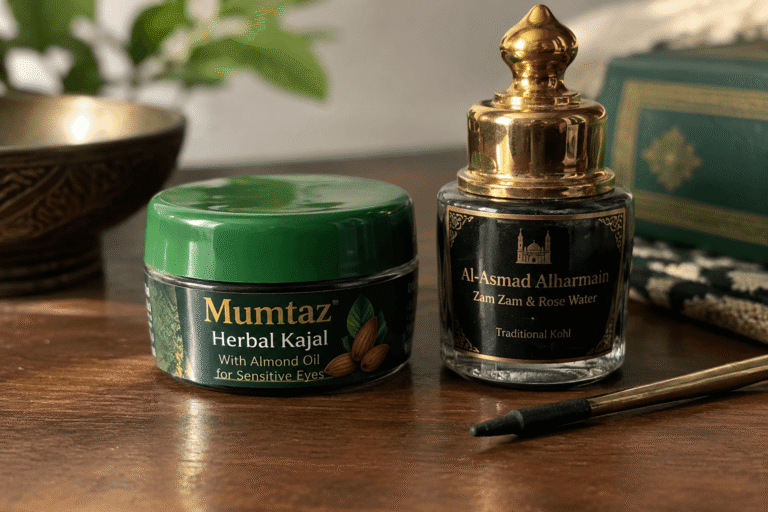
Lead in kajal has prompted Health Canada to recall two traditional eye cosmetics because their lead content exceeds cosmetic impurity limits. Consumers should stop using the affected products and return them to Sara Islamic Store for a refund [1].
The concern extends beyond eye irritation. Lead exposure can occur without obvious symptoms, particularly in children. Anyone who has used a recalled cosmetic should consider the exposure history rather than wait for visible signs of illness before seeking medical advice [2].
Which Kajal and Kohl Products Were Recalled?
| Recall detail | Information |
|---|---|
| First product | Mumtaz: Herbal Kajal With Almond Oil for Sensitive Eyes |
| Second product | Al-Asmad Alharmain Zam Zam & Rose Water |
| Recall date | September 4, 2026 |
| Sales period | January through August 2026 |
| Reported sales | 576 units of each product |
| Importer | Sara Islamic Store, Mississauga, Ontario |
| Listed origins | India and United Arab Emirates |
| Recall identification | RA-82595 |
The company had received no reports of incidents or injuries as of August 28, 2026. The notice does not publish lot numbers or measured lead concentrations [1].
This notice confirms a recall in Canada; it does not establish recall status elsewhere. For refund inquiries, contact Sara Islamic Store at 437-246-8899 or saraislamicstore2@gmail.com [1].
Why Lead in Kajal Is a Health Concern
Health Canada’s guidance sets a lead impurity limit of 10 parts per million, or ppm, in cosmetics. This measures lead in the product, not the amount absorbed by someone using it. The guidance also recognizes that metals can enter cosmetic ingredients through contaminated raw materials [3].
Some traditional kohl preparations contain lead sulfide, a mineral compound that can account for a substantial proportion of the product. This is different from assuming that every eyeliner contains the same ingredients or presents the same risk [4,5].
Exposure is not limited to absorption through skin. Cosmetic residue can transfer from hands to the mouth and be swallowed, an important concern when products are applied to young children. Skin absorption of heavy metals is generally low, but that does not eliminate other exposure routes [3].
Children are especially vulnerable because lead can affect the developing brain, learning, attention, and behavior. In adults, exposure can contribute to kidney damage and cardiovascular problems. During pregnancy, lead in the mother’s blood can expose the developing baby. No blood lead concentration is known to be free of harmful effects [6].
What to Do After Using an Affected Product
Keep the closed container and applicator away from children while arranging the return. Enclose the product securely to prevent access or spills, and wash your hands after handling it. Photograph the packaging so the product can be identified during a medical consultation [4,8].
Tell your clinician who used the cosmetic, how often it was applied, and when use stopped. Mention whether it was used on a child or during pregnancy or breastfeeding. FDA guidance specifically recommends asking about lead testing for children and pregnant or nursing women who have used these traditional eye cosmetics [5].
Do not assume that washing away visible makeup establishes whether exposure occurred. A blood test, rather than the appearance of the eyes or skin, is used to assess lead exposure [2].
Lead Poisoning Symptoms and When to Seek Care
Lead exposure may cause symptoms that resemble common illnesses, including abdominal pain, constipation, headaches, fatigue, and irritability. These symptoms do not prove lead poisoning, but the history of cosmetic use can help a clinician decide what to investigate [7].
| Situation | What it means | Recommended action |
|---|---|---|
| No symptoms despite using the product | Lead exposure cannot be excluded by appearance or how someone feels | Ask about blood lead testing, particularly for a child or someone pregnant or breastfeeding [2,5] |
| Persistent abdominal discomfort, constipation, headaches, fatigue, or irritability | These symptoms have several possible causes, including lead exposure | Contact a clinician promptly and mention the cosmetic [7] |
| Severe abdominal pain with repeated vomiting, confusion, seizures, or loss of consciousness | These are warning signs requiring urgent assessment | Seek emergency medical care rather than waiting for a routine appointment [8] |
Who Should Have a Blood Lead Test?
A blood lead test is the best way to determine whether a child has an elevated blood lead level. Children with possible exposure should be assessed even when they appear healthy. Adults should discuss testing with a clinician based on their exposure history, symptoms, and circumstances [2,5,7].
An initial childhood screening test may use blood from a finger prick. If that result is elevated, a sample taken from a vein is generally needed for confirmation because lead on the skin can contaminate a finger prick sample. The urgency of confirmation and subsequent testing depends on the result [2,8].
Does Exposure Automatically Require Treatment?
Using a contaminated cosmetic does not automatically mean someone needs chelation, a prescription treatment that removes lead from the body. Management depends on the blood lead level and clinical findings. Care may include removing exposure sources, repeat testing, assessing iron deficiency, reviewing nutrition, and monitoring childhood development [8].
Do not start a commercial heavy metal cleanse or an unapproved chelation product. FDA warns that these products can cause serious harm, including dehydration and kidney failure, and may delay appropriate care [9].
What Research Shows About Traditional Eye Cosmetics
A 2024 investigation published in the CDC’s Morbidity and Mortality Weekly Report described elevated blood lead levels in a mother and her four children over an 11-year period. Investigators identified surma as the only potential exposure source common to the cases. An available sample contained 390,000 ppm of lead [10].
The investigation concerned a different product, not the two cosmetics in this recall. Its findings cannot be used to estimate their lead concentrations. However, the report demonstrates why a shared cosmetic can warrant assessment of several family members and why an absence of symptoms does not rule out exposure [10].
Frequently Asked Questions
Does “Herbal” Mean Kajal Is Free of Lead?
No. A botanical ingredient or a “herbal” description does not establish that the finished cosmetic has been tested for heavy metals. Lead can enter products through raw materials, so safety cannot be determined from those words alone [3].
Is Every Eyeliner Labeled “Kohl” Dangerous?
No. Health Canada distinguishes traditional kohl preparations from modern eyeliners that may use “kohl” as a product description. The name alone does not establish the formulation. Avoid assuming either that all such products are contaminated or that an unfamiliar product is safe [4].
Does Using Kajal Once Mean Someone Has Lead Poisoning?
Not necessarily. Exposure depends on factors including the product’s composition, the amount transferred into the body, and the pattern of use. A single application does not establish a diagnosis, but suspected exposure in a child deserves medical advice rather than reassurance based only on a lack of symptoms [2,3].
References
- Health Canada. (2026, September 4). Traditional kohl products recalled due to chemical hazard. Government of Canada.
https://recalls-rappels.canada.ca/en/alert-recall/traditional-kohl-products-recalled-due-chemical-hazard
Official product identification, sales information, and refund instructions. (Recalls and Safety Alerts) - Centers for Disease Control and Prevention. (2026, March 11). Testing for lead poisoning in children.
https://www.cdc.gov/lead-prevention/testing/index.html
Explains testing after possible exposure, the absence of symptoms, and differences between capillary and venous samples. - Health Canada. (2017, October 2). Guidance on heavy metal impurities in cosmetics. Government of Canada.
https://www.canada.ca/en/health-canada/services/consumer-product-safety/reports-publications/industry-professionals/guidance-heavy-metal-impurities-cosmetics.html
Describes the 10 ppm lead impurity limit, contamination of raw materials, and potential exposure routes. - Health Canada. (2016, December 6). Health concerns about lead in traditional kohl. Government of Canada.
https://www.canada.ca/en/health-canada/services/cosmetics/health-concerns-about-lead-traditional-kohl.html
Provides background safety advice and distinguishes traditional kohl from modern eyeliner. - U.S. Food and Drug Administration. (n.d.). Kohl, kajal, al-kahal, surma, tiro, tozali, or kwalli: By any name, beware of lead poisoning.
https://www.fda.gov/cosmetics/cosmetic-products/kohl-kajal-al-kahal-surma-tiro-tozali-or-kwalli-any-name-beware-lead-poisoning
Explains lead-containing traditional eye cosmetics and recommends testing advice for exposed children and pregnant or nursing women. - World Health Organization. (2026, June 10). Lead poisoning.
https://www.who.int/news-room/fact-sheets/detail/lead-poisoning-and-health
Summarizes developmental, pregnancy, kidney, and cardiovascular risks associated with lead exposure. - Centers for Disease Control and Prevention, National Institute for Occupational Safety and Health. (2024, April 11). Symptoms of lead exposure.
https://www.cdc.gov/niosh/lead/signs-symptoms/index.html
Describes symptoms following short and prolonged exposures and explains why lead poisoning may resemble other illnesses. - Centers for Disease Control and Prevention. (2025, August 21). Recommended actions based on blood lead level.
https://www.cdc.gov/lead-prevention/hcp/clinical-guidance/index.html
Provides guidance on confirmatory testing, follow-up care, urgent symptoms, and specialist treatment. - U.S. Food and Drug Administration. (n.d.). Questions and answers on unapproved chelation products.
https://www.fda.gov/drugs/medication-health-fraud/questions-and-answers-unapproved-chelation-products
Explains why unsupervised chelation and commercial detoxification claims can expose consumers to harm. - Hore, P., Sedlar, S., & Ehrlich, J. (2024). Lead poisoning in a mother and her four children using a traditional eye cosmetic—New York City, 2012–2023. Morbidity and Mortality Weekly Report, 73(30), 667–671.
https://www.cdc.gov/mmwr/volumes/73/wr/mm7330a2.htm
A family case investigation identifying surma as the likely shared exposure source and demonstrating the importance of sustained follow-up.