


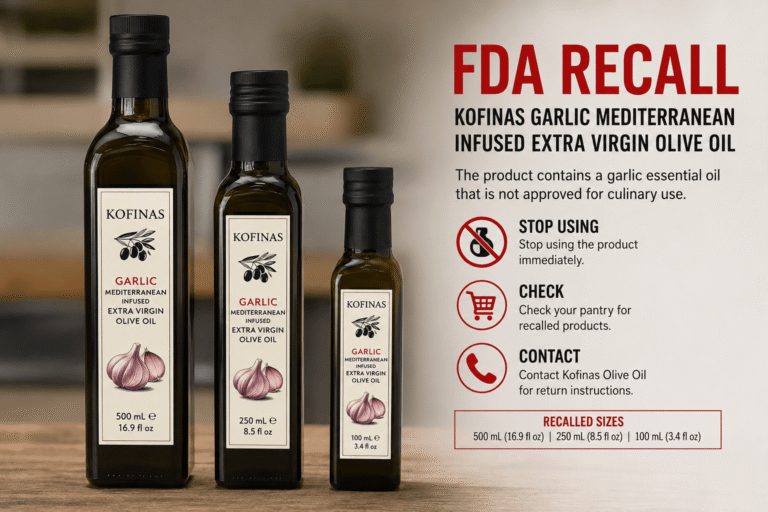
Updated September 1, 2026
The FDA garlic olive oil recall covers Kofinas Garlic Mediterranean Infused Extra Virgin Olive Oil sold in three glass bottle sizes. LMSI LLC voluntarily recalled the product because it was made with a garlic essential oil that the recall announcement describes as not approved for culinary use.
The affected oil was available from August 31, 2025, through August 27, 2026, at two Cincinnati retail locations and through direct online orders from the company’s website. No illnesses had been reported when the FDA published the announcement on August 31, 2026. Consumers who have the recalled oil should stop using it, avoid tasting it to determine whether it seems safe, and contact Kofinas Olive Oil for instructions [1].
Technically, this is a voluntary company recall posted by the FDA as a public service. The public notice does not state that the FDA ordered the recall.
Which Kofinas Garlic Olive Oil Was Recalled?
The recall applies specifically to Kofinas Garlic Mediterranean Infused Extra Virgin Olive Oil. Other olive oil brands and other Kofinas products are not identified in the announcement.
Recalled Kofinas olive oil details
| Recall detail | Information consumers should check |
|---|---|
| Brand | Kofinas |
| Product name | Garlic Mediterranean Infused Extra Virgin Olive Oil |
| Company | LMSI LLC, also identified as Kofinas Olive Oil |
| Container | Glass bottle |
| Recalled sizes | 500 mL, about 16.9 fluid ounces; 250 mL, about 8.5 fluid ounces; and 100 mL, about 3.4 fluid ounces |
| Sale dates | August 31, 2025, through August 27, 2026 |
| Retail location 1 | Montgomery Store and Infusion Kitchen, 8210 Market Place Lane, Cincinnati, Ohio 45242 |
| Retail location 2 | Findlay Market, 1801 Race Street, Cincinnati, Ohio 45202 |
| Online sales | Direct orders through the Kofinas Olive Oil website |
| Recall reason | Garlic essential oil not approved for culinary use |
| Reported illnesses | None reported when the announcement was published |
| Lot number, UPC or best by date | Not provided in the public recall announcement |
The public notice does not identify a particular lot number, UPC, production date or expiration date. Consumers should therefore compare the brand, exact product name, bottle size, place of purchase and purchase date with the information above [1].
People who purchased another type of Kofinas oil should not automatically assume that it is recalled. The announcement names only the garlic flavored extra virgin olive oil.
Why Was the Garlic Infused Olive Oil Recalled?
LMSI LLC stated that the olive oil was recalled because it contained a garlic essential oil that was not approved for culinary use [1]. The announcement does not identify a pathogen, undeclared allergen, pesticide, heavy metal or other specific contaminant. It also does not disclose the concentration, supplier, manufacturing method or chemical specifications of the essential oil.
This distinction matters. The notice does not establish that every garlic essential oil is illegal or unsafe in food.
What does “not approved for culinary use” mean?
Ingredients intentionally added to food must have an appropriate legal basis for their intended use. They may be approved food additives, generally recognized as safe under specified conditions, or otherwise exempt from the legal definition of a food additive. The safety assessment must apply to the substance, its intended purpose and the conditions under which it is used [2,3]. (Federal Register)
Federal food regulations recognize garlic derivatives, including essential oils, as potential flavoring ingredients. However, garlic oil used in food must meet applicable specifications and must not be used above levels consistent with good manufacturing practice [2]. Therefore, the recall appears to concern the particular essential oil used in this product or the conditions surrounding its food use, rather than a blanket prohibition on garlic oil. (Federal Register)
The announcement does not explain whether the issue involved purity specifications, ingredient documentation, processing, formulation, intended use or another compliance requirement. Until additional information is released, it would be inaccurate to claim that a specific poison or contaminant was found.
Why an essential oil is different from ordinary garlic
Garlic essential oil is a concentrated volatile extract containing sulfur based compounds such as diallyl sulfide, diallyl disulfide and diallyl trisulfide. Its composition can vary substantially according to the garlic source, extraction technique, processing temperature and formulation [9,10]. (PubMed)
A recent review found that most of the available safety evidence for garlic oil came from laboratory and animal studies rather than extensive long term human trials. The authors concluded that processing differences and uncertain dosage standards remain important safety considerations [10]. This evidence cannot determine the risk posed by the recalled Kofinas oil because its essential oil concentration and specifications have not been publicly disclosed. (Springer)
Is This a Botulism Recall?
No. The FDA announcement does not describe the Kofinas recall as a botulism incident. It does not identify Clostridium botulinum, botulinum toxin, improper refrigeration or microbial contamination. The stated reason is the use of a garlic essential oil not approved for culinary use [1]. (U.S. Food and Drug Administration)
Garlic stored in oil can nevertheless raise a separate food safety concern when prepared at home. Garlic is a low acid food, and an oxygen limited oil environment may permit botulinum toxin formation under unsafe storage conditions. The CDC advises refrigerating homemade oils containing garlic or herbs and discarding them after four days [8]. This general guidance should not be confused with the stated reason for the Kofinas recall. (CDC)
What Should Consumers Do With the Recalled Garlic Olive Oil?
Consumers should take the following precautions even when the oil looks, smells and tastes normal:
- Stop using the oil immediately. Do not use it in salad dressing, marinades, bread dipping sauces, pasta, vegetables or cooked dishes.
- Do not taste test it. Appearance, odor and flavor cannot confirm that an ingredient meets food safety requirements.
- Check the label and purchase history. Look for the Kofinas brand, the exact garlic Mediterranean infused product name, one of the three recalled bottle sizes and a purchase within the stated sale window.
- Set the bottle aside securely. Keep it sealed and away from children and pets. Do not give it away, donate it or transfer it into another container.
- Contact Kofinas Olive Oil. The company lists 513-325-5502 and 513-981-1412 for consumer questions and return or refund instructions [1].
The announcement specifically states that a customer who reports a reaction will receive a full refund. Consumers without symptoms should still contact the company rather than assuming the same refund procedure applies.
If the recalled oil has already been mixed into a dish, the safest course is not to serve the dish. Heating, baking or boiling should not be treated as a reliable remedy because the recall involves the regulatory suitability of an ingredient, not a simple undercooking problem.
What Health Problems Could the Recalled Olive Oil Cause?
No specific illness pattern has been linked to the recalled oil, and no illnesses were reported in the FDA announcement [1]. Because the notice does not identify the essential oil’s concentration, purity issue or possible contaminant, the probability and severity of harm cannot currently be calculated.
Possible symptoms discussed below are general warning signs associated with garlic reactions, concentrated essential oil exposure or foodborne illness. They are not evidence that the recalled oil has caused these effects.
Garlic consumed orally can cause nausea, abdominal pain, gas and allergic reactions in some people. Concentrated garlic products may also affect bleeding, particularly in people taking anticoagulants, aspirin or other medicines that influence clotting [6].
Essential oils vary considerably in composition and potency. Some essential oil products can cause poisoning when swallowed, and aspiration into the lungs during choking or vomiting can cause serious lung injury. Poison Control advises obtaining individualized guidance whenever someone swallows an essential oil or a product containing essential oils and there is concern about the exposure [5].
Symptoms and recommended action
| Symptoms or situation | Recommended action |
|---|---|
| No symptoms after eating the oil | Stop further use. No special laboratory testing is recommended in the recall notice. Monitor for symptoms and keep the bottle and purchase information available. |
| Mild nausea, heartburn, stomach cramps, gas or loose stools | Stop using the oil, drink fluids as tolerated and contact a clinician if symptoms persist, worsen or affect a medically vulnerable person. |
| Hives, facial swelling, swollen lips or tongue, wheezing, throat tightness, faintness or difficulty breathing | Call 911 immediately. These can be signs of a severe allergic reaction. |
| Choking, persistent coughing, chest discomfort or shortness of breath after swallowing | Obtain urgent medical help because oil entering the lungs can cause aspiration injury. Call 911 for breathing difficulty. |
| Repeated vomiting, severe abdominal pain, unusual confusion, extreme sleepiness or a seizure | Seek emergency evaluation and contact Poison Control at 1-800-222-1222. |
| Bloody diarrhea, diarrhea lasting longer than three days, fever above 102°F, frequent vomiting or signs of dehydration | Seek medical care promptly. These are CDC warning signs of potentially severe foodborne illness [7]. |
| Unusual bruising or bleeding in someone taking a blood thinner or aspirin | Contact the prescribing clinician promptly. Do not stop a prescribed medicine without medical guidance. |
The most common foodborne illness symptoms include diarrhea, abdominal cramps, nausea, vomiting and fever. Reduced urination, dry mouth, dizziness while standing or an inability to keep fluids down may indicate dehydration [7].
Who Should Be Especially Cautious?
Everyone with the recalled bottle should stop using it. A lower threshold for contacting a clinician or Poison Control is appropriate for:
People with a known allergy to garlic or other ingredients in the product should watch carefully for hives, swelling, wheezing or breathing problems. Children and people with swallowing difficulties may be more vulnerable to choking or aspiration if oil is swallowed. Poison Control also notes that children may be more susceptible to some essential oil effects than adults [5].
People taking warfarin, apixaban, rivaroxaban, dabigatran, clopidogrel, aspirin or another medicine that affects bleeding should not consume the recalled oil. Garlic supplements can increase bleeding risk, although the degree of risk from this particular product is unknown because the essential oil concentration has not been disclosed [6]. Do not discontinue a prescribed blood thinner without guidance from the clinician managing it.
Pregnant or breastfeeding individuals should also avoid the recalled product. Normal culinary quantities of garlic differ from concentrated garlic preparations, and safety information for amounts exceeding ordinary food exposure is limited [6].
Older adults, people with serious chronic disease, and those with impaired immunity should seek medical advice sooner if vomiting, diarrhea, fever, dehydration or an allergic reaction develops.
What to Do If You Already Ate the Recalled Oil
A person who consumed the oil but feels well should stop further exposure and monitor for symptoms. The FDA notice does not recommend preventive blood tests, scans, detoxification, medication or emergency treatment for an asymptomatic consumer [1].
Record approximately how much was eaten, when it was consumed, whether it was heated or mixed with other foods, and whether anyone else ate the same meal. Keep the bottle, label, receipt and online order confirmation. These details may help a clinician, Poison Control, the company or a food safety investigator evaluate the exposure.
Do not induce vomiting unless Poison Control or a qualified medical professional specifically directs you to do so. Vomiting can increase the chance that oil will enter the lungs.
For individualized advice about a possible essential oil ingestion, contact Poison Control at 1-800-222-1222 or use its online assessment service. Assistance is available 24 hours a day [5].
When to Seek Emergency Medical Care
Call 911 immediately if the person has:
Difficulty breathing, wheezing or throat tightness
Swelling of the face, lips, tongue or throat
Collapse, fainting or inability to awaken
A seizure
Severe choking or sudden shortness of breath
Confusion accompanied by severe illness
These symptoms require emergency assessment rather than waiting for the company or FDA to respond.
Seek prompt medical care for bloody diarrhea, a temperature above 102°F, diarrhea lasting more than three days, vomiting that prevents fluid intake, severe abdominal pain or dehydration [7].
How to Report an Illness or Reaction
Consumers should first obtain appropriate medical help. They can then report the reaction to Kofinas Olive Oil at 513-325-5502 or 513-981-1412 [1].
A food related illness, injury, allergic reaction or quality complaint can also be submitted to the FDA through the Safety Reporting Portal. Consumers who prefer telephone assistance may call 1-888-SAFEFOOD, or 1-888-723-3366, during the FDA Human Foods Program’s operating hours [4].
A useful report should include the exact product name, bottle size, purchase date and location, amount consumed, time symptoms began, medical treatment received, current medications and clear photographs of the front and back labels. Keep the original bottle unless the company or a regulator instructs otherwise.
Frequently Asked Questions
What garlic olive oil is being recalled?
Kofinas Garlic Mediterranean Infused Extra Virgin Olive Oil in 500 mL, 250 mL and 100 mL glass bottles is recalled. It was sold from August 31, 2025, through August 27, 2026, at two Cincinnati locations and through direct online orders
Why was Kofinas garlic olive oil recalled?
The company recalled it because the product used a garlic essential oil that the announcement describes as not approved for culinary use. The public notice does not disclose the oil’s concentration or the specific regulatory deficiency.
Have any illnesses been reported?
No illnesses involving the recalled product had been reported when the FDA published the announcement on August 31, 2026 [1]. Absence of reported illnesses does not mean consumers should continue using the product.
Is every garlic essential oil unsafe to eat?
No. Federal regulation recognizes garlic essential oils as possible food flavorings when they meet applicable specifications and are used according to good manufacturing practice [2]. The recall concerns the essential oil used in this particular product.
Is this a Class I FDA recall?
As of September 1, 2026, the public announcement does not state a Class I, Class II or Class III classification. The product should not be described as a Class I recall unless the FDA formally assigns and publishes that classification.
Is the recall related to botulism?
The announcement does not identify botulism or microbial contamination. Homemade garlic oils have a separate botulism risk and should be refrigerated and discarded after four days, according to the CDC.
Can cooking the recalled oil make it safe?
No validated cooking method has been provided. Consumers should not attempt to correct an ingredient approval or specification problem through heating. Stop using the oil and follow the company’s instructions.
What if I ate the oil and feel fine?
Stop consuming it and monitor for symptoms. The recall notice does not recommend special testing or treatment for people without symptoms. Contact Poison Control or a clinician if the amount consumed is concerning, the consumer is a child, or symptoms develop.
Are all Kofinas olive oils recalled?
No. The announcement specifically names Kofinas Garlic Mediterranean Infused Extra Virgin Olive Oil. It does not identify the company’s plain olive oil or other infused varieties as recalled.
References
- U.S. Food and Drug Administration. (2026, August 31). LMSI LLC/Kofinas Olive Oil issues a voluntary recall of its Garlic Mediterranean Infused Extra Virgin Olive Oil for using a garlic essential oil not approved for culinary use.
https://www.fda.gov/safety/recalls-market-withdrawals-safety-alerts/lmsi-llckofinas-olive-oil-issues-voluntary-recall-its-garlic-mediterranean-infused-extra-virgin
Official recall announcement containing the product name, bottle sizes, sale dates, locations, reason for recall, illness status and company contact information. - Electronic Code of Federal Regulations. (2026). 21 C.F.R. § 184.1317: Garlic and its derivatives.
https://www.ecfr.gov/current/title-21/chapter-I/subchapter-B/part-184/subpart-B/section-184.1317
Federal requirements governing garlic derivatives, garlic oil specifications, flavoring use and good manufacturing practice. - U.S. Food and Drug Administration. (2026). Generally recognized as safe.
https://www.fda.gov/food/food-ingredients-packaging/generally-recognized-safe-gras
Explains when substances intentionally added to food require food additive approval or a valid GRAS basis. - U.S. Food and Drug Administration. (2026). Get assistance from the FDA Human Foods Program.
https://www.fda.gov/food/resources-you-food/get-assistance-fda-human-foods-program-hfp
Official instructions for reporting food complaints, illnesses, injuries and allergic reactions. - National Capital Poison Center. (n.d.). Essential oils: Poisonous when misused. Retrieved September 1, 2026, from
https://www.poison.org/articles/essential-oils
Clinical toxicology guidance about swallowing essential oils, aspiration, allergic reactions, safe storage and Poison Control contact procedures. - National Center for Complementary and Integrative Health. (2025, February). Garlic: Usefulness and safety.
https://www.nccih.nih.gov/health/garlic
Evidence based information on garlic related gastrointestinal symptoms, allergies, bleeding risk, pregnancy precautions and medication interactions. - Centers for Disease Control and Prevention. (n.d.). Food poisoning symptoms. Retrieved September 1, 2026, from
https://www.cdc.gov/food-safety/signs-symptoms/index.html
Lists common foodborne illness symptoms and warning signs that require medical attention. - Centers for Disease Control and Prevention. (n.d.). Botulism prevention. Retrieved September 1, 2026, from
https://www.cdc.gov/botulism/prevention/index.html
Provides foodborne botulism prevention guidance, including storage and disposal advice for homemade garlic and herb oils. - Huang, L., Liu, Z., Wang, J., Fu, J., Jia, Y., Ji, L., & Wang, T. (2023). Bioactivity and health effects of garlic essential oil: A review. Food Science & Nutrition, 11(6), 2450–2470.
https://pubmed.ncbi.nlm.nih.gov/37324866/
Peer reviewed review describing garlic essential oil composition, organosulfur compounds and areas where further research is needed. - Zhang, S., Duan, H., Zhao, J., Guo, Y., Wang, L., & Yan, W. (2025). Discussion on the safety of garlic oil as a raw material for health food. Agricultural Products Processing and Storage, 1, Article 28.
https://link.springer.com/article/10.1007/s44462-025-00034-4
Recent open access review examining extraction methods, process dependent composition, toxicology evidence, dosage uncertainty and regulatory requirements.