

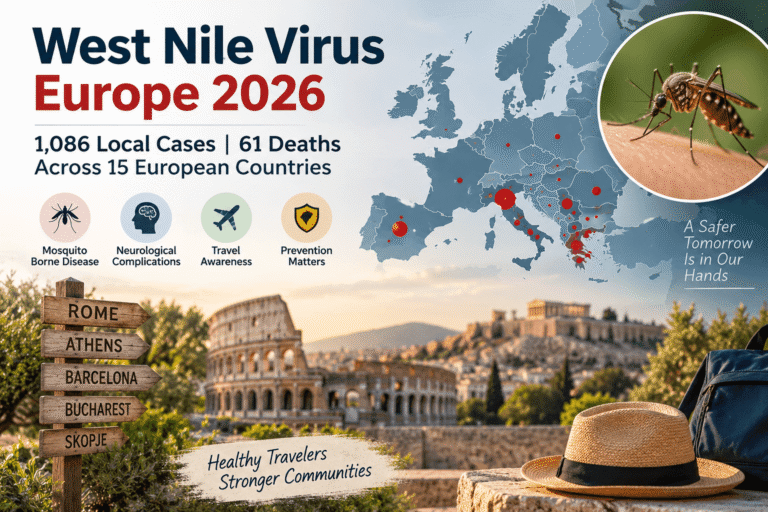
West Nile virus Europe 2026 has become one of the most important mosquito-borne disease updates of the season. According to European surveillance data, 1,086 locally acquired human West Nile virus infections and 61 deaths had been reported across 15 European countries through 3 September 2026 [1].
Italy and Greece are carrying the highest reported case burden, followed by Spain, Romania and North Macedonia. ECDC also reports that 161 affected areas had been identified across 15 European countries as of 10 September 2026 [1]. The agency describes the current season as one with intense West Nile virus circulation in humans and animals, although it has not found clear evidence that the virus is causing more severe disease than expected [1].
This does not mean every traveler or resident is at high risk. Most West Nile virus infections cause no symptoms. The concern is that a small proportion of infected people can develop serious neurological illness, especially older adults and people with weakened immunity or chronic diseases [2].
Latest West Nile Virus Europe 2026 Case Numbers
ECDC reports 1,086 locally acquired human West Nile virus infections in Europe through 3 September 2026. The leading countries are Italy with 516 cases, Greece with 284 cases, Spain with 88 cases, Romania with 56 cases and North Macedonia with 55 cases [1].
| Country | Reported local human cases | Reported deaths |
|---|---|---|
| Italy | 516 | 25 |
| Greece | 284 | 24 |
| Spain | 88 | 2 |
| Romania | 56 | 2 |
| North Macedonia | 55 | 7 |
| France | 36 | Not reported in the deaths list |
| Serbia | 18 | Not reported in the deaths list |
| Netherlands | 9 | 1 |
| Croatia | 7 | Not reported in the deaths list |
| Cyprus | 6 | Not reported in the deaths list |
| Austria | 4 | Not reported in the deaths list |
| Hungary | 3 | Not reported in the deaths list |
| Germany | 2 | Not reported in the deaths list |
| Albania | 1 | Not reported in the deaths list |
| Kosovo | 1 | Not reported in the deaths list |
The total reported deaths are 61, including 25 in Italy, 24 in Greece, seven in North Macedonia, two in Romania, two in Spain and one in the Netherlands [1].
Why the 2026 West Nile Virus Season Is Important
The 2026 West Nile virus season is important because the reported human case count is above the average seen at the same point during the previous decade. ECDC notes that 1,086 cases reported by 3 September exceed the 10-year average of 736 cases for the same period [1].
This suggests more intense virus circulation rather than simply a routine seasonal pattern. Reporting delays may also mean the current burden is underestimated [1]. ECDC expects that more human cases and animal outbreaks may be reported in the coming weeks because environmental conditions remain favorable for mosquito-borne transmission [1].
Countries and Areas Currently Affected
As of 10 September 2026, ECDC reported 161 affected areas across 15 countries in Europe [1]. These affected areas were identified in Italy, Greece, Romania, France, the Netherlands, Serbia, Croatia, Spain, North Macedonia, Hungary, Austria, Germany, Albania, Cyprus and Kosovo [1].
Italy remains the most affected country in 2026, reporting the highest number of human cases and avian outbreaks. Greece has recorded its highest number of human West Nile virus cases for this stage of the year. The Netherlands has reported its first human West Nile virus infections since 2020, with infections detected alongside bird and equid outbreaks across a broad geographic area [1].
North Macedonia is also experiencing an unusually large outbreak, especially around the capital region, where human infections and bird detections have been reported [1].
What Is West Nile Virus?
West Nile virus is a mosquito-borne viral infection. It circulates mainly between birds and mosquitoes. Humans and other mammals can become infected after being bitten by infected mosquitoes, but humans usually do not spread the virus further through mosquito bites [2].
In Europe, West Nile virus activity is usually linked to mosquito season, with most human infections reported between July and September [2]. Warmer weather, mosquito breeding conditions, wetlands, migratory bird routes and previous local virus activity can influence where cases appear [2].
How West Nile Virus Spreads
West Nile virus usually spreads when mosquitoes bite infected birds and later bite humans or animals [2]. Culex mosquitoes are important vectors in Europe, especially because they help maintain the bird mosquito transmission cycle [2].
Casual person-to-person spread does not occur. Rare human-to-human transmission has been documented through blood transfusion, organ or tissue transplantation, pregnancy, breastfeeding and laboratory exposure, but these are not the usual routes [2,3].
Symptoms of West Nile Virus Infection
Most people infected with West Nile virus do not develop symptoms. ECDC and WHO report that around 80% of human infections are asymptomatic [2,3].
When symptoms occur, they often resemble a viral fever. A patient may develop fever, headache, body pain, tiredness, muscle pain, vomiting, rash, eye pain or general weakness [2,3]. This milder illness is commonly called West Nile fever.
A small proportion of infected people develop neuroinvasive disease, where the virus affects the nervous system. This can present as meningitis, encephalitis or acute flaccid paralysis [2,4].
Warning Signs That Need Urgent Medical Care
Urgent medical evaluation is needed if a person develops high fever with severe headache, neck stiffness, confusion, drowsiness, tremors, convulsions, new muscle weakness, difficulty walking, facial weakness, paralysis or breathing difficulty after mosquito exposure or travel to an affected area [3,4].
These warning signs may suggest involvement of the brain, spinal cord or meninges. Severe neurological disease is uncommon, but it can be serious and may require hospitalization [3,4].
Who Has a Higher Risk of Severe Disease?
Older adults have a higher risk of serious illness from West Nile virus. People with weakened immunity, transplant history, cancer, diabetes, kidney disease, high blood pressure, blood disorders or other chronic conditions may also have higher risk [2,4].
This is why prevention matters most for elderly people, immunocompromised patients, people with chronic illness and travelers spending time in affected regions during mosquito season.
Diagnosis and Treatment
West Nile virus diagnosis may involve blood tests, cerebrospinal fluid testing, antibody testing and molecular tests, depending on the clinical situation [2,3]. In patients with neurological symptoms, doctors may also evaluate for meningitis, encephalitis or other causes of brain and nerve inflammation [4].
There is no specific antiviral cure for West Nile virus infection and no human vaccine currently available [2,3]. Treatment is supportive. Mild illness may need rest, fluids and symptom control under medical advice. Severe neuroinvasive disease may require hospitalization, intravenous fluids, respiratory support, seizure management and prevention of secondary complications [3].
How to Reduce the Risk of West Nile Virus
The most practical protection is avoiding mosquito bites. People in affected areas should use mosquito repellent, wear clothing that covers the arms and legs, use window screens, sleep in screened or air-conditioned rooms and reduce stagnant water around homes [2,3].
Travelers should be especially cautious during evening and night hours when Culex mosquitoes may be active. People with high-risk medical conditions should take prevention seriously and seek medical advice quickly if symptoms appear after mosquito exposure.
Ayurvedic and Natural Support Perspective
West Nile virus is a modern virological diagnosis and should not be treated casually at home when neurological symptoms are present. Emergency symptoms such as confusion, paralysis, seizures, neck stiffness or severe weakness need immediate hospital care.
Ayurveda can be considered only as supportive care after proper medical assessment, especially for post-fever weakness, appetite recovery, digestion, sleep, strength and convalescence. Classical Ayurveda discusses fever conditions under Jwara, including the importance of assessing strength, digestion, dosha involvement and stage of illness before treatment. This is described in Charaka Samhita, Nidana Sthana, Jwara Nidana and Charaka Samhita, Chikitsa Sthana, Jwara Chikitsa [6].
Any herbal or Ayurvedic support should be individualized by a qualified physician. Patients should not delay testing, hospitalization or neurological evaluation when warning signs are present.
What This Means for Patients and Travelers
The rise in West Nile virus Europe 2026 cases is a genuine public health signal, not just a seasonal headline. Italy, Greece, Spain, Romania and North Macedonia have the largest reported case numbers, while the Netherlands development is important because local human infections have reappeared after several years [1].
For most healthy people, the individual risk of severe illness remains low. For older adults, immunocompromised patients and people with chronic illness, the safest approach is strict mosquito protection and early medical evaluation if symptoms develop.
FAQ
Is West Nile virus spreading in Europe in 2026?
Yes. ECDC reports 1,086 locally acquired human West Nile virus infections across 15 European countries through 3 September 2026, with 61 deaths reported [1].
Which European countries have the most West Nile virus cases in 2026?
Italy has reported the highest number of cases, followed by Greece, Spain, Romania and North Macedonia [1].
Is West Nile virus contagious from person to person?
West Nile virus is not spread through casual contact. It usually spreads through infected mosquito bites. Rare transmission can occur through blood transfusion, organ transplantation, pregnancy, breastfeeding or laboratory exposure [2,3].
What are the serious symptoms of West Nile virus?
Serious symptoms may include high fever, severe headache, neck stiffness, confusion, tremors, convulsions, muscle weakness, paralysis or coma. These symptoms need urgent medical care [3,4].
Is there a vaccine or specific medicine for West Nile virus?
No human vaccine and no specific antiviral treatment are currently available. Treatment is supportive and depends on the severity of illness [2,3].
References
- European Centre for Disease Prevention and Control. (2026, September 11). Communicable disease threats report, 5 to 11 September 2026, week 37. European Centre for Disease Prevention and Control.
Clean URL: https://www.ecdc.europa.eu/sites/default/files/documents/Communicable-disease-threats-report-week-37-2026.pdf - European Centre for Disease Prevention and Control. (2023, December 15). Factsheet about West Nile virus infection. European Centre for Disease Prevention and Control.
Clean URL: https://www.ecdc.europa.eu/en/west-nile-fever/facts - World Health Organization. (2017, October 3). West Nile virus. World Health Organization.
Clean URL: https://www.who.int/news-room/fact-sheets/detail/west-nile-virus - Centers for Disease Control and Prevention. (2025, August 19). Clinical signs and symptoms of West Nile virus disease. Centers for Disease Control and Prevention.
Clean URL: https://www.cdc.gov/west-nile-virus/hcp/clinical-signs/index.html - European Centre for Disease Prevention and Control. (2026, September 10). Weekly updates: Seasonal surveillance in humans in 2026 for West Nile virus. European Centre for Disease Prevention and Control.
Clean URL: https://www.ecdc.europa.eu/en/west-nile-fever/surveillance-and-disease-data/disease-data-ecdc - Sharma, R. K., & Dash, B. (Trans.). (2014). Charaka Samhita: Text with English translation and critical exposition based on Cakrapani Datta’s Ayurveda Dipika. Chowkhamba Sanskrit Series Office. Relevant sections: Nidana Sthana, Jwara Nidana; Chikitsa Sthana, Jwara Chikitsa.