

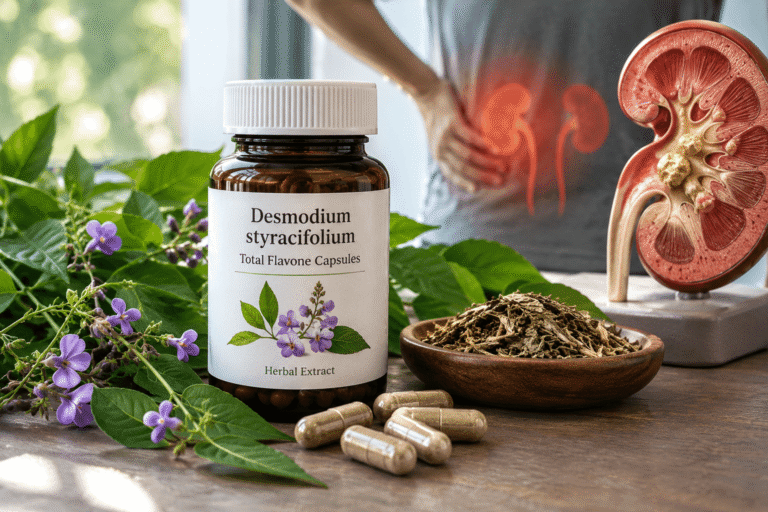
A new Phase 3 randomized clinical trial published in JAMA Network Open has brought serious attention to herbal treatment for kidney stones. The study evaluated Desmodium styracifolium total flavone capsules, a standardized traditional Chinese herbal extract, in adults with 5–10 mm ureteral stones. By day 28, confirmed stone passage occurred in 44.6% of patients who received the herbal extract compared with 33.8% who received placebo [1].
This result is important because kidney stones are common, painful and often recurrent. Many patients search for natural, herbal or Ayurvedic options, but most herbal remedies are not tested in large, modern clinical trials. This study is different because it used a randomized, double-blind, placebo-controlled Phase 3 design, which gives the findings greater clinical value.
The result should be understood carefully. The herbal extract improved stone passage in selected ureteral-stone patients, but it did not work for every patient. It also does not mean that every kidney stone can be treated at home with herbs. Stone size, stone location, infection, urine blockage, kidney function and pain severity must always guide treatment decisions.
What Was Studied in This Kidney Stone Trial?
The study tested Desmodium styracifolium total flavone capsules, a traditional botanical extract used in Chinese medicine. The trial included adults aged 18 to 70 years with ureteral stones measuring 5–10 mm. These stones were located in the ureter, the tube that carries urine from the kidney to the bladder [1].
The treatment was given for 28 days. Patients were randomly assigned to receive either the herbal extract or placebo. The study was double-blind, meaning neither the patients nor the treating team knew who received the active herbal extract during the trial period. Computed tomography was used to confirm stone status, which makes the outcome more reliable than relying only on symptoms or patient memory [1].
The trial included more than 600 evaluable patients across multiple study sites in China. Most participants were middle-aged adults, and the average stone size was around 6 mm. This is clinically relevant because stones in the 5–10 mm range may sometimes pass naturally, but many patients still experience pain, delayed passage or need urological intervention.
Main Trial Result
The main outcome was stone passage by day 28. The herbal extract group showed a higher passage rate than placebo.
| Trial Finding | Herbal Extract Group | Placebo Group | Meaning for Patients |
|---|---|---|---|
| Stone passage by day 28 | 44.6% | 33.8% | Higher chance of passing the stone |
| Absolute difference | 10.9 percentage points | Reference | Modest but clinically relevant improvement |
| Relative risk | 1.32 | Reference | Stone passage was more likely with the extract |
| Adverse events | Similar to placebo | Similar to herbal group | No major safety signal in the trial population |
The improvement was meaningful, but it was not dramatic. Around 45 out of 100 patients in the herbal extract group passed their stone by day 28, while around 34 out of 100 patients in the placebo group passed their stone. This means some patients may benefit, but many patients still need close monitoring and may require standard medical or urological treatment.
Why This Trial Matters for Traditional Herbal Medicine
This trial is valuable because it shows how a traditional herbal medicine can be tested using modern scientific standards. The researchers used defined inclusion criteria, placebo comparison, randomization, blinding, imaging confirmation and adverse-event monitoring [1].
For patients, this type of research is helpful because it separates serious clinical evidence from unsupported home remedies. For traditional medicine systems, including Ayurveda, it shows a practical path forward: classical herbal knowledge can be studied with modern outcome measures without losing its traditional foundation.
The strongest message from this study is not that one herb should be used by everyone. The stronger message is that traditional botanical medicines deserve rigorous testing, proper standardization and responsible clinical use.
Who May Fit This Type of Treatment Approach?
This trial studied a selected group of patients. The findings apply mainly to adults with 5–10 mm ureteral stones, adequate kidney function and no severe complications. These patients were medically evaluated before treatment [1].
A patient with a small or moderate ureteral stone, stable kidney function and no infection may sometimes be managed conservatively under medical supervision. In such cases, doctors may use hydration guidance, pain control, observation, medical expulsive therapy and follow-up imaging. A standardized herbal approach may become part of this discussion when evidence, safety and patient suitability are considered.
However, this trial does not apply to every kidney-stone patient. Patients with severe obstruction, fever, pus in urine, rising creatinine, uncontrolled pain, repeated vomiting, pregnancy, severe hydronephrosis or a single functioning kidney need urgent medical evaluation.
What Patients Should Not Misunderstand
This study does not prove that herbs dissolve every kidney stone. It measured stone passage, not universal stone dissolution. It also does not prove that all kidney stones can be cured naturally.
Kidney stones are not all the same. Some are calcium oxalate stones, some are uric acid stones, some are struvite stones, and some are cystine stones. The treatment plan depends on the stone type, size, density, location, recurrence pattern and metabolic cause.
A patient should not start random herbal products without diagnosis. The trial used a standardized extract, a fixed dose, medical selection and follow-up imaging. This is very different from taking unverified herbal mixtures without knowing the stone size, kidney status or infection risk.
Ayurvedic View of Kidney Stones
In Ayurveda, urinary stones are classically described under Mutrashmari. Sushruta Samhita, Nidana Sthana, Chapter 3 explains the development and clinical features of Ashmari, including pain, difficulty in urination, interrupted urine flow, blood in urine and passage of sandy particles [6].
Sushruta Samhita, Chikitsa Sthana, Chapter 7 discusses the management of urinary disorders and Ashmari. The classical approach recognizes that early and manageable stones may respond to internal medicines, diet correction, urinary-supportive herbs and lifestyle changes, while large, chronic or complicated stones may need procedural intervention [7].
This is a mature clinical view. Ayurveda does not treat every case blindly in the same way. The patient’s Dosha, Agni, urine symptoms, pain pattern, obstruction, recurrence tendency and strength must be assessed before selecting treatment.
Important Ayurvedic Herbs Traditionally Used in Mutrashmari
Ayurvedic practice commonly considers herbs that support urinary flow, reduce burning urination, assist stone passage and reduce recurrence tendency. The selection should be individualized rather than copied as a single formula for every patient.
| Ayurvedic Herb | Common Clinical Purpose in Mutrashmari Care | Practical Relevance |
|---|---|---|
| Pashanabheda | Traditionally used for urinary stones and gravel-like urine | Often considered in stone-passage support |
| Varuna | Used in urinary obstruction and stone-related urinary symptoms | Relevant when urinary flow is affected |
| Gokshura | Supports urinary tract function and urine flow | Often used in Mutravaha Srotas disorders |
| Punarnava | Supports fluid balance and urinary clearance | Useful where swelling or sluggish elimination is present |
| Kulattha | Traditionally used in Ashmari and urinary deposits | Often discussed in stone-related diet and formulation contexts |
| Yavakshara | Classical alkaline preparation used in selected urinary disorders | Requires expert supervision |
| Chandraprabha Vati | Classical formulation used in urinary and genitourinary disorders | Should be selected according to patient condition |
| Gokshuradi Guggulu | Used in urinary tract and inflammatory conditions | Requires physician-guided use |
These medicines should not be used casually in every patient. Kshara preparations, mineral preparations, guggulu-based medicines and strong diuretic herbs need proper assessment, especially in patients with kidney disease, liver disease, pregnancy, hypertension, diabetes or ongoing prescription medicines.
How This Herbal Trial Connects With Ayurveda
Desmodium styracifolium is mainly associated with traditional Chinese medicine, not classical Ayurveda. Still, the study is highly relevant to Ayurveda because it supports a broader principle: traditional plant medicines can be tested through strong clinical research.
For Ayurveda, the ideal research model for Mutrashmari would include clear stone size, stone site, stone composition, imaging confirmation, urine analysis, kidney-function testing, pain scoring, recurrence tracking and long-term safety monitoring.
This is the type of evidence that can help traditional medicine communicate with modern urology in a more responsible and convincing way.
Current Medical Approach to Ureteral Stones
Modern urology usually decides treatment based on stone size, location, symptoms and complications. Small stones may pass naturally, while larger stones may need intervention. Stones in the lower ureter may sometimes be managed with medical expulsive therapy when there is no infection, uncontrolled pain or kidney-risk situation [2].
Guidelines support active treatment when there is persistent obstruction, infection, uncontrolled pain, impaired kidney function or low chance of spontaneous passage [2]. Procedures may include ureteroscopy, shock wave lithotripsy, stent placement or percutaneous stone removal, depending on the case [4].
This is why patient selection is essential. Herbal and Ayurvedic treatment can be considered only after proper evaluation. When red flags are present, urgent urological care should not be delayed.
Warning Symptoms That Need Urgent Care
Kidney stones can become dangerous when they block urine flow or occur with infection. Patients should seek urgent medical attention if they develop fever, chills, severe persistent pain, repeated vomiting, inability to urinate, worsening weakness, confusion, severe blood in urine or reduced urine output [3].
Pain that does not settle, pain with fever, pain with kidney swelling or stone disease in a patient with one kidney should never be ignored. Infected obstruction is a medical emergency. Delayed treatment can damage the kidney and may become life-threatening.
Prevention After Stone Passage
Passing the stone is only one part of treatment. Preventing recurrence is equally important. Many patients form stones again because the underlying cause is not corrected.
A proper prevention plan may include stone analysis, urine testing, blood testing, kidney-function assessment, diet review and imaging follow-up. Fluid intake is important for most patients, but the correct amount should be individualized in people with kidney, heart or fluid-retention disorders [5].
| Prevention Area | Why It Matters | Patient-Friendly Action |
|---|---|---|
| Fluid intake | Dilutes urine and reduces crystal concentration | Drink regularly unless restricted by a doctor |
| Stone analysis | Identifies stone type | Save the passed stone for testing if possible |
| Urine testing | Finds metabolic risk factors | Consider 24-hour urine testing in recurrent cases |
| Sodium control | High sodium can increase urinary calcium | Reduce salty and packaged foods |
| Protein balance | Excess animal protein may increase stone risk | Keep protein intake moderate and appropriate |
| Oxalate management | Important in calcium oxalate stones | Adjust high-oxalate foods only when relevant |
| Dietary calcium | Helps bind oxalate in the gut | Do not stop food calcium unnecessarily |
| Follow-up imaging | Confirms stone clearance | Repeat ultrasound or CT as advised |
Diet should not be extreme. Many patients wrongly stop calcium completely after calcium oxalate stones. In reality, dietary calcium from food may be protective when taken properly with meals. The correct diet depends on the stone type and metabolic findings [5].
Sponsor Disclosure
The Phase 3 trial was sponsored by the product’s manufacturer. The study article reported that the sponsor was involved in trial design, study monitoring, data collection and data analysis according to the prespecified statistical plan [1].
This does not mean the result should be rejected. Manufacturer-sponsored trials can still provide useful evidence when the design, data and reporting are transparent. At the same time, sponsorship should be clearly understood by readers because independent replication would make the evidence stronger.
Patient-Centered Takeaway
The Phase 3 trial found that a standardized traditional herbal extract improved 28-day passage of selected 5–10 mm ureteral stones compared with placebo. The benefit was modest but clinically meaningful, and adverse-event rates were similar between the two groups [1].
For patients, the practical message is clear. Herbal treatment for kidney stones should not mean random self-medication. It should mean proper diagnosis, stone-size assessment, kidney-function testing, infection screening, pain monitoring, follow-up imaging and physician-guided use of selected herbs when suitable.
For Ayurveda, this study strengthens the case for rigorous research on classical Mutrashmari management. Traditional medicine becomes more powerful and trustworthy when it is supported by careful patient selection, measurable outcomes and transparent safety monitoring.
FAQs
Can herbal treatment help kidney stones pass?
A Phase 3 trial found that a standardized Desmodium styracifolium herbal extract improved 28-day stone passage in selected patients with 5–10 mm ureteral stones. It may help some patients, but it is not suitable for every stone case.
Does this mean herbs dissolve all kidney stones?
No. The trial measured stone passage, not guaranteed stone dissolution. Kidney stones differ by size, location and composition, so treatment must be individualized.
Is Desmodium styracifolium an Ayurvedic herb?
Desmodium styracifolium is mainly used in traditional Chinese medicine. Ayurveda has its own Mutrashmari herbs and formulations, including Pashanabheda, Varuna, Gokshura and related classical preparations.
Can kidney stones be treated at home?
Some small, uncomplicated stones may pass with conservative care, but patients need medical evaluation first. Fever, severe pain, vomiting, urine blockage, kidney swelling or infection symptoms need urgent care.
What is the Ayurvedic name for kidney stones?
The classical Ayurvedic condition most closely related to urinary stones is Mutrashmari. It is discussed in Sushruta Samhita, especially in Nidana Sthana Chapter 3 and Chikitsa Sthana Chapter 7
What is the safest approach for recurrent kidney stones?
The safest approach is to identify the stone type, assess urine and blood risk factors, improve hydration, correct diet, monitor kidney function and use herbal or Ayurvedic support only under qualified supervision.
References
- Wang, D., Zhang, S., Zhao, W., et al. (2026). Desmodium styracifolium total flavone capsules for urolithiasis: A phase 3 randomized clinical trial. JAMA Network Open, 9(9), e2632874.
https://jamanetwork.com/journals/jamanetworkopen/fullarticle/2853853 - European Association of Urology. (2026). EAU guidelines on urolithiasis. European Association of Urology Guidelines Office.
https://uroweb.org/guidelines/urolithiasis/chapter/guidelines - National Institute of Diabetes and Digestive and Kidney Diseases. (2017). Symptoms and causes of kidney stones. National Institutes of Health.
https://www.niddk.nih.gov/health-information/urologic-diseases/kidney-stones/symptoms-causes - National Institute of Diabetes and Digestive and Kidney Diseases. (2017). Treatment for kidney stones. National Institutes of Health.
https://www.niddk.nih.gov/health-information/urologic-diseases/kidney-stones/treatment - National Institute of Diabetes and Digestive and Kidney Diseases. (2017). Eating, diet, and nutrition for kidney stones. National Institutes of Health.
https://www.niddk.nih.gov/health-information/urologic-diseases/kidney-stones/eating-diet-nutrition - Bhishagratna, K. L. (Trans.). (1911). The Sushruta Samhita: Nidana Sthana, Chapter III, Diagnosis of urinary calculus.
https://www.wisdomlib.org/hinduism/book/sushruta-samhita-volume-2-nidanasthana/d/doc142861.html - Bhishagratna, K. L. (Trans.). (1911). The Sushruta Samhita: Chikitsa Sthana, Chapter VII, The medical treatment of urinary conditions.
https://www.wisdomlib.org/hinduism/book/sushruta-samhita-volume-4-cikitsasthana/d/doc142907.html - Ma, X., Zheng, C., Hu, C., Rahman, K., & Qin, L. (2011). The genus Desmodium Fabaceae: Traditional uses in Chinese medicine, phytochemistry and pharmacology. Journal of Ethnopharmacology, 138(2), 314–332.
https://pubmed.ncbi.nlm.nih.gov/21963853/ - Zhou, J., Jin, J., Li, X., et al. (2018). Total flavonoids of Desmodium styracifolium attenuate calcium oxalate urolithiasis formation in experimental models. Urolithiasis, 46(3), 231–241.
https://pubmed.ncbi.nlm.nih.gov/ - American Urological Association. (2019). Kidney stones: Medical management guideline. American Urological Association.
https://www.auanet.org/guidelines-and-quality/guidelines/kidney-stones-medical-mangement-guideline