


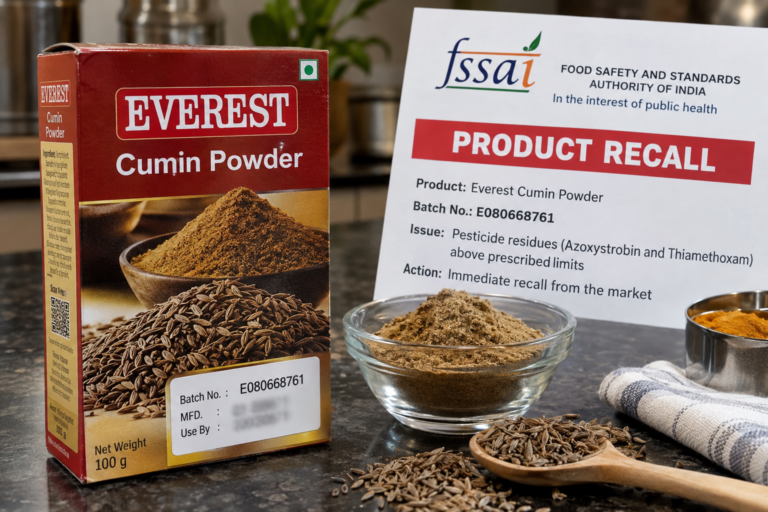
Event date: 4 October 2026
Affected country: India; potentially relevant elsewhere if the affected batch was exported
Recalled product: Everest pre-packed cumin powder
Batch number: E080668761
Pesticides detected above prescribed limits: Azoxystrobin and thiamethoxam
Regulatory authority: Food Safety and Standards Authority of India
The Everest cumin powder recall concerns Batch No. E080668761, which the Food Safety and Standards Authority of India ordered withdrawn after two regulatory laboratories found azoxystrobin and thiamethoxam above prescribed maximum residue limits. The initial sample was reportedly collected from Riverside Resorts & Holiday Homes in Goa. After the manufacturer appealed the first test result, a Referral Food Laboratory independently tested the sample and again classified it as unsafe. FSSAI then directed the company to recall the implicated batch, maintain recall records, take corrective measures and report completion of the recall. [1,2]
This finding does not mean that every Everest spice product, every cumin powder packet or cumin itself is unsafe. It is a batch-specific recall based on the information publicly available. Consumers should therefore check the batch number rather than discard unrelated products solely because they contain cumin.
The central health question is whether azoxystrobin and thiamethoxam can cause disease. At sufficiently high or repeated exposure, these chemicals may produce acute pesticide poisoning and organ injury. Human reports have linked substantial thiamethoxam exposure with acute kidney injury and neurological symptoms. Regulatory animal studies have identified possible effects on the liver, bile ducts, kidneys, blood cells, testes and developing nervous system. These findings do not prove that a person who used a small culinary amount of the recalled cumin will develop any of these conditions.
What Does “Above the Maximum Residue Limit” Mean?
A maximum residue limit, or MRL, is the highest legally permitted concentration of a pesticide residue in a particular food. MRLs are established using pesticide-use data, toxicology studies, dietary-consumption patterns and safety margins intended to protect consumers over both short-term and lifetime exposure. [3]
An MRL should not be interpreted as a boundary at which a substance suddenly changes from harmless to poisonous. A residue level above the MRL means that the food does not comply with the applicable safety standard and may indicate improper pesticide use, inadequate observance of the pre-harvest interval, contamination during processing or another failure in the supply chain. It justifies withdrawal of the affected batch, but it does not by itself diagnose pesticide poisoning in everyone who consumed the food.
The actual health risk depends on the measured concentration, amount of contaminated cumin consumed, frequency and duration of use, body weight, age, pregnancy status, route of exposure and underlying medical conditions. WHO similarly explains that pesticide effects depend on the quantity and manner of exposure, while the general population usually receives substantially lower exposure through food than agricultural or occupational workers receive during direct pesticide handling. [3]
The publicly reported recall information identifies the pesticides as exceeding prescribed limits but does not provide the numerical concentrations detected. Without those concentrations and an estimate of the amount consumed, it is not possible to calculate an individual consumer’s absorbed dose or predict a specific disease.
How Azoxystrobin Affects the Human Body
Azoxystrobin is a broad-spectrum fungicide used to control fungal diseases in crops. It interferes with mitochondrial energy production in fungi. Mammalian toxicology studies indicate that it has relatively low acute toxicity, but repeated exposure to sufficiently high doses has affected the liver and biliary system in experimental animals. [4]
Regulatory studies reported increased liver weight, microscopic changes in the liver and bile ducts, increased alkaline phosphatase and gamma-glutamyl transferase, reduced serum albumin, diarrhoea, reduced food utilisation and lower body-weight gain at specified experimental doses. Exposure to a concentrated inhaled formulation also produced microscopic changes in the nasal cavity and larynx of laboratory animals. [4]
These findings indicate the organs that may become vulnerable during substantial exposure. They do not demonstrate that occasional dietary exposure to the recalled spice will cause liver disease, bile-duct disease or respiratory damage in humans.
EPA toxicology assessments classified azoxystrobin as having a low order of acute toxicity and as “not likely to be carcinogenic to humans” based on the available animal carcinogenicity studies. [4]
How Thiamethoxam Affects the Human Body
Thiamethoxam is a neonicotinoid insecticide. It acts primarily on nicotinic acetylcholine receptors in insects, disrupting nerve transmission. Differences between insect and mammalian receptors make neonicotinoids substantially more toxic to insects, but high or repeated human exposure can still cause adverse effects.
EPA’s regulatory review identified the liver, kidneys, testes and blood-cell system as the principal target systems in mammalian studies. Developmental neurological effects were also observed in rats. These findings were used to set protective exposure limits with additional uncertainty factors for differences between animals and humans and for variation in human susceptibility. [5]
At higher experimental doses, thiamethoxam was associated with increased urea and creatinine, leukopenia, altered red-cell measurements, reduced thymus weight and microscopic changes in the liver, thymus and spleen. Reproductive studies reported testicular tubular atrophy, sperm abnormalities and loss of developing germ cells in male animals. [5]
These are important warning signals for regulatory risk assessment, but animal findings cannot be directly translated into a statement that dietary thiamethoxam residues cause kidney disease, infertility, anaemia or immune disease in humans.
What Diseases and Medical Conditions Can These Pesticides Cause?
It is medically more accurate to discuss toxic syndromes and organ injuries rather than claim that the recalled cumin causes a long list of chronic diseases. The evidence also varies considerably: some effects have been reported in humans after concentrated pesticide exposure, while others have been observed mainly in laboratory animals.
Acute Pesticide Poisoning
Substantial ingestion, inhalation or occupational exposure may cause an acute pesticide-poisoning syndrome. Possible symptoms can include nausea, vomiting, diarrhoea, abdominal discomfort, headache, dizziness, unusual weakness, drowsiness, tremor, confusion and changes in consciousness.
These symptoms are nonspecific. Headache or nausea after eating food does not independently prove pesticide poisoning. Diagnosis requires an exposure history, clinical examination and assessment for dehydration, neurological abnormalities and organ injury.
A small culinary exposure cannot be equated with swallowing an agricultural pesticide formulation. Commercial pesticide formulations may contain much higher chemical concentrations and additional solvents or surfactants that influence toxicity.
Acute Kidney Injury and Acute Tubular Necrosis
The most clearly documented serious human condition associated specifically with thiamethoxam is acute kidney injury following substantial poisoning. A published case report described acute tubular injury after thiamethoxam ingestion. Acute tubular necrosis damages the kidney’s microscopic filtering tubules and can cause a rapid rise in creatinine, reduced urine production, electrolyte disturbances and fluid accumulation. [7]
This report is clinically important because it demonstrates that thiamethoxam can be nephrotoxic under poisoning conditions. However, it was an individual high-exposure case and cannot be used to conclude that eating a small quantity of cumin containing residues above an MRL will cause kidney failure.
Patients should seek prompt medical assessment if suspected substantial exposure is followed by markedly reduced urination, swelling, persistent vomiting, severe weakness, confusion or breathlessness. People who already have chronic kidney disease may warrant a lower threshold for clinical review.
Possible Toxic Liver and Biliary Injury
Repeated high-dose azoxystrobin exposure consistently affected the liver and bile ducts in animal studies. Thiamethoxam studies also identified liver changes at higher doses. These findings raise the possibility of toxic liver or hepatobiliary injury during sufficiently high exposure, but comparable disease has not been established in consumers of the recalled cumin batch. [4,5]
Possible clinical indicators of liver or biliary injury would include jaundice, dark urine, pale stool, persistent upper abdominal pain, severe itching, unexplained fatigue or abnormal liver-function tests. These symptoms have many other causes and should not automatically be attributed to cumin or pesticide residues.
A person who consumed a small amount once and remains well does not ordinarily need to assume that liver injury has occurred. Medical evaluation becomes more relevant after repeated consumption, unusually large exposure, new symptoms or pre-existing liver disease.
Neurological Effects
Neonicotinoids act on nerve receptors, although they are more selective for insect receptors than mammalian receptors. Human evidence of chronic neurological toxicity remains limited.
One occupational case involved a pest-control worker with repeated thiamethoxam inhalation exposure. The patient initially developed fever and headache and later had persistent oral dysesthesia—an abnormal or unpleasant mouth sensation—and postural finger tremor even after detectable pesticide levels declined. This was a single occupational case involving a very different exposure route and intensity from normal food consumption. [8]
A systematic review found only a limited number of human studies on neonicotinoid exposure. Some reported possible developmental or neurological associations, but the authors considered the chronic-exposure evidence suggestive and methodologically weak. The review therefore did not establish that thiamethoxam causes Parkinson’s disease, dementia, autism, peripheral neuropathy or another defined chronic neurological disease. [9]
Persistent tremor, confusion, loss of consciousness, seizures, new weakness or difficulty walking after suspected significant pesticide exposure requires urgent assessment.
Blood-Cell and Immune-Related Changes
Animal studies of thiamethoxam reported leukopenia, meaning a reduction in white blood cells, as well as alterations in haematocrit, haemoglobin and red-cell counts. Changes were also observed in immune-related tissues such as the thymus and spleen at higher experimental doses. [5]
These findings do not prove that dietary thiamethoxam causes anaemia, immunodeficiency, leukaemia or bone-marrow disease in humans. No such diagnosis should be made from the recall information alone.
A complete blood count may be considered by a clinician when there has been substantial or repeated exposure accompanied by systemic illness, recurrent fever, unexplained bruising or unusual weakness. Routine blood-count testing is not automatically required after one symptom-free culinary exposure.
Testicular Injury, Sperm Abnormalities and Possible Reproductive Toxicity
Thiamethoxam reproductive studies in animals identified testicular tubular atrophy, sperm abnormalities and germ-cell loss at specified doses. These findings show a reproductive hazard under experimental conditions and are incorporated into regulatory exposure limits. [5]
They do not establish that men who consumed the recalled cumin will become infertile, experience reduced testosterone or develop testicular disease. Evidence directly connecting ordinary dietary thiamethoxam exposure with clinically diagnosed human infertility is insufficient.
A person should not undergo fertility testing solely because the spice was used once. Medical evaluation may be reasonable when there was unusually high or prolonged exposure and a pre-existing reproductive concern, but the results would not necessarily prove that pesticide residues were the cause.
Developmental and Pregnancy-Related Effects
Developmental neurological effects and increased susceptibility during early development were observed in some animal thiamethoxam studies. Such findings justify particular caution for pregnant women and children because fetal development is sensitive and a child’s dose per kilogram of body weight may be higher than an adult’s after consuming the same quantity. [5]
Current evidence does not prove that consumption of the recalled cumin causes miscarriage, congenital anomalies, developmental delay or autism. The limited human neonicotinoid literature contains reported associations with certain developmental outcomes, but the systematic review found the evidence too limited and methodologically weak to establish causation. [9]
Pregnant women who used the affected batch should stop using it but should not assume that fetal harm has occurred. A clinician can consider the amount and duration of exposure and determine whether any additional follow-up beyond routine antenatal care is justified.
Cancer Risk
The recall does not establish that either pesticide caused cancer in consumers.
Azoxystrobin is classified by EPA as “not likely to be carcinogenic to humans” based on the evaluated evidence. [4] Thiamethoxam caused liver tumours in certain mouse studies, but regulators concluded that these occurred through a non-genotoxic, dose-dependent mechanism requiring sufficient formation of a hepatotoxic metabolite. EPA classified thiamethoxam as “not likely to be carcinogenic to humans” below the exposure levels needed to initiate that mechanism. [5] Fed
It would therefore be inaccurate to tell consumers that the recalled cumin causes liver cancer or another malignancy. It would be equally inaccurate to describe unnecessary pesticide exposure as acceptable. The appropriate response is to remove the recalled batch and prevent continued exposure without making unsupported cancer claims.
Diseases That Should Not Be Attributed to This Recall Without Evidence
The available information does not demonstrate that consuming this batch causes chronic kidney disease, cirrhosis, gallbladder disease, Parkinson’s disease, Alzheimer’s disease, thyroid disease, diabetes, autoimmune disease, infertility, birth defects, autism or cancer.
Some of these outcomes have been discussed in broader pesticide or neonicotinoid research, but an association reported for a pesticide class does not prove that thiamethoxam caused the disease. It also cannot establish that the amount present in this specific cumin batch was sufficient to produce it.
A diagnosis requires clinical findings and, where relevant, laboratory testing, imaging or specialist evaluation. The presence of a recalled food packet in a household should not become the sole explanation for unrelated symptoms or a disease that was already developing.
Why One Accidental Use Is Different From Repeated Exposure
Toxicity depends on dose. Someone who sprinkled a small quantity of cumin into one family meal would generally have a much lower exposure than someone who repeatedly consumed the powder, used it in concentrated home remedies or swallowed a pesticide formulation.
Body weight also matters. A given amount represents a larger dose per kilogram for a young child than for an adult. The same concern applies to people using cumin powder several times daily in digestive drinks, herbal mixtures or medicinal preparations.
The sensible response after accidental use is to stop using the affected batch, preserve the packet details and monitor for significant symptoms. Consumers should not induce vomiting or begin extreme fasting, purgation, laxative use or unproven “pesticide detox” programmes. Public clinical guidance surrounding the recall similarly emphasises discontinuing the product rather than panicking after one exposure.
What Consumers Should Do With Batch E080668761
Check the package for the brand, product name and Batch No. E080668761. The batch number is more important than relying on the appearance, smell or taste of the powder.
Do not use a matching packet in food, herbal drinks, home remedies or Ayurvedic preparations. Photograph the label, batch number, manufacturing information and place of purchase before returning or disposing of it according to retailer or FSSAI instructions.
Keep the powder away from children and do not transfer it into an unlabelled container. If the packet has already been discarded but substantial consumption is suspected, record approximately when it was purchased, how often it was used and whether any symptoms occurred.
Consumers whose packet carries another batch number should continue to monitor official recall notices. The presently reported action concerns the identified batch and should not be represented as a recall of every Everest product.
When Medical Attention Is Needed
Urgent assessment is appropriate after a substantial suspected exposure or when a person develops persistent vomiting, severe abdominal pain, confusion, pronounced drowsiness, tremor, seizure, fainting, breathing difficulty, jaundice, swelling or a marked reduction in urine output.
Children, pregnant women, older adults and people with established kidney or liver disease deserve additional caution. The product packet or a clear photograph of its label should be shown to the clinician whenever possible.
Emergency treatment should not be delayed while trying to identify a home antidote. There is no established household remedy that neutralises absorbed azoxystrobin or thiamethoxam.
Are Blood Tests Necessary After Consuming the Recalled Cumin?
Routine testing is not automatically required after one small, symptom-free culinary exposure. Testing becomes more reasonable when consumption was repeated, the quantity was unusually large, symptoms developed or the person has underlying kidney or liver vulnerability.
Depending on the clinical situation, a physician may consider serum creatinine, estimated glomerular filtration rate, urea, electrolytes, urinalysis and urine-output monitoring to assess kidney function. Liver assessment may include alanine aminotransferase, aspartate aminotransferase, alkaline phosphatase, gamma-glutamyl transferase, bilirubin and albumin. A complete blood count may be considered when systemic toxicity or blood-cell abnormalities are suspected.
These investigations detect possible organ injury; they do not prove that the pesticide caused it. Direct measurement of pesticide compounds or metabolites requires specialised toxicology facilities and is not a routine screening test for asymptomatic consumers.
Can Roasting or Cooking Make the Recalled Cumin Safe?
Roasting, frying or boiling should not be used as a reason to continue consuming a recalled batch. Food processing may alter some pesticide residues, but the extent varies by chemical, temperature, duration and food matrix.
EFSA’s assessment of azoxystrobin reports that it is hydrolytically stable under standard food-processing conditions. This means consumers cannot assume that ordinary cooking will reliably destroy or remove it. [6]
Powdered cumin also cannot be washed effectively in the way that some whole fruits or vegetables can. Once a batch has been recalled, avoidance is more reliable than attempting home decontamination.
Why the Recall Matters to Ayurveda
Cumin is known in Ayurveda as Jiraka or Jeeraka and is not treated merely as a flavouring agent. It appears in the Charaka Samhita, Sutra Sthana, Chapter 4, within the Shula Prashamana group; in the Sushruta Samhita, Sutra Sthana, Chapter 38, within the Pippalyadi Gana; and in the Bhavaprakasha Nighantu, Haritakyadi Varga, in the Jiraka section. [10]
Classically, Jiraka is described with Deepana and Pachana actions. Deepana refers to supporting appetite and digestive capacity, while Pachana refers to assisting the digestion of incompletely processed material. These traditional descriptions concern the properly identified and suitably prepared botanical; they do not guarantee that every commercial batch is free from agricultural contaminants.
The recall illustrates an essential distinction between the medicinal identity of a plant and the quality of a particular raw-material batch. A botanically correct herb can still contain excessive pesticide residues, heavy metals, aflatoxins, pathogenic microorganisms or adulterants.
Ayurvedic processing methods should not be presumed to neutralise pesticide contamination unless validated analytical evidence demonstrates adequate removal. Neither classical claims nor the addition of other herbs can make a regulator-confirmed recalled ingredient suitable for patient use.
Quality Standards Ayurvedic Clinics and Pharmacies Should Apply
Medicinal-herb sourcing should include supplier qualification, botanical authentication, batch coding, traceable purchase records and defined acceptance criteria. High-risk materials should undergo pesticide-residue testing using validated multiresidue analytical methods.
Testing should not stop with pesticides. Depending on the botanical and formulation, quality control may also require heavy-metal analysis, aflatoxin testing, microbial limits, assessment for pathogenic organisms, foreign-matter examination, moisture measurement and identification of undeclared pharmaceutical substances.
A certificate of analysis is useful only when it identifies the tested batch, analytical method, laboratory, date, specification and actual result. A generic certificate that is not connected to the supplied material provides little assurance.
For custom powders, decoctions, avaleha and other formulations, every incoming batch should remain traceable to the final medicine supplied to the patient. This allows rapid containment if a raw ingredient later fails testing or becomes subject to a recall.
Frequently Asked Questions
Is every Everest cumin powder packet unsafe?
No. The reported recall identifies Everest pre-packed cumin powder, Batch No. E080668761. Consumers should verify the batch number. The current notice should not be interpreted as evidence that every Everest product or every cumin powder is contaminated. [1,2]
What should I do if I ate the recalled cumin once?
Stop using the packet and retain its details. A single small exposure does not automatically mean poisoning or organ damage. Medical advice is appropriate if a large quantity was consumed, symptoms developed or the person is especially vulnerable.
Can thiamethoxam cause kidney failure?
Substantial thiamethoxam poisoning has been associated with acute kidney injury and acute tubular damage in a published human case. That exposure was not comparable to normal culinary use. The recall does not establish that consumers of the cumin batch will develop kidney failure. [7]
Can these pesticides damage the liver?
Repeated high-dose animal studies identified the liver and bile ducts as important target organs, particularly for azoxystrobin. This supports regulatory caution, but human liver disease from consuming the recalled cumin has not been demonstrated. [4,5]
Can the recalled cumin cause infertility?
Thiamethoxam caused testicular and sperm-related abnormalities in animal studies at specified experimental doses. Evidence is insufficient to conclude that dietary residues in the recalled cumin cause human infertility. [5]
Can azoxystrobin or thiamethoxam cause cancer?
Current regulatory evaluations do not classify either compound as likely to cause human cancer under assessed exposure conditions. The recall provides no evidence that consumers developed cancer from this batch. [4,5]
Should pregnant women be worried?
Pregnant women should discontinue the affected batch, but use of the spice does not mean fetal damage has occurred. The amount and frequency of exposure should be discussed with the treating clinician when use was substantial or repeated.
Can cooking destroy the pesticides?
Consumers should not rely on cooking, frying or roasting to make the recalled product safe. Azoxystrobin has been found stable under standard processing conditions, and a recalled powdered spice cannot be effectively washed. [6]
Is cumin itself harmful?
No. Cumin is a widely used culinary spice and Ayurvedic botanical. The issue is contamination in an identified commercial batch, not the inherent safety of properly sourced and quality-tested cumin.
Conclusion
The Everest cumin powder recall should prompt action without unnecessary panic. Batch No. E080668761 should not be consumed because two laboratories reportedly confirmed azoxystrobin and thiamethoxam above prescribed limits.
At substantial exposure, these pesticides can be associated with acute poisoning, and thiamethoxam has been linked in human case reports to acute kidney injury and neurological symptoms. Liver and bile-duct injury, blood-cell abnormalities, testicular damage, sperm changes and developmental neurological effects arise mainly from animal toxicology studies and cannot be presented as confirmed diseases among consumers of the recalled cumin.
The safest response is to identify and discontinue the affected batch, seek medical care for significant symptoms and reject unproven detoxification methods. For Ayurveda and herbal medicine, the broader lesson is equally important: traditional medicinal value must be accompanied by modern contaminant testing, supplier accountability and complete batch traceability.
References
- Food Safety and Standards Authority of India. (2026, October 4). Product recall order: M/s Everest Food Products Private Limited directed to recall pre-packed cumin powder [Post]. X. Used for: Official recall announcement and product identification. Official FSSAI announcement
- Warli, L. (Ed.). (2026, October 4). ‘Unsafe after 2 tests’: FSSAI orders Everest Food to recall pre-packed cumin powder from market. The Times of India. Used for: Sample location, two-stage laboratory confirmation, appeal process and recall obligations. The Times of India
- World Health Organization. (2022, September 15). Pesticide residues in food. Used for: Explanation of pesticide toxicity, dietary exposure, acceptable intake and maximum residue limits. World Health Organization
- U.S. Environmental Protection Agency. (2018, November 15). Azoxystrobin; pesticide tolerances. Federal Register, 83. Used for: Azoxystrobin target organs, liver and biliary findings, acute toxicity and cancer classification. Federal Register
- U.S. Environmental Protection Agency. (2017, February 15). Thiamethoxam; pesticide tolerance. Federal Register, 82. Used for: Thiamethoxam effects on the liver, kidneys, testes, blood-cell system, developing nervous system and regulatory cancer assessment. Federal Register
- European Food Safety Authority. (2024). Setting of import tolerances for azoxystrobin in melons and watermelons. EFSA Journal, 22(9), Article e9130. Used for: Stability of azoxystrobin under standard food-processing conditions and residue-analysis context. EFSA
- Ramanathan, S., Kumar, M. S., Sanjeevi, G., Narayanan, B., & Kurien, A. A. (2020). Thiamethoxam, a neonicotinoid poisoning causing acute kidney injury via a novel mechanism. Kidney International Reports, 5(7), 1111–1113. Used for: Human case report of acute kidney injury following substantial thiamethoxam poisoning. PubMed Central
- Nishizawa, T., Ikenaka, Y., Ichikawa, G., & Taguchi, T. (2022). Thiamethoxam intoxication due to occupational inhalational exposure. BMJ Case Reports, 15(11), Article e251110. Used for: Human occupational case involving headache, oral dysesthesia and persistent tremor. PubMed
- Cimino, A. M., Boyles, A. L., Thayer, K. A., & Perry, M. J. (2017). Effects of neonicotinoid pesticide exposure on human health: A systematic review. Environmental Health Perspectives, 125(2), 155–162. Used for: Evaluation of the limited human evidence and methodological weaknesses in reported chronic health associations. PubMed
- Sreelakshmi, L., Sri Durga, C., & Satyaprabha, K. (2025). Literature review and pharmacological activities of Jeeraka. International Journal of Ayurveda and Pharma Research, 13(5), 76–79. Used for: Classical placement of Jiraka in Charaka Samhita, Sushruta Samhita and Bhavaprakasha Nighantu, and its traditional digestive actions. IJAPR