

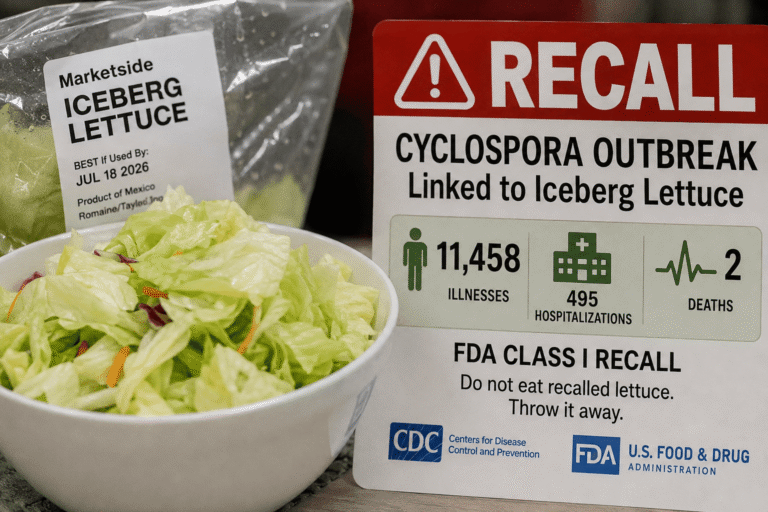
Cyclospora lettuce outbreak 2026 has reached 11,458 laboratory confirmed illnesses across 20 states. At least 495 people have been hospitalized, and two deaths have been reported in Michigan. Illnesses connected to this outbreak began on June 14 and continued through August 15, 2026, according to the latest CDC update published on August 27, 2026 [1,2].
Federal and state investigators linked the outbreak to processed iceberg lettuce supplied by Taylor Farms de Mexico. The implicated lettuce was sourced from central Mexico and distributed through retail stores, restaurants, food service businesses, and commercial customers. Taylor Farms de Mexico initiated a voluntary recall on July 17, 2026 [2,3,5].
On August 28, 2026, the FDA classified the recall as Class I, its most serious recall category. This classification does not mean that the recall is new, expanded, or upgraded. The original recall remains unchanged, and the FDA says the recalled products should no longer be available in stores or restaurants because all listed best by dates have passed [3,4].
New illnesses may still be added to the official count even though the affected lettuce is expected to be off the market. It can take approximately six weeks for health officials to determine whether a laboratory confirmed illness belongs to a particular outbreak [2].
Cyclospora lettuce outbreak 2026 at a glance
| Outbreak measure | Latest official information |
|---|---|
| Laboratory confirmed illnesses | 11,458 |
| Hospitalizations | 495 |
| Deaths | 2 deaths reported in Michigan |
| States reporting outbreak illnesses | 20 |
| Earliest illness onset | June 14, 2026 |
| Latest known illness onset | August 15, 2026 |
| Recall initiation date | July 17, 2026 |
| FDA Class I classification date | August 28, 2026 |
| Recalled product | Iceberg lettuce sourced from central Mexico |
| Supplier identified by traceback | Taylor Farms de Mexico |
| Current market status | FDA is confident the recalled lettuce is off the market |
| Investigation status | Ongoing |
These numbers describe laboratory confirmed illnesses connected to this particular lettuce outbreak. They do not include every Cyclospora infection diagnosed in the United States during 2026. CDC is also investigating other Cyclospora illnesses and outbreaks that are unrelated to Taylor Farms de Mexico iceberg lettuce [1,2].
What does an FDA Class I recall mean?
An FDA Class I recall is used when exposure to a recalled product has a reasonable probability of causing serious health consequences or death. It is the most serious of the three FDA recall classifications [4].
The classification reflects the health risk associated with the implicated product during the period when exposure occurred. It does not mean that every person who consumed the lettuce will experience severe illness. It also does not mean that every current package of iceberg lettuce is unsafe.
The FDA said the decision was based on the strength of the epidemiological evidence connecting the lettuce to the outbreak, together with the exceptional scale and severity of the event. Hundreds of hospitalizations and two reported deaths contributed to the agency’s determination that the recall met the Class I standard [4].
The August 28 classification has caused some confusion because Taylor Farms de Mexico had already initiated the recall on July 17. The FDA normally completes its formal recall classification after a company publishes its public recall notification and the agency has reviewed the available health hazard information [4].
The Class I announcement therefore did not begin another recall. It did not expand the affected product list, change the original recall dates, or indicate that newly stocked lettuce had become contaminated.
Why was iceberg lettuce recalled?
FDA traceback work identified Taylor Farms de Mexico as the common supplier of iceberg lettuce consumed by many patients before they became ill. Epidemiological evidence, purchase and restaurant information, product tracing, and Cyclospora genotyping supported the connection between the processed iceberg lettuce and the outbreak [2,3].
Genotyping examines selected markers in the parasite and helps investigators determine whether infections are genetically related. CDC reported that Cyclospora parasites collected from patients in this outbreak were genetically related, providing additional evidence that the illnesses shared a common source [2].
Taylor Farms de Mexico voluntarily removed all iceberg lettuce sourced from central Mexico from the United States market. The company also stopped receiving implicated product, suspended distribution from the affected source, and notified customers [5].
FDA inspections and environmental sampling at iceberg lettuce growing locations and the processing facility in Mexico were still ongoing at the time of the August 27 update [3].
Which iceberg lettuce products were recalled?
The recall included consumer products sold under the Marketside brand and numerous commercial food service products. Some restaurant customers may not have seen the Taylor Farms name because the lettuce was served as an ingredient in prepared meals, salads, sandwiches, tacos, or other menu items [3,5].
The two most recognizable consumer products were Marketside Iceberg Salad and Marketside Shredded Lettuce sold at selected Walmart stores. Food service products included shredded lettuce, chopped lettuce, iceberg and romaine blends, and salad mixes sold under several product codes [5].
| Recall category | Product information |
|---|---|
| Marketside Iceberg Salad | 12 ounce and 24 ounce packages |
| Marketside Shredded Lettuce | 8 ounce and 16 ounce packages |
| Retail best by dates | July 18 through August 3, 2026 |
| Retail seller | Selected Walmart stores |
| Food service product types | Shredded lettuce, chopped lettuce, salad mixes, and iceberg with romaine blends |
| Food service codes or brands | CV, JB, MARK, PK, SUB, SY, and TF |
| Food service best by dates | Varied by product from July 16 through August 3, 2026 |
| Distribution period | June 29 through July 16, 2026 |
| Consumer action | Discard a matching product and do not taste or consume it |
| Present availability | Products should no longer be available in normal retail or restaurant circulation |
Consumers who still possess an old package matching the recalled product name, package size, and date should discard it. Washing the lettuce does not make a recalled product safe [5,8].
The complete FDA recall notice contains a longer list of commercial product descriptions and date codes. Restaurants, institutions, distributors, and commercial kitchens that received bulk lettuce should compare their purchase records with the complete FDA product list [5].
Which states reported Cyclospora illnesses?
Laboratory confirmed illnesses connected to this outbreak were reported in Arkansas, Georgia, Iowa, Illinois, Indiana, Kansas, Kentucky, Massachusetts, Maine, Michigan, Missouri, Nebraska, New Hampshire, North Carolina, Ohio, Oklahoma, Pennsylvania, Tennessee, Texas, and West Virginia [2,3].
The state where a patient resides may not always be the state where exposure occurred. CDC notes that the total includes some people who travelled to one of the affected states during the relevant exposure period but normally live elsewhere [2].
The true geographical reach may therefore be broader than the map suggests. Some infected people recover without testing, while others may be diagnosed in a state that has not yet connected their illness to the outbreak.
Where was the recalled lettuce distributed?
Confirmed food service distribution included Alabama, Arkansas, Connecticut, Florida, Georgia, Iowa, Illinois, Indiana, Kansas, Kentucky, Louisiana, Massachusetts, Maine, Maryland, Michigan, Missouri, Mississippi, North Carolina, Nebraska, New Hampshire, New Jersey, New York, Ohio, Oklahoma, Pennsylvania, South Carolina, Tennessee, Texas, Virginia, Wisconsin, and West Virginia [3].
The FDA also stated that further distribution may have reached the District of Columbia, Delaware, North Dakota, Puerto Rico, Rhode Island, South Dakota, Vermont, and Washington [3].
Marketside retail products were sold at selected Walmart stores in Alabama, Arkansas, Florida, Georgia, Indiana, Kansas, Kentucky, Louisiana, Missouri, Mississippi, Oklahoma, Tennessee, Texas, Virginia, and West Virginia [3].
A product distribution state is not the same as a case state. Distribution records show where recalled lettuce was sent, whereas the outbreak map shows where patients reported becoming ill or where relevant exposure was identified.
Was Taco Bell lettuce involved in the outbreak?
Taco Bell was an important part of the early investigation, but the outbreak was not limited to Taco Bell restaurants.
During the initial investigation, public health officials identified many patients who reported eating at certain Taco Bell locations in Indiana, Kentucky, Michigan, Ohio, and West Virginia. An analysis of food histories from 190 patients in Michigan found that approximately 90 percent reported eating iceberg lettuce [2].
FDA traceback then identified Taylor Farms de Mexico as the supplier of shredded iceberg lettuce used by the implicated locations. Not every Taco Bell restaurant received lettuce from the same supplier, and the warning did not apply to every Taco Bell location [2].
Taco Bell stopped using lettuce from Taylor Farms de Mexico on July 17, 2026. Later investigation identified additional patients who had consumed Taylor Farms de Mexico iceberg lettuce at other restaurants, stores, or food service locations. The final outbreak definition therefore extended beyond people who reported eating at Taco Bell [2,3].
Are recalled lettuce products still being sold?
The FDA says the recalled iceberg lettuce should no longer be available in stores or restaurants. All listed best by dates have passed, and FDA recall audit checks support the agency’s conclusion that the affected products are off the market [3,4].
The publication of the Class I classification on August 28 should not be interpreted as evidence that recalled lettuce has returned to stores. It reflects the seriousness of the earlier exposure and the health consequences observed during the outbreak.
A household, business, or institution may still discover an old package, receipt, carton label, or stored product. Any item matching the recalled product details should be discarded rather than tasted or served [5].
Refrigerator shelves, storage containers, preparation surfaces, knives, cutting boards, and utensils that touched recalled lettuce should be cleaned thoroughly to reduce the possibility of contaminating other foods [3,8].
Why are cases increasing after the recall?
The delay between exposure and official reporting can be substantial. Symptoms usually begin approximately one week after consuming contaminated food or water, but the interval may range from two days to two weeks or longer [1,6].
A patient may then wait before seeking medical care. Once medical care is obtained, Cyclospora may not be included in routine stool testing. Additional stool specimens or specialized laboratory methods may be needed [1,6].
After laboratory confirmation, local and state health departments may interview the patient about meals, restaurants, travel, and food purchases during the two weeks before symptoms began. Investigators then compare the information with product records and other cases before adding the patient to a defined outbreak [2].
CDC estimates that this process can take approximately six weeks. A rising total after the recall may therefore represent infections that occurred weeks earlier rather than continued sale of contaminated lettuce [2].
The reported number is also likely to underestimate the true total. Some people have mild symptoms, do not consult a clinician, or are never tested specifically for Cyclospora [2].
What is Cyclospora?
Cyclospora cayetanensis is a microscopic single celled parasite that infects the small intestine. The resulting illness is called cyclosporiasis [6].
People become infected when they consume food or water contaminated with human fecal material containing the parasite. Fresh produce may become contaminated during growing, irrigation, harvesting, processing, packing, transportation, or food preparation [6,8].
Cyclospora passed in a bowel movement is not immediately infectious. The parasite generally requires at least one to two weeks in the environment to mature into an infectious form. For this reason, direct transmission from one person to another through ordinary contact is considered unlikely [6].
This characteristic distinguishes Cyclospora from several viral and bacterial gastrointestinal infections that can spread rapidly among household members.
Fresh herbs, berries, leafy vegetables, salad mixes, and other produce have previously been associated with Cyclospora outbreaks. Contaminated water can also transmit the parasite [6,8].
Cyclospora symptoms patients should recognize
Frequent watery diarrhea is the most characteristic symptom of cyclosporiasis. The diarrhea may continue for days or weeks, or it may temporarily improve and then return [1,5,6].
Other symptoms can include loss of appetite, unintentional weight loss, abdominal cramps, stomach pain, bloating, increased gas, nausea, prolonged fatigue, body aches, headache, and a low fever. Vomiting can occur but is less common [1,5,6].
Some infected people have no noticeable symptoms. Others may experience significant fluid loss and weakness.
Symptoms most often begin approximately seven days after exposure, although they may appear as early as two days or more than two weeks after consuming contaminated food or water [1].
Without effective treatment, symptoms can last from several days to a month or longer. The illness may follow a relapsing pattern in which diarrhea and fatigue return after an apparent period of recovery [6,7].
People with weakened immunity, poor general health, or significant underlying illness may experience a more severe or prolonged infection [5,7].
When should a patient contact a doctor?
A person should contact a healthcare professional if watery diarrhea continues for more than three days, repeatedly returns, or begins after possible exposure to recalled iceberg lettuce [8,9].
The clinician should be told about recent restaurant meals, bagged lettuce, salads, Walmart purchases, Taco Bell visits, and travel during the two weeks before symptoms began. Mentioning the Cyclospora lettuce outbreak may help the clinician request the correct laboratory test [1,6].
Prompt medical assessment is particularly important for children, older adults, pregnant patients, people with kidney disease, and individuals with weakened immunity.
Medical care should also be sought when diarrhea is associated with a high fever, blood in the stool, persistent abdominal pain, repeated vomiting, or progressive weakness [9].
Urgent care may be necessary when vomiting prevents fluid intake or when there are signs of dehydration, such as very little urine, a dry mouth, dizziness when standing, fainting, confusion, or severe weakness [9].
How is cyclosporiasis diagnosed?
Cyclosporiasis is diagnosed by identifying Cyclospora in a stool sample. However, routine stool testing does not always include this parasite [1,6].
Standard ova and parasite examinations may require additional staining or laboratory procedures to detect Cyclospora. Not every gastrointestinal polymerase chain reaction panel includes a Cyclospora target [6].
A clinician who suspects cyclosporiasis may therefore need to request specific Cyclospora testing. The laboratory may use specialized microscopy, staining techniques, fluorescence examination, or molecular testing for parasite genetic material [6].
Diagnosis can remain difficult because the number of parasites passed in stool may be low or intermittent, even when a patient has substantial diarrhea. A single negative result does not always exclude the infection. Several stool specimens collected on different days may be required when suspicion remains high [6].
Testing for other parasites, bacteria, or viruses may also be necessary because several gastrointestinal infections can produce similar symptoms.
What is the recommended Cyclospora treatment?
Trimethoprim with sulfamethoxazole is the treatment of choice for cyclosporiasis. It is a prescription combination medicine, and treatment should be selected by a qualified healthcare professional [7].
A small randomized placebo controlled clinical trial involving travellers and foreign residents in Nepal found that cotrimoxazole treatment produced substantially greater parasite clearance than placebo. Parasite clearance was also associated with clinical improvement, supporting the medicine’s use as the established treatment for Cyclospora infection [10].
Patients should not take leftover antibiotics or another person’s prescription. The appropriate treatment depends on age, pregnancy status, kidney function, allergies, immune status, other medicines, and the severity and duration of symptoms.
People with a sulfonamide allergy require individualized medical guidance because no highly effective alternative medicine has been consistently identified. CDC advises that alternatives are supported by limited evidence and should not be selected without professional assessment [7].
Most people with healthy immune systems eventually recover even without treatment, but untreated illness may be prolonged and may repeatedly return. People with weakened immunity can require a longer or more closely supervised treatment course [7].
Rest and adequate fluid intake are also important. Oral rehydration solution can help replace the water, salts, and glucose lost through frequent diarrhea. Small, frequent amounts may be easier to tolerate when nausea is present.
Hydration alone does not eliminate Cyclospora, but it can reduce the risk of complications caused by fluid and electrolyte loss.
Can washing lettuce remove Cyclospora?
Rinsing fresh produce under clean running water is an appropriate food safety step, but washing cannot guarantee removal of Cyclospora [8].
The parasite can remain attached to the surface of leafy vegetables and is resistant to standard chlorine based sanitizers. Commercial washing of precut or prewashed produce may also be insufficient to remove it [8].
Consumers should not use soap, bleach, detergent, or household disinfectants directly on lettuce. These products are not intended for consumption and may create an additional chemical exposure [8].
Cooking produce to at least 70 degrees Celsius, or 158 degrees Fahrenheit, can kill Cyclospora. This option is practical for vegetables that are normally cooked but is not generally suitable for iceberg lettuce intended for salads [1,8].
A recalled product should always be discarded. It should not be washed and served.
Can Cyclospora be detected by appearance, smell, or taste?
Cyclospora contamination does not necessarily change the color, texture, smell, or taste of lettuce. A contaminated package may look completely fresh and normal.
Consumers should therefore rely on the brand, package size, product description, best by date, retailer, and FDA recall information rather than visual inspection.
Tasting a recalled product to determine whether it is safe is not recommended. Even a small amount may create an exposure.
Is all iceberg lettuce unsafe?
No. The recall applies to identified iceberg lettuce sourced from central Mexico and supplied by Taylor Farms de Mexico during the affected distribution period [3,5].
The recall does not apply to every farm, every lettuce brand, every Walmart salad, or every current package of iceberg lettuce.
All listed best by dates ended by August 3, 2026, and the FDA says the recalled product is no longer in normal commercial circulation [4,5].
Consumers can continue checking current FDA and CDC outbreak notices because food investigations may change when new information becomes available. However, the August 28 Class I announcement by itself does not indicate that newly stocked lettuce is part of this recall.
What should people who ate the lettuce but have no symptoms do?
People who may have eaten the recalled lettuce but remain well do not generally require treatment solely because an exposure might have occurred.
They should monitor for watery diarrhea, abdominal cramps, bloating, loss of appetite, weight loss, nausea, or unusual fatigue. Symptoms may begin from two days to more than two weeks after exposure [1].
Testing is most relevant when compatible symptoms are present. A healthcare professional can decide whether testing is appropriate based on the timing and nature of the exposure.
Because the recalled best by dates have passed, someone who consumed the lettuce many weeks earlier and has remained well is unlikely to develop a new illness from that old exposure.
Advice for readers in the UK, Canada, Singapore, and Australia
The FDA’s published distribution information lists commercial distribution in the United States and consumer sales in Mexico. The official outbreak notice does not list routine commercial distribution to the United Kingdom, Canada, Singapore, or Australia [3].
This makes direct retail exposure in those countries less likely, but it does not completely exclude exposure through travel, private food transport, or secondary commercial movement that has not been identified.
A person who travelled to the United States or Mexico during the relevant period and developed persistent watery diarrhea should tell the clinician where the person travelled, what foods were eaten, and whether salads or raw lettuce were consumed.
Cyclospora also occurs independently of this particular outbreak. A patient can acquire the infection from contaminated produce or water in tropical and subtropical regions, even without any connection to Taylor Farms de Mexico [6].
Readers outside the United States should consult their own national food safety authority for any local recall or import notice. Persistent diarrhea after international travel should be medically evaluated even when the person’s home country is not listed in the United States outbreak.
Frequently asked questions
Is the Cyclospora outbreak still ongoing?
The public health investigation remained ongoing in the latest FDA update. However, the FDA is confident that the recalled lettuce itself is off the market. Continuing investigation does not necessarily mean that contaminated products remain for sale
Why did the FDA wait until August 28 to announce Class I status?
The company initiated the voluntary recall on July 17. The FDA subsequently reviewed the health hazard evidence and published the formal classification through its normal recall process. The later classification did not change or expand the original recall
How long after eating contaminated lettuce do symptoms begin?
Symptoms usually begin around one week after exposure. The reported range is approximately two days to two weeks or longer.
Can Cyclospora symptoms return after improving?
Yes. Cyclosporiasis may follow a relapsing pattern. Diarrhea, fatigue, bloating, or other symptoms can improve and then return one or more times.
Will a normal stool test detect Cyclospora?
Not always. Routine stool examinations and some gastrointestinal molecular panels do not include Cyclospora. Specific testing and several specimens collected on different days may be necessary.
Can Cyclospora spread between family members?
Direct person to person transmission is unlikely because the parasite requires time in the environment before it becomes infectious. Good hand hygiene and safe food handling remain important.
Does washing recalled lettuce make it safe?
No. Washing can reduce some contamination but cannot reliably eliminate Cyclospora. Recalled lettuce should be discarded.
What medicine treats Cyclospora?
Trimethoprim with sulfamethoxazole is the established treatment of choice. It requires a prescription and individual medical assessment.
Should everyone avoid iceberg lettuce?
No. The recall concerns specific products and distribution dates associated with Taylor Farms de Mexico. Current iceberg lettuce from unrelated sources is not automatically included.
The Cyclospora lettuce outbreak 2026 is significant because of its exceptional size, 495 hospitalizations, and two reported deaths. The FDA Class I classification confirms the seriousness of the health risk associated with the recalled lettuce, but it does not represent a new or expanded recall [1,4].
The implicated products should no longer be available in stores or restaurants. Consumers do not need to avoid every current lettuce product solely because the FDA published the Class I classification on August 28.
Patients should instead focus on relevant exposure and symptoms. Persistent or relapsing watery diarrhea after eating iceberg lettuce, restaurant salads, or other raw produce during the affected period warrants medical assessment.
The healthcare professional should be told specifically about the outbreak because routine stool testing may not include Cyclospora. Early recognition, adequate hydration, appropriate testing, and prescription treatment when indicated can shorten illness and reduce the risk of prolonged symptoms and dehydration [6,7].
References
- Centers for Disease Control and Prevention. (2026, August 27). Cyclospora outbreak linked to iceberg lettuce.
https://www.cdc.gov/cyclosporiasis/outbreaks/07-26/index.html
Brief: Provides the latest official totals for cases, hospitalizations, deaths, affected states, symptoms, incubation period, and patient recommendations.
- Centers for Disease Control and Prevention. (2026, August 27). Investigation update: Cyclospora outbreak, July 2026.
https://www.cdc.gov/cyclosporiasis/outbreaks/07-26/investigation.html
Brief: Explains the outbreak timeline, illness onset dates, reporting delay, affected states, Taco Bell investigation, traceback evidence, and parasite genotyping.
- U.S. Food and Drug Administration. (2026, August 27). Investigation of multistate outbreak of Cyclospora illnesses: Iceberg lettuce, July 2026.
Brief: Provides current case totals, product distribution, retail locations, international distribution information, recall status, and FDA inspection updates.
- U.S. Food and Drug Administration. (2026, August 28). Explaining the FDA’s classification of the Taylor Farms de Mexico iceberg lettuce recall.
Brief: Explains the Class I classification and clarifies that it did not expand, upgrade, or change the original July 17 recall.
- U.S. Food and Drug Administration. (2026, July 18). Taylor Fresh Foods recalls iceberg lettuce from central Mexico because of possible health risk.
Brief: Lists Marketside retail products, food service products, package sizes, product codes, best by dates, distribution information, and disposal instructions.
- Centers for Disease Control and Prevention. (2024, February 29). Clinical overview of cyclosporiasis.
https://www.cdc.gov/cyclosporiasis/hcp/clinical-overview/index.html
Brief: Describes Cyclospora transmission, clinical symptoms, relapse, direct transmission risk, diagnostic methods, specialized stool testing, and the need for multiple specimens.
- Centers for Disease Control and Prevention. (2024, February 27). Clinical care of cyclosporiasis.
https://www.cdc.gov/cyclosporiasis/hcp/clinical-care/index.html
Brief: Provides professional treatment guidance for trimethoprim with sulfamethoxazole, prolonged illness, sulfonamide allergy, pregnancy, breastfeeding, immune suppression, and pediatric precautions.
- U.S. Food and Drug Administration. (2026, July 16). Cyclospora.
https://www.fda.gov/food/foodborne-pathogens/cyclospora
Brief: Explains produce washing limitations, resistance to chlorine based sanitizers, safe handling, avoidance of soap and bleach, cross contamination prevention, and cooking temperatures.
- Centers for Disease Control and Prevention. (2025, November 24). Food poisoning symptoms.
https://www.cdc.gov/food-safety/signs-symptoms/index.html
Brief: Identifies warning signs that require medical attention, including prolonged diarrhea, high fever, persistent vomiting, blood in stool, and signs of dehydration.
- Hoge, C. W., Shlim, D. R., Ghimire, M., Rabold, J. G., Pandey, P., Walch, A., Rajah, R., Gaudio, P., and Echeverria, P. (1995). Placebo controlled trial of cotrimoxazole for Cyclospora infections among travellers and foreign residents in Nepal. The Lancet, 345(8951), 691 to 693.
https://pubmed.ncbi.nlm.nih.gov/7885125
Brief: A randomized placebo controlled trial showing that cotrimoxazole produced substantially greater Cyclospora clearance than placebo, with parasite clearance associated with clinical improvement.