

Publication date: 18 September 2026
Study country: Germany
Journal: npj Science of Food
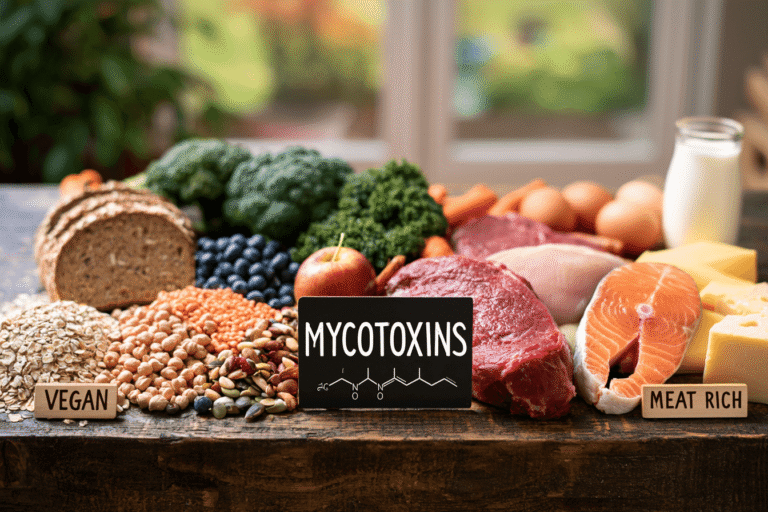
Mycotoxins in food are not limited to visibly mouldy products. They can develop in grains, nuts, seeds, spices, coffee, dried fruits and other agricultural materials before harvest or during drying and storage. A new randomized trial from Germany found that people following vegan and meat-rich diets developed distinctly different urinary mycotoxin patterns after eight weeks. However, the study did not show that either diet caused poisoning, disease or organ damage [1].
Urinary deoxynivalenol, ochratoxin A and zearalenone were higher in the vegan group after adjustment for urinary creatinine. T-2 toxin was higher in the meat-rich group. These findings deserve attention from food producers, herbal manufacturers and patients, but they should not be simplified into the claim that vegan diets are unsafe.
What Are Mycotoxins in Food?
Mycotoxins are naturally occurring compounds produced by certain moulds, particularly species of Aspergillus, Penicillium and Fusarium. Mould growth and toxin formation may occur while crops are growing, during harvest or when foods are dried and stored under unsuitable conditions [2].
The presence of a urinary mycotoxin biomarker indicates that a person was exposed to and excreted a measurable compound or metabolite. It does not automatically mean that the exposure reached a harmful dose.
Health risk depends on the specific mycotoxin, amount consumed, frequency and duration of exposure, age, nutritional status and other individual factors. Food concentration limits and urinary biomarker measurements also use different units and cannot be directly compared.
Many mycotoxins are chemically stable. Milling, washing, heating or ordinary cooking may reduce some contamination, but these processes do not reliably eliminate every mycotoxin [2,3].
How the Randomized Trial Was Conducted
The researchers studied 63 healthy adults who were consuming an omnivorous mixed diet before enrolment. After a one-week run-in period, participants were randomized to one of two diets for eight weeks [1].
Thirty-two participants followed a vegan diet that excluded animal-derived foods. Thirty-one followed a meat-rich diet containing at least 150 grams of meat per day. Fish did not count towards this meat target. The diets were intended to provide comparable energy intake, but the participants selected and prepared their own food rather than receiving standardized meals.
Morning spot urine samples were collected at the beginning of the trial and after eight weeks. The researchers measured six mycotoxins and reported both crude urinary concentrations and values adjusted for creatinine.
Creatinine adjustment is commonly used to account for differences in urine dilution. However, this adjustment requires particular caution when comparing vegan and meat-consuming groups because cooked meat and fish can temporarily increase urinary creatinine excretion [5].
What the Randomized Trial Found
The clearest reported differences involved deoxynivalenol, ochratoxin A, zearalenone and T-2 toxin. The following results are median concentrations at eight weeks, expressed as micrograms per gram of urinary creatinine.
| Mycotoxin biomarker | Vegan diet | Meat-rich diet | Main finding |
|---|---|---|---|
| Deoxynivalenol | 7.15 µg/g | 2.85 µg/g | Higher in the vegan group |
| Ochratoxin A | 0.45 µg/g | 0.20 µg/g | Higher in the vegan group |
| Zearalenone | 1.34 µg/g | 0.49 µg/g | Higher in the vegan group |
| T-2 toxin | 3.44 µg/g | 5.15 µg/g | Higher in the meat-rich group |
The between-group differences were statistically significant for creatinine-adjusted deoxynivalenol, ochratoxin A and zearalenone. The researchers’ repeated-measures analyses, which considered baseline and week-eight results together, supported the same general direction for these three mycotoxins [1].
The T-2 result was less secure. Its direct week-eight comparison narrowly reached statistical significance, with a reported p value of 0.047. However, the diet-by-time comparison in the repeated-measures model was not statistically significant. It would therefore be inappropriate to conclude that eating meat directly caused higher T-2 exposure.
Why the Creatinine Adjustment Changes the Interpretation
The most widely reported differences for deoxynivalenol, ochratoxin A and zearalenone were based on concentrations divided by urinary creatinine. This correction helps compensate for whether the urine was dilute or concentrated, but it introduces another variable into the calculation.
A German biomarker study involving 36 vegans and 36 omnivores demonstrated the problem. Total 24-hour excretion of an example biomarker was identical in the two groups, yet its creatinine-adjusted concentration appeared 26 percent lower in the omnivores because their urinary creatinine excretion was higher [5].
Meat contains creatine, some of which is converted into creatinine during cooking. Recent meat consumption, muscle mass, sex, age and kidney function can consequently influence the denominator used in the calculation.
This does not invalidate the new trial. It means the adjusted results must be interpreted together with the crude concentrations, baseline measurements and repeated-measures analyses.
In the crude week-eight urine measurements, the between-group differences for deoxynivalenol, ochratoxin A and zearalenone were not statistically significant. Crude T-2 concentration was higher in the meat-rich group. Therefore, the strongest conclusion is that the dietary interventions produced different biomarker patterns, not that one group necessarily absorbed a clearly greater total toxic burden.
The Trial Measured Exposure Rather Than Illness
The investigators measured urinary biomarkers. They did not report clinical mycotoxin poisoning, liver injury, kidney injury, hormonal disease, reproductive dysfunction, immune suppression or cancer caused by either diet [1].
Urinary concentrations also cannot be read as though they were regulatory limits for food. Food-safety limits are generally based on toxin concentration within a particular food or estimated intake relative to body weight. A urinary biomarker is influenced by absorption, metabolism, timing of the last meal, hydration, urinary excretion and the laboratory method.
The trial lasted eight weeks and included a relatively small group of healthy adults. It was suitable for detecting short-term changes in exposure biomarkers but was not designed to determine whether either dietary pattern produced long-term clinical harm.
Which Foods May Explain the Different Patterns?
Deoxynivalenol is primarily produced by Fusarium moulds and is commonly associated with wheat, maize, oats, barley and foods made from these grains. Processing can reduce deoxynivalenol, but it may not remove it completely [3].
Ochratoxin A may occur in wheat, rye, oats, barley, coffee, dried grapes, wine, spices and liquorice. It is particularly associated with inadequate drying and storage [2,3].
Zearalenone is another Fusarium toxin that may occur in maize, oats, wheat, sorghum and rice. T-2 and HT-2 toxins are also associated mainly with contaminated cereals, particularly oats, wheat, rye and barley [2,3].
The vegan participants consumed more nuts, vegetables, legumes, fruits, vegetable oils and plant-based yoghurt. However, the trial did not identify a significant difference in reported whole-grain or refined-grain consumption between the groups. Some correlations were observed between vegetables and deoxynivalenol or ochratoxin A, and between whole grains and zearalenone, but the dietary categories were broad and could not establish the exact contaminated food [1].
The unexplained increase in T-2 toxin among meat-rich participants further demonstrates why the labels “vegan” and “meat-rich” are too crude to identify the source. A person following either pattern may consume grains and processed foods originating from different farms, harvests, suppliers and storage conditions.
Does This Mean Vegan Diets Contain More Mycotoxins?
The trial does not establish that vegan diets are generally more contaminated or more harmful.
A separate 2026 study from Iceland compared 47 vegans with 171 omnivores. Deoxynivalenol concentrations were similar between the groups, ochratoxin A was approximately ten times lower in the vegans, and zearalenone showed a different pattern, with more frequent detection among vegans. The investigators concluded that the groups had distinct exposure profiles but found no support for the assumption that vegans were universally more exposed [4].
These apparently conflicting studies may reflect differences in geography, crop conditions, food brands, storage, grain varieties, dietary choices and laboratory methods. Mycotoxin exposure can change substantially between individual food batches. Dietary identity alone cannot describe these variables.
A 2026 analysis of 32 plant-based meat, cheese and fish alternatives found at least one target mycotoxin in 27 products. Alternaria toxins were common, and seitan-based products had the highest contamination in that sample [6]. This finding identifies an area requiring stronger surveillance, but a small product survey cannot establish that all plant-based alternatives are hazardous.
Earlier research among UK vegetarians also reported higher urinary deoxynivalenol on some sampling days, illustrating the importance of cereal exposure. However, considerable individual and day-to-day variation was present [7].
Why Mycotoxins Matter to Ayurveda and Botanical Products
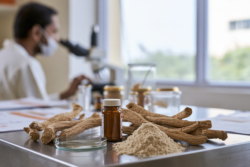
The German dietary trial did not test Ayurvedic medicines, medicinal herbs or classical formulations. Its relevance to Ayurveda comes from the fact that many herbal materials share the same agricultural and storage risks as food crops.
Herbs, spices, seeds, nuts, roots, fruits and powdered botanical ingredients can become vulnerable when they are harvested during wet weather, dried inadequately, stored at excessive humidity or kept in damaged packaging. Grinding a contaminated raw material into powder may make visible inspection more difficult.
WHO quality-control guidance for herbal materials includes assessment of contamination and methods relevant to aflatoxins and other quality hazards [9]. Reliable botanical manufacturing therefore requires more than botanical identification alone.
Appropriate controls include verified suppliers, hygienic harvesting, rapid and complete drying, moisture monitoring, clean storage, batch traceability and risk-based laboratory testing. High-risk materials may require validated multi-mycotoxin analysis, particularly when supplier history, climatic conditions, visible deterioration or moisture measurements raise concern.
Traditional use does not protect a poorly stored herb from fungal contamination. At the same time, the possibility of contamination should not be used to portray every herbal or plant-based product as unsafe. Risk is determined by the condition of the specific raw material and the quality system used to process it.
How Patients Can Reduce Mycotoxin Exposure
Buy Grains Nuts and Spices in Manageable Quantities
Buying smaller quantities reduces prolonged household storage. Foods should come from suppliers with rapid stock turnover and intact, moisture-resistant packaging.
Store Dry Foods Away From Moisture and Heat
Grains, flour, nuts, seeds, dried fruits and spices should be kept dry, cool and protected from insects. Containers should be clean and completely dry before refilling. New stock should not be mixed with old residue.
Discard Visibly Damaged Products
Mouldy, discoloured, shrivelled or unusually soft grains and nuts should be discarded. A persistent musty odour, damp clumping or visible fungal growth is also a reason not to consume the product. Removing only the visible mould may be inadequate because mould and toxins can extend deeper into food [2].
Maintain Dietary Variety
Rotating grains, legumes, nuts, seeds, fruits and other staples may reduce repeated exposure to a single contaminated commodity. Dietary variety also improves nutritional coverage. It is more rational than eliminating every cereal, nut or plant food because one study detected a biomarker difference.
Do Not Depend on Cooking Alone
Normal cooking may lower certain contaminants but cannot be relied upon to neutralize all mycotoxins. Prevention through agricultural control, drying, storage, supplier monitoring and testing remains more dependable [2,3].
Choose Traceable Herbal Products
Botanical products should have clear labelling, batch identification, manufacturing and expiry information, protected packaging and an identifiable manufacturer. Where relevant, contaminant testing should use validated methods and be linked to the actual batch supplied to the patient.
A general claim such as “natural,” “organic” or “traditionally prepared” does not replace contaminant control. Organic crops can also develop mould when environmental and storage conditions permit.
What Patients Should Take From This Study
The study provides useful evidence that changing the overall diet can change urinary mycotoxin patterns within eight weeks. It does not prove that vegan diets are toxic, that meat-rich diets are safer or that the measured concentrations caused illness.
Three creatinine-adjusted biomarkers were higher after the vegan intervention, while T-2 toxin was higher after the meat-rich intervention. Some findings changed when crude rather than creatinine-adjusted urine values were considered, and the T-2 repeated-measures result was not statistically significant.
The practical message is therefore not to fear plant foods. Greater attention should be given to crop quality, drying, storage, food diversity, processing, supplier traceability and laboratory surveillance. The same principles apply to grains, packaged foods, spices, herbal materials and botanical formulations.
Frequently Asked Questions
Are mycotoxins in food higher in vegan diets?
Not consistently. The German trial found higher creatinine-adjusted levels of three biomarkers in the vegan group, but another 2026 study found much lower ochratoxin A among vegans. Specific foods and contamination conditions matter more than the diet label alone.
Did anyone in the trial develop mycotoxin poisoning?
The study measured urinary exposure biomarkers rather than poisoning or disease. It did not demonstrate that the reported concentrations caused symptoms, organ damage or long-term toxicity.
Why was T-2 toxin higher in the meat-rich group?
The study did not identify a definite source. T-2 toxin is usually associated with contaminated cereals, and both dietary groups could consume grain products. The repeated-measures comparison for T-2 was also not statistically significant.
Can cooking destroy mycotoxins?
Cooking and processing may reduce certain mycotoxins but cannot reliably eliminate all of them. Many mycotoxins are chemically stable, making proper drying, storage and quality control essential.
Which foods are most likely to contain mycotoxins?
Potential sources include cereals, maize, oats, wheat, barley, nuts, seeds, dried fruits, coffee, spices and poorly stored agricultural products. Contamination varies by crop, climate, harvest and storage conditions.
Can Ayurvedic herbs contain mycotoxins?
Herbal materials can become contaminated when harvesting, drying or storage is inadequate. Botanical authentication, moisture control, hygienic processing, traceability and appropriate batch testing help reduce this risk.
Should healthy people undergo routine urine mycotoxin testing?
This trial does not support routine screening of healthy individuals. Spot urine results can vary with recent meals, hydration, metabolism and the correction method. Testing is more meaningful when there is a defined exposure concern and qualified clinical interpretation.
References
- Kanonier, P. S., Kowarschik, S., Huber, R., & Storz, M. A. (2026). Mycotoxin exposure following an eight-week vegan or meat-rich dietary intervention: A randomized-controlled trial. npj Science of Food.
- World Health Organization. (2023, October 2). Mycotoxins.
- U.S. Food and Drug Administration. (2026, July 6). Mycotoxins.
- Halldorsson, T. I., Birgisdottir, B. E., Eiríksdóttir, Á. V., Ragnarsdóttir, O., Kosicki, R., Twarużek, M., & Olafsdottir, K. (2026). Is adherence to plant-based diet associated with higher exposure to mycotoxins?. Journal of Exposure Science & Environmental Epidemiology, 36, 871–877.
- Abraham, K., Penczynski, K., Monien, B. H., Bergau, N., Knüppel, S., & Weikert, C. (2023). Risks of misinterpretation of biomarker measurements in spot urine adjusted for creatinine: A problem especially for studies comparing plant based with omnivorous diets. International Journal of Hygiene and Environmental Health, 249, 114142.
- Schneidemann-Bostelmann, S., Otting, Y., Dick, F., Lefever, T., Asam, S., & Rychlik, M. (2026). Mycotoxin occurrence and risk assessment in plant-based meat, cheese, and fish alternatives based on an adapted UHPLC-MS/MS multi-method. Mycotoxin Research, 42, Article 22.
- Wells, L., Hardie, L., Williams, C., White, K., Liu, Y., De Santis, B., Debegnach, F., Moretti, G., Greetham, S., Brera, C., Papageorgiou, M., Thatcher, N., Rigby, A., Atkin, S., & Sathyapalan, T. (2017). Deoxynivalenol biomarkers in the urine of UK vegetarians. Toxins, 9(7), 196.
- Mihalache, O. A., Mignogna, C., Torrijos, R., Rinaldi de Alvarenga, J. F., Monica, E., Morandini, M. S., Del Burgo-Gutiérrez, C., Bonaccio, M., Ruggiero, E., Del Rio, D., Rosi, A., Mena, P., & Dall’Asta, C. (2026). Multi-mycotoxin biomonitoring in Italian adults: Revealing the connection between diet habits and mycotoxin exposure. Environment International, 214, 110372.
- World Health Organization. (2011). Quality control methods for herbal materials.