

- What Is Rosacea?
- Symptoms of Rosacea
- Why Rosacea Happens According to Ayurveda
- Modern Science Supports a Root-Cause View of Rosacea
- Common Rosacea Triggers: Nidana That Keep the Face Inflamed
- Is It Rosacea or Something Else? Herpes, Lupus, Acne, Steroid Rash, and Other Mimics
- Does Herpes Cause Rosacea?
- Ayurvedic Cure from the Root: How Treatment Works
- Classical Avaleha for Rosacea-Like Skin Disease
- Sushrutokta Khadiradya Avaleha Preparation for 30 Days
- Diet for Rosacea According to Ayurveda
- Skincare for Rosacea-Prone Sensitive Skin
- Prognosis: Can Rosacea Improve Permanently With Ayurveda?
- When to Seek Urgent Medical Help
- Map Your Rosacea Root Pattern Before Starting Another Cream or Herb
- FAQs
- References
Rosacea usually appears on the face, but the face is not always the real root of the disease. For many patients, facial redness, burning, flushing, heat, bumps, visible blood vessels, and sensitive skin are only the outer signs of a deeper internal imbalance.
In Ayurveda, this condition can be understood as a Pitta-Rakta dominant Twak Vikara. This means the main disturbance is not only in the skin surface, but also in the heat-regulating and blood-related channels of the body. When Pitta becomes aggravated and affects Rakta, the skin may become red, hot, sensitive, reactive, and inflamed. If Vata is also involved, the patient may experience sudden flushing, stinging, dryness, anxiety-triggered redness, or unpredictable flare-ups. If Kapha and Kleda are involved, the redness may be accompanied by papules, pustules, swelling, heaviness, or acne-like bumps.
This is why many patients feel frustrated. They apply creams, avoid cosmetics, change face washes, and try repeated topical treatments, but the redness returns again and again. The reason is simple: if the internal trigger chain continues, the skin keeps reacting. Heat, sun exposure, spicy food, alcohol, stress, poor sleep, constipation, acidity, gut imbalance, harsh skincare, and steroid creams may keep the inflammatory cycle active.
Modern dermatology also recognizes rosacea as more than a simple cosmetic problem. Research describes rosacea as a chronic inflammatory condition involving immune dysregulation, neurovascular sensitivity, skin-barrier disturbance, microbial factors, and environmental triggers [4]. This modern explanation connects closely with the Ayurvedic view, where repeated triggers disturb Agni, produce Ama, aggravate Pitta and Rakta, and finally express through the skin.
Ayurveda does not look at rosacea as “redness only.” It asks a deeper question: why is the skin producing heat, inflammation, flushing, and sensitivity again and again? The answer may be different for each patient. One person may have a strong Pitta-Rakta pattern with burning and heat. Another may have Vata-Pitta flushing linked with stress and dryness. Another may have Kapha-Pitta involvement with pustules, heaviness, and sluggish digestion. A fourth patient may not have rosacea at all, but a mimic such as steroid-induced dermatitis, herpes, shingles, lupus, acne, contact dermatitis, or ocular disease.
This is why root-cause assessment matters. A patient with burning facial redness should not be treated the same way as a patient with papules and pustules. A patient with constipation and acidity needs a different plan from someone with dry, stinging, highly sensitive skin. A patient with painful blisters or one-sided facial rash should be evaluated for viral conditions such as herpes simplex or shingles rather than being treated as routine rosacea.
The Ayurvedic goal is samprapti-vighatana, which means breaking the disease pathway. In a rosacea-like condition, this may involve removing triggers, correcting Agni, reducing Ama, cooling aggravated Pitta, purifying and stabilizing Rakta, calming Vata-driven flushing, reducing Kapha-Kleda inflammation, supporting bowel regularity, and strengthening the skin barrier.
This is also why the aim of Ayurvedic care is not temporary suppression. The aim is to move the patient toward calmer skin, fewer flare-ups, reduced burning, better trigger tolerance, improved digestion, better sleep, and long-term remission. When the internal chain is corrected, the face no longer has to keep showing the same alarm signal again and again.
For patients in the USA, UK, Canada, Australia, and Singapore, this root-cause view is especially important because many people are already using multiple skincare products, antibiotics, lasers, steroid creams, or over-the-counter treatments without understanding why their rosacea keeps returning. A complete Ayurvedic approach begins with a proper diagnosis, careful pattern assessment, and a personalized treatment plan rather than a random “skin supplement” or one common herb for everyone.
Rosacea may be visible on the face, but in Ayurveda, the deeper work begins inside the body. The face is the mirror. The root cause must be understood before true healing can begin.
What Is Rosacea?
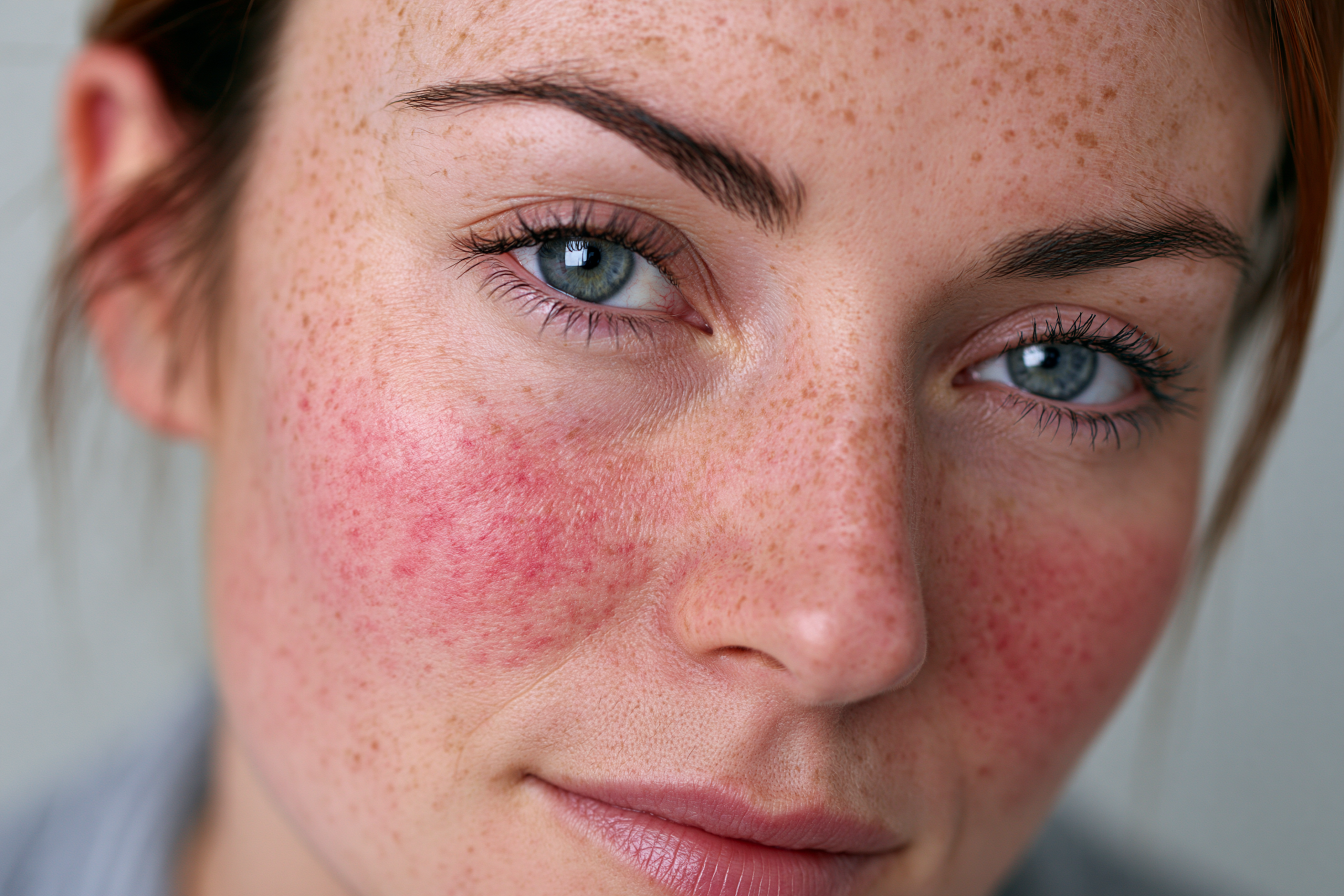
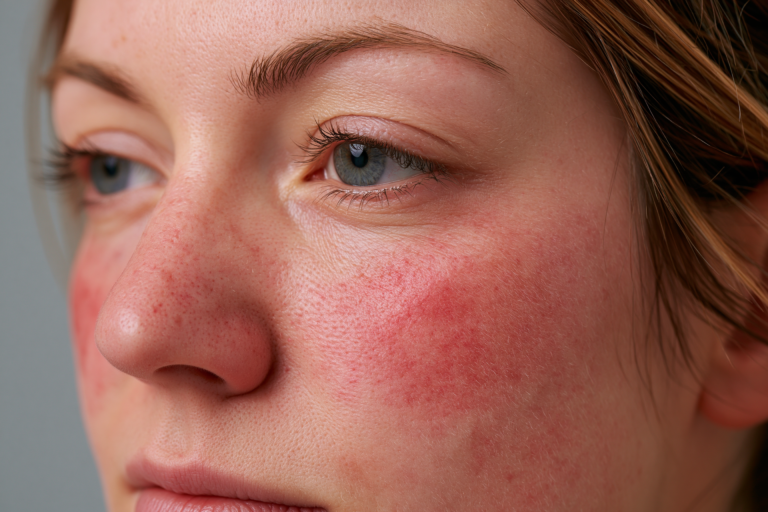
Rosacea is a chronic inflammatory condition of the face that commonly affects the cheeks, nose, chin, and forehead. It may cause repeated facial flushing, persistent redness, burning, stinging, visible blood vessels, acne-like bumps, pustules, skin sensitivity, dryness, swelling, and sometimes eye irritation. [1,2,3]
Many people first mistake rosacea for acne, allergy, sun sensitivity, or a reaction to skincare products. Some are told they simply have “sensitive skin.” Others try acne creams, steroid creams, scrubs, exfoliating acids, or cosmetic treatments, only to find that the face becomes more red, reactive, hot, and painful.
Rosacea is not ordinary acne. It is a recurring inflammatory and vascular reaction of the skin. The face becomes over-responsive to triggers such as heat, sun exposure, stress, alcohol, spicy food, hot drinks, cold wind, exercise, harsh skincare, and internal inflammatory disturbances. Over time, the skin may become more sensitive and may flare even after small triggers. [1,2,3]
In Ayurvedic clinical understanding, rosacea-like facial inflammation is assessed as a Pitta-Rakta dominant Twak Vikara, where heat, blood tissue involvement, inflammation, burning, redness, and sensitivity are central. When sudden flushing, dryness, stinging, anxiety-linked redness, or unpredictable flare-ups are present, Vata is also involved. When papules, pustules, oiliness, swelling, heaviness, or thick inflammatory buildup are present, Kapha and Kleda become important. [9,10,11]
Rosacea is therefore more than a cosmetic redness problem. It is a repeated heat-inflammatory pattern that appears on the face but is driven by a deeper internal disease chain.
Modern dermatology describes the visible disease pattern: redness, flushing, inflammation, papules, pustules, visible vessels, and sometimes eye involvement. Ayurveda studies the inner pathway that keeps producing those signs: Pitta aggravation, Rakta Dushti, disturbed Agni, Ama formation, Vata reactivity, Kapha-Kleda accumulation, Nidana exposure, and weakened skin tolerance. [4,9,10,11]
Rosacea Is More Than Redness
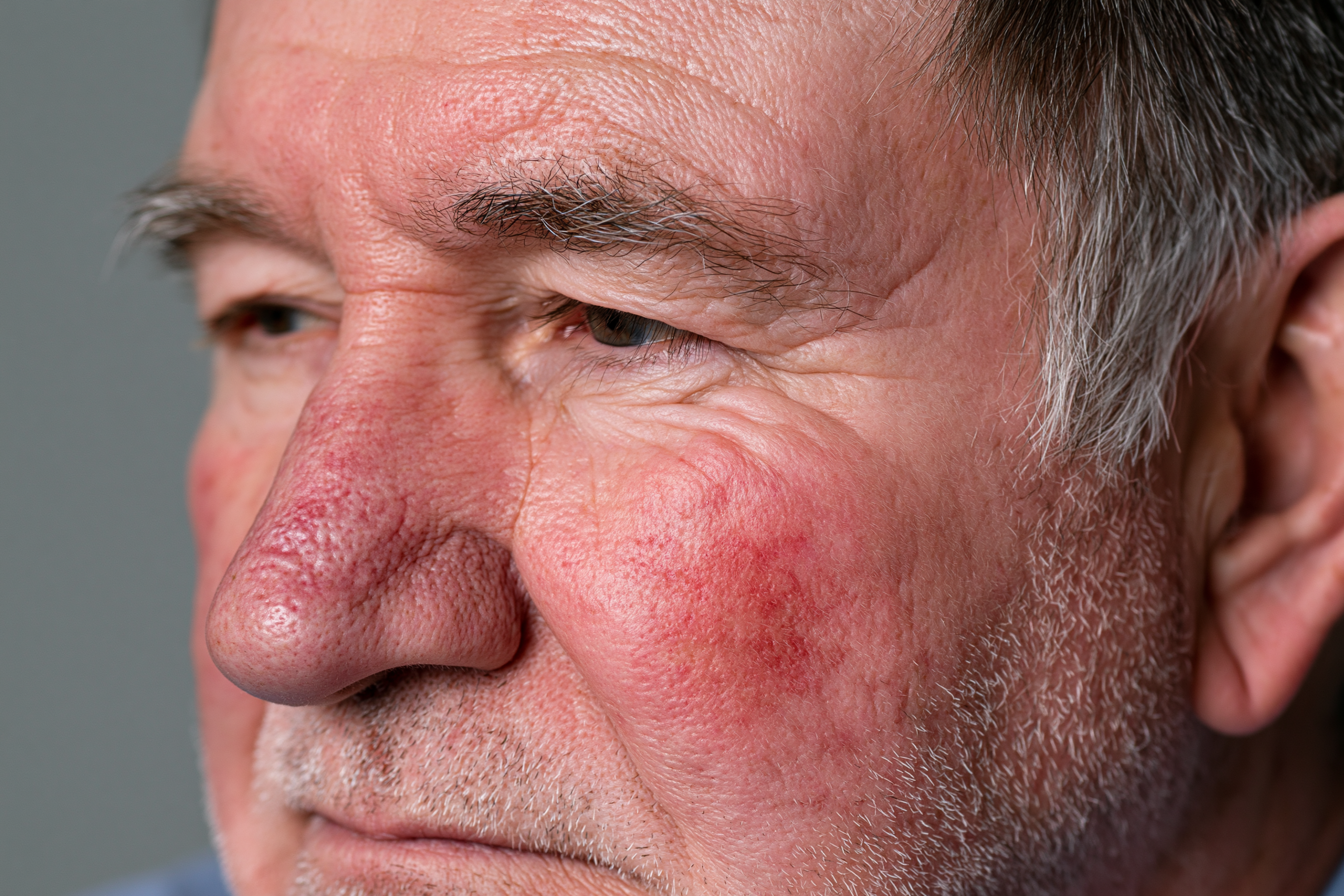
Many people think rosacea only means a red face. In reality, rosacea can appear in several different ways.
Some patients mainly experience flushing. Their face suddenly becomes red after sun exposure, heat, stress, embarrassment, alcohol, spicy food, hot drinks, exercise, or temperature changes.
Some patients have persistent redness. Their cheeks, nose, chin, or forehead remain pink or red even when there is no obvious trigger.
Some develop acne-like bumps or pustules, usually without blackheads or whiteheads.
Some experience burning, stinging, dryness, roughness, or product intolerance. Even gentle skincare may sting or burn.
Some develop visible blood vessels on the cheeks, nose, or chin.
Some develop eye symptoms such as dryness, grittiness, redness, watering, eyelid irritation, light sensitivity, or blurred vision. This is known as ocular rosacea and requires careful attention. [2,18]
Some develop thickened or uneven skin texture, especially around the nose. This is known as phymatous rosacea or rhinophyma and usually requires specialist care. [1,2]
This variety is important because rosacea should not be treated with one single cream, herb, detox, diet, or face pack for everyone. The treatment must match the patient’s pattern.
A person with burning and heat needs a different approach from a person with papules and pustules. A person with sudden flushing and anxiety-linked redness needs a different approach from a person with constipation, acidity, and food-triggered flares. A person with steroid-damaged facial skin needs a different plan from a person with ocular symptoms.
Ayurveda is valuable because it does not treat only the disease name. It studies the patient’s Prakriti, Vikriti, Dosha, Dushya, Agni, Ama, Koshtha, Nidana, disease stage, bowel pattern, diet, stress, sleep, climate exposure, skincare history, steroid use, and associated symptoms.
Rosacea Is Not Acne
Rosacea is often mistaken for acne because both can produce red bumps and pustules. But they are not the same condition.
Acne usually involves comedones, meaning blackheads and whiteheads. It often begins during adolescence and may affect the face, chest, back, and shoulders. Acne is strongly linked with sebum, follicular blockage, hormonal influence, bacterial involvement, and inflammation.
Rosacea usually affects the central face and is strongly associated with flushing, burning, heat, skin sensitivity, visible blood vessels, and trigger-related flares. Blackheads and whiteheads are usually absent. [1,2,3]
This difference matters because many acne treatments are too harsh for rosacea-prone skin. Strong benzoyl peroxide, aggressive retinoids, scrubs, chemical peels, alcohol toners, exfoliating acids, and frequent cleansing may worsen burning, dryness, redness, and skin-barrier injury.
From an Ayurvedic perspective, acne-like rosacea bumps are not treated simply as common facial pimples. They are assessed through the full pattern of Pitta-Rakta heat, Vata sensitivity, Kapha-Kleda papules, and possible Agni-Ama involvement.
Two patients may both say, “I have red bumps on my face,” but one may need Pitta-Rakta cooling, another may need Agni-Ama correction, another may need Kapha-Kleda reduction, and another may need repair from steroid or skincare damage.
Rosacea Is Not Contagious
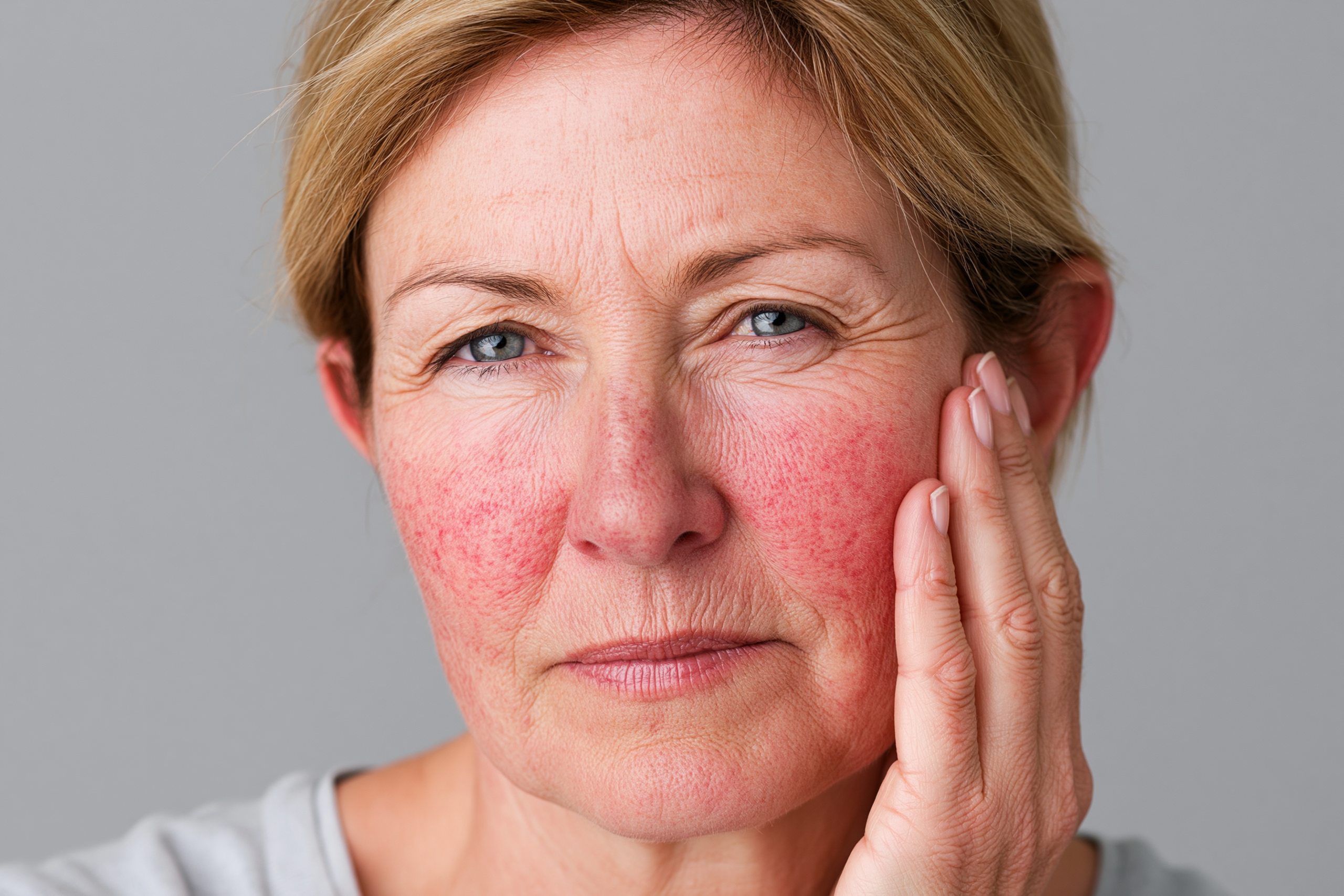
Rosacea is not contagious. It does not spread from one person to another through touch, towels, food, close contact, or shared spaces.
This matters because many patients feel embarrassed and worry that others may think their skin condition is infectious. Rosacea is an inflammatory skin condition, not a contagious disease.
However, some diseases that look like rosacea can be infectious. Herpes simplex, shingles, impetigo, cellulitis, and fungal infections may cause redness, pain, swelling, blisters, crusting, or facial irritation. These conditions require different assessment and should not be treated as ordinary rosacea. [16,17,19]
A red face is not always rosacea.
Painful blisters, crusting, one-sided rash, fever, rapid swelling, severe pain, eye pain, blurred vision, or non-healing lesions need careful evaluation.
Rosacea Can Affect All Skin Types
Rosacea is often described in fair-skinned people because redness is easier to see on lighter skin. But rosacea can affect people of many skin tones.
In darker skin, redness may be less obvious. Instead, patients may describe heat, burning, stinging, swelling, roughness, sensitivity, papules, pustules, facial discomfort, or skin that reacts badly to products. Because the redness is harder to see, diagnosis may be delayed.
This is especially important in the USA, UK, Canada, Australia, and Singapore, where patients come from many ethnic backgrounds and may not show rosacea in the same way.
Ayurveda does not depend only on visible redness. It also studies symptoms such as Daha meaning burning, Ushnata meaning heat, Sparsha-Asahatva meaning touch or product intolerance, Toda meaning stinging or pricking discomfort, Pidaka meaning papules or pustule-like eruptions, Shotha meaning swelling, and the patient’s digestion, bowel pattern, trigger response, sleep, stress, and seasonal aggravation.
A patient may say:
- “My face burns even when it does not look very red.”
- “My skin feels hot after spicy food.”
- “My cheeks sting when I apply sunscreen.”
- “My face flares after stress.”
- “My skin gets bumps but no blackheads.”
- “My eyes feel dry and gritty.”
These are clinically important symptoms even when redness is subtle.
Different Presentations of Rosacea
Rosacea does not look the same in every patient. The presentation gives important clues about the deeper pattern.
Flushing-Dominant Rosacea
This patient develops sudden redness after heat, sun exposure, emotional stress, embarrassment, alcohol, spicy food, hot drinks, exercise, or temperature changes.
In Ayurvedic assessment, this suggests Vata-Pitta involvement with Rakta sensitivity. Vata moves aggravated Pitta-Rakta quickly through the facial channels, causing sudden redness and heat. These patients may also have anxiety, poor sleep, dryness, irregular digestion, or stress-linked flares.
Persistent Redness-Dominant Rosacea
This patient has a red or pink face most of the time, especially on the cheeks, nose, chin, or forehead. Visible blood vessels may also appear.
In Ayurvedic assessment, this suggests Pitta-Rakta Dushti with chronic heat and vascular reactivity. The condition may become more fixed when heat-producing triggers continue for months or years.
Papulopustular Rosacea
This patient develops red bumps and pustules that look like acne, but usually without blackheads and whiteheads.
In Ayurvedic assessment, this suggests Pitta-Kapha involvement with Kleda and possible Ama. This pattern often requires attention to digestion, bowel regularity, heaviness, inflammatory diet, oiliness, and recurrent internal heat.
Sensitive Burning Rosacea
This patient has burning, stinging, dryness, product intolerance, and a feeling that the skin barrier is damaged.
In Ayurvedic assessment, this suggests Vata-Pitta aggravation with reduced skin tolerance. These patients often worsen with harsh skincare, over-cleansing, acne products, strong exfoliation, steam, heating herbs, and aggressive detoxification.
Ocular Rosacea
This patient has eye dryness, redness, irritation, grittiness, watering, eyelid inflammation, light sensitivity, or blurred vision.
In Ayurvedic assessment, this reflects Pitta-Rakta involvement affecting the eye region, but it must be handled carefully because eye symptoms can also occur in other conditions. Eye pain, photophobia, blurred vision, or suspected herpes keratitis should not be treated casually. [18,19]
Phymatous Rosacea
This patient develops thickened, uneven, enlarged skin texture, commonly around the nose.
In Ayurvedic assessment, this suggests chronic dosha-dushya involvement with deeper structural change. This stage is more difficult and may require integrative care, including specialist dermatological procedures.
The Disease Name Alone Is Not Enough
One of the biggest mistakes in rosacea treatment is assuming that every patient with redness needs the same treatment.
Five patients may all say, “I have rosacea,” but their root patterns may be completely different.
One patient has heat and burning after spicy food.
One patient has sudden flushing with anxiety and stress.
One patient has papules, pustules, constipation, and heaviness.
One patient has steroid-damaged facial skin.
One patient has eye symptoms and may need urgent eye care.
One patient may not have rosacea at all. The condition may be herpes, shingles, lupus, contact dermatitis, fungal infection, perioral dermatitis, acne, or another facial rash. [16,17,18,19]
This is why Ayurvedic treatment should not begin with a product. It should begin with root-pattern mapping.
A proper assessment should study:
- facial redness pattern
- flushing triggers
- burning and stinging
- papules or pustules
- visible blood vessels
- dryness or oiliness
- eye symptoms
- bowel pattern
- acidity or bloating
- constipation or loose stools
- food triggers
- sleep quality
- stress response
- climate exposure
- skincare history
- steroid use
- history of herpes-like blisters
- disease duration
- seasonal aggravation
- Prakriti
- Vikriti
- Agni
- Ama
- Koshtha
- Dosha
- Dushya involvement
Only after this mapping should herbs, Avaleha, diet, lepa, cleansing, Rasayana, skincare, or integrative care be selected.
Rosacea Through the Ayurvedic Perspective
Ayurvedic clinical assessment reads rosacea-like facial inflammation through the patient’s visible signs, internal symptoms, triggers, digestion, tissue involvement, and disease pathway.
Facial redness and heat point toward Pitta-Rakta aggravation.
Sudden flushing, stinging, dryness, and unpredictability point toward Vata-Pitta involvement.
Papules, pustules, oiliness, swelling, and heaviness point toward Kapha-Kleda association.
Bloating, acidity, constipation, coating on the tongue, heaviness after meals, and food-triggered flares point toward Agni disturbance and Ama formation.
Recurrent flares after sun, heat, alcohol, spicy food, sour food, stress, poor sleep, harsh skincare, or steroid use show ongoing Nidana exposure.
This deeper reading is the foundation of Ayurvedic root-cause treatment.
The aim is not only to reduce redness for a few days. The aim is to break the disease chain, cool the aggravated Pitta-Rakta, correct Agni, clear Ama, stabilize Vata, reduce Kapha-Kleda, strengthen skin tolerance, and prevent repeated relapse.
Patient Takeaway
Rosacea is not just a cosmetic redness problem.
It is a recurring inflammatory facial condition that may involve redness, flushing, burning, sensitivity, bumps, visible vessels, eye symptoms, and long-term trigger sensitivity.
Modern dermatology describes the visible disease pattern. Ayurveda investigates the internal pathway that keeps producing that pattern.
The most important step is not choosing a random cream or herb. The most important step is identifying the patient’s root pattern:
- Pitta-Rakta heat pattern
- Vata-Pitta flushing pattern
- Kapha-Pitta papulopustular pattern
- Agni-Ama gut-skin pattern
- Steroid-damaged facial skin pattern
- Ocular involvement pattern
- Herpes, shingles, lupus, dermatitis, acne, or other mimic pattern
Once the pattern is understood, treatment can move from temporary symptom control toward root-cause correction, better trigger tolerance, calmer skin, and long-term remission.
Symptoms of Rosacea
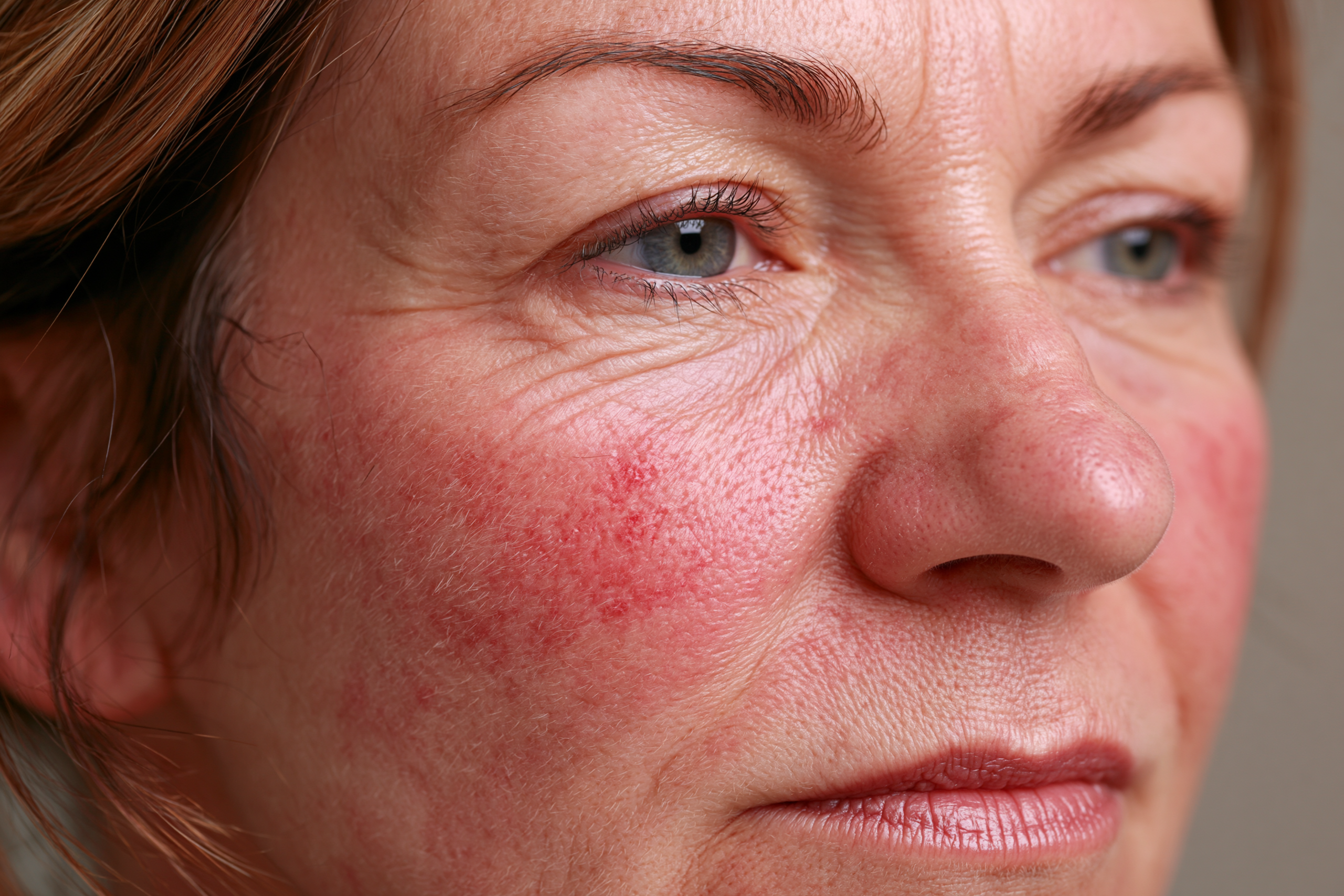
Rosacea symptoms are not random. They are visible signs of a deeper inflammatory, vascular, digestive, and trigger-sensitive pattern. One person may mainly experience redness and flushing, while another may feel burning, stinging, dryness, swelling, or acne-like bumps. Some patients develop eye irritation, and a smaller group may develop thickened skin around the nose. Because rosacea appears differently in different people, it should not be treated with one fixed remedy for everyone. The symptoms must be read carefully because they reveal the deeper disease pattern. [1,2,3]
In modern dermatology, rosacea commonly presents with facial flushing, persistent redness, visible blood vessels, papules, pustules, burning, stinging, dry sensitive skin, eye involvement, and sometimes thickened skin. [1,2,3] In Ayurvedic assessment, these same symptoms are understood through the involvement of Pitta, Rakta, Vata, Kapha, Kleda, Agni, Ama, and Twak. Redness and burning point toward Pitta-Rakta aggravation. Sudden flushing and stinging suggest Vata-Pitta reactivity. Papules and pustules suggest Kapha-Kleda involvement with Pitta. Food-triggered flares, constipation, acidity, bloating, or heaviness after meals suggest Agni disturbance and Ama formation. [9,10,11]
Persistent Facial Redness
Persistent facial redness is one of the most recognized signs of rosacea. It usually appears on the cheeks, nose, chin, and forehead. In the early stage, the redness may come and go. The patient may notice that the face becomes red after sun exposure, stress, heat, spicy food, alcohol, hot drinks, or exercise, and then slowly settles. Over time, if the disease pathway continues, the redness may become more fixed and remain visible even when there is no obvious trigger. [1,2,3]
Many patients describe this as a constant flushed look. The cheeks may appear red as if the person has been in the sun, even when there has been no recent sun exposure. The nose and central face may remain pink or red throughout the day. In some patients, the redness becomes more noticeable after washing the face, applying skincare, entering a warm room, drinking something hot, or feeling emotionally stressed.
From an Ayurvedic viewpoint, persistent facial redness suggests Pitta-Rakta Dushti. Pitta creates heat, inflammation, and burning, while Rakta carries this heated inflammatory pattern into the skin. When Pitta and Rakta remain aggravated for a long time, the facial skin becomes more reactive, and redness becomes more stable. This is why persistent redness should not be understood only as a cosmetic color change. It is a sign that repeated internal and external heat has affected the facial skin channels.
Facial Flushing
Flushing is sudden redness that appears quickly and may fade after minutes or hours. It is often triggered by heat, sun exposure, emotional stress, embarrassment, spicy food, alcohol, hot drinks, exercise, temperature change, or anxiety. [1,2,3] Some patients say their face looks normal at one moment and suddenly becomes red, hot, and uncomfortable. Others notice that public speaking, emotional pressure, anger, or nervousness can make the face flush immediately.
In Ayurveda, sudden flushing suggests Vata-Pitta involvement with Rakta sensitivity. Pitta produces heat and redness, while Vata creates movement, instability, sudden expression, and hypersensitivity. When Vata moves aggravated Pitta-Rakta rapidly through the facial region, the face becomes red, hot, and reactive. This explains why flushing may appear suddenly, disappear, and then return with another trigger.
When Vata is strongly involved, rosacea becomes more unpredictable. The patient may not look red all the time, but the skin reacts quickly to emotional, dietary, climatic, or sensory triggers. This type of rosacea-like presentation requires both cooling of Pitta-Rakta and stabilization of Vata. If only cooling medicines are used while stress, irregular sleep, anxiety, dryness, and nervous-system reactivity remain untreated, flushing may continue.
Burning and Heat Sensation
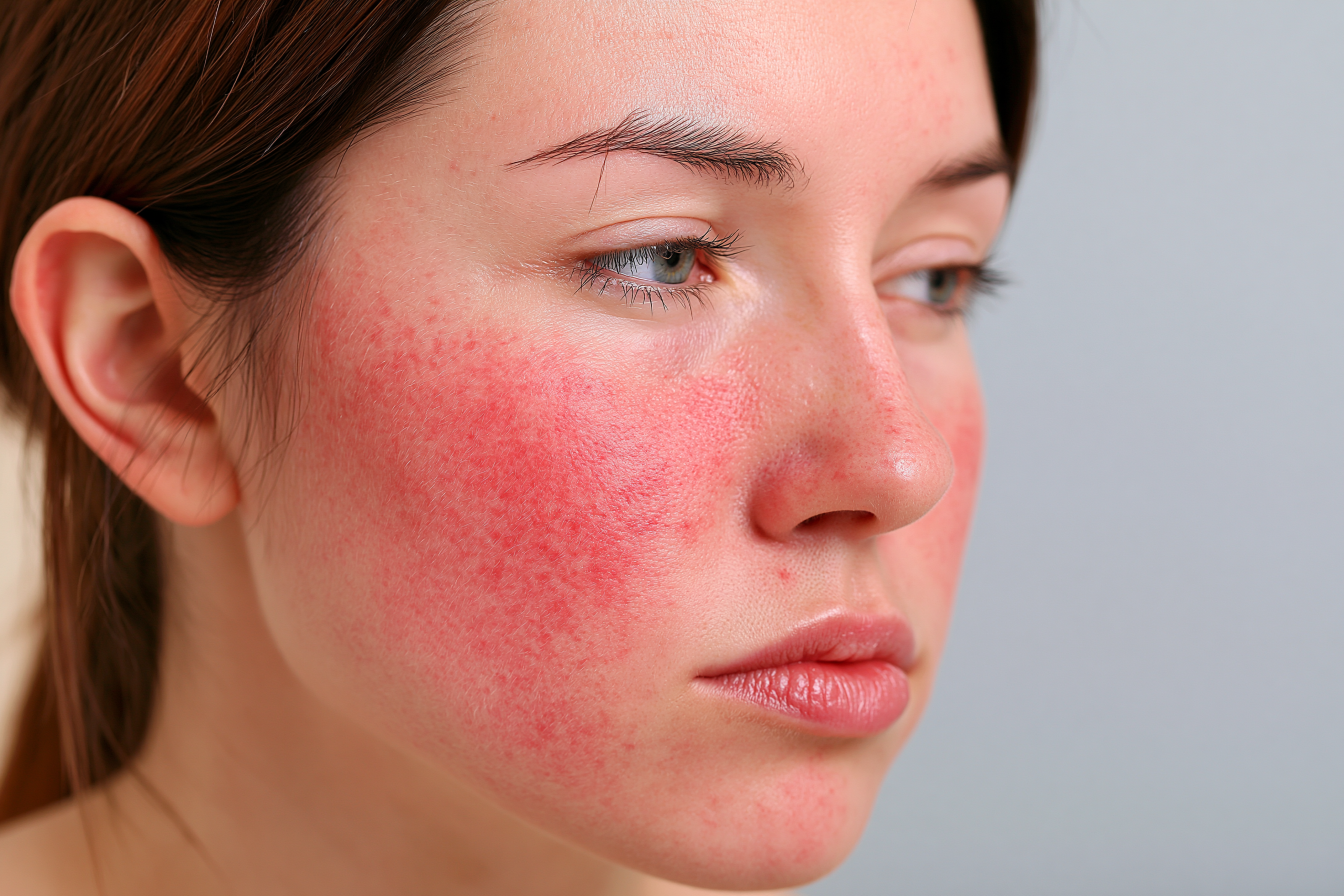
Burning is one of the most distressing symptoms of rosacea. The face may feel hot, irritated, inflamed, or sunburned even when the redness is not very severe. Some patients describe the sensation as if their skin is on fire. This burning may worsen after sun exposure, hot weather, spicy food, alcohol, hot drinks, anger, emotional stress, steam, sauna, hot water washing, harsh skincare, chemical peels, over-exfoliation, or steroid misuse.
From an Ayurvedic viewpoint, burning and heat are direct signs of Pitta aggravation and Rakta involvement. The symptom of Daha refers to burning, and Ushnata refers to heat. When these symptoms repeatedly appear on the face, the deeper disease pathway is not only external irritation. It reflects internal Pitta-Rakta aggravation, especially when the burning worsens after heat-producing foods, alcohol, sun exposure, anger, or late nights. [9,10,11]
Patients with burning rosacea should be treated carefully. Strong heating herbs, aggressive detoxification, steam therapy, harsh scrubs, irritating face packs, essential oils, lemon application, or strong exfoliating products can make the condition worse. The first therapeutic aim is to cool, calm, and stabilize the disease pathway rather than provoke more heat.
Stinging, Pricking, and Skin Sensitivity
Many rosacea patients experience stinging, pricking, tightness, or sharp discomfort on the face. This may happen after applying sunscreen, moisturizer, cleanser, makeup, herbal lepa, or even plain water. The patient may feel that almost everything burns the skin. This sensitivity is often emotionally frustrating because products that were once tolerated may suddenly become irritating.
In Ayurveda, this type of sensitivity reflects Vata-Pitta aggravation. Pitta creates heat, burning, and irritation, while Vata creates dryness, instability, hypersensitivity, and intolerance. When both are aggravated, the skin becomes reactive, hot, fragile, and easily disturbed. The patient may describe the skin as thin, damaged, tight, rough, or unable to tolerate normal skincare.
This presentation requires a gentle treatment strategy. The skin must be cooled, protected, and gradually strengthened. Harsh topical therapies, strong ubtan, excessive turmeric rubbing, lemon, baking soda, alcohol-based toners, frequent cleansing, steam, aggressive exfoliation, and unsupervised steroid use may worsen the Vata-Pitta state and increase sensitivity.
Papules and Pustules
Some patients develop red bumps and pus-filled lesions that resemble acne. This is often called papulopustular rosacea. The important difference is that rosacea usually does not have blackheads or whiteheads. [1,2,3] The patient may say that the face has acne-like bumps, but typical acne treatment makes the skin worse. The bumps may appear on a background of redness, heat, burning, or sensitivity.
From an Ayurvedic viewpoint, papules and pustules suggest that Kapha-Kleda has joined the Pitta-Rakta pattern. Pitta creates heat, redness, and inflammation. Kapha and Kleda create swelling, heaviness, stickiness, congestion, oiliness, and inflammatory buildup. When Ama is also present, the bumps may become recurrent, stubborn, and associated with digestive symptoms such as heaviness after meals, constipation, acidity, bloating, coated tongue, or food-triggered flares. [9,10,11]
Papulopustular rosacea should therefore not be treated merely as a facial pimple problem. It often reflects a deeper Pitta-Kapha-Ama pattern. These patients require assessment of digestion, bowel regularity, heaviness, inflammatory diet, oiliness, recurrent internal heat, and trigger exposure. If only external creams are used while Agni, Ama, Kapha, and Kleda remain uncorrected, the bumps may return.
Visible Blood Vessels
Visible blood vessels, also called telangiectasia, may appear on the cheeks, nose, or chin. They may look like fine red lines or small branching vessels. These often develop after repeated flushing and long-standing facial redness. [1,2]
From an Ayurvedic viewpoint, visible vessels suggest chronic Rakta involvement and repeated Pitta aggravation in the facial channels. When the face is repeatedly exposed to heat, sun, alcohol, spicy food, stress, emotional flushing, and inflammatory triggers, the vascular signs may become more fixed.
Ayurvedic treatment may help reduce heat, burning, new flare-ups, and the tendency toward repeated vascular irritation. However, fixed visible vessels may not always disappear completely with internal treatment alone. In some patients, integrative care such as vascular laser or IPL may be considered for persistent visible vessels. The Ayurvedic priority is to reduce the internal pattern that keeps producing new redness and vascular reactivity.
Dryness, Roughness, and Product Intolerance
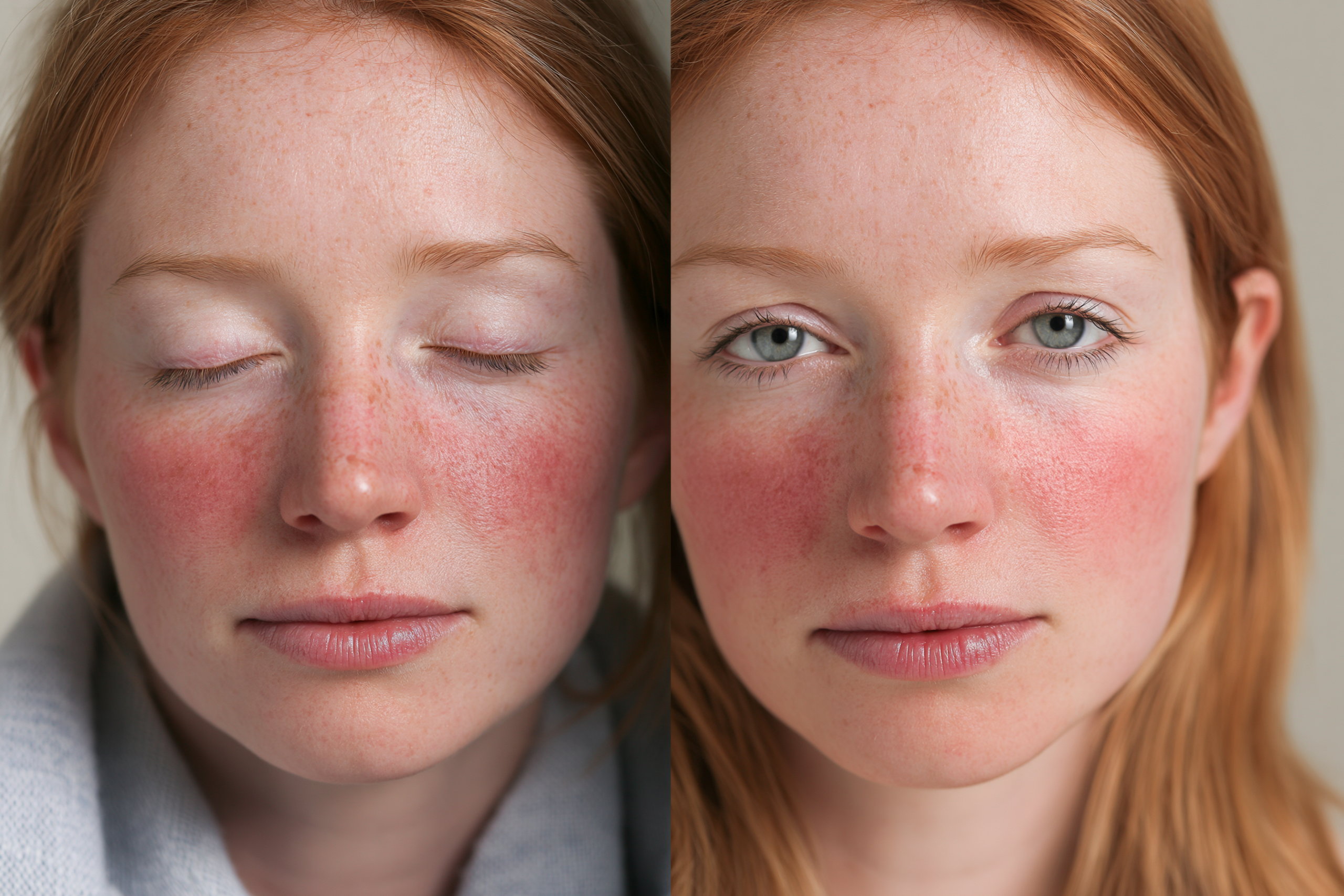
Rosacea-prone skin may feel dry, rough, tight, irritated, or easily inflamed. Some patients have oily areas and dry areas at the same time. Others feel that their face reacts to almost everything. This happens because rosacea can weaken the skin barrier. When the skin barrier is weak, the face becomes more sensitive to cleansers, cosmetics, sunscreens, sweat, pollution, weather changes, and even herbal applications.
In Ayurvedic understanding, dryness and roughness suggest Vata involvement, while heat and burning suggest Pitta involvement. When Vata and Pitta are both active, the skin may feel hot yet dry, inflamed yet fragile, and reactive yet easily irritated. These patients often worsen when they over-cleanse, scrub, use hot water, apply strong actives, use essential oils, or try aggressive detoxification.
This presentation requires cooling, soothing, and barrier-supportive care. External Ayurvedic applications may be useful, but they must be mild, non-irritating, and patch-tested. A strong lepa may be suitable for some skin diseases, but a sensitive rosacea-like face may react badly if the application is too heating, abrasive, drying, or pungent.
Swelling and Facial Fullness
Some rosacea patients experience mild swelling, puffiness, or facial fullness during flares. The cheeks or nose may feel warm, heavy, inflamed, or slightly swollen. The swelling may worsen after alcohol, salty food, late nights, heat exposure, emotional stress, or inflammatory meals.
In Ayurveda, swelling corresponds to Shotha. When swelling occurs with heat and redness, Pitta-Rakta involvement is prominent. When swelling occurs with heaviness, oiliness, papules, pustules, or a congested feeling, Kapha-Kleda is also important. This pattern requires attention to digestion, salt intake, alcohol exposure, late nights, inflammatory diet, bowel regularity, and repeated trigger exposure.
Eye Symptoms
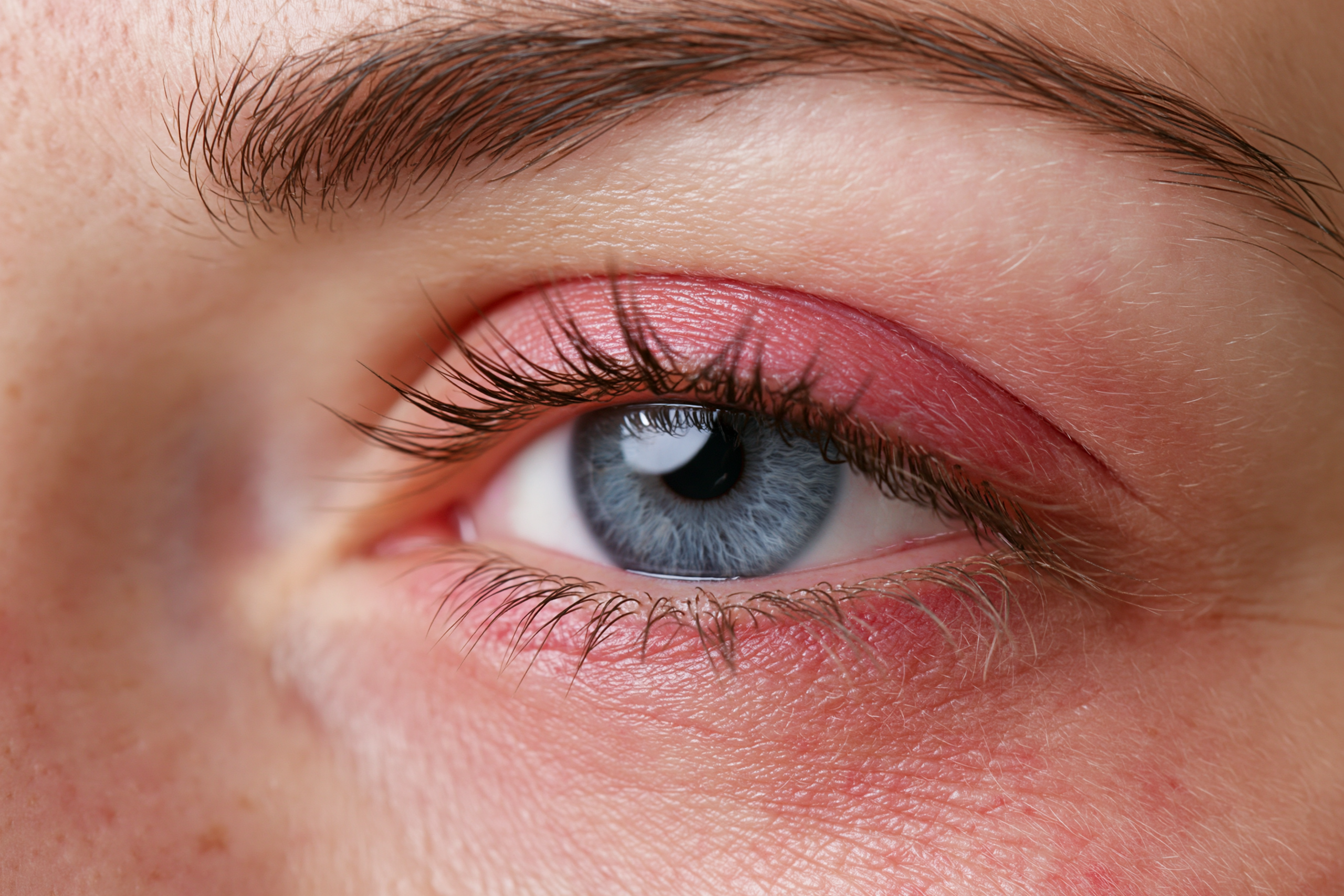
Rosacea can affect the eyes. This is known as ocular rosacea. Symptoms may include dryness, redness, burning, grittiness, watering, eyelid irritation, recurrent styes, light sensitivity, blurred vision, or the feeling that something is inside the eye. [2,18] Eye symptoms may occur along with facial redness, but in some patients they may appear even when skin symptoms are mild.
Ocular symptoms must be taken seriously. Eye dryness and irritation may look simple at first, but ocular rosacea can sometimes involve the eyelids, tear film, meibomian glands, and cornea. It may also be confused with other eye conditions, including herpes simplex keratitis. [18,19]
In Ayurvedic assessment, eye involvement may reflect Pitta-Rakta aggravation affecting the eye region, but practical care must include proper eye evaluation when warning signs are present. Eye pain, blurred vision, photophobia, severe redness, corneal discomfort, or suspected herpes keratitis should not be treated with home remedies or casual herbal eye applications.
Thickened Skin and Rhinophyma
In long-standing or severe cases, some patients develop thickened, uneven, enlarged skin texture, most commonly around the nose. This is known as phymatous rosacea or rhinophyma. [1,2] The nose may gradually appear bulky, irregular, swollen, or enlarged. This presentation is more common in men and usually develops slowly.
From an Ayurvedic viewpoint, this suggests chronic dosha-dushya involvement with deeper structural change. Pitta-Rakta inflammation may have continued for a long time, while Kapha, Kleda, and tissue-level thickening become more prominent. This stage is more difficult than early redness or flushing. Ayurvedic treatment may help reduce ongoing inflammation and prevent worsening triggers, but established structural change may require specialist dermatological or procedural care.
Rosacea Symptoms in Darker Skin
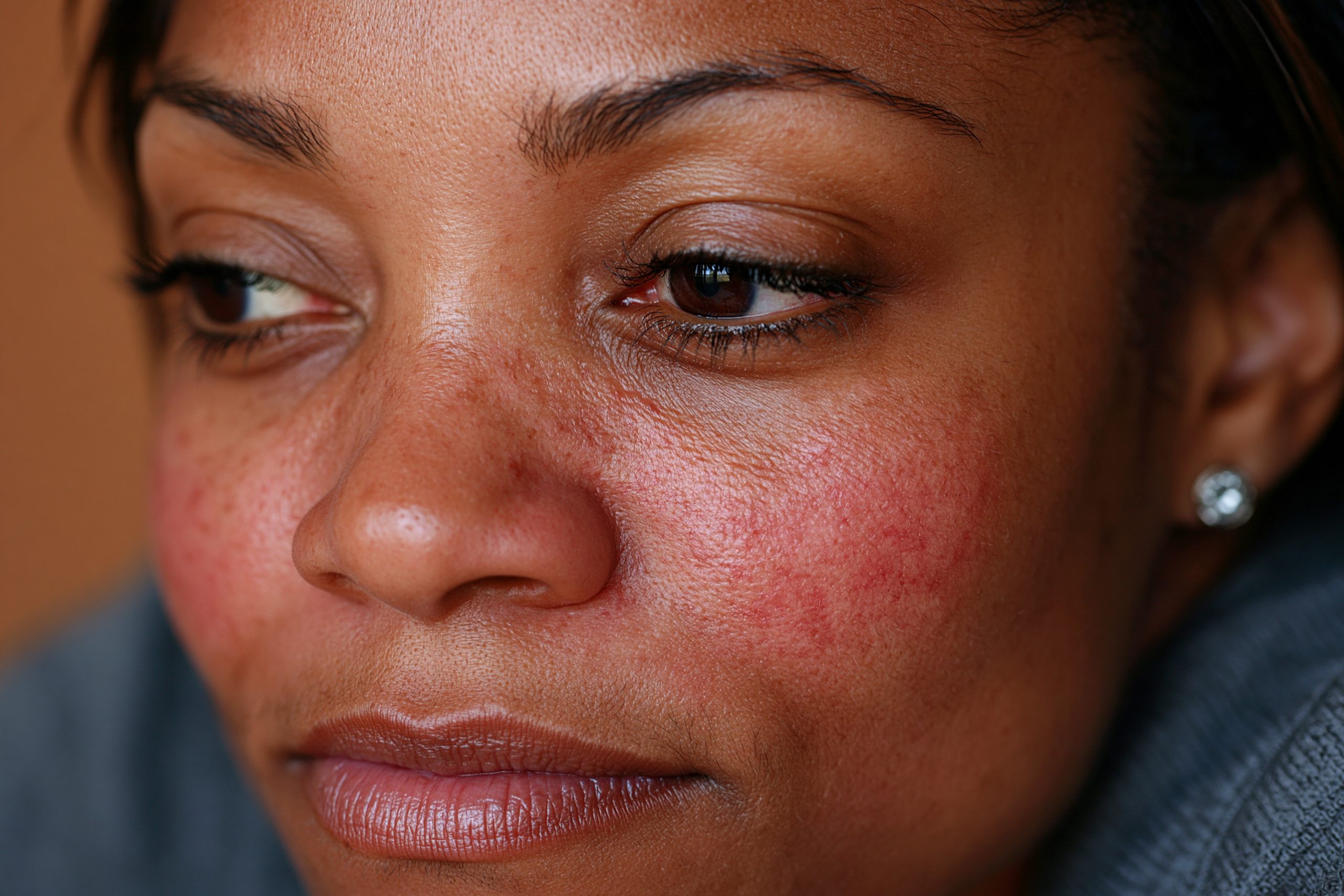
In darker skin tones, rosacea can be more difficult to recognize because redness may not appear bright red. The patient may instead describe heat, burning, stinging, swelling, roughness, bumps, eye irritation, or product intolerance. Because redness is harder to see, diagnosis may be delayed or the condition may be mistaken for acne, allergy, pigmentation, or dermatitis.
Ayurvedic assessment is useful in such patients because it does not depend only on visible redness. It also studies subjective symptoms such as Daha, Ushnata, Sparsha-Asahatva, Toda, Pidaka, and Shotha, along with digestion, bowel pattern, trigger response, sleep, stress, and seasonal aggravation. A patient may not look intensely red but may still have strong burning, heat sensation, food-triggered flares, stinging, and Vata-Pitta sensitivity.
This is especially important for patients in the USA, UK, Canada, Australia, and Singapore, where diverse ethnic groups may present differently. A face may not appear visibly red, but the patient’s experience of heat, burning, sensitivity, and trigger reactivity still matters.
Symptoms That May Not Be Ordinary Rosacea
A red face is not always rosacea. Some symptoms suggest another condition or a more urgent problem. A one-sided painful rash, clustered blisters, crusting ulcers, severe eye pain, blurred vision, light sensitivity, rapid facial swelling, fever, severe tenderness, rash with muscle weakness, butterfly-like rash with systemic symptoms, non-healing facial lesions, sudden worsening after steroid cream, or recurrent painful blisters near the mouth, nose, or eye should not be treated as routine rosacea.
Herpes simplex may cause painful blisters or ulcers. Shingles may cause a painful one-sided facial eruption. Herpes simplex keratitis can affect the eye and may threaten vision if not treated properly. [17,18,19] These conditions can mimic rosacea or coexist with rosacea, but they require a different assessment and treatment pathway.
This is why correct diagnosis is essential. Ayurveda should not treat every red face as Pitta-Rakta rosacea. The physician must first understand whether the presentation is rosacea-like facial inflammation, steroid-induced eruption, herpes, shingles, lupus, dermatitis, fungal infection, acne, ocular disease, or another condition.
What the Symptoms Reveal
Rosacea symptoms are clinical clues. Persistent redness points toward Pitta-Rakta heat. Sudden flushing suggests Vata-Pitta reactivity. Burning shows aggravated Pitta. Stinging and product intolerance show Vata sensitivity. Papules and pustules show Kapha-Kleda involvement. Gut-linked flares suggest Agni disturbance and Ama formation. Eye symptoms require careful evaluation. Thickened skin suggests chronic deeper dosha-dushya involvement.
The aim of Ayurvedic treatment is not only to reduce what is visible on the face. The aim is to understand why these symptoms are appearing, identify the root pattern, break the disease chain, reduce flare frequency, improve skin tolerance, and support long-term remission.
Why Rosacea Happens According to Ayurveda
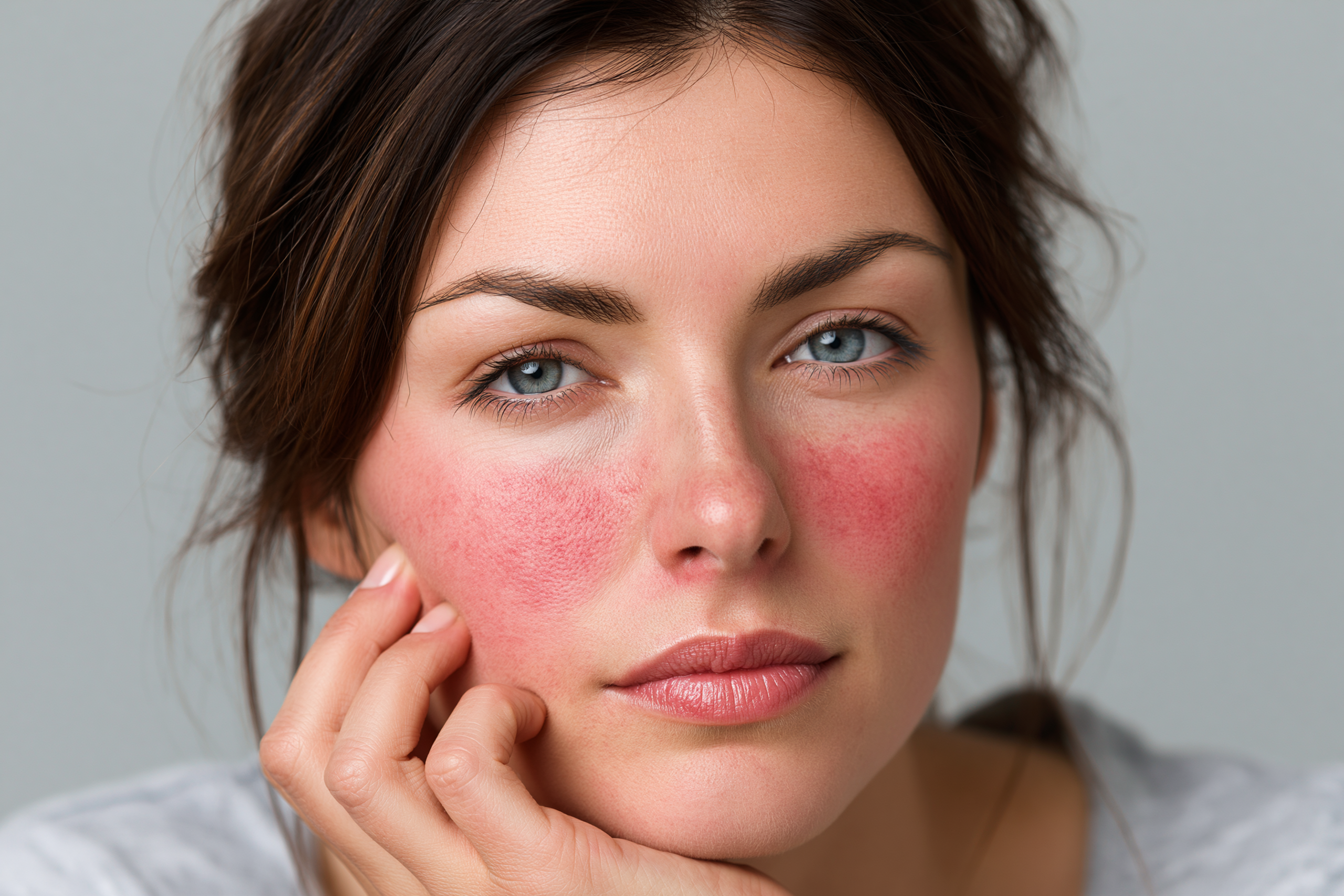
الوردية ليست مجرد احمرار في الوجه
روزیشیا صرف چہرے کی سرخی نہیں ہے
Rosacea is not only a problem of facial redness. In Ayurvedic understanding, the red, hot, burning, sensitive, and reactive face is the visible signal of a deeper internal disease pathway. The skin is showing what the body is unable to balance inside.
الوردية ليست مجرد احمرار؛ إنها علامة على حرارة داخلية واضطراب في الدم والهضم وتفاعل الجلد مع المحفزات.
روزیشیا صرف سرخی نہیں؛ یہ اندرونی گرمی، خون کی خرابی، کمزور ہاضمہ اور محرکات کے خلاف جلد کی حساسیت کی علامت ہے۔
In Ayurveda, rosacea-like facial inflammation is best understood as a Pitta-Rakta dominant Twak Vikara, often associated with disturbed Agni, formation of Ama, increased Vata reactivity, and in papulopustular cases, Kapha-Kleda involvement. The face becomes red because Pitta heats Rakta. The face burns because Pitta and Rakta are inflamed. The face flushes suddenly because Vata moves this heat quickly. The face develops bumps and pustules when Kapha, Kleda, and Ama join the inflammatory process. [9,10,11]
Ayurveda does not read rosacea only as “red skin.” It reads the full disease chain: Nidana → Agni disturbance → Ama → Pitta-Rakta Dushti → Vata movement → Kapha-Kleda buildup → Twak and Srotas involvement → repeated flare-ups.
Classical Ayurvedic Foundation: Health Begins With Balance
Text: Suśruta Saṃhitā
Section: Sūtra Sthāna
Chapter: 15, Doṣa-Dhātu-Mala-Kṣaya-Vṛddhi Vijñānīya Adhyāya
Verse: 15/41
Reference number: [27]
Sanskrit
समदोषः समाग्निश्च समधातुमलक्रियः ।
प्रसन्नात्मेन्द्रियमनाः स्वस्थ इत्यभिधीयते ॥४१॥
Transliteration
samadoṣaḥ samāgniś ca samadhātumala-kriyaḥ |
prasannātmendriya-manāḥ svastha ity abhidhīyate ||41||
Translation
A person is called healthy when the doshas are balanced, Agni is balanced, dhatus and malas function properly, and the soul, senses, and mind remain clear and pleasant.
This shloka gives the foundation of Ayurvedic root-cause medicine. A disease does not begin only when a visible lesion appears. Disease begins when balance is lost. In rosacea-like facial inflammation, the visible redness is the final expression of deeper imbalance in Dosha, Agni, Rakta, Twak, and sometimes Mala/Bowel function. This is why Ayurveda does not treat the face alone. It treats the internal pattern that keeps producing facial heat and inflammation.
Pitta-Rakta Dushti: Why Heat, Sun, Alcohol, Spicy Food, Anger, and Indigestion Trigger Rosacea
Text: Charaka Saṃhitā
Section: Sūtra Sthāna
Chapter: 24, Vidhiśoṇitīya Adhyāya
Verses: 24/5 and 24/9–10
Reference number: [11]
Sanskrit
प्रदुष्टबहुतीक्ष्णोष्णैर्मद्यैरन्यैश्च तद्विधैः ।
तथाऽतिलवणक्षारैरम्लैः कटुभिरेव च ॥५॥
अत्यादानं तथा क्रोधं भजतां चातपानलौ ।
छर्दिवेगप्रतीघातात् काले चानवसेचनात् ॥९॥
श्रमाभिघातसन्तापैरजीर्णाध्यशनैस्तथा ।
शरत्कालस्वभावाच्च शोणितं सम्प्रदुष्यति ॥१०॥
Transliteration
praduṣṭa-bahu-tīkṣṇoṣṇair madyair anyaiś ca tadvidhaiḥ |
tathā’tilavaṇa-kṣārair amlaiḥ kaṭubhir eva ca ||5||
atyādānaṁ tathā krodhaṁ bhajatāṁ cātapānalau |
chardi-vega-pratīghātāt kāle cānavasecanāt ||9||
śramābhighāta-santāpair ajīrṇādhyaśanais tathā |
śaratkāla-svabhāvāc ca śoṇitaṁ sampraduṣyati ||10||
Translation
Rakta becomes vitiated by excessive use of sharp, hot, unsuitable drinks, excessive salty, alkaline, sour and pungent foods, overeating, anger, exposure to sun and fire, suppression of natural urges, excessive exertion, heat, indigestion, and eating again before the previous meal is digested.
This is one of the most important classical foundations for rosacea-like disease. Many modern rosacea triggers are already explained in Ayurvedic language as Rakta-vitiating and Pitta-provoking Nidana. The patient who flares after sun, heat, alcohol, spicy food, sour food, hot drinks, anger, stress, late nights, indigestion, or overeating is not experiencing random sensitivity. The body is showing a Pitta-Rakta reaction.
In Arabic, this can be explained to Gulf patients as:
الحرارة، الشمس، الأطعمة الحارة، الكحول، الغضب، والسهر لا تهيّج الجلد فقط؛ بل ترفع حرارة الدم وتدفع الاحمرار إلى الوجه.
In Urdu, this can be explained as:
گرمی، دھوپ، مرچ مصالحہ، غصہ، شراب، رات جاگنا اور بدہضمی صرف جلد کو نہیں چھیڑتے؛ یہ خون اور پِتّہ کو بھڑکا کر چہرے پر سرخی اور جلن پیدا کرتے ہیں۔
This is the root message: rosacea is not just a skin reaction. It is a Rakta-Pitta heat reaction expressed through the face.
Agni: Why Digestion Matters in Rosacea
Text: Aṣṭāṅga Hṛdaya
Section: Sūtra Sthāna
Chapter: 1, Āyuṣkāmīya Adhyāya
Verse: 1/8
Reference number: [28]
Sanskrit
तैर्भवेद्विषमस्तीक्ष्णो मन्दश्चाग्निः समैः समः ॥८॥
Transliteration
tair bhaved viṣamas tīkṣṇo mandaś cāgniḥ samaiḥ samaḥ ||8||
Translation
According to the influence of the doshas, Agni becomes irregular, sharp, weak, or balanced. When the doshas are balanced, Agni remains balanced.
This shloka explains why rosacea cannot be separated from digestion. In many patients, facial redness worsens after certain foods, heavy meals, alcohol, chili, vinegar, fermented foods, late dinners, constipation, acidity, bloating, or eating before the previous meal has digested. In Ayurveda, this means the face is not reacting only from the outside; the internal digestive fire is disturbed.
When Agni becomes irregular, the patient may have unpredictable flares. When Agni becomes sharp with aggravated Pitta, the patient may experience burning, acidity, sour belching, and heat rising toward the face. When Agni becomes weak, Ama forms and the skin becomes dull, congested, swollen, or papulopustular. When Agni is corrected, the skin becomes less reactive because the internal inflammatory load begins to reduce.
This is why Ayurvedic rosacea treatment must assess appetite, acidity, bloating, stool pattern, constipation, heaviness after meals, food triggers, tongue coating, and meal timing. A cream may calm the skin temporarily, but if Agni remains disturbed, the face may continue to flare.
Pitta: Why the Face Becomes Hot, Red, and Burning
Text: Aṣṭāṅga Hṛdaya
Section: Sūtra Sthāna
Chapter: 1, Āyuṣkāmīya Adhyāya
Verse: 1/11
Reference number: [28]
Sanskrit
पित्तं सस्नेहतीक्ष्णोष्णं लघु विस्रं सरं द्रवम् ॥११॥
Transliteration
pittaṁ sasneha-tīkṣṇoṣṇaṁ laghu visraṁ saraṁ dravam ||11||
Translation
Pitta has slightly unctuous, sharp, hot, light, spreading, and liquid qualities.
This shloka explains the burning nature of rosacea. Pitta is Ushna and Tikshna, meaning hot and sharp. When aggravated Pitta affects Rakta and Twak, the patient experiences burning, heat, redness, sharp irritation, sensitivity, flushing, and inflammation. [28]
This is why harsh therapies often worsen rosacea-like presentations. Steam, hot water, aggressive exfoliation, strong scrubs, heating herbs, pungent lepa, lemon, essential oils, chemical peels, and excessive sweating can increase the same qualities that are already aggravated. The correct Ayurvedic direction is not to provoke more heat, but to calm the heat, stabilize the skin, and remove the root causes that keep producing it.
Kushtha Samprapti: How Dosha Enters the Skin
Text: Charaka Saṃhitā
Section: Nidāna Sthāna
Chapter: 5, Kuṣṭha Nidāna
Verse: 5/6
Reference number: [10]
Sanskrit
त्रयो दोषाः युगपत् प्रकोपमापद्यन्ते;
त्वगादयश्चत्वारः शैथिल्यमापद्यन्ते;
तेषु शिथिलेषु दोषाः प्रकुपिताः स्थानमधिगम्य
सन्तिष्ठमानास्तानेव त्वगादीन् दूषयन्तः
कुष्ठान्यभिनिर्वर्तयन्ति ॥६॥
Transliteration
trayo doṣāḥ yugapat prakopam āpadyante;
tvagādayaś catvāraḥ śaithilyam āpadyante;
teṣu śithileṣu doṣāḥ prakupitāḥ sthānam adhigamya
santiṣṭhamānās tān eva tvagādīn dūṣayantaḥ
kuṣṭhāny abhinirvartayanti ||6||
Translation
The three doshas become aggravated together, and the four skin-related dushyas beginning with Twak become weakened. The aggravated doshas enter and lodge in these weakened tissues, vitiate them, and produce skin diseases.
This is the classical Ayurvedic explanation of why skin disease becomes chronic. The doshas do not remain floating in the body; they lodge in a vulnerable tissue field. In rosacea-like facial inflammation, this vulnerable field is the facial Twak, with strong involvement of Rakta, and in chronic or papulopustular cases, possible involvement of Mamsa, Lasika/Rasa, Kapha, Kleda, and Ama.
This is why every red face is not the same. One patient may have mainly Pitta-Rakta heat. Another may have Vata-Pitta flushing. Another may have Kapha-Kleda papules. Another may have Agni-Ama gut-skin involvement. Another may have steroid-damaged skin. Ayurveda treats the tissue-dosha pathway, not just the disease name.
Early Signs: Burning, Heat, Pricking, Swelling, and Discoloration
Text: Charaka Saṃhitā
Section: Nidāna Sthāna
Chapter: 5, Kuṣṭha Nidāna
Verse: 5/7
Reference number: [10]
Sanskrit
वैवर्ण्यं कण्डूर्निस्तोदः सुप्तता परिदाहः ।
खरत्वमूष्मायणं गौरवं श्वयथुः ॥७॥
Transliteration
vaivarṇyaṁ kaṇḍūr nistodaḥ suptatā paridāhaḥ |
kharatvam ūṣmāyaṇaṁ gauravaṁ śvayathuḥ ||7||
Translation
Discoloration, itching, pricking sensation, numbness, burning, roughness, heat sensation, heaviness, and swelling can appear as early or associated signs of skin disease.
This verse is highly relevant to rosacea-like presentation because many patients complain of burning, heat, pricking, sensitivity, swelling, roughness, and color change even before the condition becomes severe. The Ayurvedic language matches what patients describe every day: “My face burns,” “my skin feels hot,” “my cheeks sting,” “my skin feels rough,” “my face becomes swollen,” or “my skin color keeps changing.”
The classical term Paridaha explains burning. Ūṣmāyaṇa explains heat sensation. Nistoda explains pricking or stinging. Vaivarṇya explains change in complexion or discoloration. Śvayathu explains swelling. These are not superficial complaints. They are signs that the dosha-dushya process has entered the skin.
The Root-Cause Map of Rosacea in Ayurveda
| Rosacea presentation | Ayurvedic root pattern | What it means for the patient |
|---|---|---|
| Redness, heat, burning, sun sensitivity, alcohol or spicy-food flares | Pitta-Rakta Dushti | The blood-skin pathway is heated and inflamed; the face is showing Rakta-Pitta aggravation. Arabic: حرارة في الدم تظهر على الوجه. Urdu: خون اور پِتّہ کی گرمی چہرے پر ظاہر ہو رہی ہے |
| Sudden flushing after stress, embarrassment, hot drinks, anxiety, or temperature change | Vata-Pitta with Rakta sensitivity | Vata moves heat quickly to the face, so redness appears suddenly and unpredictably. Arabic: احمرار مفاجئ بسبب حركة الحرارة. Urdu: گرمی اچانک چہرے کی طرف بڑھتی ہے |
| Papules, pustules, swelling, oiliness, heaviness, acne-like bumps without blackheads | Pitta-Kapha with Kleda and possible Ama | Heat combines with congestion and inflammatory moisture, creating bumps and pustules. Arabic: التهاب مع رطوبة واحتقان. Urdu: گرمی کے ساتھ رطوبت اور جماؤ دانے بناتے ہیں |
| Flares after heavy meals, acidity, constipation, bloating, sour belching, coated tongue | Agni Mandya / Vishama Agni with Ama | Poor digestion creates internal inflammatory burden, making the skin reactive. Arabic: ضعف الهضم يزيد التهاب الجلد. Urdu: کمزور ہاضمہ جلد کی سوزش بڑھاتا ہے |
| Dryness, stinging, product intolerance, roughness, barrier weakness | Vata-Pitta with weak Twak tolerance | The skin is hot but fragile; harsh skincare or heating therapies can worsen it. Arabic: الجلد حار وحساس وضعيف. Urdu: جلد گرم، حساس اور کمزور ہو چکی ہے |
| Fixed visible vessels and long-standing redness | Chronic Rakta involvement | Repeated flushing has affected the facial vascular channels; new flares can be reduced, while fixed vessels may need integrative care. Arabic: تأثر مزمن في أوعية الوجه. Urdu: چہرے کی باریک رگوں پر دیرینہ اثر |
How the Disease Chain Forms
Rosacea-like facial inflammation usually begins when the patient repeatedly follows heat-producing and Rakta-vitiating Nidana. These may include excessive sun exposure, hot climate, alcohol, spicy food, sour and fermented foods, hot drinks, late nights, anger, stress, indigestion, eating before the previous meal is digested, constipation, harsh skincare, steam, sauna, and steroid misuse. Over time, these factors disturb Agni and create Ama. Ama blocks channels and makes the skin more reactive. Pitta then heats Rakta, and heated Rakta expresses through the facial skin as redness, burning, flushing, and sensitivity.
When Vata joins this pathway, the redness becomes sudden. The patient may flush during stress, anxiety, public speaking, embarrassment, hot drinks, cold wind, or temperature change. The face may look normal one moment and become red and hot within minutes.
When Kapha and Kleda join the pathway, the condition becomes papulopustular. The patient develops red bumps, pustules, swelling, oiliness, heaviness, and congestion. These patients often have digestive heaviness, constipation, coated tongue, food-triggered flares, or recurrent inflammatory buildup.
When Twak and Srotas become weakened, the skin barrier becomes reactive. The face may sting after sunscreen, moisturizer, cleanser, makeup, herbal lepa, sweat, cold wind, or even plain water. This is why rosacea-prone skin cannot tolerate aggressive treatment.
Why Rosacea Keeps Coming Back
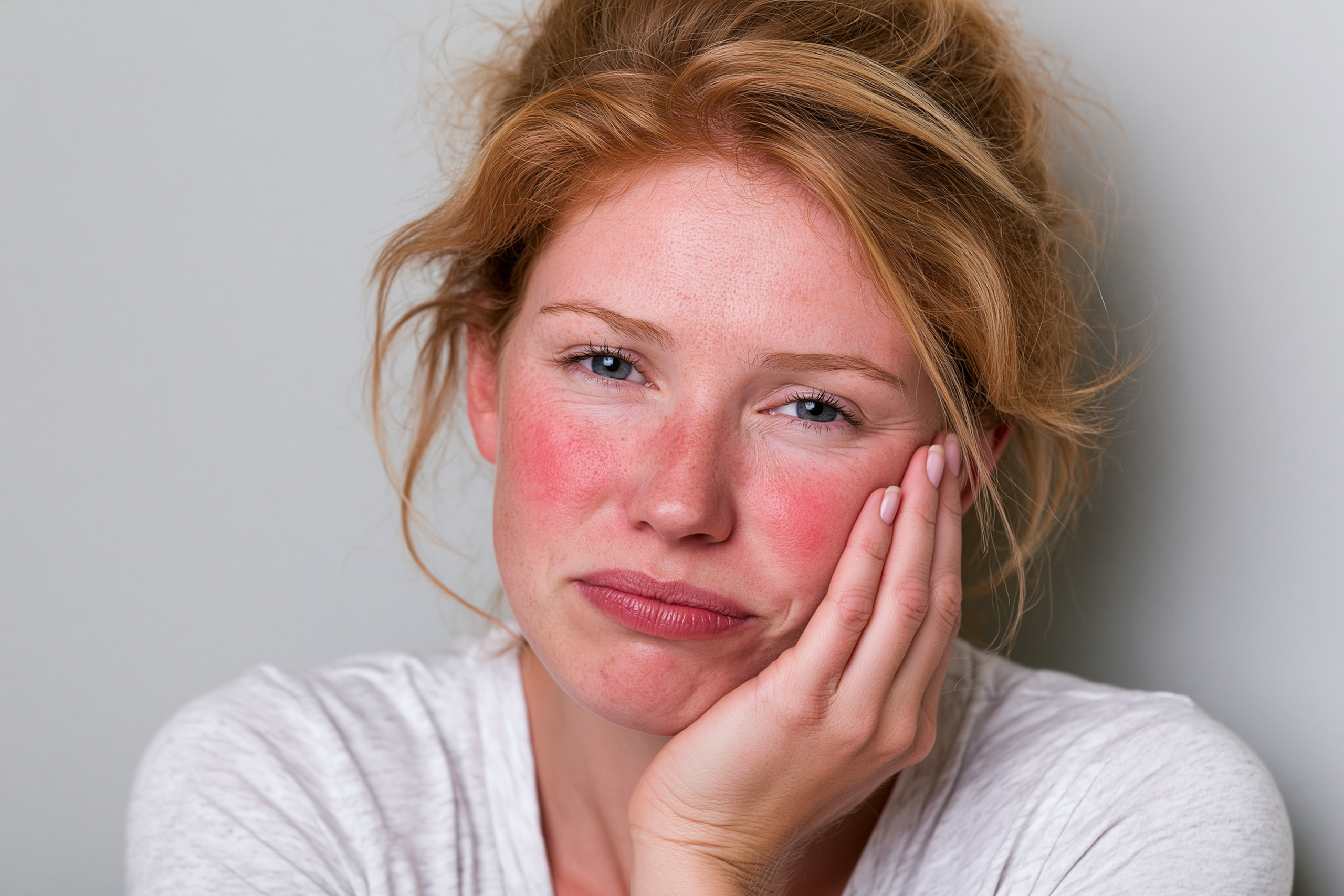
Rosacea keeps returning when the disease pathway is not fully broken. A cream may reduce redness, but if Pitta-Rakta remains heated, the redness returns. Antibiotics may reduce bumps, but if Agni, Ama, Kapha, and Kleda remain uncorrected, the bumps return. Skincare may calm irritation, but if Vata-Pitta sensitivity, poor sleep, stress, and trigger exposure continue, flushing returns.
In Ayurveda, relapse happens when Nidana continues and Samprapti remains active.
The real Ayurvedic aim is Samprapti-Vighatana, which means breaking the disease pathway. For rosacea-like facial inflammation, this means removing the triggers, correcting Agni, reducing Ama, cooling Pitta-Rakta, stabilizing Vata, reducing Kapha-Kleda, strengthening Twak tolerance, and preventing recurrence.
الهدف في الأيورفيدا ليس إخفاء الاحمرار فقط، بل كسر سلسلة المرض من جذورها.
آیوروید کا مقصد صرف سرخی چھپانا نہیں، بلکہ بیماری کے راستے کو جڑ سے توڑنا ہے۔
This is the patient-facing truth: the face is not the root problem. The face is the signal. The root lies in the internal heat, blood irritation, digestive disturbance, nervous-system reactivity, tissue vulnerability, and repeated triggers that keep bringing inflammation back to the skin.
Modern Science Supports a Root-Cause View of Rosacea
Modern science and Ayurveda use different languages, but both point toward the same truth: rosacea is not only a surface redness problem. It is a complex inflammatory condition involving the skin, blood vessels, nerves, immune response, barrier function, microbes, digestion, and repeated triggers. [4,5,6,21]
Ayurveda describes this through Dosha, Dushya, Agni, Ama, Rakta, Twak, Srotas, and Nidana. Modern science describes it through immune dysregulation, neurovascular dysfunction, skin-barrier disturbance, microbiome changes, Demodex-related inflammation, gut-skin axis disturbance, and environmental triggers. [4,5]
The language is different, but the patient experience is the same. The face becomes hot, red, burning, swollen, sensitive, and reactive because the inner terrain is unstable.
الوردية ليست مشكلة جلدية سطحية فقط؛ إنها اضطراب التهابي معقّد يشمل المناعة، الأوعية، الأعصاب، الهضم، وحاجز الجلد.
روزیشیا صرف اوپر کی جلد کا مسئلہ نہیں؛ یہ قوتِ مدافعت، باریک رگوں، اعصاب، ہاضمہ اور جلد کی حفاظتی تہہ سے جڑا ہوا پیچیدہ التہابی مسئلہ ہے۔
Classical Ayurvedic Bridge: Similar Triggers Increase the Same Disease Pattern
Text: Charaka Saṃhitā
Section: Sūtra Sthāna
Chapter: 1, Dīrghañjīvitīya Adhyāya
Verse: 1/44
Reference number: [29]
Sanskrit
सर्वदा सर्वभावानां सामान्यं वृद्धिकारणम् ।
ह्रासहेतुर्विशेषश्च प्रवृत्तिरुभयस्य तु ॥४४॥
Transliteration
sarvadā sarvabhāvānāṁ sāmānyaṁ vṛddhikāraṇam |
hrāsahetur viśeṣaś ca pravṛttir ubhayasya tu ||44||
Translation
Similarity always causes increase, while dissimilarity causes decrease. Both increase and decrease happen according to repeated exposure or application.
This is a powerful principle for rosacea. When a patient already has heat, redness, burning, and Pitta-Rakta aggravation, repeated exposure to similar qualities increases the disease. Heat increases heat. Alcohol increases heat. Spicy food increases heat. Sun increases heat. Anger increases heat. Late nights increase Pitta. Hot drinks, sauna, steam, harsh skincare, and aggressive exfoliation further provoke the same inflammatory pathway.
This is why rosacea patients often say, “Every time I take spicy food, alcohol, sun, stress, or heat, my face flares.” Ayurveda explains this clearly: similar qualities increase the existing imbalance.
الحرارة تزيد الحرارة، والأطعمة الحارة تزيد تفاعل الوجه، والغضب والسهر يزيدان اضطراب بيتا وراكتا.
گرمی گرمی کو بڑھاتی ہے، مرچ مصالحہ چہرے کی جلن بڑھاتا ہے، غصہ اور رات جاگنا پِتّہ اور رکت کو مزید بگاڑتے ہیں۔
The opposite principle is also important. Cooling diet, gentle skincare, proper sleep, calm digestion, bowel regulation, sun protection, emotional balance, and Pitta-Rakta pacification reduce the disease pattern because they apply the opposite qualities.
Rosacea Is an Inflammatory Disease, Not Just Sensitive Skin
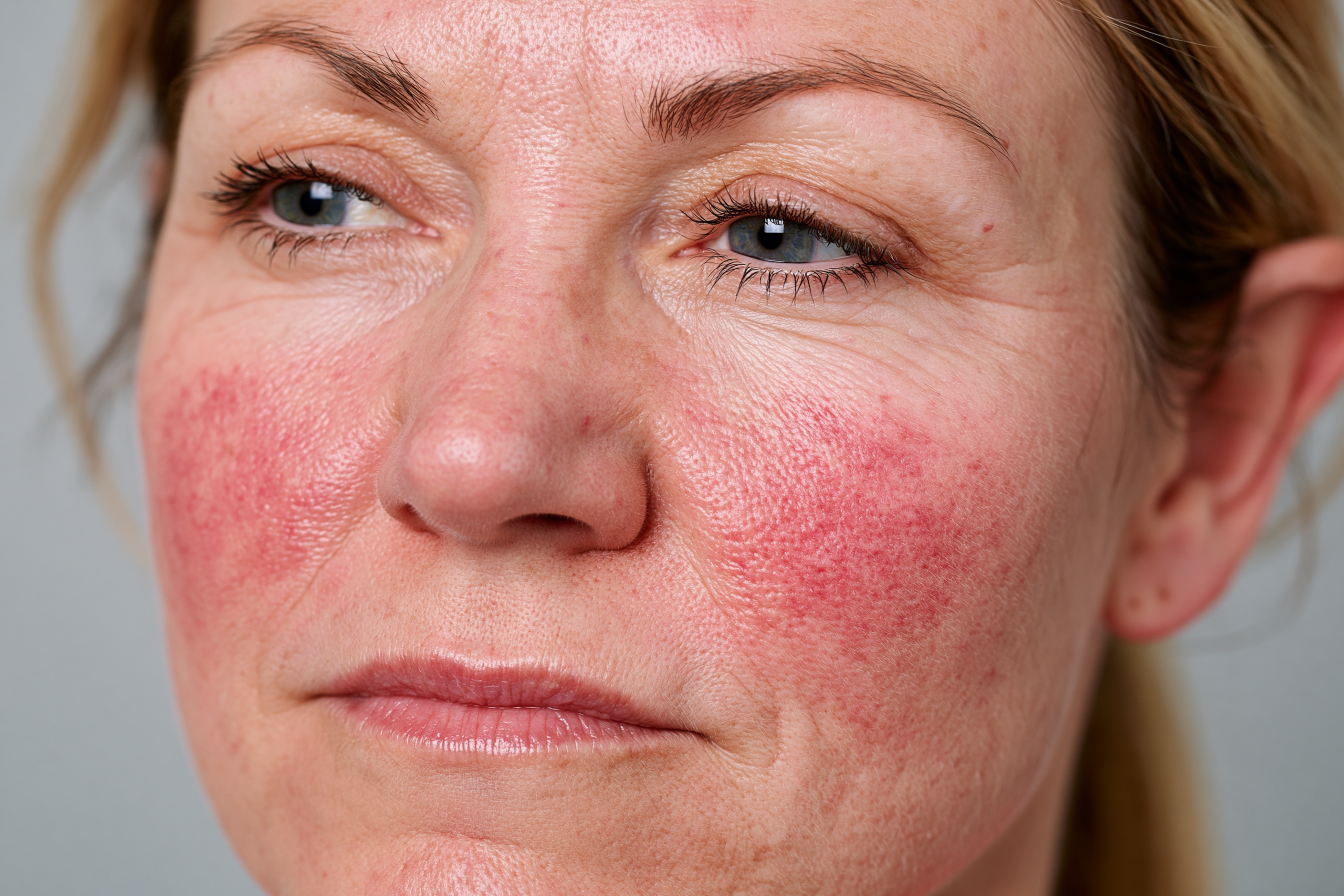
Many patients are told they have sensitive skin. This is partly true, but incomplete. Rosacea-prone skin is sensitive because deeper inflammatory mechanisms are active. Modern research describes rosacea as a chronic inflammatory condition involving immune dysregulation, abnormal vascular responses, nervous-system sensitivity, skin-barrier dysfunction, microbial factors, and repeated environmental triggers. [4]
This matches the Ayurvedic concept of Pitta-Rakta Dushti. Pitta explains heat, burning, sharp irritation, inflammation, and redness. Rakta explains vascular redness, facial flushing, and blood-tissue involvement. When Pitta and Rakta are aggravated together, the face becomes hot, red, and reactive. The skin may burn even without strong visible redness, and the patient may feel as if the face is internally heated.
Modern medicine may call this inflammation and vascular reactivity. Ayurveda calls it Pitta-Rakta aggravation expressing through Twak.
Neurovascular Dysfunction and Vata-Pitta Flushing
One of the most distressing symptoms of rosacea is sudden flushing. The face may become red and hot within minutes after stress, embarrassment, anxiety, hot drinks, temperature change, spicy food, or alcohol. Modern science explains this through neurovascular dysfunction and nervous-system-related inflammatory pathways. [4]
Ayurveda explains the same pattern through Vata-Pitta involvement. Pitta creates heat and redness. Vata creates movement, suddenness, instability, and sensitivity. When Vata moves aggravated Pitta-Rakta quickly toward the face, flushing appears suddenly.
This is why some patients do not remain red all day, but flush dramatically during emotional or environmental triggers. Their treatment cannot focus only on cooling herbs. It must also stabilize Vata through sleep correction, regular meals, stress regulation, nervous-system calming, dryness reduction, and daily rhythm.
الاحمرار المفاجئ ليس عشوائياً؛ إنه حركة سريعة للحرارة نحو الوجه.
اچانک سرخی بے وجہ نہیں؛ یہ گرمی کا تیزی سے چہرے کی طرف بڑھنا ہے۔
Skin-Barrier Damage and Weak Twak Tolerance
Rosacea skin often becomes intolerant. Sunscreen burns. Moisturizer stings. Cleanser irritates. Makeup causes redness. Herbal face packs may also worsen the skin if they are too strong. Modern research recognizes skin-barrier dysfunction as an important part of rosacea pathogenesis. [4]
Ayurveda reads this as weakened Twak tolerance, often associated with Vata-Pitta aggravation. Pitta makes the skin hot and inflamed. Vata makes it dry, fragile, and hypersensitive. When both are involved, the skin becomes reactive to even mild contact.
This is why rosacea-prone skin should not be attacked with harsh scrubs, steam, hot water washing, essential oils, lemon, baking soda, strong exfoliation, chemical peels, or aggressive lepa. Even Ayurvedic external applications must be selected gently and patch-tested. A treatment may be classical, but if it is too heating, sharp, drying, or abrasive for the patient’s current state, it can worsen the face.
The correct approach is to calm the skin first, then correct the deeper disease chain.
Microbiome, Demodex, Kapha-Kleda, and Papulopustular Rosacea

Some rosacea patients develop papules and pustules that resemble acne. Modern research has explored the role of the skin microbiome, Demodex mites, microbial antigens, and inflammatory responses in rosacea, especially in papulopustular patterns. [4,5]
Ayurveda explains this through Pitta-Kapha-Kleda involvement. Pitta creates heat and redness. Kapha creates heaviness, swelling, thickness, and stagnation. Kleda creates moist inflammatory congestion. When this combination affects the facial skin, the patient develops red bumps, pustules, swelling, oiliness, and recurrent inflammatory lesions.
This is why papulopustular rosacea should not be treated exactly like common acne. Harsh acne treatments may dry and irritate the face. The Ayurvedic direction is more intelligent: reduce Kapha-Kleda and Ama without increasing Pitta or damaging the skin barrier.
A patient with redness, pustules, heaviness, coated tongue, constipation, bloating, oiliness, or food-triggered bumps needs more than a topical product. The internal terrain must be corrected.
Gut-Skin Axis, Agni, Ama, and Rosacea
The gut-skin connection is one of the strongest bridges between modern science and Ayurveda. Modern research has explored links between rosacea and digestive disorders, microbiome disturbance, inflammatory bowel disease, and Helicobacter pylori. A systematic review and meta-analysis found an association between rosacea and inflammatory bowel disease, supporting the need to consider gut health in rosacea patients. [6] Another meta-analysis reported a possible association between rosacea and H. pylori infection, although this does not prove that H. pylori causes every case of rosacea. [21]
Ayurveda has always placed digestion at the center of skin disease. When Agni is disturbed, food is not processed correctly. When digestion is incomplete, Ama forms. Ama blocks channels, increases inflammatory burden, and makes the skin reactive. In rosacea-like patients, this may appear as acidity, bloating, constipation, irregular stools, heaviness after meals, sour belching, coated tongue, or flare-ups after certain foods.
The face may be the place where the redness appears, but the gut may be one of the places where the disease chain is maintained.
إذا كان الهضم مضطرباً، فقد يظهر الالتهاب على الوجه.
اگر ہاضمہ خراب ہو تو سوزش چہرے پر ظاہر ہو سکتی ہے۔
This is why Ayurvedic rosacea treatment must ask about bowel movement, appetite, acidity, bloating, food triggers, meal timing, constipation, heaviness, and gut inflammation. A patient whose rosacea flares after heavy meals, fermented food, vinegar, alcohol, chili, or constipation needs Agni and Ama correction, not only facial skincare.
Modern Science and Ayurveda: One Root-Cause Map
| Modern mechanism in rosacea | Ayurvedic understanding | What the patient experiences |
|---|---|---|
| Immune dysregulation and chronic inflammation | Pitta aggravation with Rakta Dushti | Redness, burning, heat, swelling, repeated inflammatory flares |
| Neurovascular dysfunction | Vata-Pitta movement through Rakta and facial Srotas | Sudden flushing after stress, anxiety, hot drinks, temperature change, or embarrassment |
| Skin-barrier dysfunction | Weak Twak tolerance with Vata-Pitta aggravation | Stinging, product intolerance, dryness, roughness, sensitivity, burning after skincare |
| Microbiome and Demodex-associated inflammation | Pitta-Kapha-Kleda involvement | Papules, pustules, oiliness, swelling, acne-like bumps without blackheads |
| Gut-skin axis and digestive associations | Agni disturbance and Ama formation | Flares after food, acidity, bloating, constipation, coated tongue, heaviness after meals |
| Environmental triggers such as UV, heat, alcohol, spicy food, stress | Nidana Sevana increasing Pitta-Rakta and Vata reactivity | Repeated relapse after sun, heat, alcohol, spicy food, poor sleep, stress, or harsh skincare |
Why This Matters for Treatment
If rosacea is treated only as redness, the treatment remains shallow. If it is understood as a multi-layer disease pathway, the treatment becomes deeper and more precise.
A patient with strong burning and heat needs Pitta-Rakta pacification. A patient with sudden flushing needs Vata-Pitta stabilization. A patient with papules and pustules needs Kapha-Kleda and Ama correction. A patient with digestive symptoms needs Agni treatment. A patient with product intolerance needs Twak barrier support. A patient with fixed vessels may need integrative care. A patient with eye symptoms needs safety evaluation.
This is the strength of Ayurveda: it does not reduce every patient to one disease name. It studies the pathway behind the presentation.
Modern science supports the idea that rosacea is complex. Ayurveda gives a practical root-cause map for managing that complexity.
Not Every Rosacea Case Has the Same Root
One person may develop redness after sun and alcohol. Another may flush with anxiety and public speaking. Another may develop pustules after constipation and heavy meals. Another may flare after steroid cream. Another may feel burning after every skincare product. Another may have eye symptoms. Another may actually have herpes, shingles, lupus, dermatitis, or an infection that looks like rosacea.
This is why a root-cause protocol must begin with diagnosis and pattern mapping. The medicine, diet, Avaleha, lepa, skincare, bowel correction, and relapse-prevention plan must be chosen according to the patient’s actual pathway.
العلاج الحقيقي لا يبدأ باسم المرض فقط، بل يبدأ بفهم نمط المريض.
حقیقی علاج صرف بیماری کے نام سے شروع نہیں ہوتا؛ یہ مریض کے اصل مزاج اور مرض کے راستے کو سمجھنے سے شروع ہوتا ہے۔
The Root-Cause Message
Rosacea is not simply a red face. It is an inflammatory pattern involving heat, blood, nerves, digestion, skin barrier, triggers, and tissue sensitivity.
Modern science calls this immune dysregulation, neurovascular dysfunction, microbiome involvement, gut-skin axis disturbance, and barrier damage. Ayurveda calls it Pitta-Rakta Dushti, Vata reactivity, Kapha-Kleda association, Agni disturbance, Ama formation, Twak involvement, and Nidana-driven relapse.
The words are different, but the conclusion is clear: lasting improvement requires more than hiding redness. The disease chain must be understood and broken from the root.
Common Rosacea Triggers: Nidana That Keep the Face Inflamed
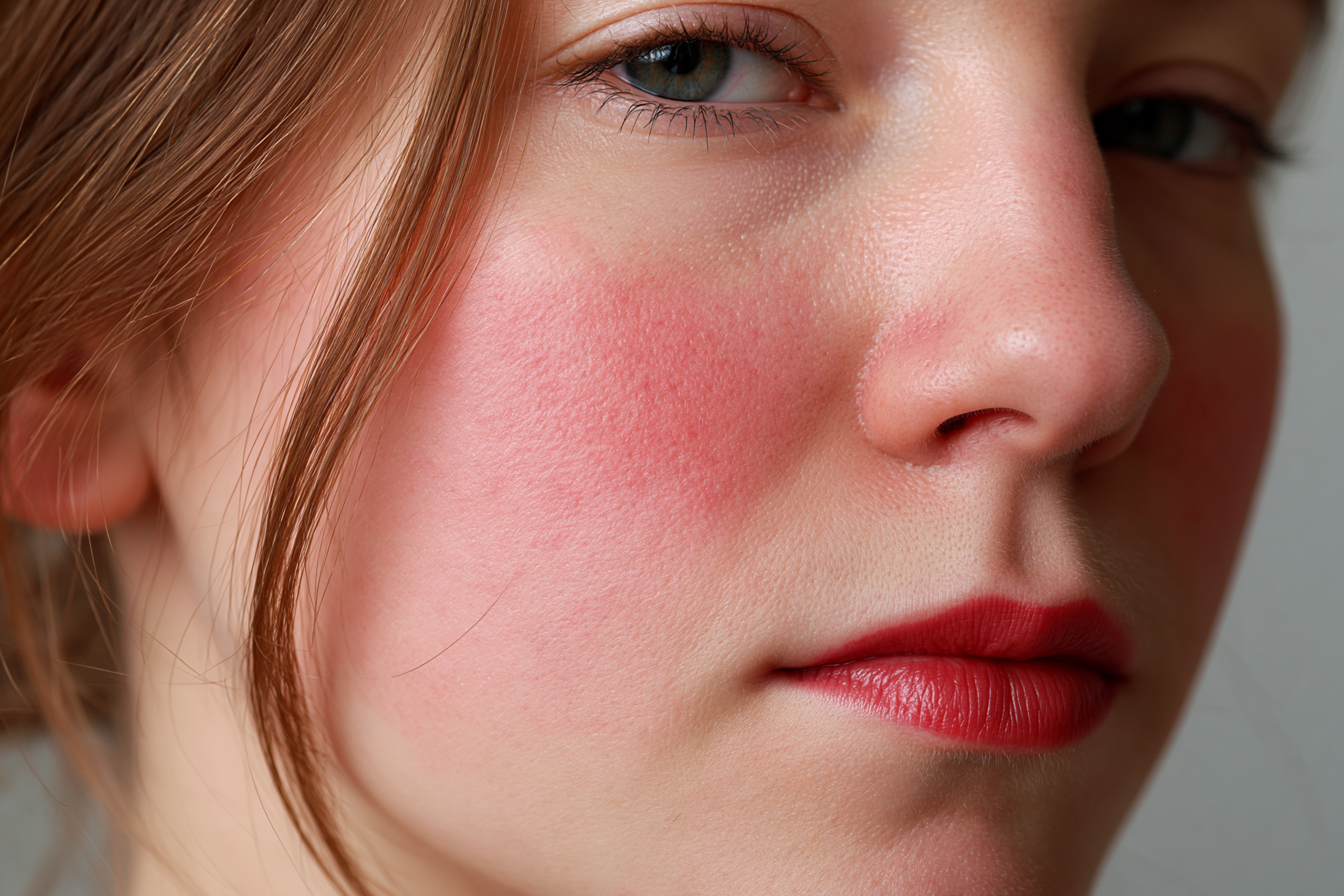
Rosacea does not flare without a reason. The reason may not always be obvious, but the body is reacting to a trigger. In Ayurveda, these triggers are called Nidana. Nidana means the cause, the maintaining factor, or the repeated exposure that keeps the disease pathway active.
In rosacea-like facial inflammation, Nidana is extremely important because the face often flares again and again from the same pattern of heat, stress, food, digestion, weather, skincare, or lifestyle. The patient may say, “My rosacea comes back suddenly,” but Ayurveda asks a deeper question: what is repeatedly increasing Pitta, heating Rakta, disturbing Agni, provoking Vata, and weakening Twak?
المحفزات في الوردية ليست عشوائية؛ إنها عوامل تزيد الحرارة في الدم وتدفع الالتهاب إلى الوجه.
روزیشیا کے محرکات بے وجہ نہیں ہوتے؛ یہ خون اور پِتّہ کی گرمی کو بڑھا کر سوزش کو چہرے پر ظاہر کرتے ہیں۔
Modern dermatology also recognizes that rosacea can worsen with triggers such as sun exposure, heat, emotional stress, alcohol, spicy food, hot drinks, harsh skincare, and temperature changes. [1,3,7] Ayurveda gives these triggers a deeper explanation: similar qualities increase the same imbalance. When the face is already hot, red, burning, and reactive, repeated exposure to heat-producing food, climate, emotions, and habits increases the same Pitta-Rakta pathway.
The Ayurvedic Rule Behind Triggers
Text: Charaka Saṃhitā
Section: Sūtra Sthāna
Chapter: 1, Dīrghañjīvitīya Adhyāya
Verse: 1/44
Reference number: [29]
Sanskrit
सर्वदा सर्वभावानां सामान्यं वृद्धिकारणम् ।
ह्रासहेतुर्विशेषश्च प्रवृत्तिरुभयस्य तु ॥४४॥
Transliteration
sarvadā sarvabhāvānāṁ sāmānyaṁ vṛddhikāraṇam |
hrāsahetur viśeṣaś ca pravṛttir ubhayasya tu ||44||
Translation
Similarity always causes increase, while dissimilarity causes decrease. Both increase and decrease happen according to repeated exposure or application.
This principle is the foundation of trigger management in rosacea. If the face is already hot, red, burning, and reactive, then heat-producing exposures will increase the disease. Sun increases heat. Alcohol increases heat. Spicy food increases heat. Anger increases heat. Late nights increase Pitta. Hot drinks, steam, sauna, hot weather, and harsh exfoliation increase the same inflammatory direction.
This is why rosacea patients often notice that their face flares after the same repeated exposures. The trigger is not accidental. It is applying a similar quality to an already aggravated state.
The opposite is also true. Cooling food, calm digestion, proper sleep, shade, sun protection, gentle skincare, bowel regulation, emotional stability, and Pitta-Rakta pacification apply the opposite quality. They help reduce the disease pathway.
الحرارة تزيد الحرارة، والبرودة العلاجية تقلل الحرارة. هذا هو منطق الأيورفيدا في علاج محفزات الوردية.
گرمی گرمی کو بڑھاتی ہے، اور مناسب ٹھنڈک گرمی کو کم کرتی ہے۔ یہی آیوروید میں روزیشیا کے محرکات کا بنیادی اصول ہے۔
Pitta-Rakta Triggers: Why Heat, Sun, Alcohol, Spicy Food, and Anger Flare the Face
The most common rosacea triggers are also classical Pitta-Rakta aggravating factors. Heat, sun, alcohol, sour food, pungent food, excessive salt, anger, exertion, indigestion, and eating before the previous meal is digested are described in Ayurveda as causes of Rakta vitiation. [11]
Text: Charaka Saṃhitā
Section: Sūtra Sthāna
Chapter: 24, Vidhiśoṇitīya Adhyāya
Verses: 24/5 and 24/9–10
Reference number: [11]
Sanskrit
प्रदुष्टबहुतीक्ष्णोष्णैर्मद्यैरन्यैश्च तद्विधैः ।
तथाऽतिलवणक्षारैरम्लैः कटुभिरेव च ॥५॥
अत्यादानं तथा क्रोधं भजतां चातपानलौ ।
छर्दिवेगप्रतीघातात् काले चानवसेचनात् ॥९॥
श्रमाभिघातसन्तापैरजीर्णाध्यशनैस्तथा ।
शरत्कालस्वभावाच्च शोणितं सम्प्रदुष्यति ॥१०॥
Transliteration
praduṣṭa-bahu-tīkṣṇoṣṇair madyair anyaiś ca tadvidhaiḥ |
tathā’tilavaṇa-kṣārair amlaiḥ kaṭubhir eva ca ||5||
atyādānaṁ tathā krodhaṁ bhajatāṁ cātapānalau |
chardi-vega-pratīghātāt kāle cānavasecanāt ||9||
śramābhighāta-santāpair ajīrṇādhyāśanais tathā |
śaratkāla-svabhāvāc ca śoṇitaṁ sampraduṣyati ||10||
Translation
Rakta becomes vitiated by excessive use of sharp, hot, unsuitable drinks, excessive salty, alkaline, sour, and pungent foods, overeating, anger, exposure to sun and fire, suppression of natural urges, excessive exertion, heat, indigestion, and eating again before the previous meal is digested.
This classical passage is directly useful for explaining rosacea triggers to patients. Many people already know that their face worsens after sun, alcohol, chili, hot drinks, anger, stress, late nights, or indigestion. Ayurveda explains why: these factors heat and disturb Rakta. When heated Rakta reaches the facial skin, the patient develops redness, burning, flushing, swelling, and sensitivity.
The Arabic explanation for Gulf patients is simple and powerful:
عندما تزداد حرارة الدم بسبب الشمس، الطعام الحار، الغضب، السهر، أو ضعف الهضم، يظهر ذلك على الوجه في صورة احمرار وحرقان وتوهج.
The Urdu explanation is equally direct:
جب دھوپ، مرچ مصالحہ، غصہ، رات جاگنا یا بدہضمی خون اور پِتّہ کو گرم کر دیتے ہیں تو یہی گرمی چہرے پر سرخی، جلن اور فلشنگ کی صورت میں ظاہر ہوتی ہے۔
This is the central point: rosacea triggers are not only external irritants. They are signs that the Pitta-Rakta pathway is already sensitive.
Sun and Heat: The Most Important External Triggers
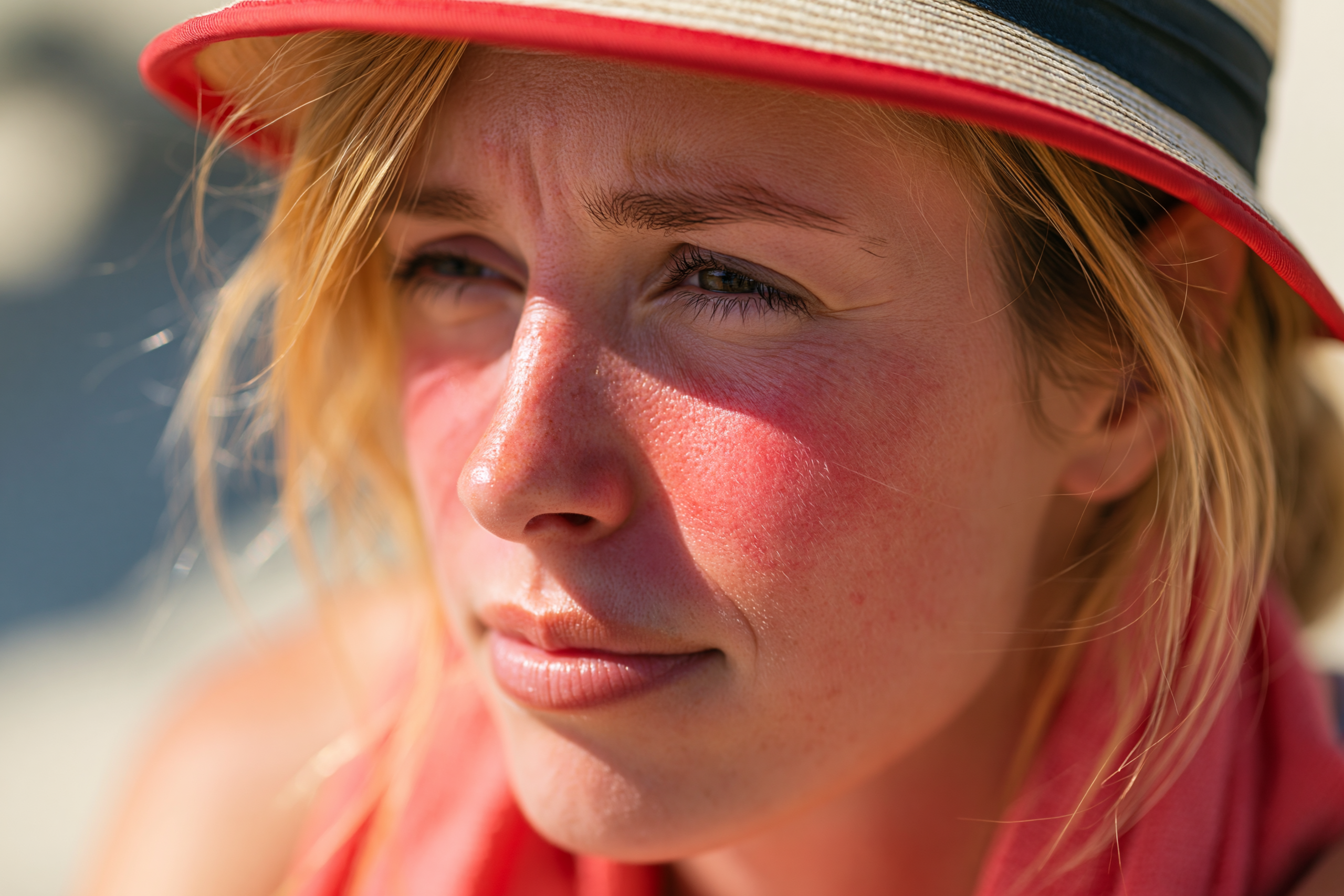
Sun exposure is one of the strongest triggers for rosacea. The face is directly exposed to UV radiation, heat, sweating, and environmental stress. In Ayurveda, sun and heat aggravate Pitta and Rakta. When the patient already has facial redness and burning, sun exposure acts like fuel on fire.
This is especially important for patients in the Gulf, Singapore, Australia, and warmer regions of the USA. Even brief sun exposure, driving heat, walking outside at midday, outdoor exercise, beach visits, steam rooms, hot baths, or sitting near strong heat can provoke facial flushing.
الشمس والحرارة من أقوى محفزات الوردية لأنها تزيد بيتا وراكتا مباشرة.
دھوپ اور گرمی روزیشیا کے سب سے طاقتور محرکات میں سے ہیں کیونکہ یہ پِتّہ اور رکت کو براہِ راست بڑھاتے ہیں۔
The Ayurvedic advice is not only “avoid sun.” The deeper instruction is to reduce repeated heat exposure because heat is the same quality that is already active in the disease. Sun protection, shaded movement, breathable clothing, cooling routines, and avoiding midday heat are part of Nidana Parivarjana, not cosmetic advice.
Spicy, Sour, Salty, Fermented, and Very Hot Foods
Food triggers are common in rosacea. Many patients flare after chili, hot sauce, spicy curries, pepper, excess garlic, vinegar, pickles, fermented foods, alcohol, very hot tea, coffee, or heavy restaurant meals. Some flare immediately; others flare the next morning.
In Ayurveda, pungent, sour, salty, sharp, hot, and fermented qualities aggravate Pitta and Rakta. If the patient already has facial heat, these foods increase the same direction. The result may be burning, redness, flushing, papules, pustules, acidity, sour belching, or heat rising toward the face.
This does not mean every patient must avoid every possible food forever. It means the physician must identify which foods are acting as Nidana for that patient. One patient may flare after chili. Another may flare after alcohol. Another may flare after vinegar and fermented foods. Another may flare after overeating or eating late at night. Ayurveda individualizes the trigger map.
For Gulf patients, this section should be written with cultural sensitivity. The issue is not “Arab food” or “Indian food.” The issue is the quality of the food: too hot, too spicy, too sour, too salty, too heavy, too late, or taken during poor digestion.
المشكلة ليست في نوع المطبخ، بل في الصفات: حرارة زائدة، حموضة زائدة، بهارات حارة، ملح زائد، أكل ثقيل، أو أكل متأخر مع ضعف الهضم.
مسئلہ کھانے کی تہذیب نہیں بلکہ اس کی کیفیت ہے: زیادہ گرمی، زیادہ کھٹاس، زیادہ مرچ، زیادہ نمک، بھاری کھانا، دیر رات کھانا یا بدہضمی کے دوران کھانا۔
Alcohol and Hot Drinks
Alcohol is a common flushing trigger. It dilates blood vessels, increases heat, and can quickly worsen redness in sensitive patients. Ayurveda reads alcohol-like, sharp, hot, and Pitta-aggravating intake as a Rakta-vitiating factor. [11]
Hot drinks can also trigger rosacea, even when the drink itself is not spicy. The heat of the drink may be enough to provoke flushing in Vata-Pitta patients. Some patients flush after hot tea, coffee, kahwa, soup, or very hot water. In these cases, temperature matters as much as the substance.
The Ayurvedic approach is practical. The patient may need to reduce alcohol, avoid very hot beverages, allow drinks to cool, and observe whether caffeine, spices, or temperature are the main trigger. For a person whose face burns easily, repeated hot drinks can act as daily micro-triggers.
Stress, Anger, Embarrassment, and Emotional Heat
Emotional triggers are among the most misunderstood causes of rosacea flares. Many patients flush during stress, anger, anxiety, embarrassment, public speaking, conflict, emotional pressure, or lack of sleep. Modern medicine explains this through neurovascular reactivity. Ayurveda explains it through Vata-Pitta movement and Rakta sensitivity.
Anger is specifically mentioned as a factor that vitiates Rakta. [11] This does not mean the patient is to blame. It means the nervous system and heat pathway are linked. When emotional heat rises, the face becomes the visible expression of that internal reaction.
الغضب والتوتر لا يؤثران على العقل فقط؛ عند مريض الوردية يمكن أن يدفعا الحرارة مباشرة إلى الوجه.
غصہ اور ذہنی دباؤ صرف دماغ پر اثر نہیں کرتے؛ روزیشیا کے مریض میں یہ گرمی کو سیدھا چہرے کی طرف لے جا سکتے ہیں۔
For this reason, treatment should include sleep correction, breathing practices, regular meals, emotional regulation, cooling routines, and Vata stabilization. A patient whose main trigger is stress will not fully improve through diet alone.
Poor Digestion, Constipation, and Eating During Indigestion
Many rosacea patients do not connect their face with their digestion. But the connection is often clear when the history is taken properly. The face may flare after heavy meals, late dinners, overeating, constipation, acidity, bloating, sour belching, fermented foods, alcohol, or eating again before the previous meal has digested.
Charaka specifically mentions indigestion and eating again before proper digestion as factors that vitiate Rakta. [11] Charaka also describes dietary and lifestyle causes of skin disease, including irregular use of hot and cold, overeating, eating in indigestion, incompatible food patterns, heat exposure after heavy intake, and other habits that provoke doshas and weaken the skin-related dushyas. [10]
This is why Agni correction is essential in rosacea-like facial inflammation. If the patient keeps eating during indigestion, skipping meals, overeating, eating late at night, or remaining constipated, the face may continue to flare even with good skincare.
ضعف الهضم والإمساك قد يحافظان على الالتهاب الداخلي، ثم يظهر ذلك على الوجه.
کمزور ہاضمہ اور قبض اندرونی سوزش کو قائم رکھتے ہیں، پھر یہ چہرے پر ظاہر ہوتی ہے۔
Harsh Skincare, Steroid Creams, and Wrong External Treatment
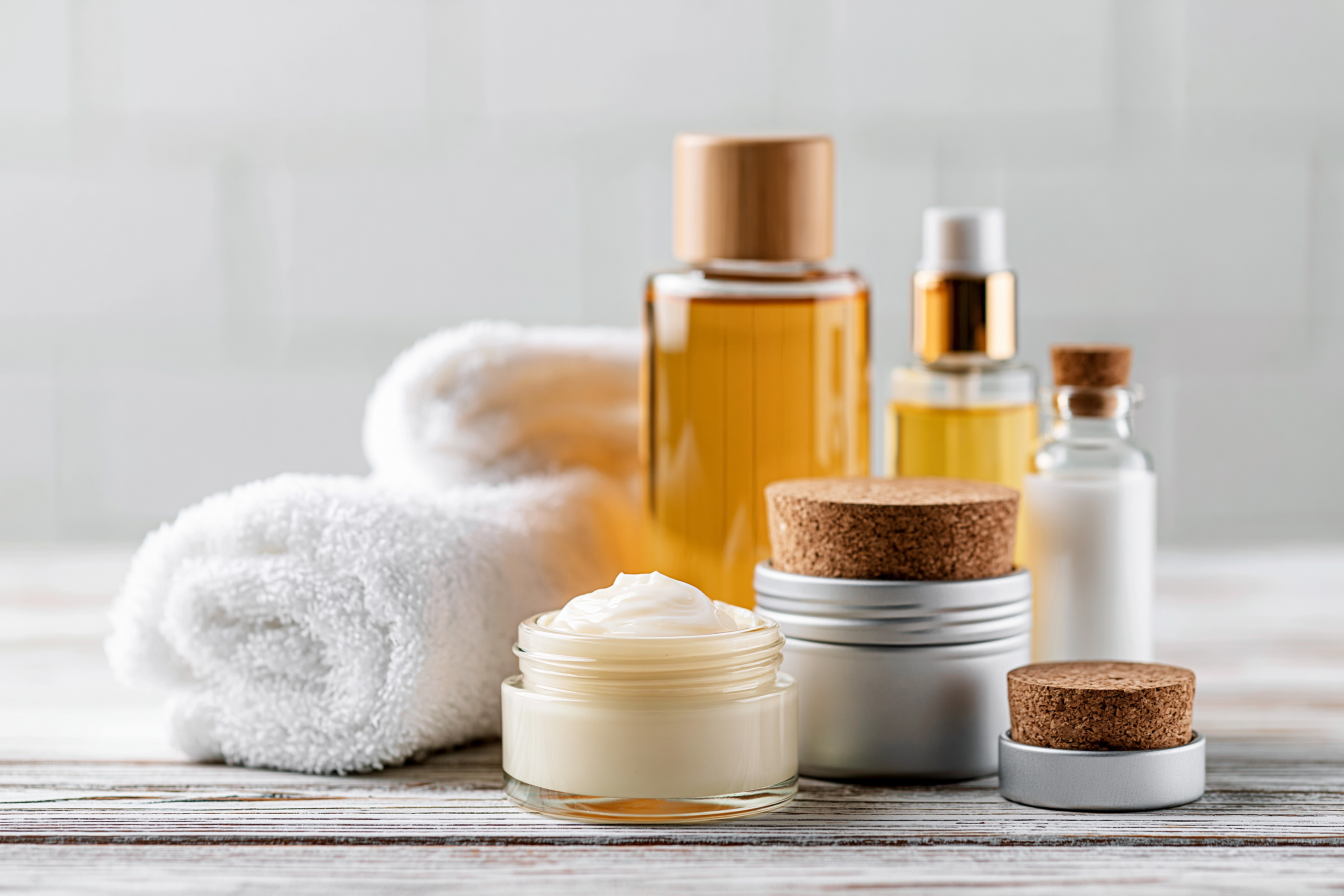
Not all triggers are food or climate. Many rosacea patients damage the skin barrier through repeated cosmetic or medicinal experiments. Scrubs, exfoliating acids, strong retinoids, benzoyl peroxide, alcohol toners, fragrance-heavy products, steam facials, chemical peels, essential oils, lemon, baking soda, aggressive ubtan, and unprescribed steroid creams can worsen rosacea-prone skin.
In Ayurveda, this can be understood as further aggravation of Pitta and Vata in an already sensitive Twak field. Pitta increases burning and inflammation. Vata increases dryness, stinging, and intolerance. Once the barrier is damaged, even mild products may burn.
This is why rosacea skincare must be simple, cooling, gentle, and protective. Even Ayurvedic lepa should be patch-tested. A classical herb may still irritate if the formulation is too heating, too abrasive, too drying, or used at the wrong stage.
Weather, Hot-Cold Switching, and Climate Change
Sudden temperature change is a common rosacea trigger. Moving from outdoor cold into indoor heating, stepping from air-conditioning into Gulf heat, taking hot showers, using steam, sitting in a sauna, exercising in hot weather, or washing the face with hot water can trigger flushing.
Charaka’s Kushtha Nidana discusses sudden and irregular use of hot and cold exposures as an etiological factor in skin disease. [10] This applies strongly to rosacea-like patients because their facial vessels and skin barrier are already reactive.
In Gulf countries, one common pattern is repeated switching between strong air-conditioning and outdoor heat. The skin moves from cold-dry indoor air to hot outdoor climate again and again. This can disturb Vata and Pitta together: Vata from dryness and sudden change, Pitta from heat and sun.
الانتقال المتكرر بين المكيف البارد والحرارة الخارجية قد يثير احمرار الوجه عند مريض الوردية.
بار بار ٹھنڈے اے سی سے باہر کی گرمی میں جانا روزیشیا کے مریض میں چہرے کی سرخی کو بھڑکا سکتا ہے۔
The Most Important Rosacea Triggers and Their Ayurvedic Meaning
| Rosacea trigger | Ayurvedic meaning | What the patient should understand |
|---|---|---|
| Sun, hot weather, sauna, steam, hot baths | Direct Pitta-Rakta aggravation | Heat increases heat; the red, burning face needs cooling protection, not more heat. |
| Alcohol, spicy food, sour food, fermented food, excess salt | Rakta-vitiating and Pitta-provoking Nidana | These foods can push internal heat toward the face and worsen redness, burning, and flushing. |
| Hot drinks, very hot meals, overeating | Pitta aggravation with Agni disturbance | Even the temperature of food or drink can trigger flushing in sensitive Vata-Pitta patients. |
| Anger, stress, anxiety, embarrassment, poor sleep | Vata-Pitta reactivity with Rakta sensitivity | Emotional heat and nervous-system reactivity can move redness quickly to the face. |
| Constipation, acidity, bloating, eating during indigestion | Agni disturbance and Ama formation | Poor digestion can maintain internal inflammation and make the skin more reactive. |
| Harsh skincare, scrubs, acids, steroid misuse, steam facials | Twak barrier injury with Vata-Pitta aggravation | A damaged skin barrier burns and stings easily; treatment must become gentler, not stronger. |
| Hot-cold switching, air-conditioning to outdoor heat, cold wind | Vata disturbance with Pitta flare | Sudden environmental change can trigger flushing and skin sensitivity. |
Why Trigger Avoidance Is Root-Cause Treatment
Many patients think trigger avoidance is a weak or temporary suggestion. In Ayurveda, it is the opposite. Trigger avoidance is Nidana Parivarjana, one of the most important foundations of treatment. If Nidana continues, the disease pathway continues. If Nidana is removed, the body has a chance to cool, digest, repair, and stabilize.
A patient may take the best herbs, Avaleha, lepa, or medicines, but if the same triggers continue every day, the face will continue to receive the same inflammatory message. The treatment may reduce symptoms temporarily, but relapse becomes likely.
The real goal is not fear-based avoidance. The goal is pattern recognition. The patient must learn which triggers are truly active in their case. Once Pitta-Rakta cools, Agni improves, Ama reduces, Vata stabilizes, Kapha-Kleda clears, and Twak becomes stronger, trigger tolerance may gradually improve.
This is the difference between suppression and root-cause care.
Gulf-Focused Rosacea Trigger Message
For Gulf patients, the trigger pattern often has a special climate component. Strong sun, high heat, sweating, outdoor travel, air-conditioning, dehydration, spicy meals, late dinners, stress, poor sleep, and cosmetic experimentation can combine to keep rosacea active. The patient may feel better indoors but flare when moving outside. Others may flare after long fasting, late-night eating, heavy meals, or hot drinks.
The Ayurvedic message should be clear:
إذا كان الوجه يحترق ويحمرّ باستمرار، فلا يكفي وضع كريم خارجي فقط. يجب معرفة ما الذي يشعل الحرارة من الداخل: الشمس، الطعام، التوتر، ضعف الهضم، السهر، أو العناية الخاطئة بالبشرة.
اگر چہرہ بار بار جلتا اور سرخ ہوتا ہے تو صرف بیرونی کریم کافی نہیں۔ یہ سمجھنا ضروری ہے کہ اندرونی گرمی کو کون بھڑکا رہا ہے: دھوپ، کھانا، ذہنی دباؤ، کمزور ہاضمہ، رات جاگنا یا غلط اسکن کیئر۔
This line connects strongly with patients because it explains their lived experience. They already know the face reacts. Ayurveda helps them understand why.
The Root-Cause Takeaway
Rosacea triggers are not random irritations. They are repeated signals that increase the same disease pathway. Heat, sun, alcohol, spicy food, sour food, hot drinks, anger, stress, poor sleep, constipation, indigestion, hot-cold switching, harsh skincare, and steroid misuse can all keep Pitta-Rakta, Vata, Kapha-Kleda, Agni, Ama, and Twak disturbance active.
The first step in Ayurvedic rosacea care is not to blindly take herbs. The first step is to identify the patient’s Nidana.
When the triggers are identified and removed, the treatment becomes stronger. Pitta-Rakta can cool. Agni can recover. Ama can reduce. Vata can stabilize. Kapha-Kleda can clear. The skin can become less reactive. Flare frequency can reduce. Long-term remission becomes more realistic.
In Ayurveda, avoiding the cause is not an accessory to treatment. It is treatment from the root.
Is It Rosacea or Something Else? Herpes, Lupus, Acne, Steroid Rash, and Other Mimics
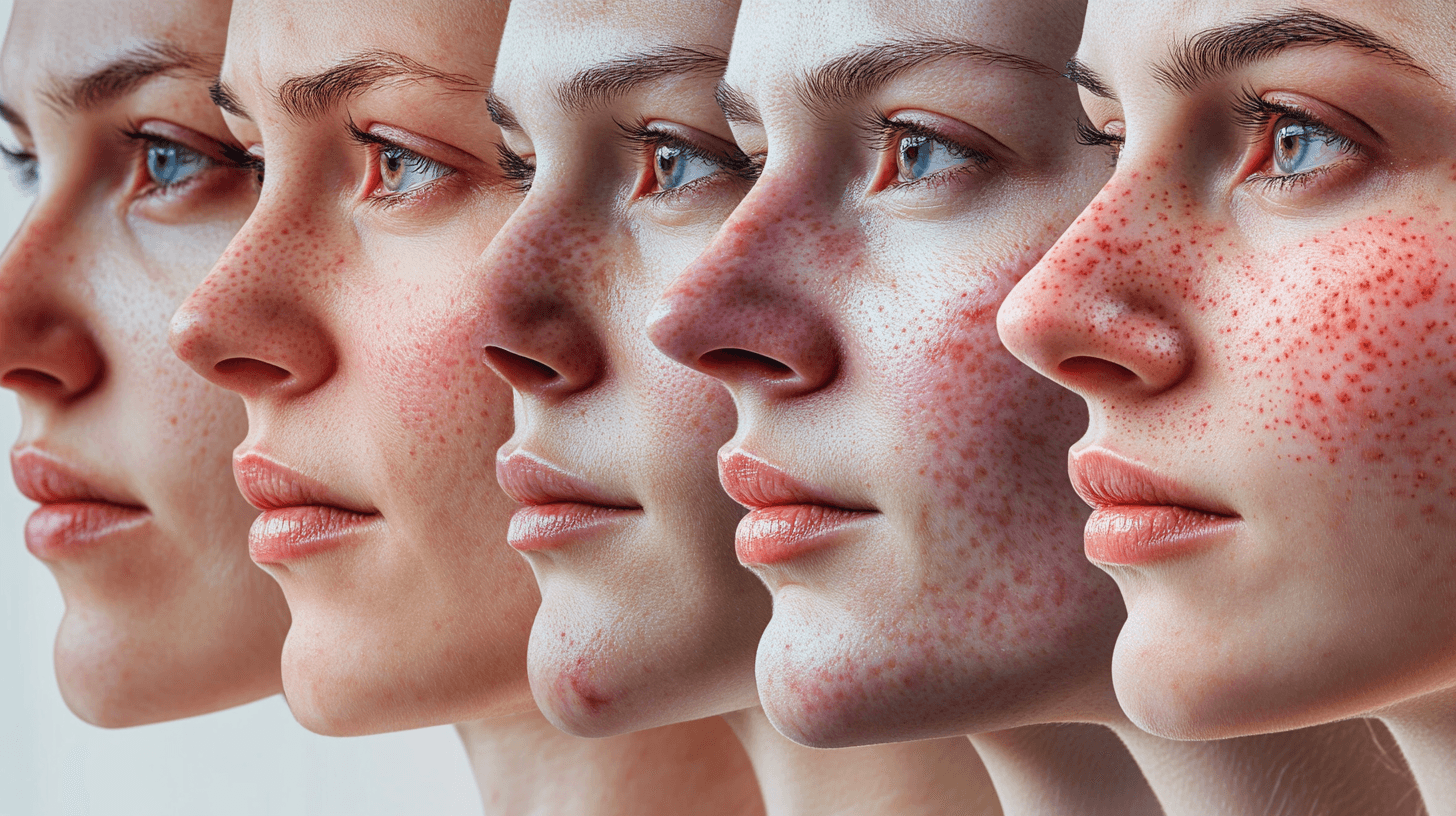
Not every red face is rosacea. This is one of the most important messages for patients, especially when the face is painful, blistering, swollen, crusted, itchy, one-sided, rapidly spreading, or associated with eye symptoms. Rosacea is common, but many other conditions can look similar in the beginning. A wrong diagnosis can delay the right treatment and may even make the disease worse.
كل احمرار في الوجه ليس وردية. بعض الحالات مثل الهربس، الحزام الناري، الذئبة، الحساسية، الفطريات، أو ضرر كريمات الكورتيزون قد تشبه الوردية ولكن علاجها مختلف.
چہرے کی ہر سرخی روزیشیا نہیں ہوتی۔ ہرپس، شنگلز، لیوپس، الرجی، فنگل انفیکشن، یا اسٹرائیڈ کریم سے خراب ہوئی جلد روزیشیا جیسی لگ سکتی ہے، مگر علاج مختلف ہوتا ہے۔
Ayurveda also does not support blind treatment by disease name alone. A physician must first examine the disease through Āptopadeśa, Pratyakṣa, and Anumāna: classical knowledge, direct observation, and clinical inference. This means the physician should study the visible rash, the patient’s symptoms, trigger history, digestion, bowel pattern, pain, itching, blisters, eye symptoms, steroid history, and systemic signs before deciding whether the condition is rosacea-like Pitta-Rakta Twak Vikāra, Visarpa-like acute spreading disease, dermatitis, acne, fungal infection, viral eruption, lupus-like disease, or another facial rash. [16,17,18,19,30]
Classical Ayurvedic Principle: Diagnosis Must Come Before Treatment
Text: Charaka Saṃhitā
Section: Vimāna Sthāna
Chapter: 4, Trividha Roga Viśeṣa Vijñānīya Vimāna
Verse: 4/3
Reference number: [30]
Sanskrit
त्रिविधं खलु रोगविशेषविज्ञानं भवति;
तद्यथा आप्तोपदेशः, प्रत्यक्षम्, अनुमानं चेति ॥३॥
Transliteration
trividhaṁ khalu roga-viśeṣa-vijñānaṁ bhavati;
tadyathā āptopadeśaḥ, pratyakṣam, anumānaṁ ceti ||3||
Translation
The specific knowledge of disease is obtained through three means: authoritative knowledge, direct observation, and inference.
This verse is very important for rosacea. A red face should not be treated only by assumption. The physician must observe the morphology, distribution, pain, itching, burning, blisters, crusting, swelling, eye involvement, digestion, triggers, and progression. Modern clinical guidance also emphasizes that red facial rashes need careful history, morphology assessment, and clinical clues to distinguish rosacea from infections, dermatitis, lupus, steroid eruptions, and other mimics. [16]
Why Correct Diagnosis Matters
Rosacea usually causes chronic or recurrent facial redness, flushing, burning, stinging, visible blood vessels, papules, pustules, and sensitive skin. It often affects the central face and tends to flare after heat, sun, alcohol, spicy food, hot drinks, emotional stress, harsh skincare, or temperature change. [1,2,3]
But herpes simplex may cause clustered painful blisters or crusted papules, often recurring in the same area. Herpes zoster, or shingles, may cause a painful one-sided rash where pain may come before the visible eruption. Impetigo may cause honey-colored crusting. Contact dermatitis may cause itching and irritation after a product exposure. Seborrheic dermatitis may cause greasy scaling around the nose, eyebrows, scalp, or ears. Lupus may cause a malar or butterfly-like rash and may be associated with systemic symptoms. Dermatomyositis may present with facial rash and muscle weakness. These are not managed the same way as rosacea. [16,17,18,19]
From an Ayurvedic viewpoint, chronic rosacea-like facial redness is usually read through Pitta-Rakta Dushti, Vata-Pitta flushing, Kapha-Kleda papules, and Agni-Ama involvement. But acute painful blistering, rapid spreading, severe swelling, fever, or one-sided eruptions may require a different assessment, including Visarpa-like or infectious presentations. This distinction protects the patient.
Classical Ayurvedic Warning: Acute Spreading Disease Is Not Ordinary Rosacea
Text: Charaka Saṃhitā
Section: Cikitsā Sthāna
Chapter: 21, Visarpa Cikitsā
Verse: 21/11
Reference number: [31]
Sanskrit
विविधं सर्पति यतो विसर्पस्तेन स स्मृतः ।
परिसर्पोऽथवा नाम्ना सर्वतः परिसर्पणात् ॥११॥
Transliteration
vividhaṁ sarpati yato visarpas tena sa smṛtaḥ |
parisarpo’thavā nāmnā sarvataḥ parisarpaṇāt ||11||
Translation
It is called Visarpa because it spreads in various ways. It is also called Parisarpa because it spreads extensively.
This verse matters because some patients with herpes zoster, acute bacterial infection, severe inflammatory facial eruptions, or rapidly spreading painful rashes may describe their condition as “redness” or “rosacea.” Ayurveda clearly separates chronic skin disorders such as Kuṣṭha-like/Twak Vikāra patterns from acute spreading conditions such as Visarpa-like presentations. If the rash is painful, blistering, rapidly spreading, one-sided, febrile, or near the eye, it should not be treated casually as ordinary rosacea. [31]
إذا كان الطفح مؤلماً، سريع الانتشار، يحتوي على فقاعات، أو قريباً من العين، فلا يجب اعتباره وردية عادية.
اگر دانے دردناک ہوں، تیزی سے پھیل رہے ہوں، چھالوں والے ہوں، یا آنکھ کے قریب ہوں تو اسے عام روزیشیا سمجھ کر علاج نہیں کرنا چاہیے۔
The Most Important Rosacea Mimics
| Condition that can look like rosacea | How it differs from rosacea | Ayurvedic clinical caution |
|---|---|---|
| Acne vulgaris | Usually has blackheads, whiteheads, oily skin, and may affect face, chest, back, or shoulders | Do not treat every facial papule as rosacea; assess Kapha, Meda, Rakta, and Yauvana Piḍakā-like features |
| Steroid-induced rosacea-like eruption | History of facial steroid cream use, rebound redness, burning, thinning, dependency, or worsening after stopping | Requires careful withdrawal planning and Vata-Pitta skin-barrier repair |
| Perioral dermatitis | Rash around mouth, nose, or eyes, often linked with steroids, cosmetics, or heavy creams | Often needs removal of Nidana and gentle external care |
| Seborrheic dermatitis | Greasy yellow-white scaling around eyebrows, nose folds, scalp, ears, or beard area | More Kapha-Kleda and Malassezia-like pattern; not pure Pitta-Rakta redness |
| Contact dermatitis | Itching, burning, scaling, or redness after skincare, cosmetics, sunscreen, fragrance, or topical medicines | Nidana is external contact; avoid blind herbal lepa without patch testing |
| Tinea faciei | Fungal rash, often ring-shaped, scaly, expanding, or one-sided | Requires fungal assessment; avoid oily or steroid applications |
| Herpes simplex | Painful grouped blisters, crusting, burning, tingling, often recurring at the same site | Viral eruption; not ordinary Pitta-Rakta rosacea |
| Herpes zoster / shingles | Painful one-sided rash, dermatomal pattern, pain may begin before blisters; eye involvement can be serious | Visarpa-like acute spreading/painful presentation; urgent care if near eye |
| Lupus erythematosus | Butterfly-like rash, photosensitivity, may spare nasolabial folds, may have fatigue, joint pain, fever, or systemic signs | Do not treat as simple rosacea; systemic assessment may be needed |
| Dermatomyositis | Facial rash with possible eyelid swelling, photosensitive rash, and muscle weakness | Systemic disease possibility; needs medical evaluation |
| Cellulitis or erysipelas | Rapid redness, warmth, swelling, pain, fever, tenderness, spreading infection | Acute inflammatory/infective state; not routine rosacea |
| Ocular herpes or severe ocular rosacea | Eye pain, light sensitivity, tearing, redness, blurred vision, corneal symptoms | Eye symptoms require urgent evaluation; avoid casual eye remedies |
This table should be read as a safety map. It helps patients understand that “red face” is not a complete diagnosis. The correct question is not only “Do I have rosacea?” The better question is, “What pattern is causing my facial redness, and is there any sign that this is not ordinary rosacea?”
Herpes Simplex and Rosacea
Herpes simplex usually does not cause rosacea. It is a different condition. However, herpes simplex can look like rosacea in the early stage, especially when redness, burning, tingling, crusting, or small eruptions appear around the mouth, nose, or cheek. Herpes simplex commonly presents with localized blistering and may recur at the same site. DermNet describes facial herpes simplex as clustered vesicles or crusted papules that are often locally recurrent. [17]
The patient may feel tingling, burning, pain, or sensitivity before the eruption becomes visible. This is different from rosacea flushing, where redness usually comes with heat, triggers, burning, and vascular reactivity rather than grouped blisters.
From an Ayurvedic viewpoint, chronic rosacea-like redness is usually a Pitta-Rakta Twak Vikāra pattern. But painful clustered vesicles, crusting, and recurrent local eruptions should not be forced into the rosacea category. They may require a viral assessment and a different treatment direction.
الهربس لا يسبب الوردية عادة، لكنه قد يشبهها في البداية. وجود فقاعات مؤلمة أو قشور متكررة في نفس المكان يحتاج إلى تقييم مختلف.
ہرپس عام طور پر روزیشیا کا سبب نہیں بنتا، لیکن شروع میں روزیشیا جیسا لگ سکتا ہے۔ دردناک چھالے یا ایک ہی جگہ بار بار بننے والی پپڑی الگ تشخیص کا تقاضا کرتی ہے۔
Herpes Zoster, Shingles, and One-Sided Facial Redness
Herpes zoster, also called shingles, can be confused with rosacea when it appears on the face. The difference is that shingles is usually painful, localized, blistering, and often one-sided. Pain may begin before the rash appears. DermNet describes herpes zoster as a localized, blistering, painful rash caused by reactivation of varicella-zoster virus, with lesions often confined to a dermatome and usually unilateral. [17]
This is very important near the eye. If the rash is on the forehead, eyelid, nose, or around the eye, or if there is eye pain, blurred vision, tearing, redness, or light sensitivity, the patient should not wait or apply home remedies. Shingles near the eye can cause serious complications.
In Ayurvedic language, a painful, spreading, blistering, acute eruption may be considered through a Visarpa-like lens rather than ordinary chronic rosacea. The treatment logic changes because the disease is acute, painful, and potentially serious.
Lupus and the Butterfly Rash
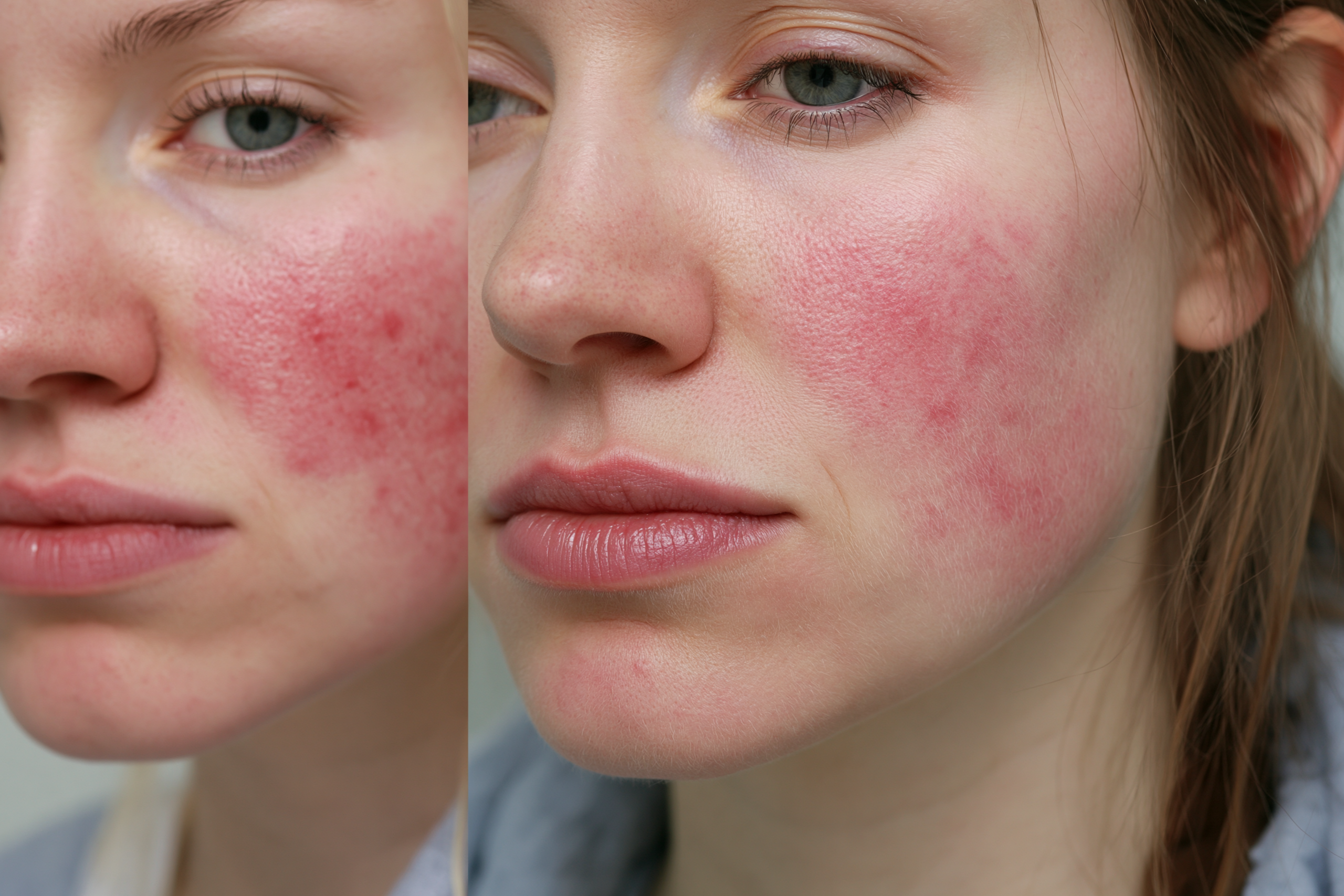
Lupus can sometimes look like rosacea because both may involve redness across the cheeks and nose. However, lupus may have different clinical clues. A malar rash is often described as a butterfly-like erythematous eruption involving the cheeks and nasal bridge, classically associated with systemic lupus erythematosus, and it may spare the nasolabial folds. Lupus may also be associated with photosensitivity, fatigue, joint pain, fever, mouth ulcers, hair loss, or other systemic symptoms. [16]
Rosacea more commonly has flushing, burning, trigger-related redness, papules, pustules, visible vessels, and skin sensitivity. Lupus should be considered when the rash is strongly photosensitive, butterfly-like, persistent, associated with systemic symptoms, or not responding as expected.
Ayurveda should not treat such a case as ordinary Pitta-Rakta facial redness without proper assessment. The patient may need laboratory evaluation and specialist care.
Steroid-Induced Rosacea-Like Eruption
A very important mimic is steroid-induced rosacea-like eruption. Many patients use steroid creams on the face for itching, redness, allergy, fairness, acne, or quick relief. In the beginning, the steroid may reduce redness. Later, the face may become dependent, thin, burning, red, reactive, and worse when the cream is stopped.
This is not ordinary rosacea alone. It is a damaged facial skin state with Vata-Pitta aggravation, barrier weakness, rebound inflammation, and often psychological distress. The patient may say, “The cream works only when I use it, but the face becomes worse when I stop.”
Ayurvedic management must be gentle. The physician should not begin with harsh detox, strong lepa, steam, exfoliation, or heating herbs. The first step is to protect Twak, reduce burning, stabilize Vata-Pitta, support the barrier, and plan safe withdrawal or integrative care when needed.
استخدام كريمات الكورتيزون على الوجه بدون إشراف قد يسبب احمراراً ارتدادياً وحرقاناً وحساسية شديدة.
چہرے پر بغیر نگرانی اسٹرائیڈ کریم لگانے سے ری باؤنڈ سرخی، جلن اور شدید حساسیت پیدا ہو سکتی ہے۔
Dermatitis, Fungal Rash, and Scaly Facial Redness
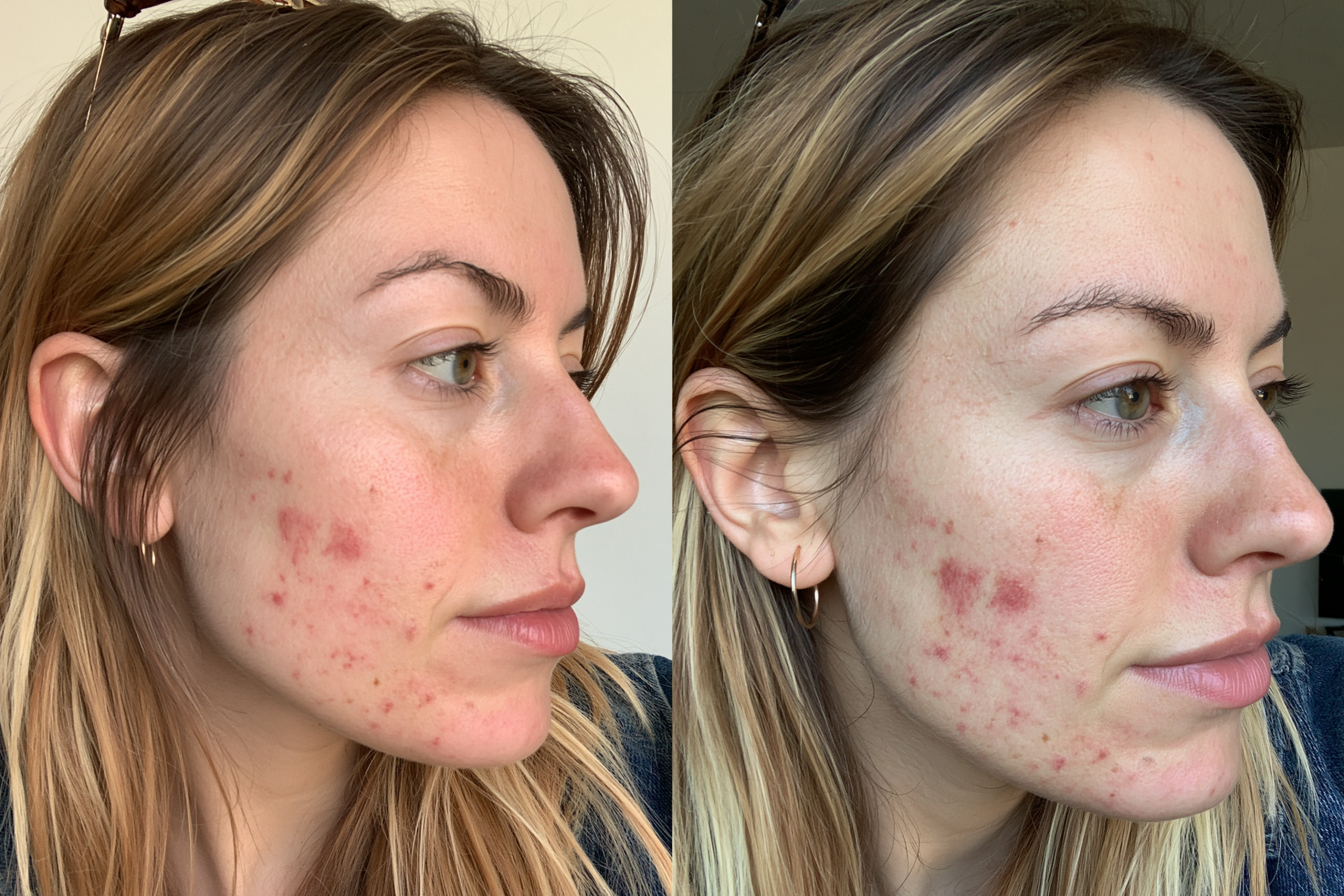
When facial redness is itchy, scaly, sharply linked with products, or appears after cosmetics, sunscreen, fragrance, beard products, or topical medicines, contact dermatitis should be considered. When the redness is greasy, scaly, and located around the eyebrows, nose folds, scalp, ears, or beard area, seborrheic dermatitis may be present. When the rash is ring-like, scaly, expanding, or one-sided, tinea faciei should be considered. DermNet notes that significant itch suggests atopic or contact dermatitis, and its facial-rash guide separates erosions/crusting, scaly rashes, papulopustular rashes, and erythematous presentations to guide diagnosis. [16]
These conditions may coexist with rosacea, but they are not the same. A patient may have rosacea plus seborrheic dermatitis, rosacea plus contact dermatitis, or rosacea worsened by fungal or microbial imbalance. This is why the skin must be examined carefully before external applications are prescribed.
Ocular Symptoms: When the Eyes Change the Whole Diagnosis
Ocular rosacea can cause dryness, redness, grittiness, burning, eyelid irritation, recurrent styes, light sensitivity, or blurred vision. But eye symptoms may also occur in herpes simplex keratitis, shingles affecting the eye, allergic eye disease, infection, or other ophthalmic conditions. [18,19]
The patient should not apply herbal eye drops, rose water, honey, ghee, or home remedies into the eye without professional evaluation. Eye pain, photophobia, blurred vision, corneal discomfort, or a facial rash near the eye should be treated as a warning sign.
In Ayurveda, Pitta-Rakta involvement near the eye may explain heat, redness, and burning, but modern eye safety must be respected. The eye is too delicate for guesswork.
How Ayurveda Separates Rosacea-Like Disease From Mimics
Ayurveda separates diseases by Nidana, Rupa, Purvarupa, Vedana, Adhishthana, Dosha, Dushya, Agni, Ama, Srotas, and Samprapti. This is why two patients with a red face may receive completely different treatment.
A patient with chronic redness, heat, burning, flushing, food triggers, alcohol sensitivity, and sun sensitivity may fit a Pitta-Rakta rosacea-like pattern.
A patient with sudden flushing during stress, anxiety, or temperature change may fit a Vata-Pitta flushing pattern.
A patient with papules, pustules, heaviness, oiliness, constipation, and coated tongue may fit a Pitta-Kapha-Kleda with Ama pattern.
A patient with painful grouped blisters may need assessment for herpes simplex.
A patient with one-sided painful blistering rash may need assessment for herpes zoster or Visarpa-like acute disease.
A patient with butterfly-like photosensitive rash and systemic symptoms may need assessment for lupus.
A patient with greasy scale may have seborrheic dermatitis.
A patient with itching after products may have contact dermatitis.
A patient with steroid history may have steroid-induced rosacea-like eruption.
This is the root of safe and intelligent Ayurvedic practice: the medicine is selected only after the disease pathway is understood.
Gulf Patient Message: Do Not Self-Diagnose Every Red Face
For Gulf patients, this section is especially important because heat, sun exposure, air-conditioning, sweating, cosmetic use, steroid-containing creams, strong skincare products, perfumes, and late-night food habits can all produce facial redness. Some patients may assume every red face is rosacea, while others may assume it is allergy or infection. Both assumptions can be wrong.
إذا كان الاحمرار مزمناً ويتكرر مع الحرارة، الشمس، الطعام الحار، التوتر أو الكحول، فقد يكون نمطاً شبيهاً بالوردية من منظور بيتا-راكتا. ولكن إذا كان هناك ألم شديد، فقاعات، قشور، طفح من جهة واحدة، حرارة بالجسم، أو أعراض في العين، فهذه ليست وردية عادية ويجب تقييمها بسرعة.
اگر سرخی پرانی ہے اور گرمی، دھوپ، مصالحہ، ذہنی دباؤ یا الکحل سے بار بار بڑھتی ہے تو یہ پِتّہ-رکت قسم کا روزیشیا جیسا پیٹرن ہو سکتا ہے۔ لیکن اگر شدید درد، چھالے، پپڑی، ایک طرف کا ریش، بخار یا آنکھ کی علامات ہوں تو یہ عام روزیشیا نہیں اور فوری جانچ ضروری ہے۔
The Root-Cause Takeaway
Rosacea-like facial inflammation should be treated only after correct diagnosis and root-pattern mapping. The face may look red in many diseases, but the cause may be completely different.
Chronic flushing and burning may indicate Pitta-Rakta aggravation. Sudden flushing may indicate Vata-Pitta reactivity. Papules and pustules may indicate Kapha-Kleda and Ama involvement. Painful blisters may indicate herpes. One-sided painful rash may indicate shingles. Greasy scale may indicate seborrheic dermatitis. Itching after products may indicate contact dermatitis. Butterfly-like rash with systemic symptoms may indicate lupus. Redness after steroid cream may indicate steroid-induced facial damage.
The strongest Ayurvedic approach is not to promise the same medicine for every red face. The strongest approach is to diagnose carefully, identify the true disease pathway, protect the patient from dangerous mimics, and then treat the root with precision.
Does Herpes Cause Rosacea?
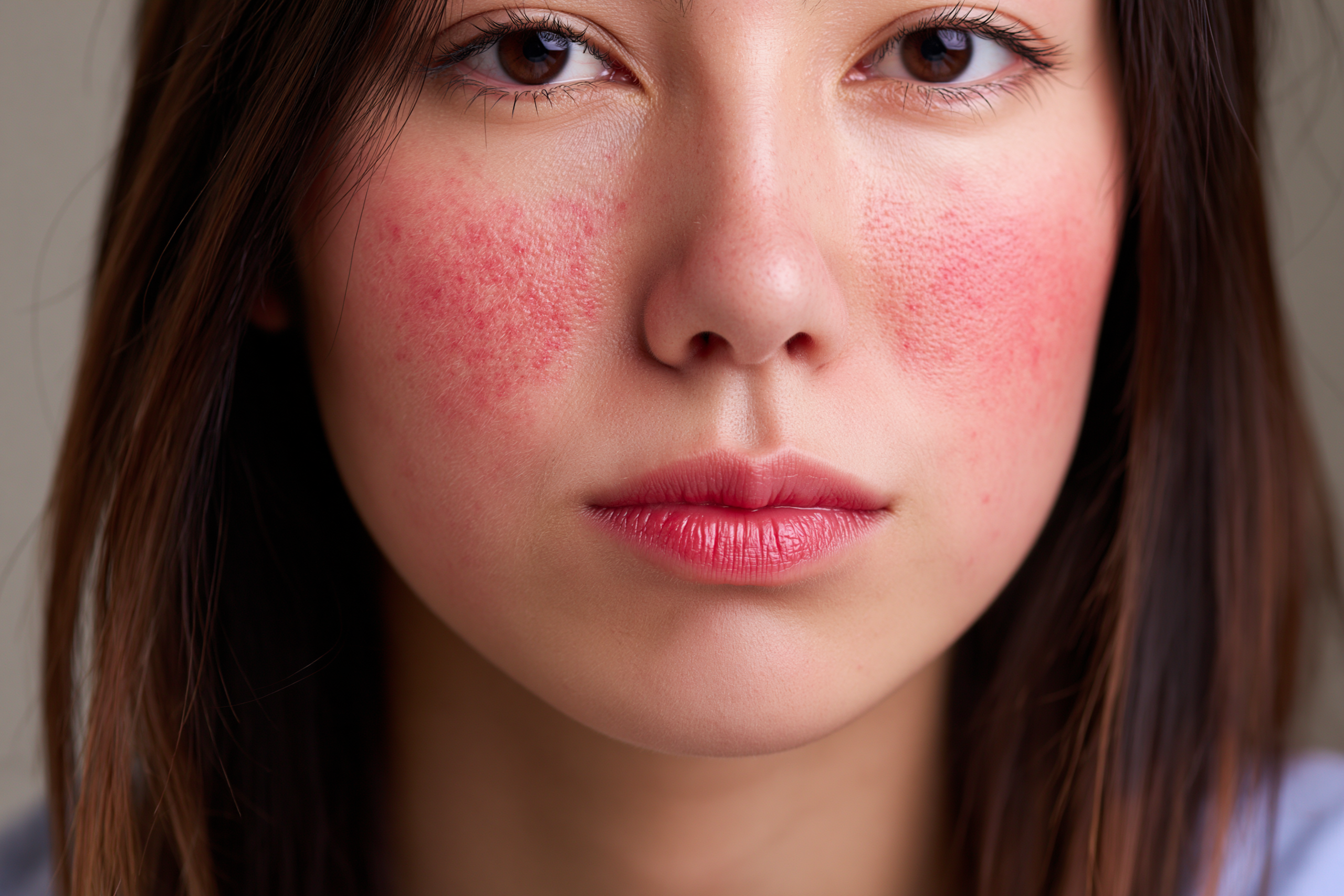
Herpes usually does not cause rosacea. Rosacea and herpes are different conditions with different disease pathways. Rosacea is usually a chronic, recurring facial inflammatory condition with flushing, redness, burning, sensitivity, visible vessels, papules, pustules, and trigger-related flares. Herpes simplex is a viral infection that commonly causes painful blisters or ulcers and spreads mainly through skin-to-skin contact. [1,2,17] WHO describes herpes simplex virus as an infection that can cause painful blisters or ulcers, while DermNet describes facial herpes simplex as clustered vesicles or crusted papules that often recur in the same site.
This distinction matters because many patients see redness, burning, or small eruptions on the face and fear that herpes is the root cause of their rosacea. In most cases, herpes is not the cause of chronic rosacea. However, herpes can sometimes mimic rosacea, coexist with rosacea, or trigger temporary facial inflammation in a person whose skin is already sensitive.
الوردية والهربس ليسا نفس المرض. الوردية نمط التهابي مزمن، أما الهربس فهو عدوى فيروسية قد تسبب فقاعات أو تقرحات مؤلمة.
Urdu, briefly: ہرپس عام طور پر روزیشیا کا سبب نہیں بنتا، مگر یہ روزیشیا جیسا دکھ سکتا ہے۔
Rosacea and Herpes Are Different Disease Pathways
Rosacea usually follows a chronic pattern. The face becomes red, hot, burning, or sensitive after triggers such as sun, heat, stress, alcohol, spicy food, hot drinks, harsh skincare, poor sleep, or digestive disturbance. The redness may come and go, but the tendency keeps returning. This fits the Ayurvedic pattern of Pitta-Rakta Dushti, with Vata involvement in sudden flushing and Kapha-Kleda involvement when papules and pustules appear. [9,10,11]
Herpes simplex follows a different pattern. It is commonly associated with tingling, burning, pain, grouped blisters, erosions, ulcers, crusting, and recurrence at or near the same site. It may appear around the lips, mouth, nose, cheeks, or periocular area. It is not simply chronic facial flushing. [17] DermNet describes recurrent HSV as clusters of small vesicles often preceded by localized tingling or burning.
In practical language, rosacea usually behaves like a recurring heat-flushing inflammatory pattern, while herpes behaves like a viral blistering or ulcerating eruption.
Classical Ayurvedic Lens: Chronic Redness Is Different From Acute Spreading or Blistering Disease
Ayurveda separates chronic skin inflammation from acute, painful, spreading eruptions. Chronic rosacea-like redness can be understood through Pitta-Rakta dominant Twak Vikara, but painful, blistering, spreading, one-sided, or rapidly changing eruptions require a different assessment. Such presentations may be considered through a Visarpa-like lens in Ayurvedic differential thinking, especially when there is acute spread, pain, heat, swelling, and vesicular change.
Text: Charaka Saṃhitā
Section: Cikitsā Sthāna
Chapter: 21, Visarpa Cikitsā
Verse: 21/11
Reference number: [31]
Sanskrit
विविधं सर्पति यतो विसर्पस्तेन स स्मृतः ।
परिसर्पोऽथवा नाम्ना सर्वतः परिसर्पणात् ॥११॥
Transliteration
vividhaṁ sarpati yato visarpas tena sa smṛtaḥ |
parisarpo’thavā nāmnā sarvataḥ parisarpaṇāt ||11||
Translation
It is called Visarpa because it spreads in various ways. It is also called Parisarpa because it spreads extensively.
This shloka is important because it prevents a dangerous mistake. A chronic red, flushing, burning face may fit rosacea-like Pitta-Rakta involvement, but a painful, spreading, blistering eruption is not ordinary rosacea. If the eruption is acute, one-sided, vesicular, crusted, severely painful, or near the eye, it must be assessed separately and urgently.
Herpes Simplex Can Mimic Rosacea
Herpes simplex can sometimes be confused with rosacea because both may involve redness, burning, tenderness, and facial discomfort. The difference is in the pattern. Herpes usually has a more localized eruption, often with grouped blisters, erosions, ulcers, crusting, tingling, or pain. Rosacea usually has broader facial flushing, persistent redness, trigger sensitivity, visible vessels, papules, pustules, and skin reactivity without typical grouped viral blisters. [1,2,17]
A patient with rosacea may say, “My whole face flushes after heat or stress.” A patient with herpes may say, “This spot tingles, burns, then forms small blisters or crusts, often in the same place.” That history is very important.
Herpes may also appear on top of rosacea-prone skin. In that situation, the patient may have both conditions: chronic rosacea-like sensitivity and a separate viral outbreak. Treating both as one disease can lead to confusion.
Herpes Zoster, Shingles, and Facial Rosacea Confusion
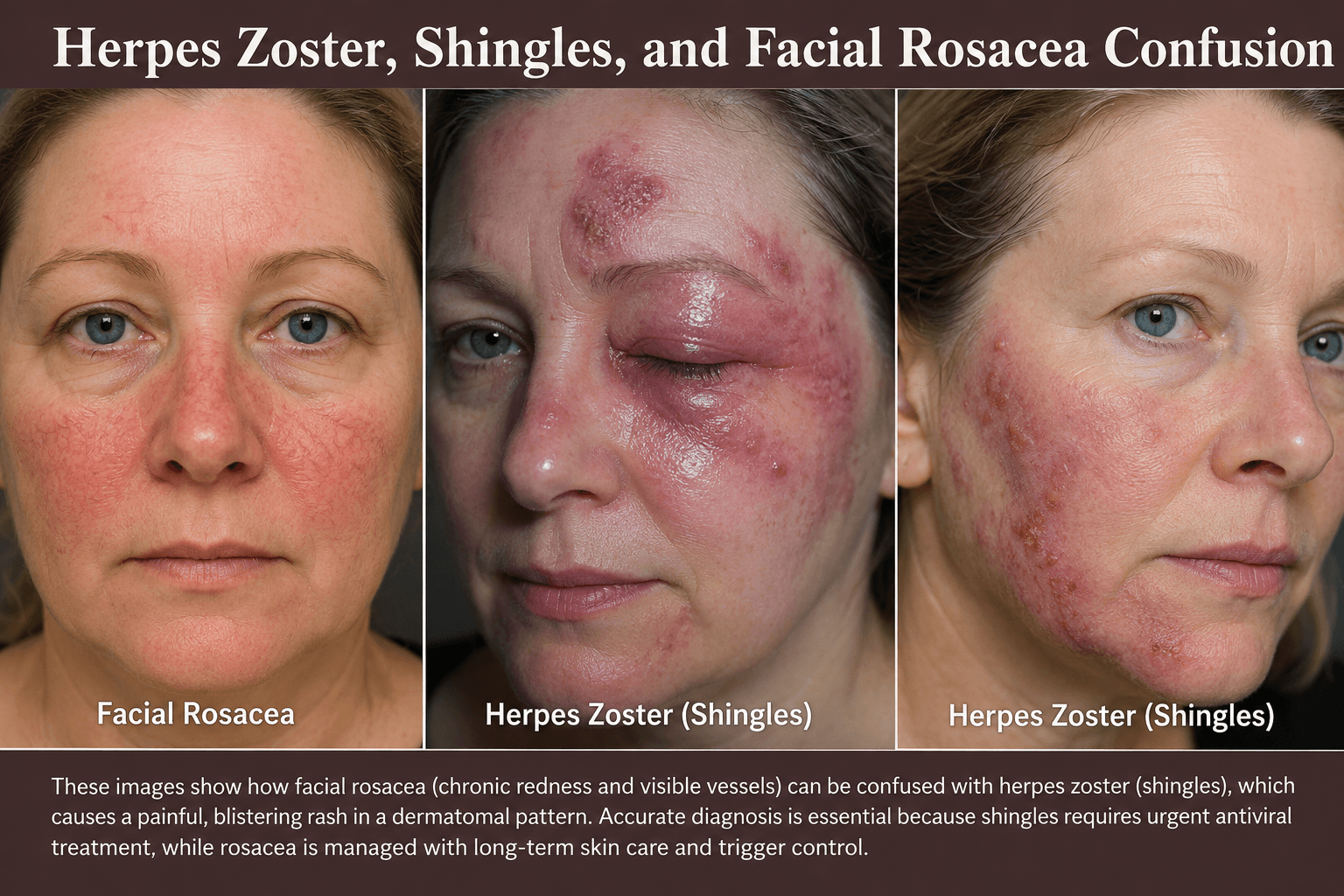
Herpes zoster, also called shingles, is not rosacea. It is caused by reactivation of varicella-zoster virus. It often presents as a localized, painful, blistering rash and is usually one-sided. DermNet describes herpes zoster as a localized, blistering, painful rash caused by reactivation of varicella-zoster virus.
Facial shingles can be mistaken for rosacea in the early stage because redness and burning may appear before blisters are obvious. The warning signs are pain, one-sided distribution, blistering, nerve-like discomfort, forehead or eyelid involvement, and symptoms near the eye. This is not a cosmetic redness problem. It needs urgent medical attention, especially if the eye area is involved.
From an Ayurvedic viewpoint, shingles-like facial eruptions should not be forced into the rosacea category. Their acute, painful, spreading, vesicular nature is closer to a Visarpa-like clinical caution than to chronic Pitta-Rakta facial flushing.
Ocular Herpes and Ocular Rosacea Must Not Be Confused
This is the most serious part of the herpes discussion. Ocular rosacea can cause dry, red, gritty, irritated, burning eyes. Herpes simplex keratitis can also cause red eye, pain, photophobia, tearing, and blurred vision, but it is a different condition and can threaten the cornea. StatPearls describes herpes simplex keratitis symptoms as discomfort, pain, redness, photophobia, watering, and blurred vision, and CDC advises calling an eye doctor immediately if symptoms such as eye pain, redness, blurred vision, light sensitivity, or watery discharge occur.
This means eye symptoms should never be treated casually. A patient with facial redness and dry eyes may have ocular rosacea. A patient with pain, photophobia, tearing, blurred vision, corneal discomfort, or a history of herpes may have herpes-related eye disease. These require different treatment pathways.
Ayurveda can support systemic Pitta-Rakta correction, but herbal eye drops, honey, rose water, ghee, or home remedies should not be used in the eye when pain, blurred vision, light sensitivity, or suspected herpes keratitis is present.
Herpes vs Rosacea: The Most Important Differences
| Feature | Rosacea | Herpes simplex | Herpes zoster / shingles |
|---|---|---|---|
| Main nature | Chronic inflammatory facial condition | Viral infection caused by HSV | Viral reactivation caused by varicella-zoster virus |
| Usual pattern | Recurrent flushing, redness, burning, sensitivity, papules, pustules | Localized tingling, burning, grouped blisters, erosions, ulcers, crusting | Painful one-sided rash, often blistering and nerve-like |
| Common location | Cheeks, nose, chin, forehead, central face | Lips, around mouth, nose, cheek, periocular area | One side of face or body; forehead/eye region can be serious |
| Trigger pattern | Sun, heat, stress, alcohol, spicy food, hot drinks, harsh skincare | May recur at same site; may follow stress, illness, sun, trauma | Reactivation risk rises with age, immune stress, or reduced immunity |
| Ayurvedic reading | Pitta-Rakta Twak Vikara with Vata/Kapha-Kleda variation | Viral/acute eruption; not ordinary rosacea | Visarpa-like caution when acute, painful, spreading, vesicular |
| Eye concern | Ocular rosacea may cause dryness, grittiness, irritation | HSV keratitis can cause pain, photophobia, blurred vision | Ophthalmic shingles can threaten the eye |
| Key warning | Chronic redness still needs pattern mapping | Painful blisters or crusting need different assessment | One-sided painful rash near eye needs urgent care |
Can Viral Infections Trigger Rosacea Flares?
Some viral infections or immune stress events may worsen rosacea temporarily in susceptible patients, but this is not the same as saying “herpes causes rosacea.” Infection, fever, stress, poor sleep, inflammation, immune activation, and medications may all disturb the internal terrain and provoke facial flushing in a rosacea-prone person.
Ayurveda would interpret this as a temporary aggravation of Pitta, Rakta, Vata, Agni, and Ama under stress. The virus may act as a trigger, but the chronic rosacea pathway depends on the patient’s underlying terrain.
This is an important distinction. A trigger is not always the root cause. Herpes may trigger a flare in some patients, but the deeper rosacea-like pattern usually still involves Pitta-Rakta heat, Vata reactivity, Agni disturbance, Ama, Kapha-Kleda, or skin-barrier weakness.
Patient-Facing Rule: When to Suspect Herpes Instead of Rosacea
A patient should suspect herpes or shingles rather than ordinary rosacea when the facial eruption is painful, blistering, crusting, localized to one repeated area, one-sided, or associated with tingling before the eruption. A rash near the eye, eye pain, blurred vision, light sensitivity, or watery painful eye should be treated as urgent.
Rosacea usually flares with heat, sun, stress, alcohol, spicy food, hot drinks, and skincare irritation. Herpes usually gives a more localized blistering or ulcerating pattern. Shingles usually gives a painful one-sided pattern. The difference can save the patient from wrong treatment.
إذا كان الاحمرار مع فقاعات مؤلمة، قشور، ألم في العين، أو طفح من جهة واحدة، فهذه ليست وردية عادية ويجب تقييمها بسرعة.
Ayurvedic Treatment Direction When Herpes Is Suspected
If herpes-like lesions are present, the case should not be treated as routine rosacea. The physician should first identify whether the patient has chronic Pitta-Rakta rosacea-like inflammation, an acute viral eruption, shingles-like facial disease, ocular involvement, steroid-damaged skin, or a mixed picture.
When chronic rosacea and herpes coexist, the acute viral issue must be handled first and safely. After the acute episode settles, the Ayurvedic root-cause plan can address the underlying terrain: Pitta-Rakta heat, Agni disturbance, Ama, Vata reactivity, Kapha-Kleda papules, and weakened Twak tolerance.
This staged approach is more intelligent than giving one medicine for every red face. Ayurveda becomes powerful when diagnosis is precise.
The Root-Cause Takeaway
Herpes does not usually cause rosacea. Rosacea is a chronic inflammatory and trigger-sensitive facial condition. Herpes simplex is a viral blistering or ulcerating infection. Shingles is a painful, often one-sided viral eruption. They may resemble each other in the early stage, but they are not the same.
The patient should not panic and assume every rosacea flare is herpes. At the same time, the patient should not ignore painful blisters, crusting, one-sided rash, eye pain, light sensitivity, or blurred vision.
The Ayurvedic masterstroke is correct separation. Chronic redness, flushing, heat, burning, papules, and food-triggered flares may need Pitta-Rakta, Agni-Ama, Vata, and Kapha-Kleda correction. Painful blisters, one-sided eruptions, or eye symptoms require a different and often urgent pathway.
Rosacea treatment becomes safe and successful when the physician first answers the most important question: Is this truly rosacea-like Pitta-Rakta facial inflammation, or is something else imitating it?
Ayurvedic Cure from the Root: How Treatment Works
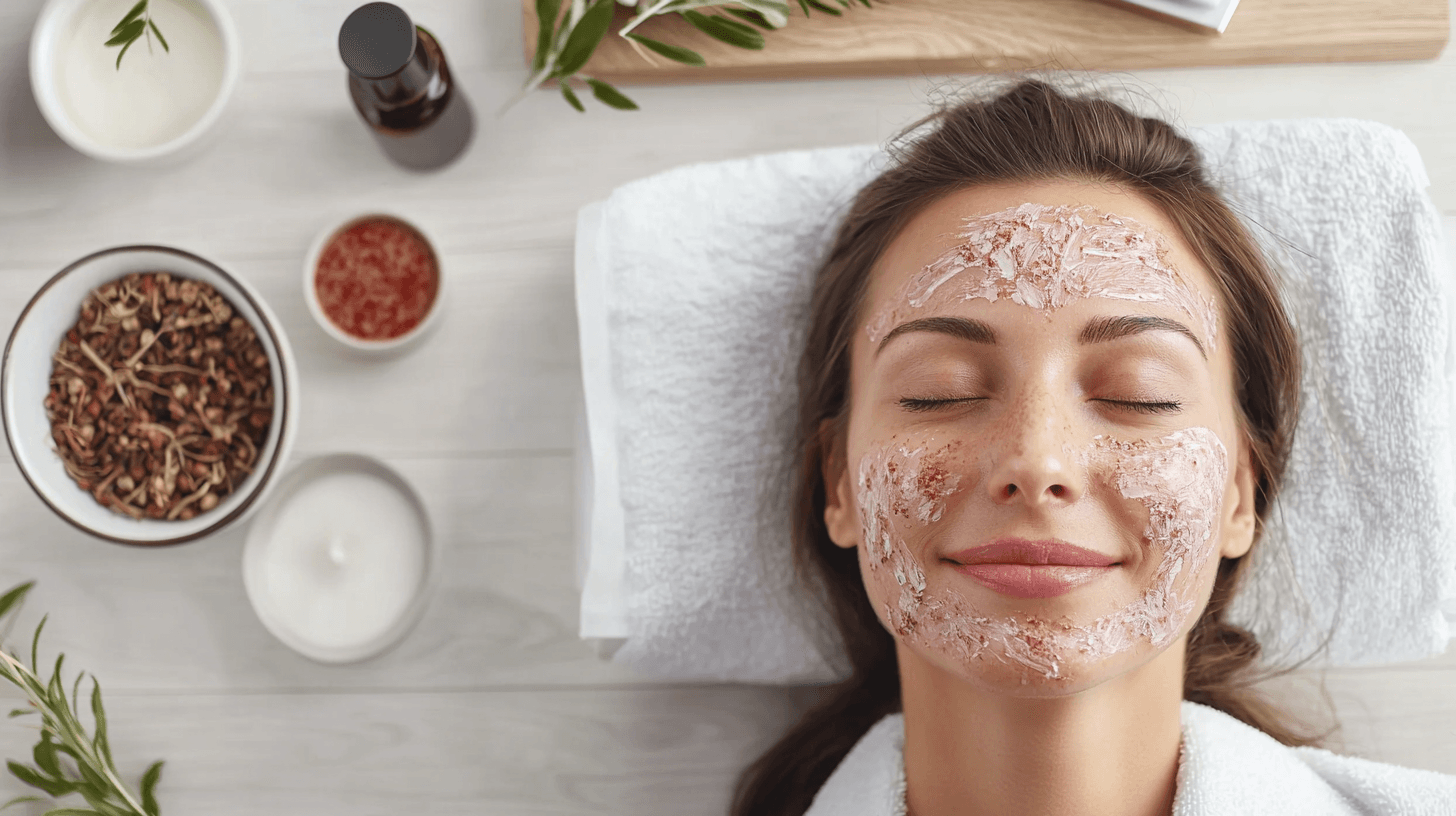
Ayurvedic treatment for rosacea-like facial inflammation does not begin with a cream, a face pack, or a random herb. It begins with understanding the disease pathway. The face is the visible field, but the root lies deeper in Nidana, Agni, Ama, Pitta, Rakta, Vata, Kapha, Kleda, Twak, and Srotas.
In Ayurveda, cure is not a marketing word. Cure means Samprapti-Vighatana, the breaking of the disease pathway. If the causes continue, the disease returns. If the pathway is broken correctly, the face can move from repeated flares toward calmer skin, better trigger tolerance, and long-term remission.
العلاج الجذري في الأيورفيدا لا يعني إخفاء الاحمرار فقط، بل يعني كسر سلسلة المرض: السبب، الهضم، السموم، الحرارة، الدم، الأعصاب، والجلد.
For rosacea-like disease, the treatment pathway must be individualized. One patient may need strong Pitta-Rakta cooling. Another may need Vata stabilization because flushing is sudden and stress-related. Another may need Kapha-Kleda and Ama correction because papules and pustules are present. Another may need gut correction because the face flares after acidity, constipation, or heavy meals. Another may need skin-barrier repair because the face has become intolerant after steroid creams or harsh skincare.
This is why Ayurveda should not treat rosacea by name alone. It treats the pathway behind the name.
The First Step Is Removing the Cause
The foundation of Ayurvedic treatment is Nidana Parivarjana, the removal of causative and maintaining factors. If the patient continues the same triggers that heat Rakta and aggravate Pitta, the disease pathway remains active. Sun, heat, alcohol, spicy food, sour food, fermented food, late nights, anger, poor sleep, indigestion, constipation, steam, sauna, harsh skincare, and steroid misuse can all keep facial inflammation alive. [10,11]
In rosacea, Nidana Parivarjana is not ordinary lifestyle advice. It is the first medicine.
A patient may take herbs, Avaleha, or topical applications, but if the same triggers continue every day, the face keeps receiving the same inflammatory signal. The redness may reduce temporarily, but the relapse cycle continues. This is why the first question is not “Which medicine should I take?” The first question is “What is repeatedly heating, irritating, congesting, or destabilizing the skin?”
جب سبب باقی رہتا ہے تو بیماری واپس آتی ہے۔
Classical Foundation for Root-Cause Treatment
Text: Charaka Saṃhitā
Section: Cikitsā Sthāna
Chapter: 7, Kuṣṭha Cikitsā
Verse: 7/39
Reference number: [9]
Sanskrit
वातोत्तरेषु सर्पिर्वमनं श्लेष्मोत्तरेषु कुष्ठेषु ।
पित्तोत्तरेषु मोक्षो रक्तस्य विरेचनं चाग्रे ॥३९॥
Transliteration
vātottareṣu sarpir vamanaṁ śleṣmottareṣu kuṣṭheṣu |
pittottareṣu mokṣo raktasya virecanaṁ cāgre ||39||
Translation
In Vata-dominant skin disease, ghee-based treatment is advised first. In Kapha-dominant skin disease, Vamana is advised. In Pitta-dominant skin disease, Rakta-mokṣa and Virechana are advised first.
This verse is extremely important for rosacea-like facial inflammation because rosacea is commonly dominated by Pitta-Rakta features: redness, heat, burning, flushing, inflammation, and sensitivity. It also explains why treatment cannot be identical for every patient. If Vata is dominant, treatment must protect and stabilize. If Kapha is dominant, congestion must be reduced. If Pitta-Rakta is dominant, heat and blood-vitiation must be addressed. Charaka’s Kuṣṭha Cikitsā gives these treatment principles and then cautions that purification must be done according to strength and dosha load.
For rosacea, this does not mean every patient needs aggressive purification. It means the physician must identify the dominant pattern and choose the right level of treatment. A burning, dry, sensitive, Vata-Pitta face should not be treated with harsh detox. A papulopustular, heavy, congested, Kapha-Pitta face should not be treated only with cooling. A patient with ocular symptoms or herpes-like lesions needs a different safety pathway first.
Treatment Must Be Strong but Not Aggressive
Many people think “root-cause treatment” means strong detoxification. In rosacea, this can be dangerous if done blindly. The face is already hot, reactive, and sensitive. Aggressive purgation, heating herbs, steam, sweating, strong lepa, and harsh external treatment may worsen burning and flushing in the wrong patient.
Charaka gives an important warning.
Text: Charaka Saṃhitā
Section: Cikitsā Sthāna
Chapter: 7, Kuṣṭha Cikitsā
Verse: 7/41
Reference number: [9]
Sanskrit
बहुदोषः संशोध्यः कुष्ठी बहुशोऽनुरक्षता प्राणान् ।
दोषे ह्यतिमात्रहृते वायुर्हन्यादबलमाशु ॥४१॥
Transliteration
bahudoṣaḥ saṁśodhyaḥ kuṣṭhī bahuśo’nurakṣatā prāṇān |
doṣe hy atimātrahṛte vāyur hanyād abalam āśu ||41||
Translation
A patient with excessive dosha should be purified repeatedly while carefully protecting strength. If dosha is removed excessively, Vata may increase and quickly harm a weak patient.
This principle is a master key for rosacea treatment. The treatment must be powerful enough to break the disease pathway, but gentle enough not to damage the patient’s strength, skin barrier, digestion, or nervous system. In rosacea-like facial inflammation, especially when burning, dryness, stinging, and product intolerance are present, Mridu Shodhana, Anulomana, and staged correction are safer than harsh cleansing. Charaka specifically cautions against excessive elimination because it can aggravate Vata and weaken the patient.
The Ayurvedic Root-Cause Protocol for Rosacea-Like Facial Inflammation
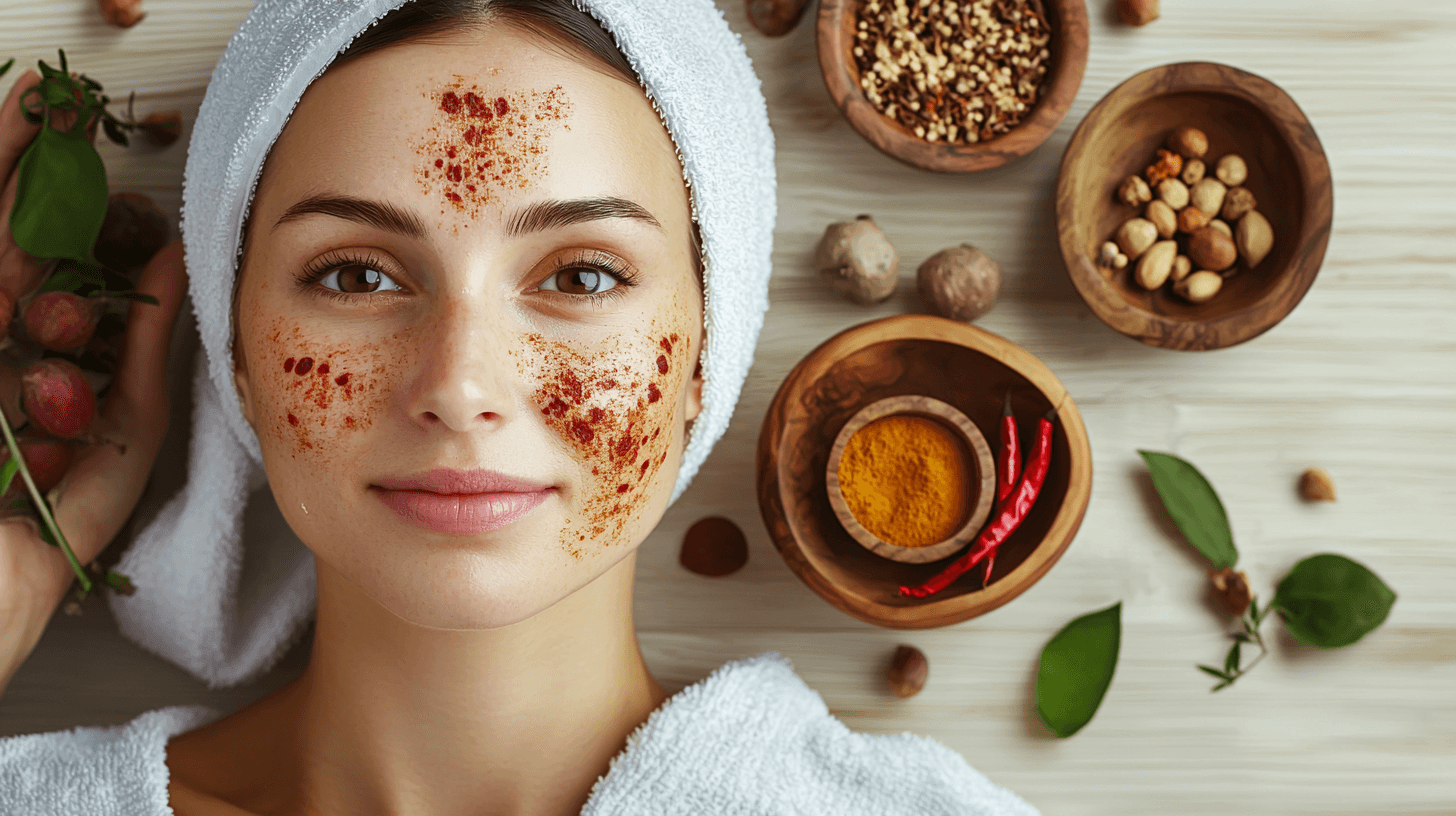
| Treatment stage | Ayurvedic aim | What this means for the patient |
|---|---|---|
| Correct diagnosis | Separate rosacea-like Pitta-Rakta disease from herpes, shingles, lupus, dermatitis, acne, steroid rash, and ocular disease | Not every red face is rosacea; wrong diagnosis gives wrong treatment |
| Nidana Parivarjana | Remove causes that heat Rakta, aggravate Pitta, provoke Vata, or damage Twak | Avoid active triggers such as sun, heat, alcohol, spicy food, late nights, stress, constipation, harsh skincare, and steroid misuse |
| Agni correction | Restore digestive fire and reduce food-triggered inflammation | Address acidity, bloating, constipation, irregular stool, heaviness, coated tongue, and food-triggered flares |
| Ama reduction | Clear toxic, sticky, inflammatory buildup from channels | Reduce recurrent papules, pustules, swelling, heaviness, and slow recovery after flares |
| Pitta-Rakta Shamana | Cool heat, burning, redness, vascular sensitivity, and inflammatory blood-skin reactivity | Use cooling, bitter, astringent, and Rakta-Pitta pacifying strategies selected by the physician |
| Vata stabilization | Reduce sudden flushing, stinging, dryness, anxiety-linked redness, and unpredictability | Improve sleep, rhythm, meal timing, stress response, nervous-system stability, and skin tolerance |
| Kapha-Kleda correction | Reduce papules, pustules, oiliness, swelling, congestion, and inflammatory moisture | Correct digestion, bowel pattern, heaviness, diet, and internal stagnation without overheating the skin |
| External care | Protect and calm Twak while avoiding irritation | Use gentle, cooling, patch-tested applications; avoid scrubs, steam, lemon, essential oils, harsh ubtan, and aggressive exfoliation |
| Rasayana and relapse prevention | Maintain remission and strengthen skin resilience | Continue seasonal care, diet, bowel regulation, stress control, skin-barrier protection, and follow-up |
Agni and Ama Correction: Treat the Gut-Skin Pathway
A large number of rosacea-like patients have digestive clues. They may have acidity, sour belching, bloating, constipation, irregular stools, coated tongue, heaviness after meals, late-night eating, or flare-ups after spicy, sour, fermented, heavy, or very hot foods. In Ayurveda, these signs point toward disturbed Agni and possible Ama. [10,11]
If Agni is not corrected, the face may continue to flare even if external treatment is changed. This is because the internal inflammatory burden remains active. A patient may use the best cleanser, sunscreen, moisturizer, or topical application, but if digestion remains unstable, the skin remains reactive.
In this stage, the physician studies whether Agni is weak, sharp, irregular, or obstructed. The treatment may focus on meal timing, light digestible food, bowel regularity, gentle Ama-pachana, reducing incompatible foods, avoiding eating during indigestion, and removing patient-specific food triggers. The goal is not to suppress appetite or force a harsh detox. The goal is to restore clean digestion so the skin receives a cleaner internal signal.
إذا كان الهضم مضطرباً، فإن الوجه قد يستمر في الاشتعال حتى مع أفضل العناية الخارجية.
Pitta-Rakta Shamana: Cooling the Heat Behind Redness
The central treatment direction in many rosacea-like cases is Pitta-Rakta Shamana. This means cooling, pacifying, and purifying the heat-inflammatory pattern affecting Rakta and Twak.
Text: Charaka Saṃhitā
Section: Cikitsā Sthāna
Chapter: 7, Kuṣṭha Cikitsā
Verses: 7/58–59
Reference number: [9]
Sanskrit
मारुतकफकुष्ठघ्नं कर्मोक्तं पित्तकुष्ठिनां कार्यम् ।
कफपित्तरक्तहरणं तिक्तकषायैः प्रशमनं च ॥५८॥
सर्पींषि तिक्तकानि च यच्चान्यद्रक्तपित्तनुत् कर्म ।
बाह्याभ्यन्तरमग्र्यं तत् कार्यं पित्तकुष्ठेषु ॥५९॥
Transliteration
māruta-kapha-kuṣṭhaghnaṁ karmoktaṁ pittakuṣṭhināṁ kāryam |
kapha-pitta-rakta-haraṇaṁ tiktakaṣāyaiḥ praśamanaṁ ca ||58||
sarpīṁṣi tiktakāni ca yac cānyad rakta-pittanut karma |
bāhyābhyantaram agryaṁ tat kāryaṁ pittakuṣṭheṣu ||59||
Translation
In Pitta-dominant skin disease, measures that reduce Kapha, Pitta, and Rakta should be used, along with pacification by bitter and astringent substances. Bitter medicated ghee and other measures that reduce Rakta-Pitta should be used internally and externally.
This is directly relevant to rosacea-like facial inflammation because the major symptoms are redness, burning, heat, flushing, and sensitivity. The classical direction is Tikta, Kashaya, Rakta-Pitta pacification, and careful internal-external treatment. This does not mean applying bitter or astringent substances randomly on the face. It means the physician selects the right internal medicines, diet, external applications, and purification strategy according to the patient’s pattern. Charaka describes bitter and astringent pacification and Rakta-Pitta reducing measures in Pitta-dominant skin disease.
For a rosacea patient, this may translate into a cooling diet, avoidance of heat-producing triggers, Rakta-prasadana herbs, gentle bowel correction, selected Avaleha or Kashaya, soothing external care, and relapse prevention.
Vata Stabilization: Calming Sudden Flushing and Sensitivity
Not every rosacea patient is dominated only by Pitta. Many have strong Vata involvement. These patients flush suddenly with stress, anxiety, public speaking, embarrassment, cold wind, temperature change, irregular meals, lack of sleep, or emotional pressure. Their skin may sting, feel dry, react to products, and flare unpredictably.
If Vata is not stabilized, Pitta keeps moving upward to the face. The patient may cool down temporarily, but flushing returns with stress or irregular routine.
Vata stabilization means the treatment must include rhythm. Regular meals, adequate sleep, calming breathing practices, bowel regularity, reduction of overwork, protection from wind and hot-cold switching, and gentle skin-barrier care all matter. A Vata-Pitta rosacea patient should not be pushed into harsh fasting, strong detox, excessive exercise, steam, or aggressive cleansing.
The treatment direction is cooling without drying, cleansing without weakening, and calming without suppressing.
Kapha-Kleda Correction: Treating Papules and Pustules
When rosacea appears with papules, pustules, swelling, oiliness, heaviness, and congestion, Kapha-Kleda has joined the Pitta-Rakta disease pathway. In such patients, the face may look acne-like, but blackheads and whiteheads are usually absent. The skin may become red, bumpy, inflamed, and sensitive at the same time.
This presentation often requires attention to Ama, constipation, heaviness after meals, late dinners, oily food, processed food, excessive dairy, sugar-heavy meals, and poor bowel movement. The treatment must reduce Kapha-Kleda without overheating the skin.
This is where many patients go wrong. They use harsh acne products to “dry out” the bumps. The result is more burning, peeling, redness, and skin-barrier damage. Ayurveda takes a more intelligent route: clear the congestion internally, regulate digestion, support elimination, reduce inflammatory foods, and protect the sensitive Pitta-Rakta skin externally.
Mridu Virechana and Anulomana: Gentle Elimination for Selected Patients
Because rosacea-like disease often involves Pitta-Rakta, bowel regulation becomes important. In selected patients, especially when constipation, acidity, papules, pustules, heaviness, Ama, or Kapha-Pitta signs are present, Mridu Virechana or Anulomana may be considered under physician supervision. [9,11,14]
The aim is not violent purgation. The aim is to guide aggravated Pitta, Ama, and obstructed waste downward in a controlled way so that heat does not repeatedly rise toward the face. This is especially useful when the patient reports that constipation, heavy food, late-night meals, or sour belching worsens facial redness.
However, patients with loose stools, weakness, dehydration, severe dryness, active eye disease, pregnancy, frailty, uncontrolled diabetes, or active viral eruptions require careful selection and may not be suitable for such treatment without detailed assessment.
In rosacea, elimination must be mild, staged, and personalized.
External Treatment: Calm the Skin, Do Not Attack It
External care is important, but it must be used correctly. Rosacea-prone skin is not ordinary skin. It is often hot, reactive, thin, dry, sensitive, and intolerant. Even a classical lepa can irritate if it is too strong, too heating, too abrasive, or used at the wrong time.
A good external plan should calm Daha, reduce Ushnata, protect Twak, and avoid further Vata-Pitta aggravation. Gentle, cooling, patch-tested applications may be used according to the patient’s stage. Harsh ubtan, lemon, baking soda, essential oils, steam, aggressive turmeric rubbing, strong exfoliation, hot water washing, and unprescribed steroid creams should be avoided.
Charaka also indicates that external applications become more effective when the internal channels and dosha burden are corrected. In Kuṣṭha Cikitsā, the text explains that lepa becomes successful after purification of the internal pathway and removal of vitiated blood factors.
This principle is highly practical. If the inside remains inflamed, the outside keeps reacting. External care should support internal correction, not replace it.
Rasayana and Relapse Prevention
Once redness, burning, papules, and flushing reduce, treatment should not stop abruptly. Rosacea-like disease often relapses when the patient returns to old triggers. The final phase must focus on Rasayana, skin resilience, seasonal Pitta management, bowel regularity, stress regulation, sleep, gentle skincare, and trigger tolerance.
This is the phase where the patient moves from flare control to stability. The face becomes less reactive. Food triggers may reduce. Burning may settle faster. The skin may tolerate products better. Papules may reduce. The patient may understand which triggers are dangerous and which are manageable.
Long-term success depends on maintaining the corrected pathway. Ayurveda does not only ask, “How do we calm today’s flare?” It asks, “How do we prevent the next flare?”
The Root-Cause Treatment Message
Ayurvedic treatment for rosacea-like facial inflammation is a complete pathway. It begins with correct diagnosis and root-pattern mapping. It removes Nidana. It corrects Agni. It reduces Ama. It pacifies Pitta-Rakta. It stabilizes Vata. It reduces Kapha-Kleda. It protects Twak. It uses internal and external treatment intelligently. It prevents relapse through Rasayana and maintenance care.
العلاج الحقيقي للوردية يبدأ عندما نفهم لماذا يعود الاحمرار، وليس فقط كيف نخفيه.
A cream may reduce redness temporarily. A medicine may reduce bumps temporarily. But root-cause Ayurvedic care asks why the heat, redness, burning, flushing, and sensitivity keep returning. When that pathway is identified and broken, the treatment becomes deeper, safer, and more precise.
The strongest Ayurvedic message for rosacea is simple:
The face is the signal.
The root is the disease pathway.
The cure begins when the pathway is broken.
Classical Avaleha for Rosacea-Like Skin Disease
For rosacea-like facial inflammation, the Avaleha should not be chosen as a common market product or a generic skin tonic. It should be selected as part of a physician-guided root-cause protocol after assessing the patient’s Pitta-Rakta heat, Vata flushing, Kapha-Kleda papules, Agni, Ama, Koshtha, bowel pattern, trigger history, steroid exposure, eye symptoms, and possible viral mimics.
The most suitable classical identity for this pillar article is Sushrutokta Khadiradya Avaleha, a physician-compounded Avaleha described in Sushruta Samhita, Chikitsa Sthana, Chapter 10, Maha Kushtha Chikitsitam, verse 10/9. This formulation is not commonly promoted as a standard retail rosacea product, which makes it clinically distinctive and stronger for a serious Ayurvedic practice. It gives the article a clear message: this is not random herbal selling; this is classical, individualized, physician-selected Ayurveda. [12,13]
In Arabic, this can be expressed to Gulf patients as:
هذا ليس علاجاً عشبيّاً عشوائياً؛ بل تركيبة كلاسيكية يختارها الطبيب حسب نمط الحرارة في الدم، الهضم، السموم، الحساسية، ومرحلة المرض.
What Is Avaleha?
Avaleha is a semi-solid Ayurvedic preparation, usually prepared by processing herbal decoction or juice with sweetening and binding substances such as jaggery, sugar, sugar candy, or honey according to the classical formula. It is designed for licking or gradual oral intake, allowing the medicine to stay palatable and suitable for long-term physician-guided use when appropriate. A review on Avaleha Kalpana describes Avaleha as a semi-solid preparation made from prescribed herbal juice or decoction with sweet substances such as jaggery, sugar, sugar candy, and honey. [15]
In skin disease, Avaleha is useful because it can combine deeper internal correction with a format that patients can follow consistently. However, Avaleha is not automatically suitable for every rosacea patient. A honey-based or sweet-based formulation must be selected carefully in patients with diabetes, metabolic syndrome, obesity, or poor glycemic control. The decision belongs to the physician after complete assessment.
Sushrutokta Khadiradya Avaleha
Text: Sushruta Samhita
Section: Chikitsa Sthana
Chapter: 10, Maha Kushtha Chikitsitam
Verse: 10/9
Formulation identity: Khadira-Asana-Nimba-Rajavriksha-Shalasara Avaleha
Reference number: [12,13]
Sanskrit
अतोऽवलेहान् वक्ष्यामः- खदिरासननिम्बराजवृक्षशालसारक्वाथे तत्सारपिण्डाञ्छ्लक्ष्णपिष्टान् प्रक्षिप्य विपचेत्, ततो नातिद्रवं नातिसान्द्रमवतार्य तस्य पाणितलं पूर्णमप्रातराशो मधुमिश्रं लिह्यात्; एवं शालसारादौ न्यग्रोधादावारग्वधादौ च लेहान् कारयेत् ॥९॥
Transliteration
ato’valehān vakṣyāmaḥ — khadirāsana-nimba-rājavṛkṣa-śālasāra-kvāthe tat-sāra-piṇḍāñ ślakṣṇa-piṣṭān prakṣipya vipacet, tato nātidravaṁ nātisāndram avatārya tasya pāṇitalaṁ pūrṇam aprātarāśo madhu-miśraṁ lihyāt; evaṁ śālasārādau nyagrodhādāv āragvadhādau ca lehān kārayet ||9||
Translation
Now the Avalehas are described. A decoction is prepared from Khadira, Asana, Nimba, Rajavriksha, and Shalasara. Fine powders of the essential parts of the same drugs are added and cooked again. The preparation is removed from the fire when it is neither too liquid nor too thick. It is then taken with honey before the morning meal. Similar Leha preparations may also be prepared from Shalasaradi, Nyagrodhadi, and Aragvadhadi groups.
Sushruta’s chapter describes this preparation under Maha Kushtha Chikitsitam, and the English translation confirms the use of Khadira, Asana, Nimba, Raja-vriksha, and Shala/Shalasara decoction with fine powders, cooked to a consistency that is neither too thick nor too thin, and taken with honey. [12,13]
Why This Avaleha Fits Rosacea-Like Pitta-Rakta-Kapha Disease
Sushrutokta Khadiradya Avaleha is important because it belongs to the classical skin-disease treatment context, not to a modern cosmetic trend. In rosacea-like facial inflammation, the physician is often dealing with redness, burning, heat, inflammatory papules, pustules, swelling, sensitivity, and recurrent flare-ups. These symptoms fit a clinical pattern where Pitta-Rakta is central, Vata may drive sudden flushing, and Kapha-Kleda may contribute to papules, pustules, oiliness, and inflammatory congestion.
Khadira, Asana, Nimba, Rajavriksha, and Shalasara are selected in a Kushtha Chikitsa context. Their classical placement supports use in skin-disease pathways where Rakta, Twak, Kapha, Kleda, and chronic inflammatory involvement must be considered. This makes the formulation more suitable as a physician-selected internal preparation for selected rosacea-like Twak Vikara patterns than a generic over-the-counter skin supplement.
The strongest positioning is:
Sushrutokta Khadiradya Avaleha may be considered in selected Pitta-Rakta-Kapha rosacea-like presentations where facial redness is associated with inflammatory papules, pustules, swelling, Kleda, chronic recurrence, and internal heat. It should be selected only after assessing Agni, Ama, Koshtha, bowel pattern, blood sugar status, eye symptoms, steroid history, and whether the patient has herpes-like or shingles-like lesions.
Why It Should Not Be Given to Every Rosacea Patient
A classical formulation becomes powerful only when selected correctly. The same Avaleha that may suit a Kapha-Kleda, Pitta-Rakta, papulopustular presentation may not suit every patient with facial burning or flushing. A patient with extreme dryness, severe stinging, loose stools, active diarrhea, strong Vata depletion, uncontrolled diabetes, pregnancy, active herpes lesions, shingles, eye pain, blurred vision, or suspected ocular herpes needs a different pathway first.
In rosacea-like disease, the physician must separate the presentation before prescribing. If the patient has chronic redness, burning, papules, pustules, heaviness, constipation, Ama, and Kapha-Kleda features, Sushrutokta Khadiradya Avaleha may become relevant. If the patient has acute painful blisters, one-sided rash, fever, or eye symptoms, the case must first be assessed for viral, ocular, or urgent mimicking conditions.
This is what makes Ayurveda safe and precise. The medicine is not selected by disease name alone. It is selected by the disease pathway.
Avaleha Selection Map for Rosacea-Like Presentations
| Patient presentation | Ayurvedic root pattern | Avaleha decision |
|---|---|---|
| Redness, heat, burning, recurrent inflammation, papules, pustules, swelling, heaviness | Pitta-Rakta with Kapha-Kleda involvement | Sushrutokta Khadiradya Avaleha may be considered under physician supervision |
| Papules and pustules with constipation, coated tongue, heaviness after meals, food-triggered flares | Pitta-Kapha with Ama and Agni disturbance | Avaleha may be combined with Agni-Ama correction and bowel regulation |
| Sudden flushing, anxiety-linked redness, dryness, stinging, product intolerance | Vata-Pitta with weak Twak tolerance | Avaleha may not be first-line; Vata-Pitta stabilization and barrier repair are prioritized |
| Only fixed visible vessels without active papules or digestive features | Chronic Rakta involvement with structural vascular change | Avaleha may help reduce new flares, but fixed vessels may require integrative care |
| Eye pain, blurred vision, photophobia, severe ocular redness | Ocular warning pattern | Do not self-medicate; urgent eye assessment is required |
| Painful blisters, one-sided rash, crusting, suspected herpes or shingles | Viral or Visarpa-like differential | Avaleha is not the first step; correct diagnosis and acute care come first |
| Diabetes, uncontrolled blood sugar, pregnancy, severe weakness, loose stools | Safety-sensitive state | Avoid self-use; physician must decide suitability |
Other Classical Avaleha Options Mentioned by Sushruta
The same Sushruta passage states that similar Leha preparations may be made from Shalasaradi, Nyagrodhadi, and Aragvadhadi groups. This allows the article to show depth without making one formulation sound like a universal cure. [12,13]
Shalasaradya Avaleha may be discussed as a classical physician-compounded option for selected chronic skin patterns where Rakta, Kapha, and Kleda require correction.
Nyagrodhadya Avaleha may be discussed in selected cases where chronicity, sensitivity, Rakta involvement, and skin stability are important.
Aragvadhadya Avaleha may be mentioned as another classical option from the same Sushruta framework, though it should not be used as the main unique identity if similar names or products are already available in the market.
The article should position these as classical options, not ready-made recommendations. The physician must decide based on the patient’s actual pattern.
Why Sushrutokta Khadiradya Avaleha Is Better
Many patients have already tried common products, supplements, creams, and internet remedies. A serious pillar article must show that your approach is different. Sushrutokta Khadiradya Avaleha creates that difference because it is classical, text-based, linked with Kushtha Chikitsa, and physician-compounded rather than commonly sold as a standard rosacea product.
This improves patient trust because the message becomes clinical rather than commercial. The article is not saying, “Buy this medicine.” It is saying, “Your disease pathway must be mapped, and when the pattern fits, a classical formulation may be compounded and selected according to the text.”
For Gulf patients, the message can be:
ليست كل حالة احمرار في الوجه تحتاج نفس الدواء. في الأيورفيدا، يتم اختيار التركيبة بعد فهم نمط الحرارة، الدم، الهضم، السموم، الحساسية، والمرحلة المرضية.
How This Avaleha Fits Into the Complete Root-Cause Protocol
Sushrutokta Khadiradya Avaleha should not stand alone. It belongs inside a complete protocol. The patient must first be assessed for rosacea mimics such as herpes, shingles, lupus, contact dermatitis, steroid-induced rosacea, acne, fungal infection, and ocular disease. After diagnosis, the physician identifies whether the patient has Pitta-Rakta heat, Vata-Pitta flushing, Kapha-Kleda papules, Agni-Ama disturbance, weak Twak tolerance, or a mixed pattern.
If the formulation is suitable, it may be used alongside Nidana Parivarjana, Pitta-Rakta pacification, Agni correction, Ama reduction, bowel regulation, gentle external care, skincare simplification, trigger control, and relapse prevention. This creates a complete Ayurvedic strategy instead of a one-product claim.
The goal is not temporary suppression. The goal is to break the disease chain that repeatedly produces redness, burning, flushing, papules, pustules, and sensitivity.
Safety and Physician Selection
Avaleha should not be used casually in rosacea-like facial inflammation. The physician should review blood sugar status, body weight, bowel pattern, pregnancy status, lactation, loose stools, active infections, eye symptoms, current medications, and the possibility of herpes, shingles, or ocular disease.
This is especially important because the Sushruta preparation is taken with honey, and many Avaleha preparations contain sweet substances. Patients with diabetes, insulin resistance, obesity, metabolic syndrome, or strict dietary restrictions need individualized decisions.
The safest public message is:
Sushrutokta Khadiradya Avaleha is a classical physician-compounded formulation for selected rosacea-like Pitta-Rakta-Kapha skin presentations. It is not a universal self-medication remedy. It must be selected after complete Ayurvedic assessment and after excluding urgent mimics such as herpes, shingles, ocular disease, lupus, infection, and steroid-damaged facial skin.
The Root-Cause Takeaway
Sushrutokta Khadiradya Avaleha gives this rosacea article a strong classical identity. It moves the discussion away from common market products and toward physician-selected Ayurveda. Its value lies not in being a single cure for every red face, but in being part of a precise classical protocol for selected skin-disease pathways.
A rosacea-like patient should not ask only, “Which Avaleha should I take?” The better question is, “What is my root pattern?”
If the root pattern is Pitta-Rakta heat with Kapha-Kleda papules, Ama, chronic recurrence, and suitable Koshtha, Sushrutokta Khadiradya Avaleha may become relevant. If the pattern is Vata-Pitta sensitivity, ocular disease, herpes-like eruption, steroid damage, or another mimic, the treatment must change.
This is the real strength of Ayurveda: not one medicine for everyone, but the right formulation for the right pathway.
Sushrutokta Khadiradya Avaleha Preparation for 30 Days
This is a physician-compounded Avaleha for selected rosacea-like Pitta-Rakta-Kapha skin presentations where facial redness is associated with burning, inflammatory papules, pustules, swelling, Kleda, food-triggered flares, constipation, Ama, and chronic recurrence.
This is not a home-remedy preparation and not a universal medicine for every red face. It should be prepared only by a qualified Ayurvedic physician or GMP-level pharmacy after confirming that the patient does not have herpes-like blisters, shingles, ocular emergency, lupus-like rash, steroid-damaged facial skin requiring special care, uncontrolled diabetes, pregnancy, severe weakness, loose stools, or another condition that needs a different pathway.
The classical basis is Sushruta Samhita, Chikitsa Sthana, Chapter 10, Maha Kushtha Chikitsitam, verse 10/9, where Avaleha is described from Khadira, Asana, Nimba, Rajavriksha, and Shalasara decoction, with fine powders of the same drugs, cooked to a consistency that is neither too liquid nor too thick, and taken with honey. The same passage also mentions that similar Leha preparations may be made from Shalasaradi, Nyagrodhadi, and Aragvadhadi groups.
This formulation is intentionally mineral-free for international and Gulf patients. Minerals, bhasma, rasaushadhi, lead, mercury, arsenic, or metallic preparations should not be added to a public patient-facing rosacea Avaleha. The FDA warns that unapproved Ayurvedic products containing harmful heavy metals may cause heavy metal poisoning, including kidney injury, gastrointestinal symptoms, neurological symptoms, and other serious effects. The TGA has also reported lead poisoning linked to imported or unregistered Ayurvedic medicines contaminated with lead, mercury, and arsenic.
For a public-facing rosacea formula, the strongest and safest strategy is not to add metals. The stronger clinical strategy is a mineral-free, text-based, herbally fortified, lab-tested Avaleha selected according to Prakriti, Vikriti, Agni, Ama, Koshtha, Pitta-Rakta heat, Vata flushing, Kapha-Kleda papules, and disease stage.
Batch Size and Dosage
This 30-day batch is designed for a patient taking 15 g twice daily.
Daily dose: 30 g per day
Course duration: 30 days
Total required Avaleha: 900 g
Number of doses: 60 doses of 15 g each
Final batch target: 900 g finished Avaleha
The patient takes 15 g in the morning and 15 g in the evening, preferably after food unless the physician advises a different timing. The classical Sushruta reference mentions licking the Avaleha with honey before the morning meal, but for rosacea-like patients with acidity, burning, sensitivity, or gut irritation, many physicians may prefer after-food dosing.
Ingredient Formula for One 30-Day Batch
| Ingredient | Latin / common identity | Weight for 900 g batch | Stage of use | Purpose in this rosacea-like formula |
|---|---|---|---|---|
| Khadira sara coarse powder | Acacia catechu heartwood | 100 g | Decoction | Classical Kushtha drug; supports Rakta-Twak cleansing and chronic skin inflammation |
| Asana sara coarse powder | Pterocarpus marsupium heartwood | 100 g | Decoction | Classical skin-supporting wood drug; useful in Kapha-Kleda and Rakta involvement |
| Nimba twak or pharmacy-confirmed Nimba part | Azadirachta indica | 100 g | Decoction | Bitter Pitta-Kapha support; useful where heat, papules, pustules, and inflammatory skin tendency are present |
| Rajavriksha / Aragvadha bark or pharmacy-confirmed part | Cassia fistula | 100 g | Decoction | Classical Kushtha-context drug; supports Pitta-Kapha and bowel-linked skin presentations |
| Shalasara coarse powder | Shorea robusta heartwood | 100 g | Decoction | Classical wood drug used in the Sushruta Avaleha context |
| Water | Clean potable water | 8 litres | Decoction | Reduce to about 2 litres before filtering |
| Khadira fine powder | Acacia catechu heartwood | 20 g | Fine powder stage | Reinforces classical base |
| Asana fine powder | Pterocarpus marsupium heartwood | 20 g | Fine powder stage | Reinforces classical base |
| Nimba fine powder | Azadirachta indica | 20 g | Fine powder stage | Reinforces bitter Pitta-Kapha action |
| Rajavriksha fine powder | Cassia fistula | 20 g | Fine powder stage | Reinforces classical base |
| Shalasara fine powder | Shorea robusta heartwood | 20 g | Fine powder stage | Reinforces classical base |
| Manjishta fine powder | Rubia cordifolia | 40 g | Fine powder stage | Rakta-prasadana support for redness, heat, and inflammatory skin pattern |
| Sariva fine powder | Hemidesmus indicus | 40 g | Fine powder stage | Cooling Pitta-Rakta support; useful in burning and heat-dominant skin patterns |
| Guduchi fine powder | Tinospora cordifolia | 30 g | Fine powder stage | Supports chronic inflammatory terrain and Pitta-Kapha balance |
| Amalaki fine powder | Emblica officinalis | 30 g | Fine powder stage | Pitta-Rakta cooling support; useful in heat, burning, and oxidative skin stress |
| Yashtimadhu fine powder | Glycyrrhiza glabra | 25 g | Fine powder stage | Soothing support for burning and sensitivity; use cautiously in hypertension or fluid retention |
| Lodhra fine powder | Symplocos racemosa | 25 g | Fine powder stage | Astringent Twak-Rakta support; useful in inflammatory and sensitive skin patterns |
| Patola fine powder | Trichosanthes dioica / related Patola source | 25 g | Fine powder stage | Bitter Pitta-Kapha skin support |
| Musta fine powder | Cyperus rotundus | 20 g | Fine powder stage | Supports Agni, digestion, and Pitta-Kapha regulation |
| Ushira fine powder | Vetiveria zizanioides | 15 g | Fine powder stage | Cooling support for burning and heat sensation |
| Katuki fine powder | Picrorhiza kurroa | 10 g | Fine powder stage | Potent Pitta-Ama support; omit in loose stools, weakness, pregnancy, or high Vata |
| Khandasharkara / Mishri powder | Sugar candy | 350 g | Avaleha base | Cooling, binding, palatability, and Avaleha consistency; avoid or modify in diabetes |
| Madhu / honey | Honey | 3–5 ml per dose if suitable | Added at time of intake only | Classical anupana; do not cook honey into the batch; avoid in diabetes or honey intolerance |
| Minerals / bhasma / rasaushadhi | Not included | 0 g | Not used | Intentionally excluded for international safety, heavy-metal risk reduction, and public patient suitability |
Preparation Method
First, authenticate all herbs before preparation. The herbs should be clean, correctly identified, free from fungal growth, free from adulterants, and preferably tested for heavy metals, pesticides, microbial contamination, and aflatoxins. This is especially important for international patients because safety and trust are part of the treatment.
Take the coarse powders of Khadira, Asana, Nimba, Rajavriksha, and Shalasara, 100 g each. Add them to 8 litres of clean water in a stainless-steel vessel. Soak for 8 to 12 hours if possible. This improves extraction and makes the decoction stronger.
After soaking, boil the mixture on medium heat. Once it begins to boil, reduce the flame and continue gentle boiling until the liquid reduces to about 2 litres. This is the main decoction. Filter it through clean muslin cloth while warm. Press the herbal material well to extract the liquid. Discard the spent coarse herbs.
Transfer the filtered decoction back into a clean stainless-steel vessel. Add 350 g of powdered Khandasharkara or Mishri. Heat gently and stir until it dissolves completely. Continue heating on low to medium flame until the decoction begins to thicken.
Mix all the fine powders separately in a clean dry bowl. This includes the fine powders of Khadira, Asana, Nimba, Rajavriksha, Shalasara, Manjishta, Sariva, Guduchi, Amalaki, Yashtimadhu, Lodhra, Patola, Musta, Ushira, and Katuki. Sieve these powders before use so that the Avaleha remains smooth and patient-friendly.
When the sweetened decoction becomes thicker, reduce the flame to low. Add the fine powder mixture slowly, in small portions, while continuously stirring. Do not add all the powder at once, because it can form lumps. Stir continuously so the mixture becomes uniform.
Continue cooking gently until the Avaleha reaches a soft semisolid consistency. The classical endpoint is that it should be neither too liquid nor too thick. In patient-friendly language, the Avaleha should not run like water, and it should not become hard like a tablet. It should remain soft enough to take with a spoon and thick enough to hold its shape briefly.
Check the final batch weight. The target is 900 g. If the mixture is above 900 g, continue gentle heating and stirring until it reaches the desired weight. If the batch becomes too thick before reaching the final weight, add a small amount of reserved filtered decoction, mix well, and adjust carefully. Do not add plain water at the end unless absolutely necessary.
Remove the vessel from heat. Allow the Avaleha to cool naturally. Do not add honey while the Avaleha is hot. Honey should not be cooked into the batch. If honey is prescribed, it should be added fresh to each dose at the time of intake.
Once cooled, transfer the Avaleha into clean, dry, sterilized glass jars. Label the jar clearly with the formulation name, batch date, total weight, dosage, storage instructions, contraindications, and physician contact details.
Patient-Friendly Label for the Jar
Sushrutokta Khadiradya Avaleha-Based Pitta-Rakta Skin Formula
Physician-compounded Avaleha for selected rosacea-like facial inflammation
Dose: 15 g twice daily after food, or as directed by the physician
Course: 30 days
Total quantity: 900 g
Anupana: lukewarm water, or 3–5 ml honey mixed at the time of intake if suitable
Storage: keep tightly closed in a cool, dry place; refrigerate after opening if climate is hot
Use only a clean, dry spoon
Do not use if smell, color, texture, or taste changes abnormally
Do not self-use during pregnancy, lactation, uncontrolled diabetes, loose stools, severe weakness, eye pain, blurred vision, herpes-like blisters, shingles-like rash, or fever
How the Patient Should Take It
The standard course is 15 g twice daily for 30 days. The morning dose may be taken after breakfast, and the evening dose may be taken after dinner, unless the physician gives a different instruction.
The Avaleha may be followed by a small amount of lukewarm water. If honey is suitable for the patient, 3–5 ml honey may be mixed freshly with each dose. Honey should not be added to hot Avaleha and should not be used in patients with diabetes, honey intolerance, or where the physician decides it is unsuitable.
The patient should avoid taking this Avaleha with very hot tea, coffee, alcohol, spicy food, sour food, or immediately after a heavy meal. In rosacea-like patients, very hot drinks and heat-producing foods can worsen Pitta-Rakta and trigger flushing.
What the Patient Should Expect During 30 Days
During the first one to two weeks, the main goal is to reduce trigger load, support bowel movement, calm digestion, and reduce the intensity of burning or heat. If the patient has constipation, heaviness, or food-triggered flares, digestion and bowel pattern should be monitored closely.
During weeks three and four, the physician should review redness intensity, burning score, flushing frequency, papule and pustule count, bowel movement, acidity, bloating, sleep, stress triggers, and skincare tolerance.
This Avaleha should not be judged only by the color of the face. Rosacea-like disease should be tracked through multiple signs: burning, flushing, sensitivity, papules, pustules, digestion, bowel regularity, trigger tolerance, sleep, stress response, and relapse frequency.
When to Stop and Contact the Physician
The patient should stop the Avaleha and contact the physician if there is diarrhea, severe abdominal cramping, worsening burning, allergic rash, swelling of lips or eyes, dizziness, severe acidity, new painful blisters, one-sided rash, fever, eye pain, light sensitivity, blurred vision, or rapid worsening of facial swelling.
Patients with diabetes or high blood sugar need special monitoring because Avaleha contains a sweet base. Patients with hypertension, kidney disease, liver disease, pregnancy, lactation, or ongoing prescription medicines should use this only after physician review.
Why No Minerals Are Added
Minerals and bhasma can be powerful in classical Ayurveda when properly indicated, purified, prepared, tested, and prescribed. However, adding mineral or metallic ingredients to a public-facing rosacea Avaleha creates unnecessary safety and regulatory risk, especially for patients in the USA, UK, Canada, Australia, Singapore, and the Gulf.
Official safety agencies have repeatedly warned about heavy metals in some Ayurvedic products. The FDA warns that harmful heavy metals in unapproved Ayurvedic products may cause heavy metal poisoning, and the TGA reports lead poisoning linked with imported or unregistered Ayurvedic medicines contaminated with lead, mercury, and arsenic. NCCIH also notes that some Ayurvedic preparations contain lead, mercury, or arsenic in amounts that can be toxic.
For this reason, the strongest patient-facing version is mineral-free, GMP-prepared, herbally potent, and lab-tested. If a physician wants to use mineral preparations, they should be prescribed separately as an individualized physician-only decision, not mixed into a public rosacea Avaleha formula.
This 30-day Sushrutokta Khadiradya Avaleha-based formula is not designed as a random skin supplement. It is a physician-compounded Ayurvedic preparation for selected Pitta-Rakta-Kapha rosacea-like skin patterns where redness, burning, papules, pustules, Ama, Kleda, and chronic recurrence are present.
The strength of this formulation lies in correct patient selection. The same formula should not be given to every person with facial redness. A patient with Vata-Pitta sensitivity, ocular symptoms, herpes-like blisters, shingles-like rash, steroid-damaged skin, diabetes, pregnancy, loose stools, or severe weakness needs a different approach.
The real Ayurvedic principle is simple: the disease pathway must be mapped before the medicine is chosen. When the pattern fits, this Avaleha can become part of a complete root-cause plan that includes Nidana Parivarjana, Agni correction, Ama reduction, Pitta-Rakta pacification, Kapha-Kleda regulation, gentle skincare, and relapse prevention.
Diet for Rosacea According to Ayurveda
Diet is one of the most important parts of Ayurvedic rosacea management because food directly influences Pitta, Rakta, Agni, Ama, Kapha, Kleda, and skin reactivity. In rosacea-like facial inflammation, the patient often notices that the face flares after spicy food, alcohol, hot drinks, sour foods, fermented foods, heavy meals, late dinners, constipation, acidity, or indigestion. These are not random reactions. Ayurveda understands them as signs that food is affecting the internal heat, blood tissue, digestion, and skin channels. [9,10,11]
A rosacea diet in Ayurveda should not be designed as a strict fear-based diet. It should be designed as a root-cause diet. The aim is to reduce the factors that heat Rakta, aggravate Pitta, disturb Agni, create Ama, increase Kapha-Kleda, and weaken Twak tolerance. When food becomes part of Nidana Parivarjana, it becomes medicine.
For Gulf patients, this message can be explained simply in Arabic:
الغذاء ليس مجرد طعام في الوردية؛ الطعام قد يزيد حرارة الدم أو يساعد على تهدئتها.
Food can either increase the fire behind rosacea or help cool the disease pathway.
Classical Ayurvedic Basis for Rosacea Diet
Text: Charaka Samhita
Section: Sutra Sthana
Chapter: 24, Vidhishonitiya Adhyaya
Verses: 24/5 and 24/9–10
Reference number: [11]
Sanskrit
प्रदुष्टबहुतीक्ष्णोष्णैर्मद्यैरन्यैश्च तद्विधैः ।
तथाऽतिलवणक्षारैरम्लैः कटुभिरेव च ॥५॥
अत्यादानं तथा क्रोधं भजतां चातपानलौ ।
छर्दिवेगप्रतीघातात् काले चानवसेचनात् ॥९॥
श्रमाभिघातसन्तापैरजीर्णाध्यशनैस्तथा ।
शरत्कालस्वभावाच्च शोणितं सम्प्रदुष्यति ॥१०॥
Transliteration
praduṣṭa-bahu-tīkṣṇoṣṇair madyair anyaiś ca tadvidhaiḥ |
tathā’tilavaṇa-kṣārair amlaiḥ kaṭubhir eva ca ||5||
atyādānaṁ tathā krodhaṁ bhajatāṁ cātapānalau |
chardi-vega-pratīghātāt kāle cānavasecanāt ||9||
śramābhighāta-santāpair ajīrṇādhyāśanais tathā |
śaratkāla-svabhāvāc ca śoṇitaṁ sampraduṣyati ||10||
Translation
Rakta becomes vitiated by excessive intake of sharp, hot, unsuitable drinks, excessive salty, alkaline, sour and pungent foods, overeating, anger, exposure to sun and fire, suppression of natural urges, excessive exertion, heat, indigestion, and eating again before the previous meal is digested.
This classical passage is highly relevant to rosacea-like disease. Many of the factors described by Charaka are the same factors that patients identify as rosacea triggers: spicy food, sour food, excessive salt, alcohol, sun, heat, anger, indigestion, overeating, and eating before proper digestion. In Ayurveda, these factors disturb Rakta and Pitta. When heated Rakta expresses through the facial skin, the patient experiences redness, burning, flushing, swelling, and sensitivity. [11]
The Food Principle: Similar Qualities Increase the Disease
Text: Charaka Samhita
Section: Sutra Sthana
Chapter: 1, Dirghanjivitiya Adhyaya
Verse: 1/44
Reference number: [29]
Sanskrit
सर्वदा सर्वभावानां सामान्यं वृद्धिकारणम् ।
ह्रासहेतुर्विशेषश्च प्रवृत्तिरुभयस्य तु ॥४४॥
Transliteration
sarvadā sarvabhāvānāṁ sāmānyaṁ vṛddhikāraṇam |
hrāsahetur viśeṣaś ca pravṛttir ubhayasya tu ||44||
Translation
Similarity always causes increase, while dissimilarity causes decrease. Both increase and decrease happen according to repeated exposure or application.
This principle explains rosacea diet clearly. If the face is already hot, red, burning, and reactive, then hot, sharp, spicy, sour, salty, fermented, and alcohol-based foods increase the same disease qualities. If the patient repeatedly eats foods with the same heating and sharp qualities, Pitta-Rakta aggravation continues.
The opposite is also true. Cooling, gentle, light, bitter, mildly sweet, astringent, and easy-to-digest foods help reduce the heat-inflammatory pattern. A rosacea diet should therefore be built around qualities, not around random food lists.
The Ayurvedic Diet Goal in Rosacea
The diet goal is to cool Pitta-Rakta without weakening Agni. This is important because many patients misunderstand a cooling diet. Cooling does not mean eating only cold, raw, heavy, refrigerated food. Excess cold food can weaken Agni, create Ama, and worsen Kapha-Kleda papules. The correct Ayurvedic diet is cooling in quality but still easy to digest.
A good rosacea diet should reduce facial heat, support digestion, regulate bowel movement, prevent Ama, reduce inflammatory congestion, and improve skin tolerance. This is especially important when the patient has acidity, bloating, constipation, heaviness after meals, food-triggered flares, or papulopustular rosacea.
The diet should be adjusted according to the patient’s pattern. A person with burning and redness needs stronger Pitta-Rakta cooling. A person with papules and pustules needs Kapha-Kleda and Ama correction. A person with dryness and stinging needs Vata-Pitta support. A person with acidity and constipation needs Agni and bowel regulation.
Foods That Commonly Worsen Rosacea-Like Pitta-Rakta Heat
In many rosacea-like patients, the face worsens after chili, hot spices, pepper, very spicy curries, alcohol, vinegar, pickles, fermented foods, excess salt, sour food, fried food, processed food, hot tea, hot coffee, very hot soups, and late-night heavy meals. These foods either increase Pitta-Rakta heat, disturb Agni, increase Ama, or create Kapha-Kleda congestion.
The problem is not the cultural cuisine. The problem is the quality of the food. A meal can be Indian, Arabic, Western, or Asian and still either help or harm the patient depending on its qualities. Very spicy, very sour, very salty, very hot, very heavy, or late-night food can flare rosacea in any cuisine.
In Gulf patients, common aggravating patterns may include very hot tea, strong coffee, spicy restaurant food, fried foods, heavy late dinners, dehydration, long sun exposure, and eating heavily after long fasting. These may combine with heat, air-conditioning, poor sleep, stress, and cosmetic irritation to keep the face inflamed.
Foods That Usually Support Rosacea-Prone Skin
A Pitta-Rakta pacifying diet should be gentle, cooling, and digestible. Suitable foods may include old rice, barley, green gram, bottle gourd, ridge gourd, cucumber if digestion tolerates it, coriander, fennel, pomegranate, amalaki if tolerated, coconut water if suitable, small amounts of ghee when appropriate, and simple home-cooked meals with mild seasoning.
Bitter and astringent tastes are often useful in Pitta-Rakta and Kapha-Kleda patterns, but they must be used wisely. Excessively bitter, dry, or cold foods may aggravate Vata in patients with dryness, stinging, anxiety-linked flushing, or weak digestion. This is why the diet must be personalized.
A patient with strong burning may do well with more cooling foods. A patient with bloating and weak digestion may need cooked cooling foods rather than raw salads. A patient with constipation may need gentle bowel support. A patient with papules and heaviness may need lighter meals and less sugar, dairy, fried food, and processed food.
Rosacea Diet Map
| Diet factor | Ayurvedic effect | Practical patient guidance |
|---|---|---|
| Chili, hot spices, pepper, very spicy meals | Increases Pitta, heat, burning, and Rakta reactivity | Reduce during active redness, burning, flushing, papules, and heat-dominant flares |
| Vinegar, pickles, fermented foods, excess sour food | Aggravates Pitta-Rakta and may worsen acidity | Avoid during active flares, especially if the face burns after sour or fermented foods |
| Alcohol and very hot drinks | Increases heat, vascular reactivity, and flushing tendency | Avoid alcohol in active rosacea; allow tea, coffee, soup, or hot water to cool before drinking |
| Excess salt, fried food, processed food | Can increase Pitta, Kapha, Kleda, swelling, and inflammatory heaviness | Reduce when there is facial swelling, papules, pustules, heaviness, or oiliness |
| Heavy late dinners and overeating | Disturbs Agni and creates Ama | Eat earlier, lighter dinners; avoid eating again before the previous meal is digested |
| Constipation-producing food habits | Obstructs elimination and may push heat upward | Support regular bowel movement through physician-guided diet, hydration, fiber, and suitable herbs |
| Old rice, barley, green gram, cooked vegetables, coriander, fennel, pomegranate | Supports light digestion and Pitta-Rakta balance | Use as the foundation of a calming rosacea diet when tolerated |
| Raw cold salads, iced drinks, excessive refrigerated foods | May feel cooling but can weaken Agni and increase Ama in some patients | Use carefully; cooked cooling foods are often better for patients with bloating or weak digestion |
| Sugar-heavy foods and excessive dairy | May increase Kapha-Kleda and papulopustular tendency in some patients | Reduce when bumps, pustules, oiliness, swelling, or heaviness are present |
| Regular meal timing and simple home-cooked food | Stabilizes Agni and reduces trigger unpredictability | Eat on time, avoid skipping meals, and keep dinner light and early |
Meal Timing Matters as Much as Food Choice
In Ayurveda, the timing and digestion of food are as important as the food itself. A patient may eat healthy food but still flare if meals are irregular, late, too heavy, or taken before the previous meal has digested. Charaka specifically mentions indigestion and eating again before proper digestion as factors that vitiate Rakta. [11]
This matters in rosacea because many patients flare after late dinners, heavy meals, overeating, constipation, or indigestion. The face becomes the external signal of internal overload. For this reason, the rosacea diet should include regular meal timing, lighter dinners, avoiding overeating, and not eating during indigestion.
If the patient wakes with facial redness, acidity, heaviness, or puffiness after late-night meals, the evening meal must be corrected first. If the face flares after fasting all day and eating heavily at night, the problem may be both Agni disturbance and Pitta-Rakta aggravation.
Hot Drinks and Coffee in Rosacea
Many patients ask whether tea or coffee must be stopped completely. The answer depends on the patient. In some people, caffeine may worsen flushing. In others, the main trigger is not caffeine but temperature. A very hot drink can provoke flushing even if the drink is otherwise mild.
Ayurveda reads this through the qualities of heat and stimulation. A Vata-Pitta patient may flush after hot tea, hot coffee, hot water, or hot soup because the heat and stimulation quickly move toward the face. The practical solution is to reduce frequency, avoid very hot temperature, observe tolerance, and avoid combining hot drinks with spicy food, stress, or sun exposure.
For rosacea-like patients, very hot drinks should not be taken during active burning or flushing. Drinks should be warm or room-temperature rather than hot.
Fasting, Long Gaps, and Gulf Lifestyle
Long fasting or irregular meal timing can affect rosacea differently in different patients. Some Pitta-dominant patients become more acidic, irritable, hot, and reactive when meals are delayed. Others overeat after a long gap and then experience facial redness, acidity, bloating, or heaviness.
For Gulf patients, this becomes important during fasting periods, late-night social meals, hot climates, and dehydration. The aim is not to reject fasting traditions, but to manage Agni carefully. The patient should avoid breaking a long fast with very spicy, fried, heavy, very hot, or sour foods. A lighter, cooling, digestible meal is usually better for rosacea-prone patients.
Hydration also matters. Dehydration and heat exposure can worsen flushing and dryness. Water intake should be adequate, but iced drinks are not always ideal for patients with weak Agni. The physician should individualize this based on digestion, bowel pattern, climate, and Pitta-Vata status.
Diet for Burning and Redness-Dominant Rosacea
When burning, heat, flushing, and redness are dominant, the diet should focus on Pitta-Rakta pacification. The patient should reduce chili, alcohol, vinegar, pickles, sour food, excess salt, fried food, hot beverages, and late-night meals. Meals should be mild, cooling, freshly prepared, and digestible.
Suitable choices often include old rice, green gram, barley, cooked bottle gourd, ridge gourd, cucumber if tolerated, coriander, fennel, pomegranate, amalaki if tolerated, and small amounts of ghee when appropriate. The exact plan depends on Agni and bowel pattern.
The aim is to reduce the heat signal entering Rakta and Twak.
Diet for Papulopustular Rosacea
When papules, pustules, oiliness, swelling, and heaviness are present, the diet should also reduce Kapha-Kleda and Ama. The patient should reduce sugar-heavy food, excessive dairy, fried food, processed food, heavy late meals, overeating, and foods that create heaviness or congestion.
This does not mean the diet should become dry, harsh, or excessively bitter. The skin is still Pitta-sensitive. The diet should be light but not depleting, cooling but not Agni-weakening, and cleansing but not aggressive.
Green gram, barley, light cooked vegetables, bitter vegetables where suitable, coriander, fennel, and physician-guided Agni support may be useful. Constipation and heaviness must be corrected.
Diet for Dry, Stinging, Vata-Pitta Rosacea
When dryness, stinging, burning, tightness, and product intolerance are present, the diet should not be too dry or too restrictive. Excess raw salads, fasting, dry crackers, bitter-only diets, and over-cleansing food plans may worsen Vata.
These patients need gentle Pitta cooling with Vata support. Warm but not hot meals, small amounts of ghee if suitable, cooked vegetables, soft grains, regular meal timing, and calming routines are often better than cold raw diets. The goal is to cool Pitta without increasing Vata dryness.
Diet for Agni-Ama Rosacea
When rosacea flares with acidity, bloating, constipation, coated tongue, heaviness after meals, sour belching, or food intolerance, the diet must first correct Agni and Ama. The patient should avoid eating during indigestion, overeating, late dinners, heavy oily food, fermented food, alcohol, and repeated snacking.
Meals should be simple, cooked, digestible, and taken at regular times. The physician may use mild Agni-deepana and Ama-pachana strategies that do not overheat Pitta. This distinction is important because many digestive herbs are heating and may worsen a burning rosacea face if used blindly.
Foods Are Not the Only Triggers
Diet is powerful, but it is not the whole story. A perfect diet may fail if the patient continues sun exposure, heat, stress, poor sleep, steroid creams, harsh skincare, constipation, or emotional overstrain. Rosacea-like disease is a multi-factor pathway. Food must be corrected along with lifestyle, skincare, bowel pattern, stress, and seasonal triggers.
The patient should not feel guilty about food. The purpose of the diet plan is not punishment. The purpose is pattern recognition. Once the patient understands which foods heat Rakta, disturb Agni, or increase Kapha-Kleda, the treatment becomes more precise.
Patient-Friendly Rosacea Diet Rule
The simplest diet rule is this: eat in a way that keeps the face cool, digestion clean, bowels regular, and skin calm.
If a food repeatedly causes burning, flushing, acidity, papules, pustules, swelling, or redness, it is acting as Nidana. If a meal keeps digestion light, bowel movement regular, and the face calm, it is supporting the treatment.
In Ayurveda, food is not separate from medicine. A rosacea patient who removes food-based Nidana often improves faster than one who takes medicine but continues the same triggers.
The Root-Cause Takeaway
The Ayurvedic diet for rosacea is not a generic anti-inflammatory diet. It is a Pitta-Rakta, Agni-Ama, Vata, Kapha-Kleda, and Twak-sensitive diet.
The main purpose is to reduce heat, burning, flushing, and Rakta aggravation; correct digestion; prevent Ama; reduce papules and Kleda; stabilize Vata; and improve skin tolerance.
The best diet is not the strictest diet. The best diet is the one that matches the patient’s root pattern and can be followed consistently.
For rosacea-like facial inflammation, the face must be treated from both directions: externally through gentle skincare and internally through food, digestion, bowel regulation, and trigger removal. When diet becomes part of Samprapti-Vighatana, it becomes one of the strongest tools for long-term remission.
Skincare for Rosacea-Prone Sensitive Skin
Rosacea-prone skin must be handled differently from ordinary oily, acne-prone, or cosmetic-damaged skin. The face is already reactive because Pitta-Rakta heat, Vata sensitivity, weak Twak tolerance, barrier disturbance, and repeated triggers are active. If the patient uses harsh skincare, the skin may become more red, more burning, more dry, and more intolerant.
In modern dermatology, gentle skincare and sun protection are considered important parts of rosacea management. Patients are commonly advised to avoid harsh products, protect the skin from sun exposure, use gentle cleansing, moisturize regularly, and apply broad-spectrum sunscreen. [7,8]
In Ayurveda, this same idea is understood through protection of Twak, reduction of Pitta-Rakta aggravation, stabilization of Vata, avoidance of irritant Nidana, and support of the skin barrier. External care should calm the skin; it should not attack it.
Classical Ayurvedic Principle for External Care
Text: Charaka Samhita
Section: Chikitsa Sthana
Chapter: 7, Kushtha Chikitsa
Verses: 7/58–59
Reference number: [9]
Sanskrit
मारुतकफकुष्ठघ्नं कर्मोक्तं पित्तकुष्ठिनां कार्यम् ।
कफपित्तरक्तहरणं तिक्तकषायैः प्रशमनं च ॥५८॥
सर्पींषि तिक्तकानि च यच्चान्यद्रक्तपित्तनुत् कर्म ।
बाह्याभ्यन्तरमग्र्यं तत् कार्यं पित्तकुष्ठेषु ॥५९॥
Transliteration
māruta-kapha-kuṣṭhaghnaṁ karmoktaṁ pittakuṣṭhināṁ kāryam |
kapha-pitta-rakta-haraṇaṁ tiktakaṣāyaiḥ praśamanaṁ ca ||58||
sarpīṁṣi tiktakāni ca yac cānyad rakta-pittanut karma |
bāhyābhyantaram agryaṁ tat kāryaṁ pittakuṣṭheṣu ||59||
Translation
In Pitta-dominant skin disease, measures that reduce Kapha, Pitta, and Rakta should be used, along with pacification through bitter and astringent substances. Bitter medicated ghee and other Rakta-Pitta reducing measures are useful both internally and externally.
This classical principle is important for rosacea-like facial inflammation. The face is hot, burning, red, and sensitive because Pitta and Rakta are active. Therefore, external care should be cooling, calming, non-irritating, and suitable for the patient’s stage. It should not increase heat, dryness, sharpness, friction, or irritation.
This also means external treatment alone is not enough. Charaka clearly speaks of both internal and external measures. A cream, lepa, or moisturizer may calm the face temporarily, but if Pitta-Rakta, Agni, Ama, Vata, Kapha-Kleda, and Nidana remain active internally, the face may continue to flare. [9]
The First Skincare Rule: Do Not Irritate the Skin
The most important skincare rule in rosacea is simple: do not irritate the skin.
A rosacea-prone face is not a strong surface that can tolerate repeated scrubbing, steaming, peeling, rubbing, exfoliating, bleaching, or experimenting. It is a heat-sensitive and barrier-sensitive skin field. When the patient applies strong products, the skin reacts with burning, redness, stinging, dryness, papules, or swelling.
This is why many patients say that every product burns. The problem is not always the product alone. The deeper issue is that Twak tolerance has become weak. Vata makes the skin dry and hypersensitive. Pitta makes it hot and inflamed. Rakta involvement makes redness and vascular sensitivity more visible. If the external treatment has heating, sharp, sour, abrasive, or irritating qualities, it can worsen the same disease pathway.
The correct approach is to simplify skincare before adding more products.
Cleansing: Gentle, Minimal, and Non-Stripping
Cleansing should remove sweat, sunscreen, dust, and pollution without damaging the skin barrier. A rosacea patient should not cleanse the face as if treating oily acne. Over-cleansing can remove protective lipids, increase dryness, aggravate Vata, and worsen burning.
The cleanser should be mild, fragrance-free, non-abrasive, and suitable for sensitive skin. Foaming cleansers that leave the face tight or squeaky clean may be too drying. Scrubs, exfoliating cleansers, cleansing brushes, hot water washing, and frequent washing should be avoided during active burning or redness.
The water temperature matters. Hot water can trigger flushing and increase Pitta. Very cold water may shock sensitive Vata-Pitta skin in some patients. Lukewarm or cool water is usually better. The face should be patted dry gently rather than rubbed with a towel.
In Ayurveda, this protects Twak from further Vata-Pitta aggravation. The aim is cleanliness without friction, heat, or depletion.
Moisturizing: Repairing Weak Twak Tolerance
Moisturizing is not cosmetic luxury in rosacea. It is barrier support. When the skin barrier is weak, the face reacts more easily to weather, sunscreen, cosmetics, sweat, pollution, and even mild herbal applications. Moisturizer helps reduce dryness, tightness, stinging, and product intolerance.
The best moisturizer for rosacea-prone skin is usually simple, fragrance-free, non-irritating, and barrier-supportive. Patients should avoid heavily perfumed creams, essential oils, strong botanical extracts, menthol, camphor, alcohol-based formulas, and products that create burning or tingling.
In Ayurvedic terms, a suitable moisturizer helps reduce Vata dryness and protects Twak. But it must not be too heavy in patients with Kapha-Kleda papules and pustules. A patient with dry, stinging, Vata-Pitta rosacea may need more barrier support, while a patient with oily papulopustular rosacea may need a lighter non-comedogenic moisturizer.
This is why skincare must match the patient’s pattern. The same cream may help one patient and worsen another.
Sunscreen: Essential for Pitta-Rakta Facial Redness
Sun exposure is one of the strongest triggers for rosacea. It directly increases heat, worsens facial redness, and can provoke flushing. In Ayurveda, sun and heat aggravate Pitta and Rakta. In modern dermatology, sun protection is a core recommendation in rosacea care. [7]
The patient should use a broad-spectrum sunscreen regularly, especially when living in sunny climates or high-UV regions. For sensitive rosacea-prone skin, mineral sunscreens containing zinc oxide or titanium dioxide are often better tolerated than chemical sunscreens, though individual tolerance varies. Tinted mineral sunscreens may also help visually reduce redness while protecting the skin.
Sunscreen should be tested gradually. A patient should not apply a new product all over the face on the first day. It is better to test behind the ear or on a small jawline area for a few days, especially in patients with burning, stinging, or product intolerance.
Sun protection should also include shade, wide-brim hats, breathable clothing, avoiding midday heat, and reducing outdoor exposure during active flares. Sunscreen alone cannot compensate for repeated heat exposure if the patient is already highly Pitta-Rakta aggravated.
Patch Testing: Essential Before Any Product or Lepa
Rosacea-prone skin can react unpredictably. Even natural products can irritate. Even classical herbs can burn if they are too strong, too heating, too drying, too abrasive, or used at the wrong stage.
Patch testing should be routine. A small amount of the product or lepa should be applied to a small area near the jawline or behind the ear and observed for 24 to 48 hours. If burning, itching, swelling, redness, rash, or worsening occurs, it should not be applied to the full face.
This rule is especially important for Ayurvedic external applications. A lepa may be excellent in one skin disease but unsuitable for active rosacea burning. The physician must choose herbs according to Pitta-Rakta, Vata, Kapha-Kleda, Agni-Ama, skin sensitivity, and disease stage.
Ayurvedic External Applications: Gentle Selection Is the Key
Ayurvedic external care can be useful in rosacea-like facial inflammation, but it must be gentle and selected carefully. Cooling and soothing herbs may be considered in suitable patients, especially when burning, redness, and sensitivity are present. Commonly considered options include Yashtimadhu, Sariva, Lodhra, Chandana, Ushira, Amalaki, Manjishta, and rose water-based compresses, but the exact selection must depend on the patient’s pattern.
A patient with strong burning and redness may need cooling and Rakta-Pitta pacifying external support. A patient with papules and pustules may need Kapha-Kleda reducing support without harsh drying. A patient with stinging and product intolerance may need only very mild barrier care at first. A patient with steroid-damaged skin may need repair and stabilization before any active lepa.
External care should not be treated as a beauty pack. It is medicine applied to a sensitive field. The wrong application can worsen flushing, burning, or dermatitis.
What to Avoid on Rosacea-Prone Skin
The following table is the most important practical skincare guide for rosacea patients. It helps patients understand why common “natural,” cosmetic, or acne-style treatments can make rosacea worse.
| Skincare habit or product | Why it may worsen rosacea | Better direction |
|---|---|---|
| Hot water washing, steam, sauna, hot towel facial | Increases Pitta, heat, flushing, and vascular reactivity | Use cool or lukewarm water and avoid heat-based facials |
| Scrubs, cleansing brushes, abrasive ubtan | Increases friction, Vata irritation, barrier damage, and stinging | Use gentle cleansing without rubbing or exfoliating during active flares |
| Lemon, vinegar, baking soda, harsh DIY packs | Can irritate the skin and disturb pH and barrier function | Use physician-selected, patch-tested, mild external applications |
| Essential oils, menthol, camphor, eucalyptus, peppermint | Heating, sharp, fragrant, and irritating for sensitive skin | Avoid during active redness, burning, or product intolerance |
| Strong retinoids, peels, acids, alcohol toners | May increase dryness, burning, peeling, and Vata-Pitta aggravation | Use only under professional guidance if appropriate |
| Heavy greasy creams in papulopustular rosacea | May worsen Kapha-Kleda congestion in some patients | Choose a lighter barrier-supportive moisturizer |
| Unsupervised steroid creams | May cause steroid-induced rosacea-like eruption, rebound redness, burning, and dependency | Use facial steroids only when medically prescribed and supervised |
| Frequent product changes | Increases confusion, irritation, and barrier instability | Keep skincare simple and introduce one product at a time |
| Herbal lepa without patch testing | Natural ingredients can still irritate rosacea-prone skin | Patch test and use only stage-appropriate formulations |
| Makeup removal by rubbing | Friction worsens redness and sensitivity | Use gentle removal and avoid aggressive wiping |
Steroid Creams: A Major Hidden Cause of Worsening Redness
Unsupervised steroid cream use on the face is one of the most important hidden problems in rosacea-like patients. Some people use steroid creams for allergy, itching, fairness, acne, redness, or quick relief. At first, the cream may reduce inflammation. Later, the skin may become dependent. When the patient stops, the face becomes more red, burning, swollen, and reactive.
This can create a steroid-induced rosacea-like eruption. The patient may think the original disease is worsening, but the skin barrier and vascular reactivity have been damaged by inappropriate steroid exposure.
From an Ayurvedic viewpoint, this creates strong Vata-Pitta disturbance in Twak. The skin becomes hot, thin, sensitive, unstable, and intolerant. Such patients should not be treated aggressively. They need careful withdrawal planning, barrier support, Pitta-Rakta calming, Vata stabilization, and physician-supervised care.
The article should clearly warn patients not to apply steroid creams on the face unless prescribed and monitored by a qualified medical professional.
Skincare for Burning and Redness-Dominant Rosacea
When burning, heat, redness, and flushing are dominant, skincare should be cooling, minimal, and protective. The patient should avoid heat-based treatments, strong actives, scrubs, fragrance, alcohol toners, and aggressive face packs.
A simple routine is usually better than a complicated one. A gentle cleanser, soothing moisturizer, and broad-spectrum sunscreen may be enough in the beginning. Ayurvedic external applications should be mild and introduced only after patch testing. If the face is actively burning, even herbal lepa may need to be delayed until the skin calms.
The goal is to reduce Pitta-Rakta stimulation and allow Twak to recover.
Skincare for Papulopustular Rosacea
When papules and pustules are present, patients often reach for acne products. This is a common mistake. Papulopustular rosacea may look like acne, but the skin is usually more sensitive, red, and heat-reactive. Strong acne products can worsen burning and barrier damage.
These patients need a balance. The skin must not be overloaded with greasy products, but it also must not be dried aggressively. Kapha-Kleda and Ama must be addressed internally, while external care remains gentle. If pustules are inflamed, harsh scrubbing should be avoided because friction can worsen redness and swelling.
A physician may select mild external applications according to the patient’s pattern, but skincare should remain simple.
Skincare for Dry, Stinging, Product-Intolerant Rosacea
When the patient says that everything burns, the skin is usually in a Vata-Pitta sensitive state. This is not the right time for multiple active products. The skin needs rest.
The routine should be reduced to the safest essentials: gentle cleansing, barrier support, and sun protection if tolerated. New products should be introduced one at a time. Herbal applications should be minimal, mild, and patch-tested. Strong lepa, dry powders, ubtan, exfoliants, steam, and essential oils should be avoided.
In this pattern, the physician must treat the skin as fragile. The first aim is to reduce reactivity, not to force rapid visible change.
Makeup and Cosmetics
Many rosacea patients use makeup to hide redness. This is understandable, but cosmetics can also become triggers if they contain fragrance, alcohol, irritating preservatives, heavy oils, harsh pigments, or strong active ingredients. The patient should choose non-irritating products suitable for sensitive skin and remove them gently.
Green-tinted or mineral-based products may help visually reduce redness, but they must be tested for tolerance. Makeup should not be removed by scrubbing. Friction itself can trigger redness.
The safest approach is to simplify. If the patient is in an active flare, cosmetics should be reduced until the skin settles.
Shaving and Beard Area Care
For male patients, shaving can trigger rosacea-like irritation around the cheeks, upper lip, chin, and jawline. Razors, aftershaves, fragrance, alcohol-based products, and friction can worsen burning and redness.
A gentle shaving routine is important. The patient should avoid alcohol-based aftershaves and strong fragranced products. The skin should be hydrated and protected before shaving, and shaving should be done with minimal pressure. If the beard area has pustules, scaling, or itching, the physician should also consider folliculitis, seborrheic dermatitis, contact dermatitis, or fungal involvement.
Climate-Specific Skincare for Gulf, Singapore, Australia, USA, UK, and Canada
In hot climates such as the Gulf, Singapore, and parts of Australia, heat, UV exposure, sweating, dehydration, and outdoor sun are major triggers. Patients need strong sun protection, breathable routines, gentle cleansing after sweat, and avoidance of heat-based facials. Moving repeatedly from air-conditioning to outdoor heat can also trigger flushing, so the skin should be protected from sudden temperature shifts.
In colder climates such as Canada, the UK, and parts of the USA, cold wind, indoor heating, dryness, and hot showers may worsen Vata-Pitta sensitivity. These patients often need stronger barrier support and protection from wind, while still avoiding heavy products that worsen papules.
The skincare plan should match climate. Rosacea is not the same in every country because the triggers are not the same.
When External Care Is Not Enough
External care is important, but it is not the whole treatment. If redness keeps returning after heat, alcohol, spicy food, stress, constipation, acidity, or poor sleep, then the internal disease pathway is still active. If papules and pustules keep returning, Kapha-Kleda, Agni, Ama, and bowel function must be assessed. If flushing is triggered by anxiety or temperature change, Vata-Pitta must be stabilized. If eye symptoms are present, medical eye assessment may be needed. If painful blisters or one-sided rash appear, herpes or shingles must be ruled out.
The face can be soothed from outside, but the disease chain must also be corrected from inside.
Patient-Friendly Skincare Routine
A rosacea-prone patient should begin with a simple routine. In the morning, the face can be cleansed gently if needed, followed by a non-irritating moisturizer and broad-spectrum sunscreen. At night, the face should be cleansed gently to remove sunscreen, sweat, and pollution, followed by moisturizer or physician-prescribed topical care if needed.
The patient should avoid adding many products at once. One new product should be introduced at a time and observed. If burning, itching, redness, swelling, or stinging increases, the product should be stopped and reviewed.
Ayurvedic external applications should be used as medicine, not cosmetics. They must be selected according to the root pattern and used only when the skin can tolerate them.
The Root-Cause Takeaway
Skincare for rosacea is not about using more products. It is about using fewer, safer, and more suitable products while correcting the internal disease pathway.
The skin must be protected from heat, friction, harsh chemicals, steroid misuse, and irritant home remedies. Gentle cleansing, barrier support, sunscreen, patch testing, and carefully selected Ayurvedic external care can help reduce reactivity. But lasting improvement requires internal correction of Pitta-Rakta, Agni, Ama, Vata, Kapha-Kleda, Nidana, and Twak sensitivity.
In rosacea-like facial inflammation, the best skincare is not the strongest skincare. The best skincare is the one that keeps the face calm while the root cause is corrected.
Prognosis: Can Rosacea Improve Permanently With Ayurveda?
Rosacea-like facial inflammation can improve deeply when the disease pathway is correctly understood and treated. In Ayurveda, prognosis does not depend only on the disease name. It depends on the stage of disease, dosha dominance, strength of the patient, Agni, Ama, depth of tissue involvement, trigger exposure, eye involvement, steroid damage, chronicity, and whether the patient follows Nidana Parivarjana.
Modern dermatology commonly describes rosacea as a chronic condition with periods of flare and remission. This means the face may calm for some time and then flare again when triggers return. [1,7] Ayurveda agrees that recurrence happens when the disease pathway remains active. The difference is that Ayurveda studies the pathway in detail and works to break it through Samprapti-Vighatana.
The Ayurvedic aim is not only temporary redness control. The aim is to reduce the internal tendency that repeatedly produces redness, burning, flushing, papules, pustules, sensitivity, and relapse.
Classical Ayurvedic View of Prognosis
Text: Charaka Samhita
Section: Chikitsa Sthana
Chapter: 7, Kushtha Chikitsa
Verses: 7/37–38
Reference number: [9]
Sanskrit
सर्वैर्लिङ्गैर्युक्तं मतिमान् विवर्जयेदबलम् ।
तृष्णादाहपरीतं शान्ताग्निं जन्तुभिर्जग्धम् ॥३७॥
वातकफप्रबलं यद्यदेकदोषोल्बणं न तत् कृच्छ्रम् ।
कफपित्त-वातपित्तप्रबलानि तु कृच्छ्रसाध्यानि ॥३८॥
Transliteration
sarvair liṅgair yuktaṁ matimān vivarjayed abalam |
tṛṣṇā-dāha-parītaṁ śāntāgniṁ jantubhir jagdham ||37||
vātakapha-prabalaṁ yadyad ekadoṣolbaṇaṁ na tat kṛcchram |
kaphapitta-vātapitta-prabalāni tu kṛcchrasādhyāni ||38||
Translation
A wise physician should avoid treating a weak patient when all severe signs are present, especially when there is intense thirst, burning, loss of digestive power, and serious tissue involvement. Skin diseases dominated by Vata-Kapha or by a single dosha are not very difficult to treat, while Kapha-Pitta and Vata-Pitta dominant conditions are difficult to cure but treatable with effort.
This passage is highly relevant to rosacea-like facial inflammation because many rosacea patients are not purely Pitta. They often have mixed patterns. A patient with burning and sudden flushing may have Vata-Pitta involvement. A patient with redness, pustules, swelling, and heaviness may have Kapha-Pitta involvement. Charaka describes these mixed Pitta states as more difficult, but not hopeless. They require correct assessment, stronger discipline, and longer treatment. The Charaka Samhita Online prognosis section gives these verses and explains that single-dosha or Vata-Kapha dominant skin disease is easier, while Kapha-Pitta and Vata-Pitta dominant disease is curable with difficulty. [9]
This is exactly what is seen clinically. Simple early redness may respond faster. Long-standing redness with burning, stress flushing, papules, pustules, digestive disturbance, steroid damage, or ocular symptoms needs deeper work.
What Good Prognosis Means in Rosacea
Good prognosis does not mean that the patient can continue every trigger and still remain clear. Good prognosis means the disease pathway is still reversible enough to be broken.
A patient usually has better prognosis when the rosacea-like symptoms are recent, redness is not fixed, visible vessels are minimal, papules and pustules are mild, Agni can be corrected, bowel movement can be regulated, the patient is willing to follow diet and trigger control, and there is no serious eye involvement, steroid damage, phymatous change, or herpes-like mimic.
In such patients, Ayurveda can work strongly because the disease has not yet become deeply fixed. Pitta-Rakta can be cooled, Vata can be stabilized, Kapha-Kleda can be reduced, Agni can be corrected, Ama can be cleared, and Twak can regain tolerance.
A patient usually has slower prognosis when the disease is long-standing, redness is fixed, visible vessels are prominent, the skin is highly reactive, the patient has used steroid creams, papules and pustules are recurrent, digestion is weak, constipation is chronic, sleep and stress are poor, or the patient continues alcohol, spicy food, sun exposure, late nights, and harsh skincare.
In these cases, improvement is still possible, but the treatment must be staged. The goal is first to reduce burning and flare intensity, then reduce flare frequency, then improve digestion and bowel pattern, then improve skin tolerance, and finally prevent relapse.
Prognosis by Rosacea Pattern
| Rosacea-like presentation | Ayurvedic prognosis | What the patient should expect |
|---|---|---|
| Early redness, heat, and burning after clear triggers | Good | Often improves well when Pitta-Rakta triggers are removed early and cooling treatment is followed |
| Sudden flushing with stress, anxiety, hot drinks, or temperature change | Moderate to good | Needs Vata-Pitta stabilization, sleep correction, stress regulation, and trigger mapping |
| Papules, pustules, swelling, oiliness, heaviness | Moderate | Needs Kapha-Kleda reduction, Agni correction, Ama reduction, and bowel regulation |
| Food-triggered flares with acidity, bloating, constipation, or coated tongue | Good if digestion is corrected | Improvement depends strongly on Agni, Ama, meal timing, and bowel regularity |
| Dry, stinging, product-intolerant skin | Moderate | Needs slow barrier repair, Vata-Pitta calming, and avoidance of harsh skincare or aggressive detox |
| Steroid-induced rosacea-like eruption | Moderate to difficult | Rebound redness and burning may occur; treatment must be gentle and supervised |
| Fixed visible blood vessels | Limited for vessel reversal | Ayurveda may reduce new flares, but fixed telangiectasia may need laser or IPL |
| Ocular rosacea symptoms | Requires caution | Ayurveda may support systemic Pitta-Rakta correction, but eye evaluation is essential |
| Rhinophyma or phymatous change | Difficult | Structural changes may need specialist dermatological or procedural care |
| Herpes, shingles, lupus, infection, or another mimic | Not routine rosacea | Prognosis depends on correct diagnosis and different treatment pathway |
The First Improvement Is Often Not Cosmetic
Many patients expect the first sign of improvement to be a completely clear face. In Ayurveda, the first improvement may appear in a deeper way.
The burning may reduce. The face may cool faster after a flare. The skin may sting less after washing. The patient may flush less intensely. The bowel may become regular. Acidity may reduce. Sleep may improve. Papules may become fewer. The skin may tolerate sunscreen or moisturizer better. The patient may recover faster after sun, stress, or food exposure.
These early changes matter because they show that the disease pathway is weakening.
If the patient focuses only on redness in the mirror, they may miss the deeper progress. Rosacea-like disease must be tracked through multiple signs: burning, flushing frequency, flare duration, papule count, pustules, swelling, digestion, bowel movement, sleep, stress response, skincare tolerance, and relapse-free days.
Expected Treatment Timeline
In the first two weeks, the main goal is to remove obvious Nidana, simplify skincare, reduce heat exposure, correct meal timing, observe food triggers, and stabilize bowel movement. The face may not become fully clear in this phase, but burning, irritation, and trigger awareness may begin to improve.
Between weeks three and six, the patient may notice reduced burning, reduced stinging, better digestion, fewer food-triggered flares, and improved skin tolerance. If papules and pustules are present, they may begin to reduce slowly, especially when Kapha-Kleda and Ama are addressed.
Between weeks six and twelve, deeper changes may become visible. Flushing frequency may reduce, flare recovery may become faster, papules and pustules may reduce further, and the skin may become less reactive to ordinary daily exposure.
Between three and six months, the focus moves from active correction to stabilization. This is where Rasayana, seasonal care, diet discipline, bowel regulation, stress management, and skin-barrier protection become important. The patient should not stop all care just because symptoms improve. This is the stage where relapse prevention is built.
After six months, the goal is long-term remission. The patient should understand their trigger map, maintain Agni, protect the skin from heat and harsh products, avoid known triggers, and follow seasonal Pitta-Rakta care. Long-term success depends on maintaining the corrected pathway.
Why Some Patients Relapse
Relapse usually happens when the visible symptoms reduce but the root causes return. The patient starts eating spicy food again, returns to alcohol, stops bowel correction, sleeps late, spends time in heat, changes skincare aggressively, restarts steroid cream, ignores stress, or stops treatment before the disease pathway is stable.
In Ayurveda, this means Nidana has returned and Samprapti has restarted.
The face may remain calm for some time, but if the same causes return every day, the skin eventually flares again. This is not failure of Ayurveda. It is proof that the disease pathway is still sensitive and requires maintenance.
A patient who wants long-term remission must understand that rosacea-like disease is not treated only during visible redness. It is treated through daily choices that prevent the internal heat-inflammatory chain from rebuilding.
Prognosis in Steroid-Damaged Rosacea-Like Skin
Steroid-induced rosacea-like eruption has a different prognosis from ordinary early rosacea. These patients often have burning, rebound redness, skin thinning, intense sensitivity, papules, dependency, and fear of stopping the cream. The face may worsen temporarily during withdrawal or correction.
Such patients need careful supervision. Harsh detox, strong lepa, steam, scrubs, peels, heating herbs, or sudden aggressive treatment may worsen the skin. The first goal is stabilization: reducing burning, protecting Twak, calming Vata-Pitta, simplifying skincare, and planning safe withdrawal or integrative care.
Prognosis is moderate when the patient follows the plan. It becomes difficult when the patient repeatedly returns to steroid creams for quick relief.
Prognosis in Ocular Rosacea
When eye symptoms are present, prognosis must be handled carefully. Dryness, grittiness, redness, eyelid irritation, recurrent styes, light sensitivity, eye pain, or blurred vision should not be ignored. Ocular rosacea may require medical or ophthalmologic care. [18,19]
Ayurveda may support systemic Pitta-Rakta correction, digestion, inflammation, and relapse prevention, but eye disease should not be treated casually with home remedies. If there is eye pain, photophobia, blurred vision, corneal discomfort, or suspected herpes keratitis, urgent eye evaluation is required.
The prognosis is better when eye symptoms are identified early and treated properly. It becomes riskier when the patient delays care or applies unverified substances into the eye.
Prognosis in Fixed Redness and Visible Vessels
Fixed redness and visible vessels are more difficult than early flushing. Ayurveda can reduce the internal tendency toward heat, burning, flushing, and new inflammation, but established telangiectasia may not fully disappear with internal treatment alone.
This should be explained honestly. The patient can still benefit greatly from Ayurveda because reducing Pitta-Rakta heat may prevent worsening, reduce new flares, improve comfort, and support remission. However, if the patient’s main concern is fixed visible vessels, integrative dermatological procedures such as laser or IPL may be considered.
This honest explanation builds trust. Ayurveda is not weakened by admitting where integrative care may help. It becomes more credible.
Prognosis in Papulopustular Rosacea
Papulopustular rosacea usually improves when Kapha-Kleda, Ama, Agni, bowel pattern, and Pitta-Rakta inflammation are corrected together. If the patient has constipation, acidity, bloating, heaviness after meals, oily skin, sugar-heavy diet, late-night meals, or food-triggered pustules, these must be addressed.
The prognosis is good to moderate when digestion and bowel movement can be corrected. It is slower when the patient continues heavy food, alcohol, spicy food, late nights, poor sleep, and harsh acne products.
The skin should not be dried aggressively. Papules and pustules must be reduced without damaging the already sensitive Pitta-Rakta skin.
Prognosis Is Better When Progress Is Measured
A serious Ayurvedic rosacea protocol should measure progress. This builds confidence for the patient and makes the treatment visible.
The physician should track redness intensity, burning score, flushing frequency, flare duration, papules, pustules, visible swelling, eye symptoms, bowel movement, acidity, bloating, sleep, stress triggers, food triggers, skincare tolerance, steroid history, and relapse-free days.
Photos can be useful if taken in the same lighting, at the same time of day, and without filters. But photos alone are not enough. A patient may still have mild redness but feel much less burning, fewer flares, better digestion, and better trigger tolerance. That is real progress.
Can Ayurveda Cure Rosacea From the Root?
Ayurveda treats rosacea-like facial inflammation from the root by identifying and breaking the disease pathway. This pathway may involve Pitta-Rakta heat, Vata-driven flushing, Kapha-Kleda papules, Agni disturbance, Ama formation, Nidana exposure, Twak sensitivity, steroid damage, and relapse tendency.
When the correct pathway is treated and the patient follows the plan, long periods of calmer skin and remission are possible. However, prognosis depends on disease stage, chronicity, fixed vessels, ocular involvement, steroid damage, digestive health, stress, sleep, diet, climate, and the patient’s consistency.
The strongest and most honest message is this: Ayurveda aims to break the root pathway so that the skin stops repeatedly producing the same redness, burning, flushing, and inflammation. The earlier the pattern is treated, the better the prognosis.
The Root-Cause Takeaway
Rosacea prognosis is not the same for everyone. Early Pitta-Rakta redness has a better prognosis than long-standing fixed vessels. Food-triggered rosacea improves when Agni and Ama are corrected. Papulopustular rosacea improves when Kapha-Kleda and bowel pattern are addressed. Vata-Pitta flushing improves when stress, sleep, routine, and nervous-system reactivity are treated. Steroid-damaged skin needs careful staged care. Ocular symptoms need medical safety.
Ayurveda does not judge prognosis only by the disease name. It studies the full pathway.
If Nidana is removed, Agni is corrected, Ama is cleared, Pitta-Rakta is cooled, Vata is stabilized, Kapha-Kleda is reduced, Twak is protected, and relapse prevention is followed, the patient has a stronger chance of long-term remission.
The face improves when the disease pathway stops receiving fuel.
When to Seek Urgent Medical Help
Rosacea-like facial redness is usually chronic and recurring, but not every red, hot, burning, or swollen face is ordinary rosacea. Some symptoms suggest herpes, shingles, eye disease, infection, lupus, steroid-induced skin damage, or another condition that needs urgent medical assessment.
This section is important because Ayurvedic treatment must begin with correct diagnosis. A patient with chronic flushing, burning, food-triggered redness, papules, pustules, and skin sensitivity may fit a Pitta-Rakta rosacea-like pattern. But a patient with painful blisters, one-sided rash, eye pain, fever, rapid swelling, or sudden severe worsening may have a different disease pathway.
In Ayurveda, this is where the physician must separate chronic Twak Vikara from acute, spreading, painful, or dangerous presentations. Treatment should not be started blindly just because the face is red.
Classical Ayurvedic Principle: Correct Diagnosis Comes First
Text: Charaka Samhita
Section: Vimana Sthana
Chapter: 4, Trividha Roga Vishesha Vijnaniya Vimana
Verse: 4/3
Reference number: [30]
Sanskrit
त्रिविधं खलु रोगविशेषविज्ञानं भवति;
तद्यथा आप्तोपदेशः, प्रत्यक्षम्, अनुमानं चेति ॥३॥
Transliteration
trividhaṁ khalu roga-viśeṣa-vijñānaṁ bhavati;
tadyathā āptopadeśaḥ, pratyakṣam, anumānaṁ ceti ||3||
Translation
The specific knowledge of disease is obtained through three means: authoritative knowledge, direct observation, and inference.
This principle is essential in rosacea care. A physician must not treat only the word “rosacea.” The physician must observe the distribution, color, heat, pain, blisters, swelling, scaling, eye symptoms, fever, itching, digestion, trigger history, steroid history, and progression of the disease. Only then can the correct treatment pathway be chosen. [30]
Modern clinical guidance also emphasizes that red facial rashes require careful assessment because acne, dermatitis, steroid-induced rosacea, lupus, shingles, fungal infection, contact allergy, and other conditions can look similar to rosacea. [16]
Red-Flag Symptoms That Are Not Routine Rosacea
Most rosacea patients have recurrent flushing, redness, burning, stinging, sensitive skin, visible vessels, papules, or pustules. These symptoms may worsen after heat, sun, alcohol, spicy food, hot drinks, stress, poor sleep, harsh skincare, or digestive disturbance. [1,2,3]
The following symptoms are different. They should not be treated as routine rosacea.
| Red-flag symptom | Why it matters | Possible concern |
|---|---|---|
| Eye pain, blurred vision, light sensitivity, severe eye redness, or watery painful eye | The eye may be involved, and corneal disease can threaten vision | Ocular rosacea, herpes simplex keratitis, shingles near the eye, eye infection |
| One-sided painful facial rash | Rosacea usually affects the central face; one-sided pain suggests another process | Herpes zoster / shingles |
| Painful blisters, grouped vesicles, ulcers, or crusting | Rosacea does not usually cause typical viral blisters | Herpes simplex or shingles |
| Rash near the eye, forehead, eyelid, or tip of nose | Viral eye involvement can become serious | Ophthalmic shingles or ocular herpes |
| Fever, severe tenderness, rapid swelling, or spreading redness | These may suggest infection or acute inflammation | Cellulitis, erysipelas, severe infection |
| Butterfly-like rash with fatigue, joint pain, fever, or mouth ulcers | This may be systemic, not simple rosacea | Lupus or connective tissue disease |
| Facial rash with muscle weakness | This needs medical assessment | Dermatomyositis |
| Sudden worsening after steroid cream | Steroid damage can create rebound redness and dependency | Steroid-induced rosacea-like eruption |
| Non-healing facial lesion or bleeding lesion | Persistent lesions must be assessed | Skin cancer or other serious skin disease |
| Severe swelling of lips, eyelids, tongue, or breathing difficulty | This can be allergic or systemic | Urgent allergic reaction |
Eye Symptoms Need Special Attention
Eye symptoms change the seriousness of rosacea-like disease. Ocular rosacea can cause dryness, burning, grittiness, redness, eyelid irritation, recurrent styes, watering, light sensitivity, or blurred vision. [18] However, other eye conditions can look similar, including herpes simplex keratitis, shingles affecting the eye, bacterial infection, allergy, and inflammatory eye disease.
Herpes simplex keratitis is especially important because it can affect the cornea. Symptoms may include eye pain, redness, tearing, photophobia, discomfort, and blurred vision. [19] A patient with these symptoms should not apply herbal eye drops, honey, rose water, ghee, or home remedies into the eye without proper assessment.
From an Ayurvedic viewpoint, eye burning and redness may reflect Pitta-Rakta involvement near the eye region. But Ayurveda also values correct disease identification. When the eye is painful, light-sensitive, or vision is affected, the case is no longer a simple facial redness problem.
The safe message is clear: eye pain, blurred vision, light sensitivity, or corneal discomfort should be assessed urgently.
Herpes and Shingles Warning Signs
Herpes simplex and herpes zoster are not ordinary rosacea. Herpes simplex may cause localized tingling, burning, painful grouped blisters, erosions, ulcers, crusting, or recurrence in the same area. [17] Shingles may cause a painful, one-sided blistering rash and can be serious when it affects the forehead, eyelid, or eye region. [17]
Rosacea usually flares with heat, sun, alcohol, spicy food, stress, hot drinks, and skincare irritation. Herpes and shingles usually have a different pattern: pain, blisters, crusting, localized recurrence, or one-sided distribution.
In Ayurveda, chronic rosacea-like redness may be assessed as Pitta-Rakta Twak Vikara. But a painful, spreading, blistering, one-sided eruption should raise a Visarpa-like clinical caution and should not be managed as routine rosacea.
Classical Ayurvedic Warning for Spreading Disease
Text: Charaka Samhita
Section: Chikitsa Sthana
Chapter: 21, Visarpa Chikitsa
Verse: 21/11
Reference number: [31]
Sanskrit
विविधं सर्पति यतो विसर्पस्तेन स स्मृतः ।
परिसर्पोऽथवा नाम्ना सर्वतः परिसर्पणात् ॥११॥
Transliteration
vividhaṁ sarpati yato visarpas tena sa smṛtaḥ |
parisarpo’thavā nāmnā sarvataḥ parisarpaṇāt ||11||
Translation
It is called Visarpa because it spreads in various ways. It is also called Parisarpa because it spreads extensively.
This verse is clinically useful because patients may describe many different eruptions as “redness.” Ayurveda separates chronic skin disease from acute spreading conditions. If a rash is painful, rapidly spreading, blistering, one-sided, associated with fever, or near the eye, it should not be handled as routine rosacea. [31]
Steroid-Damaged Facial Skin Needs Careful Handling
Many patients apply steroid creams on the face for allergy, itching, acne, redness, fairness, or quick relief. At first, the cream may seem helpful. Later, the face may become more red, burning, thin, swollen, reactive, and dependent on the cream. When the patient stops the steroid, rebound redness may occur.
This is not ordinary rosacea alone. It may be steroid-induced rosacea-like eruption or steroid-damaged facial skin. These patients often have strong Vata-Pitta aggravation in Twak, weak barrier tolerance, burning, dryness, stinging, and fear of stopping the cream.
They should not begin harsh detox, strong lepa, steam, scrubs, chemical exfoliation, or heating herbs. The first priority is careful assessment, barrier repair, Vata-Pitta calming, safe withdrawal planning, and supervision.
If a patient says, “My face becomes worse whenever I stop the cream,” steroid dependency must be considered.
When Lupus or Systemic Disease Should Be Considered
Rosacea can resemble lupus because both may create redness across the cheeks and nose. However, lupus may have additional clues such as strong photosensitivity, butterfly-like facial rash, fatigue, joint pain, fever, mouth ulcers, hair loss, chest symptoms, or other systemic signs. [16]
A facial rash with muscle weakness may suggest dermatomyositis or another systemic inflammatory condition. A rapidly changing rash with fever, swelling, tenderness, or severe pain may suggest infection.
Ayurveda should not treat these cases as simple Pitta-Rakta facial redness without proper assessment. When systemic signs are present, the case needs medical evaluation.
When to Stop Home Care or Ayurvedic External Applications
A patient should stop self-treatment and seek assessment if the face becomes rapidly worse after a home remedy, herbal lepa, essential oil, lemon, baking soda, scrub, steroid cream, cosmetic product, or unknown topical medicine.
Rosacea-prone skin is reactive. Even natural substances can irritate if they are too heating, sharp, sour, abrasive, or drying. If a lepa causes severe burning, swelling, blistering, itching, or worsening redness, it should not be continued.
In Ayurvedic care, external treatment should calm Twak. If it is provoking more burning, heat, swelling, or stinging, the selection may be wrong for the patient’s current stage.
Emergency and Urgent Care Guidance for Patients
A patient should seek urgent medical care if there is eye pain, blurred vision, light sensitivity, severe eye redness, a painful rash near the eye, one-sided blistering facial rash, fever, rapid swelling, severe tenderness, breathing difficulty, swelling of lips or tongue, or sudden severe worsening.
A patient should arrange prompt clinical review if there are recurrent painful blisters, crusting lesions, non-healing facial sores, suspected steroid damage, persistent rash that does not behave like rosacea, butterfly-like rash with systemic symptoms, or facial rash with muscle weakness.
A patient should book a root-cause Ayurvedic assessment when the symptoms are chronic or recurrent and include flushing, redness, burning, stinging, papules, pustules, food-triggered flares, stress-linked flushing, constipation, acidity, bloating, poor sleep, heat sensitivity, or skincare intolerance.
This staged guidance protects the patient. It allows urgent conditions to be handled first and root-cause rosacea treatment to begin safely when appropriate.
What This Means for Ayurvedic Treatment
A strong Ayurvedic rosacea protocol does not ignore modern safety. It integrates diagnosis, differential assessment, and root-cause mapping.
If the patient has chronic redness, burning, flushing, food-triggered flares, and heat sensitivity, the treatment may focus on Pitta-Rakta Shamana, Agni correction, Ama reduction, Vata stabilization, and Nidana Parivarjana.
If the patient has papules, pustules, heaviness, oiliness, constipation, or coated tongue, Kapha-Kleda and Ama must be addressed.
If the patient has steroid damage, the treatment must first protect Twak and calm Vata-Pitta.
If the patient has painful blisters, one-sided rash, fever, or eye symptoms, urgent differential assessment comes before routine rosacea treatment.
The right treatment begins only after the right diagnosis.
Patient Takeaway
Rosacea-like facial redness is treatable from the root only when the true disease pathway is identified. Chronic flushing, burning, redness, and trigger sensitivity may reflect Pitta-Rakta facial inflammation. Papules and pustules may reflect Kapha-Kleda and Ama involvement. Sudden flushing may reflect Vata-Pitta reactivity.
But eye pain, blurred vision, light sensitivity, painful blisters, one-sided rash, fever, rapid swelling, systemic symptoms, or steroid damage should not be treated as ordinary rosacea.
The safest and strongest Ayurvedic approach is this: first protect the patient, then identify the true pattern, then break the disease pathway from the root.
Map Your Rosacea Root Pattern Before Starting Another Cream or Herb
A red face does not always need the same treatment. One patient may have heat and burning after sun exposure. Another may flush suddenly with stress or hot drinks. Another may develop papules and pustules after constipation, heavy meals, or food-triggered inflammation. Another may have steroid-damaged skin. Another may have eye symptoms. Another may not have rosacea at all; the condition may be herpes, shingles, lupus, dermatitis, acne, fungal infection, or another facial rash.
This is why the next step is not to choose a random cream, herb, detox, or Avaleha. The next step is to map the root pattern.
In Ayurveda, this mapping is based on Nidana, Dosha, Dushya, Agni, Ama, Koshtha, Twak, Rakta, Vata movement, Kapha-Kleda involvement, disease stage, strength of the patient, and the presence of warning signs. In modern clinical practice, the same patient must also be assessed for ocular symptoms, viral eruptions, steroid history, contact allergy, acne, dermatitis, lupus-like signs, infection, and other mimics. [1,2,9,10,11,16,18,19]
A proper root-cause assessment makes treatment safer and stronger. It prevents the mistake of treating every red face as the same disease. It also helps the physician select the correct diet, skincare, internal medicine, external application, Avaleha, bowel correction, and relapse-prevention plan.
The Rosacea Root-Cause Scorecard
This scorecard helps patients understand why their rosacea-like symptoms may be returning. It is not a final diagnosis. It is a guide to help the patient recognize the pattern and seek the correct physician-guided treatment.
| What the patient experiences | Likely root pattern | What the treatment must focus on |
|---|---|---|
| Face becomes red, hot, burning, or sunburn-like after heat, sun, alcohol, spicy food, sour food, anger, or late nights | Pitta-Rakta heat pattern | Cooling Pitta-Rakta, removing heat triggers, supporting Rakta and Twak, reducing burning and redness |
| Sudden flushing after stress, anxiety, embarrassment, hot drinks, public speaking, cold wind, or temperature change | Vata-Pitta flushing pattern | Stabilizing Vata, calming nervous-system reactivity, improving sleep, regular meals, and reducing sudden heat movement to the face |
| Red bumps, pustules, swelling, oiliness, heaviness, or acne-like eruptions without blackheads | Kapha-Pitta-Kleda pattern | Reducing Kapha-Kleda, correcting digestion, clearing Ama, supporting bowel movement, and avoiding harsh acne-style skincare |
| Flares after acidity, bloating, constipation, heavy meals, late dinners, fermented foods, or eating during indigestion | Agni-Ama gut-skin pattern | Correcting Agni, reducing Ama, regulating bowel movement, improving meal timing, and removing food-based Nidana |
| Dryness, stinging, burning after products, tightness, roughness, and intolerance to sunscreen or moisturizer | Vata-Pitta weak Twak pattern | Repairing skin tolerance, simplifying skincare, avoiding scrubs and actives, and using gentle external care |
| Worsening redness after facial steroid creams, rebound burning after stopping, thin sensitive skin, or dependency on a cream | Steroid-damaged facial skin pattern | Safe withdrawal planning, barrier support, Vata-Pitta calming, and supervised treatment |
| Eye dryness, grittiness, redness, eyelid irritation, light sensitivity, eye pain, or blurred vision | Ocular involvement pattern | Eye safety assessment, medical review when needed, and systemic Pitta-Rakta support after urgent risks are excluded |
| Painful blisters, crusting, one-sided rash, rash near the eye, fever, rapid swelling, or severe tenderness | Urgent mimic pattern | Rule out herpes, shingles, infection, lupus, ocular disease, or other serious conditions before routine rosacea treatment |
Why This Scorecard Matters
Most patients begin treatment from the wrong end. They ask, “Which cream should I use?” or “Which herb cures rosacea?” But Ayurveda asks a deeper question: “What is the disease pathway in this patient?”
If the patient has Pitta-Rakta heat, treatment must cool the internal heat and protect Rakta. If the patient has Vata-Pitta flushing, treatment must calm sudden movement, stress reactivity, sleep disturbance, and dryness. If the patient has Kapha-Kleda papules, treatment must reduce congestion, heaviness, Ama, and inflammatory buildup. If the patient has gut-linked flares, treatment must begin with Agni and bowel correction. If the patient has steroid-damaged skin, treatment must first protect the barrier and stabilize Vata-Pitta. If the patient has eye pain, herpes-like blisters, or one-sided rash, routine rosacea treatment must wait until urgent mimics are ruled out.
This is the difference between symptom chasing and root-cause Ayurveda.
What a Proper Ayurvedic Assessment Should Include
A complete Ayurvedic assessment should study the redness pattern, flushing triggers, burning intensity, stinging, dryness, visible vessels, papules, pustules, swelling, eye symptoms, bowel movement, appetite, acidity, bloating, constipation, food triggers, sleep, stress, alcohol intake, spicy food tolerance, sun exposure, climate, skincare history, steroid cream use, herpes-like lesions, disease duration, seasonal aggravation, Prakriti, Vikriti, Agni, Ama, Koshtha, Dosha, Dushya, and patient strength.
This level of assessment is important because rosacea-like facial inflammation is rarely a single-factor problem. The same person may have Pitta-Rakta heat, Vata flushing, weak Agni, constipation, harsh skincare damage, and stress triggers at the same time. Another person may have redness that is actually dermatitis, herpes, shingles, lupus, or steroid-related damage.
When the pathway is clear, the treatment can be built with precision.
The Consultation Goal
The goal of consultation is not only to name the disease. The goal is to answer why it keeps returning.
The physician should identify what is feeding the flare cycle. The flare may be fed by sun, heat, alcohol, spicy food, sour food, emotional stress, late nights, acidity, constipation, heavy meals, air-conditioning changes, harsh skincare, steroid misuse, or unresolved gut-skin inflammation.
Once the cause is identified, treatment becomes structured. Nidana Parivarjana removes the fuel. Agni correction improves digestion. Ama reduction clears inflammatory burden. Pitta-Rakta Shamana cools redness and burning. Vata stabilization reduces sudden flushing and sensitivity. Kapha-Kleda correction reduces papules and pustules. Gentle skincare protects Twak. Classical formulations are selected only when the patient’s pattern fits. Relapse prevention helps the patient stay stable after improvement.
This is how Ayurveda moves from temporary relief to long-term remission support.
What Patients Should Track During Treatment
Progress should not be judged only by looking in the mirror. Rosacea-like disease should be tracked through several signs because the deeper pathway often improves before the face becomes completely clear.
The patient should observe whether burning is reducing, whether flushing is less frequent, whether the face cools faster after a flare, whether papules and pustules are fewer, whether the skin tolerates products better, whether bowel movement is more regular, whether acidity and bloating are reducing, whether sleep is improving, and whether known triggers produce a smaller reaction than before.
Photographs may help if they are taken in the same lighting, at the same time of day, without filters, and from the same angle. But photos should not be the only measure. A patient with slightly visible redness but no burning, fewer flares, better digestion, and improved trigger tolerance is moving in the right direction.
Why One Medicine Cannot Be the Answer for Everyone
A single Avaleha, cream, herb, or supplement cannot be the answer for every rosacea-like case because the root pattern is not the same in every patient. Sushrutokta Khadiradya Avaleha may be considered in selected Pitta-Rakta-Kapha presentations with papules, pustules, Kleda, Ama, and chronic skin inflammation. But it may not be the first choice for a patient with severe dryness, intense Vata-Pitta sensitivity, loose stools, ocular symptoms, herpes-like blisters, pregnancy, uncontrolled diabetes, or steroid-damaged skin requiring stabilization.
This is why the article must clearly communicate that the formulation is selected after assessment. The medicine is powerful when the patient is correctly selected. It becomes unsafe or ineffective when used blindly.
Ayurveda is not one medicine for one disease name. Ayurveda is the right medicine for the right person at the right stage.
The Patient’s Next Step
If the patient has chronic redness, burning, flushing, papules, pustules, sensitive skin, food-triggered flares, stress-linked redness, constipation, acidity, bloating, or repeated relapse, the next step is a root-cause Ayurvedic assessment.
If the patient has painful blisters, one-sided rash, eye pain, blurred vision, light sensitivity, fever, rapid swelling, or severe tenderness, the next step is urgent medical assessment before routine rosacea care.
If the patient has used steroid creams on the face and now experiences rebound redness, burning, thin skin, or dependency, the next step is supervised withdrawal and skin-barrier stabilization.
If the patient has fixed visible vessels or thickened skin, the next step may include Ayurveda for internal flare control along with integrative dermatology options where needed.
Final Call to Action
Your face is showing a signal. The redness, burning, flushing, bumps, and sensitivity are not random. They are clues.
The real question is not only, “How do I remove redness?” The real question is, “Why does my skin keep producing redness?”
Ayurveda answers this by mapping the disease pathway. Once the pathway is identified, the treatment can move from temporary control toward root-cause correction.
Start with your root pattern. Understand your triggers. Correct your digestion. Calm Pitta-Rakta. Stabilize Vata. Reduce Kapha-Kleda. Protect Twak. Prevent relapse.
Long-term remission begins when the disease pathway is finally broken.
FAQs
Can Ayurveda cure rosacea from the root?
Ayurveda treats rosacea-like facial inflammation by identifying the root disease pathway behind redness, burning, flushing, papules and relapse. This may involve Pitta-Rakta Dushti, disturbed Agni, Ama, Vata-driven flushing, Kapha-Kleda inflammation, diet triggers, stress, sun exposure and steroid-damaged skin.
Is rosacea a Pitta disorder?
Rosacea-like facial redness is usually Pitta-dominant because it involves heat, burning, flushing, inflammation and aggravation from sun, spicy food, alcohol, anger and hot drinks. However, many patients also have Vata involvement in sudden flushing and Kapha-Kleda involvement in papules or pustules.
Why does my face become red after spicy food, alcohol, heat or stress?
Spicy food, alcohol, heat, sun and stress can trigger rosacea because they increase Pitta, disturb Rakta and stimulate facial vascular reactivity. In Ayurveda, these triggers aggravate heat and inflammation in the blood and skin, causing redness, burning, flushing and sensitivity.
Is rosacea related to digestion and gut health?
Rosacea may be related to digestion and gut health in some patients. Ayurveda connects rosacea-like inflammation with disturbed Agni, Ama, constipation, acidity, bloating and food-triggered flares. Modern research also explores rosacea links with the gut-skin axis, microbiome, inflammatory bowel disease and H. pylori.
Which Ayurvedic Avaleha is used for rosacea-like facial inflammation?
A classical Avaleha option for selected rosacea-like skin inflammation is Sushrutokta Khadiradya Avaleha, described in Sushruta Samhita, Chikitsa Sthana, Chapter 10, Maha Kushtha Chikitsitam. It may be considered in Pitta-Rakta-Kapha presentations after physician assessment.
Does herpes cause rosacea?
Herpes usually does not cause rosacea. Rosacea is a chronic inflammatory facial condition, while herpes simplex is a viral infection that commonly causes painful blisters or ulcers. However, herpes can mimic rosacea, coexist with it or worsen facial inflammation in sensitive patients.
Can shingles look like rosacea?
Yes, shingles can sometimes look like rosacea in the early stage because redness and burning may appear before blisters. However, shingles is usually painful, one-sided and may involve blisters. A painful facial rash near the eye needs urgent medical assessment.
Is rosacea the same as acne?
Rosacea is not the same as acne. Rosacea usually causes facial redness, flushing, burning, visible vessels, sensitivity and acne-like bumps without blackheads. Acne commonly causes blackheads, whiteheads, nodules and oily breakouts on the face, chest, back or shoulders.
Can steroid creams worsen rosacea?
Yes, steroid creams can worsen rosacea-like facial inflammation when used incorrectly on the face. They may give short-term relief but later cause rebound redness, burning, thin skin, sensitivity, swelling and steroid-induced rosacea-like eruptions that require careful correction.
What foods should be avoided in rosacea according to Ayurveda?
Ayurveda usually advises rosacea-prone patients to avoid heat-producing and Pitta-Rakta aggravating foods such as chili, alcohol, vinegar, pickles, very spicy food, excess sour food, fermented foods, hot drinks, deep-fried food, late-night meals and eating during indigestion.
How long does Ayurvedic treatment take for rosacea?
Ayurvedic treatment for rosacea-like inflammation may take several weeks to months, depending on disease stage, triggers, digestion, steroid history, eye involvement and visible vessels. Early burning and flushing may improve faster, while chronic fixed redness or steroid-damaged skin usually takes longer.
References
[1] DermNet. (n.d.). Rosacea. https://dermnetnz.org/topics/rosacea
Brief: Explains rosacea symptoms, chronic relapsing nature, triggers, management, prognosis, and clinical features.
[2] Farshchian, M., & Daveluy, S. (2023). Rosacea. In StatPearls. National Center for Biotechnology Information. https://www.ncbi.nlm.nih.gov/books/NBK557574/
Brief: Useful for defining rosacea phenotypes, flushing, erythema, papules, pustules, ocular rosacea, and phymatous rosacea.
[3] Mayo Clinic. (2023). Rosacea: Symptoms and causes. https://www.mayoclinic.org/diseases-conditions/rosacea/symptoms-causes/syc-20353815
Brief: Patient-friendly source for symptoms, flare-ups, facial redness, visible vessels, bumps, and acne-like confusion.
[4] Wang, H., et al. (2025). Advances in the pathogenesis of rosacea. Frontiers in Immunology. https://www.frontiersin.org/journals/immunology/articles/10.3389/fimmu.2025.1705588/full
Brief: Supports the modern root-cause explanation involving immune dysregulation, neurovascular dysfunction, microbiome, skin barrier damage, and environmental triggers.
[5] Sánchez-Pellicer, P., et al. (2024). Rosacea, microbiome and probiotics: The gut-skin axis. Frontiers in Microbiology. https://www.frontiersin.org/journals/microbiology/articles/10.3389/fmicb.2023.1323644/full
Brief: Supports the gut-skin axis discussion and connects well with Ayurvedic Agni, Ama, digestion, and inflammatory terrain.
[6] Jun, Y. K., et al. (2023). The relationship between rosacea and inflammatory bowel disease: A systematic review and meta-analysis. Dermatology and Therapy, 13, 1465–1477. https://pmc.ncbi.nlm.nih.gov/articles/PMC10307732/
Brief: Shows association between rosacea and inflammatory bowel disease, useful for gut-related rosacea discussion.
[7] American Academy of Dermatology Association. (n.d.). Rosacea: Diagnosis and treatment. https://www.aad.org/public/diseases/rosacea/treatment/diagnosis-treat
Brief: Authoritative dermatology source for diagnosis, treatment goals, trigger avoidance, skincare, medicines, and laser/light therapy.
[8] Cochrane. (2015). Featured review: Interventions for rosacea. https://www.cochrane.org/about-us/news/featured-review-interventions-rosacea
Brief: Summarizes evidence from randomized trials for conventional treatments such as azelaic acid, ivermectin, brimonidine, doxycycline, isotretinoin, metronidazole, and tetracycline.
[9] Charaka Samhita Online. (n.d.). Kushtha Chikitsa. Charaka Samhita, Chikitsa Sthana, Chapter 7. https://www.carakasamhitaonline.com/index.php/Kushtha_Chikitsa
Brief: Main Ayurvedic foundation for skin disease treatment, dosha-dhatu involvement, prognosis, and chikitsa principles.
[10] Charaka Samhita Online. (n.d.). Kushtha Nidana. Charaka Samhita, Nidana Sthana, Chapter 5. https://www.carakasamhitaonline.com/index.php/Kushtha_Nidana
Brief: Useful for explaining etiological factors and samprapti of skin diseases under the Kushtha/Twak Vikara framework.
[11] Charaka Samhita Online. (n.d.). Vidhishonitiya Adhyaya. Charaka Samhita, Sutra Sthana, Chapter 24. https://www.carakasamhitaonline.com/index.php/Vidhishonitiya_Adhyaya
Brief: Strong source for Rakta Dushti, Pitta-Rakta aggravation, heat, sour, salty, pungent foods, anger, sun exposure, and blood-vitiating factors.
[12] Sushruta. (n.d.). Maha Kushtha Chikitsitam. Sushruta Samhita, Chikitsa Sthana, Chapter 10, verses 6–10. https://www.siva.sh/sushruta-samhita/chikitsa-sthana/10/6-10
Brief: Main source for Sushrutokta Khadiradya Avaleha and other classical avaleha options such as Shalasaradya, Aragvadhadya, and Nyagrodhadya Avaleha.
[13] Bhishagratna, K. K. L. (Trans.). (n.d.). Sushruta Samhita: Chikitsa Sthana, Chapter 10, Medical treatment of Maha Kushtha. https://www.wisdomlib.org/hinduism/book/sushruta-samhita-volume-4-cikitsasthana/d/doc142911.html
Brief: English translation support for Sushruta’s Kushtha Chikitsa and avaleha preparation references.
[14] Ashtanga Hridayam. (n.d.). Kushtha Chikitsa. Ashtanga Hridaya, Chikitsa Sthana, Chapter 19. https://www.easyayurveda.com/ashtanga-hridayam-chikitsasthanam-chapter-19-kushta-chikitsa-treatment-of-skin-diseases/
Brief: Useful for Kushtha treatment principles, diet rules, purification methods, and formulations including Sitadi Leha.
[15] Tiwari, P., & Tiwari, P. (2019). Avaleha Kalpana: A review. Ayurlog: National Journal of Research in Ayurved Science. https://www.ayurlog.com/index.php/ayurlog/article/view/351
Brief: Explains Avaleha as a semi-solid Ayurvedic preparation and supports the formulation-method explanation.
[16] RACGP. (2024). Red in the face: Approach to diagnosis of red rashes on the face. Australian Journal of General Practice. https://www1.racgp.org.au/ajgp/2024/april/red-in-the-face-approach-to-diagnosis-of-red-rashe
Brief: Useful for differential diagnosis: acne, dermatitis, steroid rosacea, lupus, shingles, tinea, and other facial redness mimics.
[17] World Health Organization. (2025). Herpes simplex virus. https://www.who.int/news-room/fact-sheets/detail/herpes-simplex-virus
Brief: Explains HSV symptoms, painful blisters or ulcers, recurrence, and transmission. Useful for herpes vs rosacea section.
[18] EyeWiki. (2026). Ocular rosacea. https://eyewiki.org/Ocular_Rosacea
Brief: Useful for ocular rosacea, eye symptoms, and differential diagnosis including herpes simplex keratitis.
[19] Ahmad, B., et al. (2024). Herpes simplex keratitis. In StatPearls. National Center for Biotechnology Information. https://www.ncbi.nlm.nih.gov/books/NBK545278/
Brief: Supports warning signs for eye herpes and why eye pain, photophobia, tearing, and blurred vision need urgent medical review.
[20] Mehta, C. S., et al. (2013). A clinical study on the role of Navayasa Rasayana Leha and Dhatryadhyo Lepa in the management of Eka Kushtha. AYU, 34(3), 243–248. https://pmc.ncbi.nlm.nih.gov/articles/PMC3902587/
Brief: Ayurvedic clinical study on chronic skin disease using Leha and Lepa. Not rosacea-specific, but useful as supportive Ayurvedic skin-disease evidence.
[21] Gao, Y., Yang, X. J., Zhu, Y., Yang, M., & Gu, F. (2024). Association between rosacea and Helicobacter pylori infection: A meta-analysis. PLOS ONE, 19(4), e0301703. https://journals.plos.org/plosone/article?id=10.1371/journal.pone.0301703
Brief: Supports the gut-infection discussion and H. pylori association with rosacea, with cautious interpretation.
[22] Federal Trade Commission. (2022). Health products compliance guidance. https://www.ftc.gov/business-guidance/resources/health-products-compliance-guidance
Brief: Useful for safe USA-facing marketing language, avoiding misleading or unsupported cure claims.
[23] Advertising Standards Authority. (n.d.). Healthcare: Medicinal claims. https://www.asa.org.uk/advice-online/healthcare-medicinal-claims.html
Brief: Useful for UK-facing claim safety and avoiding unqualified disease-cure claims.
[24] Therapeutic Goods Administration. (2022). Applying the Advertising Code rules: General requirements. https://www.tga.gov.au/resources/guidance/applying-advertising-code-rules-general-requirements
Brief: Useful for Australia-facing compliance, especially claims that must be accurate, balanced, substantiated, and not misleading.
[25] Health Sciences Authority Singapore. (2025). Guidelines for claims and claims substantiation of health supplements and traditional medicines. https://www.hsa.gov.sg/docs/default-source/hprg-tmhs/chpb-tmhs/tmhs_claims_guidelines.pdf
Brief: Useful for Singapore-facing traditional medicine and health supplement claim safety.
[26] Health Canada. (2022). Pathway for licensing natural health products making modern health claims. https://www.canada.ca/en/health-canada/services/drugs-health-products/natural-non-prescription/legislation-guidelines/guidance-documents/pathway-licensing-making-modern-health-claims.html
Brief: Useful for Canada-facing natural health product claim evidence, safety, and efficacy positioning.