

Thyroid Nodule Blood Test Shows 99.7% Specificity for Differentiated Thyroid Cancer
Publication date: 1 October 2026
Study country: China
Journal: Cell Research
Focus keyword: thyroid nodule blood test
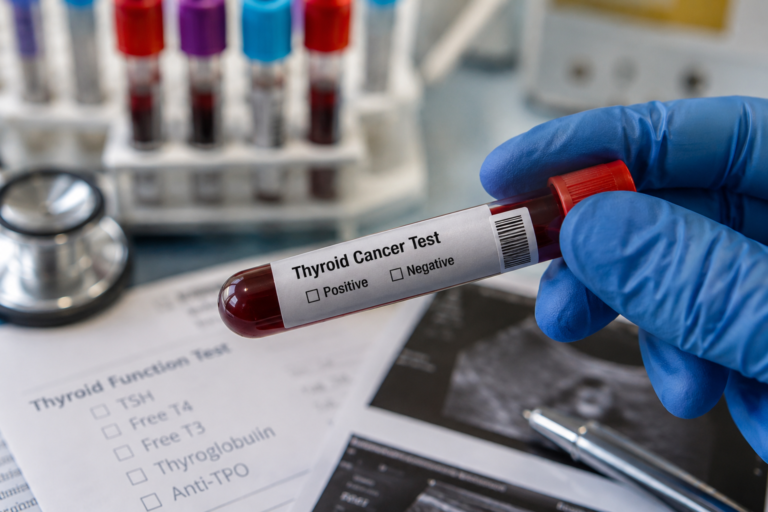
A new thyroid nodule blood test based on circulating thyroid-hormone metabolites has distinguished differentiated thyroid cancer from benign nodules with high accuracy in a large multicentre study.
Across two prospective validation cohorts involving 791 patients, the test achieved 92.1% sensitivity, 99.7% specificity and 94.9% overall accuracy. In the particularly difficult group of Bethesda III and IV nodules, sensitivity reached 93.5% and specificity reached 100% [1].
The results are clinically important because indeterminate thyroid biopsy findings can lead to repeat procedures, costly molecular testing, prolonged uncertainty or diagnostic surgery. However, the test remains investigational. It has not yet been validated internationally or shown to replace thyroid ultrasound, fine-needle aspiration biopsy or histopathology.
What Is the New Thyroid Nodule Blood Test?
The test does not measure the routine thyroid markers that patients commonly see on laboratory reports, such as thyroid-stimulating hormone, free T4 or free T3.
Instead, it measures three less familiar thyroid-hormone metabolites:
- T0, also known as thyronine
- 3-T1AM, or 3-iodothyronamine
- 3-T1, or 3-iodothyronine
These metabolites are small molecules produced during the processing and breakdown of thyroid hormones. Researchers measured their serum concentrations using liquid chromatography–tandem mass spectrometry, commonly abbreviated as LC–MS/MS [1].
The three measurements were combined in a logistic-regression model that generated a probability of differentiated thyroid cancer. Higher T0 and 3-T1AM values and lower 3-T1 values were associated with malignancy.
The investigators also examined thyroid tissue and found a similar metabolic pattern inside differentiated thyroid cancers. This provides biological support for the blood-test signal, although it does not by itself prove that the model will perform equally well in other populations.
How the Multicentre Study Was Conducted
Researchers initially recruited 1,706 adults with thyroid nodules from five tertiary medical centres in China between August 2020 and May 2025. After exclusions, 1,663 patients were enrolled. Their median age was 48 years, and approximately 72% were women [1].
The study was divided into three main cohorts.
A retrospective group of 872 patients was used to develop the diagnostic model. It included 454 patients with differentiated thyroid cancer and 418 with benign thyroid nodules.
The first prospective validation cohort included 392 patients: 195 with differentiated thyroid cancer and 197 with benign nodules.
The second prospective validation cohort included 399 patients: 300 with differentiated thyroid cancer and 99 with benign nodules.
Laboratory personnel measuring the metabolites were blinded to the patients’ diagnoses. Pathologists and ultrasound specialists reviewing the nodules were also blinded to the metabolite results. Central expert committees reviewed the pathology, cytology and ultrasound findings, strengthening the internal reliability of the study [1].
Of the 949 cancers included, 922 were papillary thyroid cancers, 19 were follicular thyroid cancers and eight were oncocytic thyroid cancers. The results were therefore driven predominantly by papillary thyroid cancer.
Thyroid Nodule Blood Test Results
| Study group | Sensitivity | Specificity | Overall accuracy |
|---|---|---|---|
| Model-development cohort, n=872 | 93.0% | 87.1% | 90.1% |
| First prospective validation, n=392 | 92.3% | 99.5% | 95.9% |
| Second prospective validation, n=399 | 92.0% | 100% | 94.0% |
| Combined validation cohorts, n=791 | 92.1% | 99.7% | 94.9% |
| Bethesda III–IV subgroup, n=226 | 93.5% | 100% | 96.0% |
In the combined validation population, 495 patients had cancer and 296 had benign nodules. The test correctly identified 456 cancers but missed 39. It correctly classified 295 of the 296 benign nodules, with only one false-positive result [1].
What Does 99.7% Specificity Actually Mean?
A specificity of 99.7% does not mean that the thyroid nodule blood test was 99.7% accurate overall.
Specificity describes how well a test correctly identifies people who do not have the disease. In the combined validation cohorts, only one of 296 benign nodules was incorrectly classified as malignant. Overall accuracy, which includes both cancerous and benign nodules, was 94.9% [1].
Sensitivity describes how well the test detects cancer. A sensitivity of 92.1% means that approximately eight out of every 100 differentiated thyroid cancers could potentially receive a negative result.
Therefore, the test’s very high specificity appears particularly promising for confirming malignancy after a positive result. Its lower sensitivity means that a negative result could not safely exclude cancer without considering ultrasound, cytology and other clinical findings.
Why the Bethesda III–IV Results Are Important
Fine-needle aspiration biopsy is commonly reported using the Bethesda System for Reporting Thyroid Cytopathology. The system contains six categories, ranging from nondiagnostic findings to clearly malignant cytology [2].
Bethesda III means atypia of undetermined significance. The sampled cells show abnormalities, but the findings are not sufficient to classify the nodule as benign or malignant.
Bethesda IV means follicular neoplasm. Cytology may identify a follicular-patterned tumour, but it generally cannot determine whether the tumour has invaded its capsule or blood vessels. That distinction may require examination of surgically removed tissue.
These categories create a difficult clinical situation. Depending on the nodule’s ultrasound appearance, size, patient history and local resources, the next step may involve repeat biopsy, DNA- or RNA-based molecular testing, surveillance or diagnostic thyroid surgery [2–4].
Among 226 Bethesda III–IV nodules in the new study, 139 were malignant and 87 were benign. The metabolite test correctly identified 130 of the cancers and all 87 benign nodules. It produced nine false-negative results and no false-positive results, giving:
- Sensitivity of 93.5%
- Specificity of 100%
- Positive predictive value of 100%
- Negative predictive value of 90.6%
- Overall accuracy of 96.0% [1]
These findings are highly encouraging, but the subgroup had a malignancy rate of 61.5%. That is a cancer-enriched population and may reflect the selection of higher-risk patients referred to tertiary hospitals or surgery. The results cannot automatically be transferred to an unselected community population with lower cancer prevalence.
Why Predictive Values Must Be Interpreted Carefully
The percentage of positive results that genuinely represent cancer is called the positive predictive value. This number depends not only on the test’s accuracy but also on how common cancer is in the population being tested.
In the combined prospective validation cohorts, 62.6% of participants had cancer. In ordinary thyroid-nodule practice, the proportion of malignant nodules is usually much lower.
The researchers mathematically adjusted the results for assumed thyroid-nodule malignancy rates of 5% to 15%. Using the combined validation performance, the estimated positive predictive value ranged from approximately 93.5% to 98.0%, while the estimated negative predictive value ranged from 98.6% to 99.6% [1].
These calculations are promising, but they remain modelled estimates. They are not a substitute for prospectively testing consecutive, unselected patients in routine clinics.
Why the Study Is Clinically Promising
The test has several important strengths.
Unlike many existing molecular tests, it uses serum rather than material obtained through fine-needle aspiration. Blood collection is simpler, less invasive and potentially easier to repeat.
The model was not evaluated only in the original development group. It was tested in two prospective validation cohorts and maintained similar sensitivity in both.
The study also included blinded laboratory assessment, central pathology review and histopathological confirmation of the prospective cases. Investigators examined whether urinary iodine levels might explain the metabolite differences and did not find evidence that iodine status accounted for the principal results [1].
Most importantly, the test was evaluated in indeterminate Bethesda III and IV nodules, where an additional reliable diagnostic tool could have substantial clinical value.
Why the Test Is Not Ready to Replace Biopsy
Despite the strong figures, several limitations prevent immediate clinical adoption.
The Validation Population Was Cancer-Enriched
Nearly two-thirds of patients in the combined validation cohorts had differentiated thyroid cancer. This does not reflect most general thyroid-nodule clinics. Diagnostic performance needs confirmation in consecutive patients whose cancer prevalence, nodule sizes and clinical characteristics resemble ordinary practice.
All Participating Centres Were in China
International validation is essential. Genetic background, iodine exposure, dietary patterns, laboratory procedures, sample handling and referral pathways may differ across countries.
A future study should test the same predefined metabolite thresholds in independent centres in India, Europe, North America, Africa, the Middle East and other Asian populations.
Many Common Medical Conditions Were Excluded
The study excluded people with thyroid dysfunction, current thyroid-hormone treatment, diabetes, immune-system disease, major organ disease, previous thyroid surgery, non-thyroid malignancy and several other conditions [1].
Real thyroid clinics include many patients with hypothyroidism, Hashimoto’s thyroiditis, diabetes and other chronic conditions. It remains uncertain whether these factors could alter metabolite concentrations or test accuracy.
The Results Mainly Reflect Papillary Thyroid Cancer
More than 97% of the cancers were papillary thyroid cancers. Only 19 follicular and eight oncocytic cancers were included.
The test was not designed to detect medullary thyroid cancer, anaplastic thyroid cancer, thyroid lymphoma or metastatic disease involving the thyroid. Its reported accuracy should therefore not be generalized to every form of thyroid malignancy.
Specificity Differed Between the Cohorts
Specificity was 87.1% in the original development cohort but increased to 99.5% and 100% in the two prospective validation cohorts [1].
Although prospective performance is generally more clinically relevant, this large difference requires explanation and independent replication. A diagnostic model should demonstrate stable performance across centres, laboratory batches and patient populations before routine adoption.
The Laboratory Method Is Specialized
LC–MS/MS is available in advanced laboratories but is not the same as an ordinary thyroid-function blood test. The method involved serum preparation, chemical extraction, metabolite enrichment and mass-spectrometry analysis.
The study did not establish routine pricing, turnaround time, inter-laboratory standardization, regulatory clearance or commercial availability. These practical issues will determine whether the test can move from research centres into everyday clinical care.
Clinical Utility Has Not Yet Been Proven
Diagnostic accuracy alone does not demonstrate that using the test will improve patient care.
Researchers must still show whether the test safely reduces repeat biopsies or unnecessary operations, shortens the time to diagnosis, lowers costs and avoids missed cancers. Ideally, a clinical-utility study would compare standard care with a pathway in which the blood test is added to ultrasound and cytology.
Does the New Blood Test Replace Ultrasound or Fine-Needle Aspiration?
No. At present, thyroid ultrasound and fine-needle aspiration remain central to evaluating suspicious thyroid nodules.
Ultrasound describes the nodule’s size, composition, echogenicity, margins, shape and calcifications. Systems such as ACR TI-RADS combine these findings to estimate malignancy risk and determine whether biopsy or ultrasound follow-up is appropriate [3].
Fine-needle aspiration then examines cells collected from the nodule. The Bethesda classification helps guide further management, including surveillance, repeat biopsy, molecular testing or surgery [2,4].
The metabolite test could eventually become an additional layer within this pathway, particularly when cytology is indeterminate. The available evidence does not support using it as a stand-alone screening test or allowing a negative result to override suspicious ultrasound or biopsy findings.
What Should Patients With a Thyroid Nodule Do Now?
Patients should not assume that this newly published test is already available through routine diagnostic laboratories.
A current thyroid-nodule assessment should consider thyroid-function tests, a high-quality ultrasound, the nodule’s TI-RADS category, its size and growth pattern, cervical lymph nodes, previous radiation exposure, family history and any pressure or voice symptoms.
When fine-needle aspiration has been performed, patients should obtain the exact Bethesda category rather than relying only on terms such as “uncertain” or “abnormal.” Those with Bethesda III or IV findings should discuss repeat biopsy, established molecular testing, surveillance and diagnostic surgery with an endocrinologist, thyroid surgeon or multidisciplinary thyroid team.
What This Means for Patients Seeking Ayurvedic Care
For a patient seeking Ayurvedic management for a thyroid lump, accurate classification should come before treatment planning. A benign thyroid nodule, an indeterminate lesion and confirmed thyroid cancer require different clinical decisions.
Patients should therefore bring their thyroid ultrasound, thyroid-function tests, fine-needle aspiration report and, where available, molecular or histopathology findings to an Ayurvedic consultation.
Ayurvedic or integrative care should not delay a medically indicated biopsy, specialist assessment or cancer treatment. If the metabolite test is validated and eventually approved, it may help integrative physicians distinguish patients suitable for conservative support from those requiring urgent oncological evaluation.
Frequently Asked Questions
Is the new thyroid nodule blood test available now?
The study describes a research-stage test performed with specialized LC–MS/MS equipment. The publication does not establish routine commercial availability, regulatory approval, standardized pricing or access through ordinary diagnostic laboratories. Patients should not replace recommended ultrasound or biopsy with an unvalidated laboratory offering that claims to reproduce the test.
Can a normal TSH blood test rule out thyroid cancer?
No. TSH primarily evaluates thyroid function and cannot reliably determine whether a nodule is benign or malignant. Many people with differentiated thyroid cancer have thyroid-function results within the normal range. The new test measures specific thyroid-hormone metabolites rather than routine TSH, T3 or T4 concentrations.
What is a Bethesda III or Bethesda IV thyroid nodule?
Bethesda III means that the sampled cells contain atypical changes but remain insufficiently defined as benign or malignant. Bethesda IV indicates a follicular-patterned neoplasm that may require further testing or tissue examination. Both are considered indeterminate categories because cytology alone may not provide a definitive diagnosis.
Does 99.7% specificity mean the test is 99.7% accurate?
No. Specificity measures how well the test recognizes benign nodules. Overall accuracy in the combined validation cohorts was 94.9%. Sensitivity was 92.1%, meaning that 39 of the 495 cancers in those cohorts produced negative test results and would have been missed by the blood test alone.
Can a negative result completely rule out thyroid cancer?
No diagnostic test should be interpreted alone. In the combined validation cohorts, approximately 7.9% of cancers were missed. A negative result would therefore need to be interpreted alongside the ultrasound pattern, Bethesda category, nodule growth, lymph-node findings and individual risk factors.
Could this blood test prevent unnecessary thyroid surgery?
Potentially, especially for Bethesda III and IV nodules, but that benefit has not yet been demonstrated. The study measured diagnostic performance rather than the number of operations avoided. Prospective clinical-utility studies must show that adding the test safely changes management without delaying treatment for patients whose cancers produce negative results.
References
- Guo, M., Geng, H., Sun, Q., Wan, H., Zhou, P., Song, Y., et al. (2026). A serum thyroid hormone metabolite test for molecular diagnostic evaluation of thyroid nodules. Cell Research. doi:10.1038/s41422-026-01300-1. Nature
- Ali, S. Z., Baloch, Z. W., Cochand-Priollet, B., Schmitt, F. C., Vielh, P., & VanderLaan, P. A. (2023). The 2023 Bethesda System for Reporting Thyroid Cytopathology. Thyroid, 33(9), 1039–1044. doi:10.1089/thy.2023.0141. PubMed
- Tessler, F. N., Middleton, W. D., Grant, E. G., Hoang, J. K., Berland, L. L., Teefey, S. A., et al. (2017). ACR Thyroid Imaging, Reporting and Data System: White Paper of the ACR TI-RADS Committee. Journal of the American College of Radiology, 14(5), 587–595. doi:10.1016/j.jacr.2017.01.046. PubMed
- Haugen, B. R., Alexander, E. K., Bible, K. C., Doherty, G. M., Mandel, S. J., Nikiforov, Y. E., et al. (2016). 2015 American Thyroid Association management guidelines for adult patients with thyroid nodules and differentiated thyroid cancer. Thyroid, 26(1), 1–133. doi:10.1089/thy.2015.0020. pmc.ncbi.nlm.nih.gov