

Publication date: 16 September 2026
WHO launch update: 17 September 2026
Affected region: Global, covering all six WHO regions
Primary source: World Health Organization
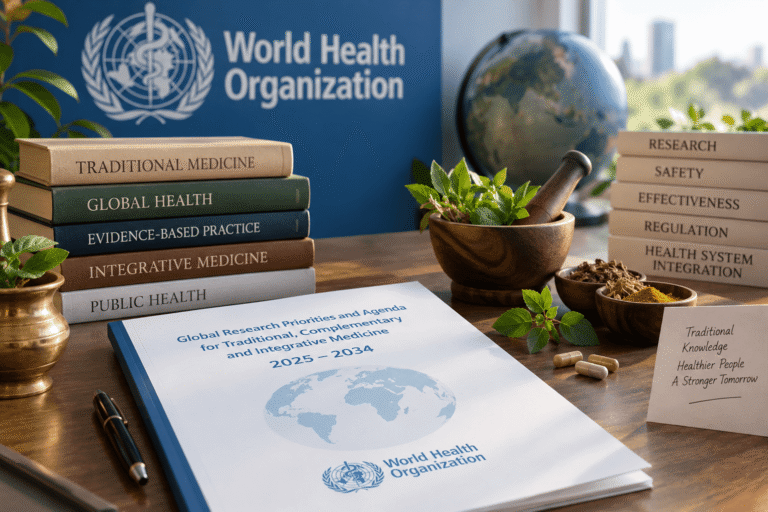
WHO traditional medicine research agenda for 2025–2034 creates a ten-year global framework for evaluating the safety, effectiveness, regulation and healthcare integration of traditional, complementary and integrative medicine. For Ayurveda, the roadmap signals a stronger international focus on rigorous clinical research, product quality, patient protection and evidence-based practice.
The agenda addresses a major imbalance in global health research. Traditional, complementary and integrative medicine is used by billions of people, yet WHO reports that the field receives less than 1% of global health research funding. Researchers working in this area represent only about 0.43% of the global health research workforce. The result is a substantial gap between widespread public use and the evidence available to guide patients, clinicians, regulators, insurers and governments.[1,2]
WHO’s action is important for Ayurveda, but it must be interpreted precisely. The organisation has not declared every traditional therapy effective, approved all Ayurvedic formulations or validated every claim made about herbs, Panchakarma, Rasayana or Bhasma. It has established a research roadmap designed to identify what works, what does not work, what is safe, which patients may benefit and where traditional medicine can appropriately contribute to prevention, treatment, rehabilitation and person-centred care.[1,2]
The WHO Agenda Is a Research Roadmap, Not a Blanket Endorsement
The new agenda is not a clinical treatment guideline and does not authorise any individual product. It is a framework intended to guide governments, universities, research institutions, regulators, funding agencies and international collaborations when deciding which traditional medicine questions should receive scientific attention.
This distinction is essential because the phrase “WHO traditional medicine agenda” could easily be misrepresented in commercial advertising. WHO is not certifying traditional medicines as a group. It is calling for stronger evidence so that effective interventions can be distinguished from ineffective, unsafe or poorly manufactured ones.
The agenda extends the work of the WHO Global Traditional Medicine Strategy 2025–2034, adopted by Member States at the Seventy-eighth World Health Assembly in May 2025. That strategy focuses on strengthening evidence, improving safety and regulation, integrating validated traditional medicine into health systems and optimising its wider social, cultural and environmental value.[2,3]
For Ayurveda, this represents a transition from general arguments about historical use towards more specific clinical questions. The central question is no longer whether “Ayurveda works” as a complete system. The scientifically useful questions are which Ayurvedic intervention works, for which condition, in which patient population, at what dose, compared with which alternative, for how long and with what safety profile.
Why WHO Considers the Evidence Gap Urgent
Traditional medicine is already part of healthcare behaviour across the world. Patients use herbs, traditional formulations, manual therapies, dietary practices, movement therapies and culturally rooted healing systems for chronic pain, diabetes, cancer-related symptoms, infertility, digestive disorders, mental health concerns and age-related conditions.
However, extensive use cannot by itself establish clinical effectiveness. A therapy may remain popular because it is culturally familiar, affordable, accessible or supported by personal experience. None of these factors can determine whether the intervention caused the reported improvement, whether the effect exceeds placebo or usual care, or whether uncommon adverse effects have been missed.
Traditional medicine research also faces problems that are less common in conventional drug trials. Products carrying the same name may vary in plant species, growing conditions, harvesting, processing, extraction, storage or contamination. Multi-herb formulations may be incompletely described. Practitioners may prescribe different combinations for patients with the same biomedical diagnosis. Dietary instructions, Anupana, external therapies and lifestyle changes may occur alongside the principal treatment, making it difficult to identify which component produced the outcome.
These complexities do not make research impossible. They mean that traditional medicine requires research designs capable of examining both clearly standardised products and carefully documented personalised systems of care.
How the Global Priorities Were Developed
WHO describes the agenda as one of the largest traditional medicine research-prioritisation exercises conducted to date. Its development included analysis of 39,927 research grants across 40 funding schemes, assessment of 116 research institutes in 67 countries, consultation with 199 experts from 75 countries and Delphi surveys involving 235 participants worldwide.[2]
The agenda was shaped through evidence reviews, research-landscape analysis and consultations across all six WHO regions. This matters because the research needs of high-income health systems are not always identical to those of low- and middle-income countries. Some countries need evidence on herb–drug interactions and insurance coverage, while others may also need research on traditional practitioners as part of primary healthcare delivery.
A related international priority-setting study coordinated through WHO networks used the Child Health and Nutrition Research Initiative method. Researchers invited 120 experts, received responses from 53 and obtained completed scoring from 34 participants. The experts evaluated 157 research ideas according to feasibility, effectiveness, deliverability, affordability, sustainability, equity and potential to reduce disease burden.[7]
In that study, the highest-ranked research question concerned the effects of traditional medicine on blood-glucose control and diabetes. Herb–drug interactions in older adults ranked second, while traditional movement and exercise approaches for preventing frailty ranked third. Dyslipidaemia, metabolic syndrome, mental health, neurological conditions and barriers to healthcare integration were also prominent.[7]
This study informed the broader research landscape but should not be confused with the complete WHO agenda. The final agenda incorporates additional consultation, institutional analysis, regional priorities and health-system considerations.
Which Health Conditions Receive Priority
WHO identifies cancer, metabolic diseases, reproductive health, stroke, pain, musculoskeletal disorders and mental health as major clinical research areas. Older adults, children and preventive health are also identified as priority populations or domains.[2]
These priorities reflect conditions that create substantial long-term disability, treatment costs and pressure on health systems. They are also areas in which patients frequently use traditional medicine alongside, or sometimes instead of, conventional care.
Cancer and Supportive Oncology
Traditional medicine research in cancer must separate supportive-care questions from claims of direct anticancer activity. An intervention that improves appetite, sleep, pain, nausea or treatment-related fatigue has not necessarily reduced tumour burden or prolonged survival.
Ayurvedic oncology studies must therefore specify whether the intervention is intended to improve symptoms, nutrition, quality of life, treatment tolerance, tumour response, progression-free survival or overall survival. Each of these is a different research question requiring different methods and outcomes.
Laboratory activity against cancer cells cannot establish effectiveness in human cancer. Animal studies, molecular docking and cell-culture findings may justify further investigation, but they cannot replace controlled human studies. Similarly, an individual case report can generate a hypothesis but cannot determine whether a treatment caused remission.
Research must also evaluate interactions with chemotherapy, immunotherapy, hormonal therapy, targeted treatment and radiotherapy. An Ayurvedic formulation may theoretically improve one symptom while altering the absorption or metabolism of an anticancer medicine. These interactions require direct investigation.
Traditional medicine should not delay biopsy, surgery, chemotherapy, radiotherapy or other time-sensitive oncology treatment when such care is medically indicated.
Diabetes and Metabolic Disease
Metabolic diseases are particularly important because patients may use traditional formulations for many months or years while also receiving glucose-lowering, antihypertensive or lipid-lowering medicines.
Reliable diabetes research requires more than a temporary reduction in fasting glucose. Depending on the research question, investigators may need to assess HbA1c, continuous glucose-monitoring patterns, hypoglycaemia, body composition, blood pressure, lipid levels, kidney function, liver fat, medicine requirements and long-term cardiovascular outcomes.
Any change in conventional medication must be recorded carefully. Otherwise, an apparent benefit may result from a changed drug dose, dietary modification, weight loss or increased physical activity rather than the investigated Ayurvedic intervention.
The high priority assigned to herb–drug interaction research in older adults is especially relevant because many elderly patients use several prescribed medicines alongside herbal products. Polypharmacy increases the possibility of altered drug metabolism, bleeding risk, hypoglycaemia, sedation, liver injury or kidney-related complications.[7]
Stroke, Pain and Musculoskeletal Disorders
In stroke, traditional medicine research may have a role in rehabilitation, mobility, swallowing, speech, spasticity, pain, cognition and quality of life after medical stabilisation. It must not be presented as a substitute for emergency stroke care.
Possible stroke symptoms such as sudden facial weakness, arm weakness, speech disturbance, visual loss or severe imbalance require immediate hospital assessment. Research on post-stroke rehabilitation is fundamentally different from emergency treatment during an acute stroke.
Pain and musculoskeletal disorders also require outcomes beyond pain scores. Studies should examine physical function, walking ability, sleep, work capacity, medicine use, mobility and the duration of improvement. Short-term symptom relief does not necessarily indicate disease modification or sustained functional recovery.
Because musculoskeletal symptoms naturally fluctuate, uncontrolled studies are particularly vulnerable to misleading improvement. Participants may enter a study when symptoms are severe and improve later regardless of treatment. Appropriate comparison groups and adequate follow-up are therefore essential.
Reproductive and Mental Health
Reproductive-health research may include menstrual disorders, infertility, polycystic ovary syndrome, menopause, pregnancy and postpartum care. Pregnancy and fertility treatment require particularly strict safety standards because an intervention may affect the mother, embryo, fetus or infant.
Traditional use during pregnancy cannot be treated as proof of safety. Research may need to evaluate miscarriage, congenital abnormalities, preterm birth, maternal complications, neonatal outcomes and interactions with hormonal or fertility medicines.
Mental-health research may examine sleep, stress, anxiety, depressive symptoms, psychological resilience and quality of life. Studies must use clearly defined diagnostic criteria and validated outcome instruments rather than general descriptions such as “mental balance.”
Severe depression, suicidal thoughts, psychosis, mania or an inability to care for oneself requires prompt psychiatric assessment. A research agenda for traditional medicine does not justify replacing emergency mental-health care with an unproven intervention.
What the Agenda Means for Evidence-Based Ayurveda
The most important implication for Ayurveda is that research must examine the actual clinical system rather than using vague labels.
A paper stating that patients received “Ayurvedic treatment” provides insufficient information. Ayurveda may involve constitutional assessment, disease-stage evaluation, herbal or herbo-mineral formulations, diet, daily routine, external therapies and repeated modification of treatment. Each relevant component must be documented.
For a formulation, researchers should report the complete ingredients, botanical names, plant parts, quantities, geographical sources, processing methods, extraction procedures, dose, treatment duration, Anupana and manufacturing details. Anupana is the substance taken with a medicine, such as water, milk, honey or another prescribed medium.
Batch identity must also be verifiable. Microbial contamination, pesticide residues, aflatoxins, heavy metals, adulterants and undeclared pharmaceutical ingredients may affect both safety and efficacy.
Personalised Ayurveda Can Still Be Researched
Ayurvedic care is often individualised according to Prakriti, disease stage, age, strength, digestion, symptoms, season and associated disorders. Prakriti refers to the patient’s constitutional pattern described in Ayurveda.
Personalisation is sometimes presented as a reason why Ayurveda cannot be evaluated through modern research. This is incorrect. It can be studied, but the clinical decision process must be made reproducible.
Researchers can define structured treatment algorithms explaining why one patient receives a particular formulation, dose or procedure while another receives a different protocol. The study can then assess whether trained practitioners apply those rules consistently and whether the personalised model improves outcomes compared with usual care or another treatment strategy.
Pragmatic trials may be especially useful because they evaluate care under realistic clinical conditions. Whole-system trials can examine an Ayurvedic programme as a coordinated treatment model, while factorial studies may help determine which components contribute most strongly to the outcome.
N-of-1 studies may be appropriate in selected stable chronic conditions, where the same patient receives alternating treatment periods under controlled conditions. Prospective registries can support long-term safety monitoring and help identify patterns that later require formal trials.
Real-world evidence is valuable, but it cannot eliminate the need for comparison groups. Observed improvement may result from spontaneous recovery, concurrent treatment, selection bias, incomplete follow-up or regression to the mean.
Ayurvedic Diagnosis Must Be Reproducible
Ayurvedic research commonly uses concepts such as Dosha predominance, Prakriti, Agni and Dhatu involvement.
Agni refers to the Ayurvedic concept of digestive and metabolic capacity. Dhatu refers to the functional tissue systems described in Ayurveda.
These assessments should be documented using predefined clinical criteria. Researchers should evaluate whether trained practitioners agree when assessing the same patient and whether the Ayurvedic classification predicts treatment response.
Inter-rater reliability is important because a diagnostic category cannot guide research consistently when different practitioners classify the same patient in substantially different ways. Structured case-record forms, practitioner training, blinded assessments and predefined decision pathways can improve reliability without eliminating clinical judgement.
Product Quality and Safety Must Become Central Outcomes
Safety cannot remain a brief statement saying that no obvious reaction was observed. Many adverse effects are silent during their early stages and can only be detected through laboratory monitoring.
Depending on the formulation and patient population, research may require complete blood counts, liver-function tests, kidney-function tests, glucose monitoring, coagulation studies, electrocardiography, pregnancy testing or pharmacokinetic analysis. Long-term follow-up may be necessary when delayed toxicity is biologically plausible.
Particular caution is required in children, older adults, pregnant women, cancer patients, transplant recipients and people taking anticoagulants, antiepileptic medicines, immunosuppressants or several simultaneous prescriptions.
A patient may tolerate a formulation for several weeks yet still develop biochemical liver injury, altered drug levels or cumulative exposure to a contaminant. This is why laboratory surveillance and active adverse-event reporting are more reliable than symptom reporting alone.
Bhasma Research Requires Advanced Characterisation
Bhasma is a specially processed Ayurvedic mineral or metal preparation produced through defined purification and incineration procedures.
Classical preparation methods are essential for identifying the intended formulation, but modern safety research must examine the finished product directly. Relevant analysis may include elemental composition, chemical form, particle characteristics, crystal structure, dissolution behaviour, bioaccessibility, batch consistency and contaminant levels.
Safety cannot be concluded solely because a preparation follows a classical name or has a long history of use. The precise manufacturing method, dose, duration and patient population determine the actual clinical exposure.
Research on Bhasma should therefore connect classical pharmaceutical processes with modern materials analysis, toxicology, pharmacokinetics and organ-specific safety monitoring. This approach does not dismiss classical knowledge; it determines whether the finished preparation consistently possesses the expected characteristics and an acceptable safety profile.
Clinical Outcomes Must Matter to Patients
Traditional medicine studies frequently report broad outcomes such as improved immunity, detoxification, better balance or general recovery. These descriptions are too imprecise for clinical decision-making unless they are translated into measurable outcomes.
For diabetes, meaningful outcomes may include HbA1c, hypoglycaemia and medicine requirements. For arthritis, they may include walking ability, pain, stiffness and physical function. In cancer, they may include treatment tolerance, quality of life, tumour response or survival, depending on the claim being investigated.
Researchers should define the primary outcome before recruiting participants. Secondary outcomes, follow-up duration, safety monitoring and statistical methods should also be established in advance.
Patient-reported outcomes remain important, particularly for pain, fatigue, sleep, bowel symptoms and quality of life. However, validated instruments are preferable to unstructured impressions because they allow results to be compared across studies.
Negative and neutral results are equally important. A credible Ayurveda research system must publish findings showing that an intervention did not work or caused unacceptable adverse effects. Selective publication of only favourable studies creates a distorted evidence base and exposes future patients to avoidable risk.
Prospective trial registration, public protocols, predefined statistical plans, complete adverse-event reporting, funding disclosure and independent replication are therefore fundamental to trustworthy Ayurveda research.
Classical Ayurveda Already Recognises Multiple Forms of Examination
The call for disciplined inquiry is not entirely foreign to classical Ayurveda.
The Charaka Samhita, Sutra Sthana, Tistraishaniya Adhyaya, Chapter 11, Verse 17 states:
द्विविधमेव खलु सर्वं सच्चासच्च; तस्य चतुर्विधा परीक्षा—आप्तोपदेशः, प्रत्यक्षम्, अनुमानं, युक्तिश्चेति ॥१७॥
Transliteration: Dvividhameva khalu sarvaṁ saccāsacca; tasya caturvidhā parīkṣā—āptopadeśaḥ, pratyakṣam, anumānaṁ, yuktiśceti.
Simple meaning: Knowledge concerning existence and non-existence is examined through authoritative testimony, direct observation, inference and reasoned synthesis.[10]
In contemporary terms, authoritative classical knowledge can generate a research hypothesis, direct clinical observation can identify possible effects, inference can suggest relationships and Yukti can help integrate multiple patient and treatment factors.
However, these classical approaches should not be presented as substitutes for randomisation, toxicology, biostatistics, pharmacokinetics or post-market safety surveillance. They provide an Ayurvedic intellectual basis for disciplined examination, while modern research methods help measure bias, causation, uncertainty and reproducibility.
India’s Role Creates Both Opportunity and Responsibility
WHO reports that India is anchoring a multi-country traditional medicine research consortium. Twenty-seven Member States had already made formal, time-bound research commitments before publication of the agenda.[2]
Tanzania committed a traditional medicine research budget of up to TSh 10 billion by 2030. Cabo Verde, Malawi, the Federated States of Micronesia and Seychelles committed to establishing national research centres, while Iran announced a national clinical-trial platform. These commitments were made at the Second WHO Global Summit on Traditional Medicine in New Delhi in December 2025.[2]
India’s research infrastructure, Ayurvedic educational institutions, pharmacopoeial systems, clinical workforce and manufacturing capacity position it to support multicentre trials, international research protocols, pharmacovigilance, product-standardisation laboratories and researcher training.
This leadership should not be interpreted as automatic global validation of Ayurveda. It creates a greater responsibility to produce evidence that can withstand independent examination across countries, institutions and healthcare systems.
Research led from India will have greater international value when protocols are registered prospectively, outcomes are clearly defined, raw methods are transparent and results can be reproduced outside the original institution.
Regulation and Health-System Integration Require More Than Positive Trials
Evidence of clinical benefit is necessary but not sufficient for integration into public healthcare.
WHO’s conceptual framework describes people-led, practitioner-led, coordinated and blended models of traditional medicine integration. These models differ according to how care is organised and whether traditional and conventional services remain separate, coordinated or structurally combined.[4]
Safe integration requires clear referral pathways, practitioner qualifications, product regulation, shared medical information, adverse-event reporting and defined responsibility for clinical decisions. Merely placing a traditional medicine clinic inside a hospital does not create meaningful integration.
Health systems must also examine cost-effectiveness. An intervention may improve symptoms but remain unsuitable for public funding when the benefit is small, temporary or excessively expensive. Conversely, an intervention that reduces hospitalisation, disability or medicine use may offer value even when its initial cost is higher.
WHO’s global survey report shows that countries vary considerably in traditional medicine governance, professional regulation, education, insurance coverage, product quality assurance and service-delivery models. The 2023 survey gathered information from 106 Member States, illustrating both the scale of international interest and the lack of uniform regulatory maturity.[5]
Artificial Intelligence Could Accelerate Research but Cannot Replace Validation
WHO and the International Telecommunication Union have mapped potential uses of artificial intelligence in traditional medicine. These include evidence synthesis, data analysis, decision support and health-system planning.[8]
In Ayurveda, artificial intelligence may assist with botanical authentication, chemical-profile comparison, literature mapping, adverse-event detection, herb–drug interaction surveillance and analysis of complex personalised-treatment data.
However, artificial intelligence cannot correct unreliable source material. A model trained on poorly described formulations, incomplete patient records or selectively published positive studies may reproduce and amplify those weaknesses.
AI-supported conclusions still require clinical validation, transparent methods and human oversight. Patient privacy, algorithmic bias, intellectual-property rights and the commercial use of traditional knowledge require explicit governance.
Traditional Knowledge Holders Must Be Research Partners
WHO’s agenda emphasises that Indigenous Peoples and traditional knowledge holders should participate as genuine research partners. This includes protection of intellectual property, cultural integrity, equitable benefit sharing and data sovereignty.[2,9]
WHO’s 2026 participatory framework connects respectful engagement with self-determination, free, prior and informed consent, reciprocity, shared governance, safeguards and accountability.[9]
This principle is relevant beyond Indigenous systems. Communities, traditional practitioners and knowledge lineages should not be treated merely as sources from which information can be extracted and commercialised.
At the same time, cultural respect cannot exempt an intervention from safety evaluation when it is offered as healthcare. Protection of traditional knowledge and protection of patients are complementary responsibilities.
What Patients Should Understand
The WHO agenda does not immediately change the established treatment of cancer, stroke, diabetes, infertility, mental illness or other serious diseases. It does not mean that patients should stop prescribed medicines or replace emergency care with traditional treatment.
Patients should disclose every herbal formulation, supplement, Bhasma and traditional procedure to all clinicians involved in their care. This is especially important when receiving anticoagulants, diabetes medicines, cancer treatment, immunosuppressants or medicines processed through the liver.
Before starting an intervention, the patient should know the intended clinical objective, the evidence supporting it, the expected duration, possible adverse effects, potential interactions and the method by which progress will be measured.
A responsible integrative plan defines the role of each treatment. It does not create artificial conflict between Ayurveda and conventional medicine, and it does not allow an unproven claim to delay urgent or potentially life-saving care.
What Success by 2034 Would Mean for Ayurveda
The success of the WHO agenda should not be measured only by the number of traditional medicine papers published.
A successful decade would produce clearer evidence about which interventions provide reproducible benefit, which patient groups are most likely to respond, which formulations require safety restrictions and which practices should be discontinued.
It would also establish better manufacturing standards, stronger herb–drug interaction data, reliable pharmacovigilance, validated Ayurvedic diagnostic tools, multicentre clinical trials and transparent reporting of both positive and negative results.
For Ayurveda, the most valuable outcome would be greater precision. Rather than making broad claims about an entire medical tradition, researchers would be able to identify specific interventions with defined indications, doses, treatment durations, expected benefits and known limitations.
Conclusion
WHO’s ten-year global research agenda gives traditional medicine greater international visibility, but it also raises the required standard of evidence.
For Ayurveda, this should not be presented as external confirmation that every classical or contemporary treatment claim is correct. It is an invitation to undertake more disciplined research.
Classical knowledge can guide hypotheses. Personalised Ayurvedic reasoning can be preserved through structured clinical algorithms. Whole-system treatment can be studied through pragmatic and comparative research. However, product quality, effectiveness, interactions, toxicity, cost and long-term outcomes must be measured rather than assumed.
By 2034, the strongest achievement would not be universal acceptance of Ayurveda. It would be a reliable evidence base showing where specific Ayurvedic interventions add measurable value, where evidence remains uncertain and where treatment should not be used.
Frequently Asked Questions
Has WHO officially approved Ayurveda?
No. WHO has launched a research agenda for traditional, complementary and integrative medicine. It has not approved every Ayurvedic formulation, procedure or therapeutic claim.
What is the WHO traditional medicine research agenda?
It is a global framework covering 2025–2034 that identifies priority diseases, patient populations, safety concerns, research gaps and health-system requirements.
Why is the less-than-1% funding figure important?
It shows a large mismatch between widespread traditional medicine use and the resources devoted to determining its safety, effectiveness and appropriate role in healthcare.
Which health conditions receive priority?
WHO identifies cancer, metabolic diseases, reproductive health, stroke, pain, musculoskeletal disorders and mental health as major clinical research areas.
What role will India play?
India is anchoring a multinational research consortium intended to strengthen international collaboration and traditional medicine evidence generation.
Can personalised Ayurveda be studied scientifically?
Yes. Personalisation can be investigated through structured treatment algorithms, pragmatic trials, whole-system studies, registries and carefully designed individual-patient studies.
Does classical use prove that an Ayurvedic medicine works?
No. Classical use may provide a rationale for research, but clinical effectiveness and safety require appropriate modern investigation.
Does the agenda immediately change patient treatment?
No. It is a research roadmap rather than a clinical guideline. Treatment changes require intervention-specific evidence, regulation and professional guidance.
Does WHO support traditional medicine integration?
WHO supports safe, effective and equitable integration where evidence and suitable regulation exist. It does not recommend integrating untested or unsafe interventions.
What is the most important safety message?
Traditional medicines should be disclosed to all treating clinicians, and they should not delay urgent diagnosis or medically necessary treatment.
References
- World Health Organization. (2026, September 16). WHO global research priorities and agenda for traditional, complementary and integrative medicine 2025–2034.
https://www.who.int/publications/i/item/9789240124738 - World Health Organization. (2026, September 17). WHO calls for more research into traditional medicine to meet growing health needs.
https://www.who.int/news/item/17-09-2026-who-calls-for-more-research-into-traditional-medicine-to-meet-growing-health-needs - World Health Organization. (2025, October 30). Global traditional medicine strategy 2025–2034.
https://www.who.int/publications/i/item/9789240113176 - World Health Organization. (2025, December 20). Integration of traditional, complementary and integrative medicine into health systems: Conceptual framework.
https://www.who.int/publications/i/item/9789240110397 - World Health Organization. (2025, December 20). WHO global report on traditional, complementary and integrative medicine 2024.
https://www.who.int/publications/i/item/9789240111387 - Steel, A., Baker, K., Adams, J., Foley, H., Carter, T., Charnaud, S., De Almeida, G. M. R., Doo-Kingue, P., Dua, P. K., Godatwar, P. R., Han, E., Hill, G., Kasilo, O. M. J., Mukankubito, I., Al-Nuseirat, A., Pirgari, D., Ross, A. L., Souza, J. P., Terry, R. F., & Pillai, G. K. G. (2025). Global research funding for traditional, complementary and integrative medicine. Bulletin of the World Health Organization, 103(11), 649–661D.
https://pmc.ncbi.nlm.nih.gov/articles/PMC12578533/ - Ahn, S., Zhou, J., Jiang, D., Kerr, S., Zhu, Y., Song, P., & Rudan, I. (2025). WHO global research priorities for traditional, complementary, and integrative medicine: An international consensus and comparisons with LLMs. Journal of Global Health, 15, 04336.
https://jogh.org/2025/jogh-15-04336/ - World Health Organization, & International Telecommunication Union. (2025, July 11). Mapping the application of artificial intelligence in traditional medicine: Technical brief.
https://www.who.int/publications/i/item/9789240107663 - World Health Organization. (2026, August 11). Participatory framework for respectful engagement with Indigenous Peoples on biodiversity, health and traditional knowledge systems.
https://www.who.int/publications/m/item/participatory-framework-for-respectful-engagement-with-indigenous-peoples-on-biodiversity–health-and-traditional-knowledge-systems - Tiwari, P., Panja, A., Godatwar, P., Dixit, U., Deole, Y. S., & Basisht, G. (2020). Tistraishaniya Adhyaya: The three desires of life and important triads (Charaka Samhita, Sutra Sthana, Chapter 11, Verse 17). Charak Samhita Research, Training and Skill Development Centre.
https://www.carakasamhitaonline.com/index.php/Tistraishaniya_Adhyaya